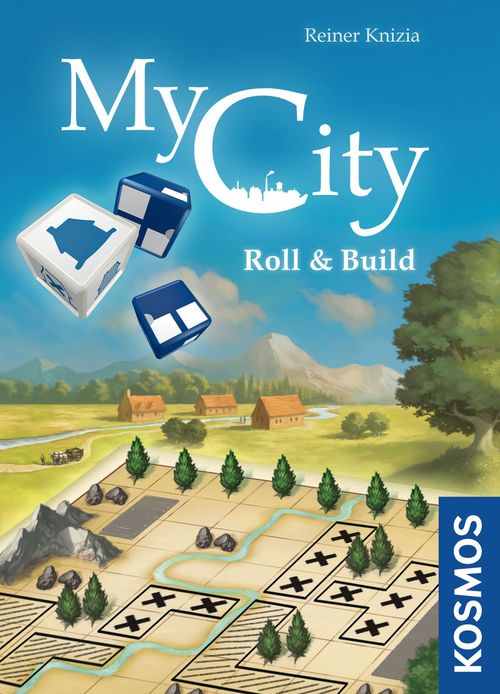
My City: Roll & Build
My City: Roll & Build Rulebook
Table of Contents
Table of Contents
GAME MATERIALS
- 1 thick pad with 144 double-sided episode sheets
- 3 special dice
- You will also need a pen each.
Tip: If you use pencils, you can correct any mistakes with an eraser.
Note: There are enough sheets that you can play every episode, every chapter or play the whole campaign multiple times. Maybe you will enjoy a particular chapter or even an episode so much that you choose to play them again and again. The episodes 3, 6 and 12 work well as a mini campaign.
The Solo Game
My City Roll & Build is also an exciting challenge for the solo player. Some rules do not apply to solo games and some rules only apply to solo games. These are marked with the corresponding symbol. You can rate the success of your city's development using the achievement table on page 12.
COURSE OF A GAME
Each of you will receive a sheet of the same episode that you see in front of you. You start with episode 1. The three dice are ready to use. Each episode consists of a number of rounds. At the start of each round the 3 dice are thrown by any player. This gives the shape and the type of building to be drawn. The result applies to everyone.
Shapes and types of buildings
Building shape: The two blue dice show building parts. Immediately after the throw, you place the two grey semi circles together to make a full circle. This will determine the shape of the building that will be constructed.
The building may be rotated in any way. You may also construct a mirror version of the building.
If one of the dice shows either a blank side or the compass icon, then only build the building shown on the other die.
Note: The circle only applies after round 4.
Building type: The white die shows the type of building to be built.
- Solid coloured = Residential building
- Lined = Industrial building
- Crossed = Public building
THE CONSTRUCTION RULES
The roll of the dice at the beginning of the round determines the shape and type of the new building. Everyone draws this building on their sheet at the same time.
Examples of a building shape (L-building) in each type: solid coloured, lined, crossed.
The following rules apply:
- The building must fit entirely into the spaces on the sheet. No building may reach beyond the boxed spaces.
- You may build on spaces with trees and rocks. However, it is best to avoid building on trees if you can, because visible tree spaces will get you points at the end of each episode. Rocks should, on the other hand, be built upon whenever possible. If these are not built upon at the end of the episode, points will be deducted.
- You may not build on mountain and forest spaces.
- Buildings must not be drawn across the river, so that parts of the same building are on either side of the river.
- The first building you draw on your sheet must border the river on at least one side.
- All other buildings must be drawn adjacent to an existing building on at least one side. Buildings are considered adjacent even if the river runs between them.
- Buildings may not be drawn on top of existing buildings.
- Drawn buildings may not be changed after the dice have been re-rolled.
- Passing: If you cannot or do not want to draw a building, you say so and must fill in the left-most 'not constructing a building' circle in the row on the sheet. If all 6 circles have already been filled in, you can no longer pass. If you cannot or do not want to construct the building at this point, your game has come to an end.
- Ending participation in an episode: After the dice roll at the beginning of every round, you can decide to end your participation in this episode. You do not need to fill in a circle. But you are also not allowed to construct any more buildings.
The previously mentioned rules can be changed or added to in individual episodes by special rules.
Important: Always draw the buildings inside the squares and not along the printed lines. Then it is easy to see where one building ends and where the next begins.
END OF AN EPISODE
An episode ends when everyone has ended their participation. Then scores are added up.
Scoring
Passing: Check under the right-most circles you have filled in the 'not constructing a building' line on your sheet, how many minus points you receive. Then enter these minus points in the box at the end of the line.
Trees: For each tree that you did not build on, you receive 1 point. You enter these points in the box of the corresponding line of your sheet.
Rocks: For each rock that you did not build on, you receive 1 minus point. You enter these minus points in the box of the corresponding line of your sheet.
Empty spaces: For each space that you did not build on, you receive 1 minus point. You enter these minus points in the box of the corresponding line of your sheet.
Note: Spaces with trees or rocks do not count as empty spaces.
Example scoring: Tree +1 → 17, Rock –1 → 2, Empty space –1 → 4.
Winning the episode
- Finally, add up all your points and enter them in the total box at the bottom right of your sheet. Whoever gets the most points wins the episode.
- On the sheet of the last episode in each chapter you combine points from the other two episodes in this chapter to get the capital point total. This determines the overall winner of the chapter.
- In the solo game you can rate how successful you were for each chapter by using the achievement table on page 12 of this rulebook.
Tip: To ensure no one misses anything, it is best to confirm out loud the building shape and type each time the dice have been rolled.
Building shapes
The possible building shapes are: One, Two, Three row, Four row, Square, Two-L, Three-L, Four-L, U-Building.
The building shapes occur with different probabilities: The 'two-L' and the 'two' buildings are the most common, the useful 'one' is less common. The big buildings are less common — but because there are so many possible forms, you should not underestimate them.
THE FURTHER EPISODES
From episode to episode new rules and new challenges come your way. These are described below, so you can read them out at the beginning of each new episode.
Chapter 1: The New Land
Episode 1
As the first settlers, you have reached the new land and construct your buildings along the banks of the river. Soon the whole country between mountains and forest will become your settlement area.
This episode uses the basic rules already explained above. So you can start playing right away.
Episode 2
After you have initially constructed your buildings, your village community has agreed on a planned course of action. Orderly districts are now emerging.
Groups of buildings: From episode 2 onwards you receive additional points for each of the three building types (solid, lined or crossed) at the end of the episode. Each player checks for each building type, which is the largest group of adjacent buildings of that type. You score as many points as there are buildings in this group. So try to build as many buildings of a type as possible adjacent to each other.
Continuation of the scoring example: For the residential buildings (solid) there are 4 points. For industrial buildings (lined) also 4 points and 2 points for the public buildings (crossed).
Note: From episode 2 you know all of the basic rules. These will be highlighted on the sheets to keep everything as clear as possible.
Episode 3
Your community continues to grow. In order to improve the water supply, a well has been drilled in the East of the settlement. Of course, as many buildings as possible should benefit from it.
Well: You get 4 additional points if you manage to construct 4 buildings adjacent to your well. The type of these buildings does not matter. The well can be built on – but then you would not score any points for it.
Note: Churches, mentioned in chapter 2, also count as buildings.
Chapter 2: The Churches
Episode 4
As more and more settlers arrive, the church also joins your community. The church builders have precise ideas about which buildings should be built. As you develop your city, you must now consider where church buildings are to be built as your building space is limited.
Churches: From episode 4, the compass side of the dice now has special importance. When the compass is rolled, the other two dice are ignored, and a church will be constructed instead. In addition, everyone fills in the next free circle in the line 'Construct churches' in the order shown at the bottom of their sheet. They then draw the shape of the church shown below this circle. When all existing compass circles have been filled in, the compass has no meaning for the rest of the episode. Then the building specified on the other two dice is built instead.
You all construct the same church. You can also see which churches are still to be constructed in the episode and you may want to plan space for them. As with the other buildings, the church buildings may also be drawn in their mirror image shape. Churches are marked with circles.
Tip: If you have a coloured pencil, you can fill the churches and thus distinguish them even better from the other three building types.
Important: If you pass when building a church, you must fill in two circles in the row 'Not constructing a building'.
Episode 5
The churches are gaining influence in your community. The different groups of settlers are therefore all looking to construct close to the churches in order to be heard.
Church points: If buildings from all 3 different building types are adjacent to a church on at least one side, you gain 3 points for this church.
Note: In episodes 5 and 6 there are 2 wells on your sheets. You can get 4 additional points per well.
Episode 6
The demands of the churches for more and more land for large church buildings leads to other groups of settlers also claiming some of the scarce building land.
Start at the church: The printed church building on the sheet counts as the first building and your next building must be drawn adjacent to it. This church also gives you 3 points if you manage to construct all 3 different building types adjacent to it.
Note: Because the printed church building already counts as your first building, you can draw buildings on any side of the church.
Important: 'Passing' is not possible in this episode. All buildings must be constructed. If you cannot or do not want to construct a building, then this episode ends for you.
Chapter 3: Challenges
Money bags: In the episodes of chapter 3, you collect money bags as well as points. Whoever scores the most, or second most, money bags in the scoring at the end of this chapter then receives 20 or 10 bonus points. During each episode, fill in the successfully collected money bags. At the end of each episode, the collected money bags are transferred to the framed space and also filled in there.
Note: In this episode you want to be the first to complete certain tasks. Sometimes it is to your advantage if the other players do not know where you are drawing your new building. On occasion you are allowed to draw your building whilst shielding your pad with your hand until everyone else has drawn their building.
Episode 7
Persistent heavy rain causes the river to burst its banks and flood the plains. The plateaus on the mountains and the sawmill in the forest offer safety from these flood waters. The swampy ground only allows the construction of smaller churches.
Start at the sawmill: The printed sawmill at the bottom right of your sheet is your starting building. The first building you draw must be adjacent to it.
Note: As with the printed church in episode 6, you can construct buildings any side of the sawmill.
Plateaus: The 4 plateaus highlighted next to the mountain are now particularly important. The first to build on all 4 plateaus receives 5 points. If several players manage this in the same round, each of them receives 5 points. If you have built on all 4 plateaus at the end of the episode, you receive 1 money bag. Empty plateaus, like any other empty space, score you 1 minus point at the end of the episode.
Reward for not passing: In Chapter 3 this rule applies: Whoever does not pass in an episode and therefore does not fill in a circle in the 'Not constructing a building' line, receives 1 money bag.
Note: Buildings on each side of the five wide river spaces are not considered adjacent when the river runs between them.
Episode 8
After the flood you are able to open up the two forest areas for reconstruction. The wood obtained in this way means that the final churches can be created.
Forest spaces: The green forest spaces can now also be built on. The first to build on all 9 forest spaces receives 5 points. If several players manage this in the same round, each of them receives 5 points. If you have built on all 9 forest spaces at the end of the episode, you receive 1 money bag. Empty forest spaces, like any other empty space, score minus 1 point at the end of the episode.
Episode 9
Gold! Much of the earth was churned up by the flood. At the edge of the development area gold has been found. The news spreads rapidly and a gold rush begins ...
Gold spaces: There are 5 gold spaces on the sheet. The first to build on all 5 gold spaces receives 5 points. If several players manage this in the same round, each of them receives 5 points. If you have built on all 5 gold spaces at the end of the episode, you receive 2 money bags. However, empty gold spaces do not score any minus points at the end of the episode.
Note: In episode 9, the compass side of the dice has no special meaning and you just construct the building shown on the other two dice. This makes the episode easier because there are more small buildings now.
Bonus scoring for Chapter 3: When determining the overall winner of Chapter 3, take into account not only the points from the three episodes of the chapter but also the bonus points for the money bags. To do this, you first transfer your collected money bags from the three episodes. Whoever filled in the most money bags receives 20 bonus points. Whoever filled in the second most money bags receives 10 bonus points. All other players receive no points for their bags.
In the solo game, 7-9 filled in money bags are worth 20 bonus points and 6 money bags are worth 10 bonus points. If you have fewer money bags, you do not receive any bonus points.
Chapter 4: Bandits
Episode 10
The gold rush reaches its peak but also attracts bandits to the area. To keep your city safe, you must arrest the bandits.
Bandits: You cannot build on bandits but need to surround them instead. To do this, all spaces adjacent to the bandit need to be built on. Once you have achieved this, cross out the bandit. Any bandit not surrounded scores 3 minus points at the end of the episode. Additionally, you must transfer any bandit that is not surrounded at the end of this episode to the next episode. Simply draw them on the same spaces on the next sheet; so from episode 10 to episode 11 and — if still not surrounded — from episode 11 to episode 12.
Episode 11
The bandits are threatening your city more and more. In order to surround them you must plan your districts and build fortresses across the country.
Fortresses: From episode 11 onwards, the compass side of the dice again has a special meaning. When the compass is rolled, the two other dice are ignored and a fortress is constructed instead. To do this, everyone fills in the next free circle in the line 'construct a fortress anywhere' at the bottom of their sheet and then draws a fortress. (No adjacent building required.)
Once all of the circles have been filled in, the compass loses its special meaning for the rest of the episode and the building shown on the other dice is constructed.
Fortresses must be constructed. You draw them on any space where there is no building or bandit. You can draw them on rocks and trees. Fortresses do not need to be adjacent to an already drawn building. You may continue play from any fortress at any time. This also applies even if this means that your buildings are no longer connected to each other. This way you can approach the bandits more easily and surround them.
Complete groups: Achieve a complete group of a building type by forming a single contiguous group containing all of your buildings of this type. Each type of building is scored separately and each type scores 3 points. If no building of a building type was constructed, this building type scores no points. If even one building of that type is not connected to the group, you do not score any points for that building type.
Episode 12
There are still some bandits in your city. Nevertheless, you set about building your city with the aim of persuing a prosperous future.
This last episode offers you many chances to win extra points. This is your chance: If you manage to construct all the buildings, keep all trees, build on all rocks and leave no empty spaces. For example, if you manage to preserve all the trees, you score +20 rather than the usual +14 points.
Complete groups are now worth 6 points each. But every bandit that you have not surrounded by the end of the last episode scores 6 minus points.
Achievement table for the solo game
| Title / Points | Chapter 1 | Chapter 2 | Chapter 3 | Chapter 4 | Total |
|---|---|---|---|---|---|
| Vagabond | 0–9 | 0–9 | 0–19 | 0–39 | 0–79 |
| Hermit | 10–17 | 10–17 | 20–27 | 40–49 | 80–109 |
| Farmhand | 18–25 | 18–25 | 28–35 | 50–59 | 110–139 |
| Apprentice | 26–33 | 26–33 | 36–43 | 60–69 | 140–169 |
| Master Craftsman | 34–41 | 34–41 | 44–51 | 70–79 | 170–199 |
| Building inspector | 42–49 | 42–49 | 52–59 | 80–89 | 200–229 |
| Municipal councillor | 50–59 | 50–59 | 60–69 | 90–104 | 230–259 |
| Mayor | 60–69 | 60–69 | 70–79 | 105–119 | 260–299 |
| Honorary citizen | 70+ | 70+ | 80+ | 120+ | 300+ |
The Designer
Reiner Knizia, born in 1957, lives in Munich. The Doctor of Mathematics has published numerous games at home and abroad. His many successes include winning the Deutscher Spielepreis four times and the "Spiel des Jahres 2008" award for Keltis, which is also published by KOSMOS. The author specialises in games with simple rules which offer a lot of freedom of choice. He was also nominated for Spiel des Jahres for his game "My City" upon which My City Roll & Build is based – similar great challenges but this time in a compact form.
The designer thanks everyone who contributed to the development of this game, in particular Sebastian Bleasdale, Jens Jahnke, Simon Kane, Andi Stamer, Jennifer Sorensen, Britta Stoeckmann, Michael Wang, Annekatrin Wernstedt, Stefan Willkofer and Peter Wimmer.
Editor: Wolfgang Lüdtke Editorial support: Peter Neugebauer, Alexandra Kunz English language editing: Nicky Thomas-Davies, Pamela Evans Technical product development: Monika Schall Illustration: Michael Menzel Graphics: Michaela Kienle/Fine Tuning
© 2022 Thames & Kosmos UK LP, 20 Rock Street, Cranbrook, Kent TH17 3HE, UK, 01580 713000 www.thamesandkosmos.co.uk © 2022 KOSMOS Verlag, Pfizerstr. 5–7, 70184 Stuttgart, Germany, kosmos.de © Thames & Kosmos LLC. 89 Ship Street, Providence, Rhode Island 02903, USA, 1-800-587-2872 www.thamesandkosmos.com ® Thames & Kosmos is registered trademark of Thames & Kosmos LLC. Protected by law. All rights reserved. MADE IN GERMANY.