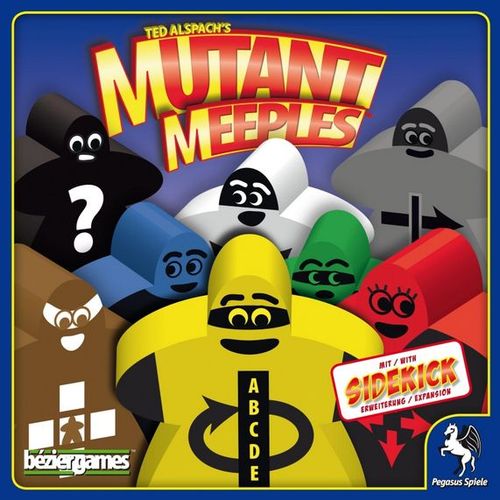
Mutant Meeples
Mutant Meeples Rulebook
Table of Contents
Table of Contents
- Contents
- Goal
- Player Setup
- Gameboard Setup
- First Game
- Gameplay
- Super Speed
- Mutant Super Powers
- Unsolvable Crimes
- Setting Up a New Round
- Winning the Game
- The 2-Sided Gameboard
- Handicaps
- Construction/Destruction
- Shorter Game Variant
- Strategy Tips
- Tournament Rules
- Game Design and Artwork by Ted Alspach
- Thank You
- Kickstarter Backers
Contents
- 1 Meeptropolis (black frame) / Meepville (green frame) 2-sided game board
- 8 Mutant Meeples and 8 Mutant Meeple placeholder circles
- 48 Square Mutant Meeple markers
- 6 Player aids
- 1 Scene of the Crime target
- 1 Plastic timer
- 6 Player boards
- 24 Movement tiles (1-24) and 18 Location (A-R) tiles
- 12 Construction/Destruction tiles
Goal
Get your meeples to the scene of the crime faster than any other player. Each meeple that reaches the destination first joins your super team; the player who completes their six Mutant Meeple super team first wins!
Player Setup
Give each player a player board, player aid, and a set of 8 Mutant Meeple markers (one of each color).
Gameboard Setup
Place the gameboard in the center of the table.
Place the movement tiles spread out near the board with all tiles visible where everyone can reach them.
Place a random Mutant Meeple placeholder circle on each of the "grate" spaces (diagonal stripes) on the game board, then place the corresponding Mutant Meeple on top of each of those placeholder circles.
Shuffle the location tiles and place them face down in a stack near the game board.
Place the Scene of the Crime target next to the Location tiles.
Place the timer near the Scene of the Crime target.
First Game
When playing Mutant Meeples for the first time, use the Meeptropolis side of the board (it has a black frame).
Gameplay
Choose a player at random for the first round to determine the scene of the crime. That player turns over two location tiles: The first determines the Avenue (column), while the second determines the Street (row). The player then places the Scene of the Crime target on the board at those coordinates.
All players then look to see how they can get any available Mutant Meeple to the Scene of the Crime target in the fewest possible moves (see Super Speed for movement rules, below). When a player thinks he has the quickest solution, he places his markers on his player board: the top row should have the tile of the first Mutant Meeple that is moved, placed in the column that corresponds to the number of moves it will make. The second row should contain the second Mutant Meeple moved, and the third row should contain the third Mutant Meeple moved. Both the 2nd and 3rd Mutant Meeple are optional; you only need one Mutant Meeple to reach the scene of the crime, but you can use up to three. Only Mutant Meeples that are not yet on that player's super team can be used by that player.
Then that player chooses a Movement tile with the total number of moves on it (the sum of all markers placed on his board), or greater and places that counter in front of him, announcing the number out loud, and flips the timer.
A player must place their markers on their player board before taking a Movement tile. Taking a Movement tile before placing his markers causes the player to be eliminated from that round. Once a player has chosen a Movement tile, he may not choose another Movement tile that round (even if he has a better solution).
Now all the other players have until the timer runs out to choose any other available Movement tile (but must still place their Mutant Meeples on the appropriate spaces on their player board first). If a player finds a solution that requires a Movement tile that has already been taken, he may take the next highest Movement tile available. This continues until everyone has chosen a Movement tile or the timer has run out, whichever happens first.
The player with the lowest number Movement tile demonstrates the moves that send the Mutant Meeple there, moving the Mutant Meeples (not the placeholders...those stay in place). For example, to start, Carbon (black) moves 4 times:
Carbon uses Ozzy's power to move through this building.
Then Forrest (green) moves 4 times, reaching the Scene of the Crime target on his last move:
Forrest uses his super power to jump over both the building and Carbon.
If he is correct, he returns the Movement tile and then places the Mutant Meeple marker that corresponds to the Mutant Meeple that reached the target upside down (showing the checkmark) below his player board, and places any other Mutant Meeples he used back above his board, and the round ends.
If he is incorrect, he must take back his choice of one of the Mutant Meeple markers (if he has any) on his super team, flipping the tile face up and placing it back with his other Mutant Meeples who are not yet on his super team, return the Movement tile and place all markers from his board back above his player board. Then the player with the next lowest chosen Movement tile demonstrates his moves. If no other player chose a Movement tile (or all players who did so cannot demonstrate a correct move), the round ends.
Super Speed
Each player may move up to three Mutant Meeples in order to have a Mutant Meeple reach the Scene of the Crime target. No Mutant Meeple may move more than 10 times per round, and the total number of moves made by all Mutant Meeples by one player may not exceed 24.
All Mutant Meeples have super speed, which they have some difficulty in controlling...they can't stop unless they run into something! A Mutant Meeple uses his super speed to move in one orthogonal (left, right, up, or down) direction until he is stopped by a building, the city edge, or another Mutant Meeple. Then he may move again in a different direction (including backwards). Each move he makes in a different direction is counted separately on each player's player board. Be sure to count moves, not spaces, when determining the number of moves a Mutant Meeple is making.
Each Mutant Meeple may make only one series of moves per turn (i.e. you cannot move a Mutant Meeple, move another Mutant Meeple, and then move the first Mutant Meeple again).
Mutant Super Powers
Each Mutant Meeple has a super power to assist him in reaching the Scene of the Crime target. A Mutant Meeple may use that super power (shown in the examples as a dotted line) once per round, at any point during that Mutant Meeple's movement phase: beginning, middle, or end. With the exception of MC Edge (yellow), Ozzy Mosis (gray), and Shortstop (brown), using a super power counts as a move. Each Mutant Meeple may also just use his power all by itself without another move (with the exception of MC Edge, Ozzy, and Shortstop, whose super powers are part of their super speed moves). A Mutant Meeple is not required to use his power (he can move using just super speed). For MC, Ozzy, and Shortstop, their super powers can also be used only once during a normal round. The following is a breakdown of each Mutant Meeple's super powers (the dotted line shows when their unique super power is being used):
Forrest Jump (green)
Forrest Jump jumps three spaces orthogonally: left, right, up, or down. He jumps over both any buildings and Mutant Meeples on those two spaces. He must jump over two spaces (he cannot jump over a single space) and land on the third. The space he lands in cannot have a Mutant Meeple in it.
Before Forrest Jump jumps, he stops, so the jump always counts as a move. After Forrest Jump jumps, he also stops. He may move again after a jump, but that is considered a new move.
Ozzy Mosis (gray)
Ozzy Mosis may pass through any building. After passing through a building, Ozzy continues in the direction he was moving and only stops when he hits another building, a Mutant Meeple, or a city edge. Ozzy's power does not count as an additional move.
Blue Beamer (blue)
The Blue Beamer "beams" (teleports) directly to any Blue Beam symbol. Beaming counts as a move. When the Blue Beamer arrives at a Blue Beam symbol, he stops. He may move again after a beam, but that is considered a new move.
Shortstop (brown)
Shortstop may stop one space short of any building, Mutant Meeple, or city edge. Shortstop's power does not count as an additional move.
Sidestep (red)
Sidestep may move one space orthogonally: left, right, up, or down. Before Sidestep uses her super power, she stops, and she also stops after using her power.
Skewt (white)
Skewt may move one space diagonally. He may move past a building, but not through a building (where two buildings join to make a corner). He may move past a Mutant Meeple or "between" Mutant Meeples. Before Skewt uses his super power, he stops, and he also stops after using his power.
MC Edge (yellow)
MC Edge wraps around the city edges. Use the letters on the edges as guides; when MC Edge uses his super power to go off the edge of the map, he'll reappear on the opposite side of the map at the same letter, and will continue moving in the direction he was moving until he is stopped by a Mutant Meeple or a building. MC's power does not count as an additional move.
Carbon (black)
Carbon may use the super power of any Mutant Meeple who is not yet on your super team. He may use any single power once per round, and may never use more than one power per round. Here's an example of Carbon using Sidestep's power to reach the Scene of the Crime target in just four moves:
(Example: Carbon uses Sidestep's power to reach the target in four moves.)
But he can get there in only three moves if he uses Skewt's power:
(Example: Carbon uses Skewt's power to reach the target in three moves.)
And he can also get there in only three moves by using Ozzy's power:
(Example: Carbon uses Ozzy's power to reach the target in three moves.)
Unsolvable Crimes
Sometimes, fighting crime is really hard. If all players agree that the current Scene of the Crime target can't be reached with their sets of Mutant Meeples, that crime goes unsolved and another set of location tiles is flipped. If this happens two times in a row, the Mutant Meeples are randomly placed on the grates (just like the setup at the beginning of the game).
Setting Up a New Round
After a round ends, put any empty Mutant Meeple placeholders back under each of the appropriate Mutant Meeples — be sure to move the placeholder circles, not the Mutant Meeples themselves! Take the Scene of the Crime target off the board, and begin a new round, with the player whose Mutant Meeples reached the Scene of the Crime target turning over two new Location tiles and placing the Scene of the Crime target at its new coordinates.
If the crime was not solved, the player who turned over the last set of Location tiles does so again.
Once you've gone through all the Location tiles, shuffle them and place them face down so you have a new stack to draw from again.
Winning the Game
The first player to create a complete super team of six Mutant Meeples (checkmark side up) wins!
The 2-Sided Gameboard
The gameboard has two sides:
Meeptropolis, which has many more city buildings and lends itself towards faster gameplay and many more options (often with fewer total movements).
The very scary Meepville, which has fewer buildings, many more wide open spaces, and requires much more teamwork (having a Mutant Meeple set up a "block" for other Mutant Meeples).
Handicaps
If some players are more experienced than others, the experienced players may remove one of their Mutant Meeple markers randomly before the game begins, placing that marker in the game box. They still have to get six Mutant Meeples on to their team, but they'll never be able to use the one that was removed, providing an extra challenge for them throughout the game. For really experienced players, remove two Mutant Meeple markers.
Construction/Destruction
Use the included Construction/Destruction tiles to vary the layout of each of the gameboards. One side of each of the tiles is the "Construction" side with a straight or corner building on it. The other side of the tiles is the "Destruction" side with no buildings on it. Adding Construction tiles makes the game a little bit easier, but can increase the number of total moves necessary to reach the Scene of the Crime target. Adding Destruction tiles can make the game much more challenging. Adding a combination of both totally changes the way each side of the game board works, allowing you to create virtually limitless combinations of board layouts!
You can place the tiles exactly where you'd like, or for a true "random" board setup, use a pair of Location tiles to determine where each tile will go. Use as many or as few tiles as you'd like in each game.
Shorter Game Variant
To reduce playing time, each player may "seed" their super team with a Mutant Meeple of their choice. They simply place one of their markers upside down below their board as if that Mutant Meeple had already reached the scene of a crime.
Strategy Tips
Whenever the Scene of the Crime appears in a mostly open area, the only way to get there is either by a Mutant Meeple using their super power as his final move (such as Forrest Jump, Shortstop, Sidestep, or Skewt) or by setting up another Mutant Meeple on a space next to the Scene of the Crime, and then having the final Mutant Meeple use him as a blocker. In many cases it's better to focus on how to get a blocker in place first, and then to focus on getting the final Mutant Meeple to the Scene of the Crime afterwards.
Towards the end of the game, pay attention to your opponents' remaining movable Mutant Meeples and any overlap between yours. Focus on the Mutant Meeples that you both share when looking for a solution; you don't want that terrible feeling in the pit of your stomach to happen when your opponent comes up with a solution that you could have done first!
Be sure to leave yourself with one or more of the "open space" Mutant Meeples (Forrest Jump, Shortstop, Sidestep or Skewt) at the end of the game so you can get to hard-to-reach locations.
Carbon becomes less and less valuable towards the end of the game. Don't be afraid to "use him up" by having him be the Mutant Meeple that gets to the Scene of the Crime early in the game.
Tournament Rules
When a player wins a game of Mutant Meeples, he removes a random Mutant Meeple marker from his supply and places it in the game box. He won't be able to use that Mutant Meeple from that point on, and he still is required to get six Mutant Meeples on his super team. If he wins a second game, he removes another Mutant Meeple. When a player wins his third game (starting with only six Mutant Meeples), he wins the tournament!
Game Design and Artwork by Ted Alspach
Ted is the designer of more than 40 games and game expansions, including Suburbia, Ultimate Werewolf, TieBreaker, Ticked Off, Perpetual-Motion Machine, Beer & Pretzels, Start Player, and many more. He's also the author of more than 35 books, including the award winning Board 2 Pieces: Of Dice & Meeples and Board 2 Pieces: Something Smells Gamey.
Thank You
Thanks to everyone who has playtested Mutant Meeples in various forms: Carol Alspach, Dakota Alspach, Gage Alspach, Toni Alspach, Sean Anderson, Devin Batutis, John Bender, Eric Burgess, Andrew Clark, Hank Drew, Mike Heller, Brian Johnson, Scott Kelly, Patrick Korner, Jeremiah Lee, Josh Lubliner, Allison Reynolds, Steve Samson, Christine Simundson, Claire Standish, Rick Thornquist, Julien Van Reeth, Richard Vernon, and Karen Woodmansee.
Based on Alex Randolph's game Ricochet Robots™.
Additional thanks to Hans im Glück for kindly granting permission to use the "standard" Carcassonne meeple shapes in this game!
Kickstarter Backers
Gerald Squelart, Pawel Skierczynski, Amy Helen Johnson, Bryan Graham, Cristian Akkermans, Melissa Rogerson, Erik Dresner, The Roach, Ben Baldanza, Scott Alden, Leland Davenport, Steve Zanini, Joseph M. Louis, Brian Leet, Christian Nord, Claudia Voelker, William Springer, Matt Grimaldi, Scott Fort, Peter Hendee, Philip Hwang, David Phipps, Thomas Michel, Michael Duggan, Scott Russell, Brian Hanechak, Ernst Milletits, Manabu Shiraki, Christopher Okasaki, Sam Ouimette, Gary Lau, Chris Holm, Bertrand Sebastien, Ken Gutermuth, John A. Tamplin, Kevin Ames, W. Eric Martin, Kevin J. Maroney, Martin Wehnert, Mark Barbieri, Josh Jenkins, Heli Barthen, Joshua Beale, Johnson Leung, Adam Smiles, Yann Bartelheimer, Christopher Moore, Kevin Bender, David desJardins, Mark Gerrits, Eric Franklin, Andrew Schensted, Steven Sartain, Larry Bogucki, Warren, Dan Cristelli, Andrea Cupido, Peter McAndrew, Philip Cahiwat, Cory Swafford, Jean-Claude ROBERT, John Morrow, Monica Rehaug, Chad Krizan, Laurent Macabet, Michael Logan, Michael Iachini, Matt Fullenwider, Ric Bretschneider, Jon Theys, David Heiligmann, Ken Davis, Oliver Grimm, Tim Farley, John Holt, Edward Garner, Jon Harrison, Josh Bluestein, Sara VanderWal, Robert Biddle, Don Clevenger, Bruce Harlick, Mark Tang, Johan Andersson, Nicholas Witchey, Joshua Crowe, Daniel Harvey, shane connery, Cynthia Rexford, Judah Warshaw, Will Sullivan, Ed Liming, Sandra Stumpf, Paulo Roberto Vasques Jr, Kevin G. Nunn, Frank Pohl, Christopher Boothe, Marcio Chammas, Jeremy Commandeur, Jonathan Jordan, Meziere Mickael, Mary Ann Nguyen, Ryan Olson, Junius Stone, Kimberly Moos, Michael Boon, Arran Cudbard-Bell, Brian Lucier, Ray Wisneski, Brian Lenz, Eric Rasmussen, Scott Gowell, Kyle Woods, Troy Weipert, Mischa Krilov, Mark Horn, Pierre St-Michel, Bruce Murphy, Paul Marshall, William Crispin, Gene Ehli, Ricardo F. Ferreira, Seth Uricheck, Mike Hansen, Brad Olson, Joanna Hobbs, Jon Dahlberg, Suzi Rondot, David T. Van Sweden, Darren Nakamura, James Butler, Sebastian Blanco, David Kiehnhoff, Arnaldo Horta, Adam Easterday, Kate Drefke, Henning Krüpke, Darren Bezzant, Olav Müller, Michael Chen, Brian Lang, Jon Wilesen, Vanessa Simek, Matt Carlson, Chris Farrell, New House, Roy Levien, Scott Halvorson, Jeff Eberlin, Kin Pi, David Rapp, Klaus Nehren, Barbara Knighton, John Sadri-Ojeda, Daniel Winterhalter, Jochen Corts, Carlo Gozzi, Stephen Frye, Benoit Kusters, David Armand, Lucio Rodriguez, Brandon Barlow, MJ Kuchenbrod, Daniel Ferreira Caldas, Timothy Hing Marie-Eve Lupien, Barry D. Guertin, Roberto Zaghis, Anthony Correia, Thierry Wasserman, Paul Dix, Nelson Beach, Thiago Brito, Björn Loesing, and Steve Reinartz. Finally, congratulations to Mr. and Mrs. Sunil & Robin Gopal!