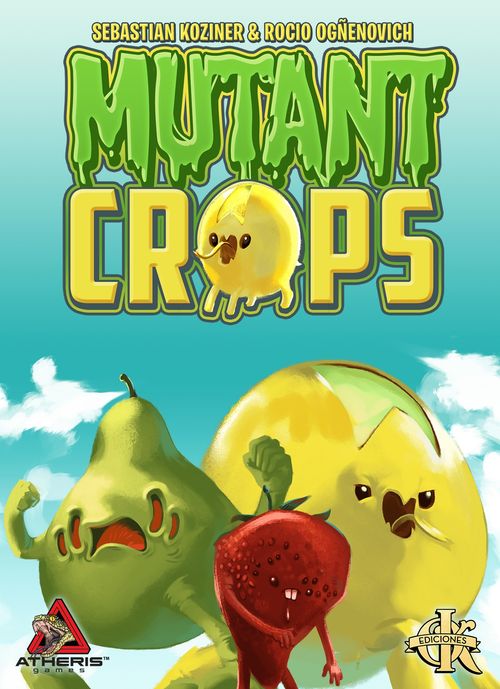
Mutant Crops
Mutant Crops Rulebook
Table of Contents
Table of Contents
Components
- A - 19 Crop cards
- B - 6 Stage 1 cards
- C - 3 Stage 2 cards
- D - 3 Stage 3 cards
- E - 1 Turn card
- F - 11 Farmers
- G - 24 Seed tokens, 24 Water tokens, 24 Meat tokens
- H - 4 Color markers
Game Objective
In Mutant Crops your mission is to score the most points (star). To do this you must plant crops that you then have to water and feed, managing to gather and spend the most tokens (blue/water, red/meat, and green/seeds) that you can. Only by carefully choosing and combining your crops, and then watering and feeding them properly, will you reach victory.
Each crop has a watering area, a feeding area, and a special area that can be watered or fed. To use the special area, you must first water and feed the crop's other two areas. You only score points from those planted crops that you have watered or fed — so it doesn't pay to hoard plants uselessly.
Setup
- Take the 6 "Stage 1" cards and place them face up in the center of the table, forming two rows of 3 cards.
- Take the 3 "Stage 2" cards, shuffle them, and place them face down to the right of the top row of "Stage 1" cards. Take the 3 "Stage 3" cards, shuffle them, and place them face down to the right of the bottom row of "Stage 1" cards.
- Shuffle the Crop cards face down and put the pile in the area above the cards you just placed. Then flip face up a number of Crop cards depending on the number of players: 3 for 2 or 3 players, 4 cards for 4 players.
- Each player takes Farmers of a color of their choice, plus the marker of the same color. In 2-player games, take 3 Farmers of the same color each. In 3- or 4-player games, take 2 each.
- Decide who will be the first player and give that player the Turn card and the black Farmer. Place the black Farmer on its silhouette on the side of the card matching the number of players. If you can't decide, the first player is whoever most recently went to the greengrocer.
- Leave the Seed, Meat, and Water tokens within reach of all players.
- Deal 1 Seed token to the first player, and 2 tokens to each of the other players.
When setup is finished, the table should look like this: the Crop deck alongside 2-4 face-up Crop cards (for example Blueberry, Cucumber, Bell Pepper, and Onion, each showing its seed cost and its water and food point values), the two rows of action cards (Stage 1 face up, Stage 2 and Stage 3 face down to their right).
Turn Structure
The game is played over exactly 7 turns, and each one includes as many actions as you have Farmers (3 for 2 players, 2 for 3 and 4 players).
Turns are played in rounds, clockwise. Each turn has as many rounds as the Turn card indicates: 3 rounds for two players, 2 rounds for 3 or 4 players.
1 - First Turn
Starting with the first player and going clockwise, each player occupies one action with their Farmer, obtaining the benefit that the action describes. For example, if the first player places their Farmer where it says "+3 water," they immediately take 3 blue tokens. (We will cover these actions in more detail later, in the "Actions" section.) To mark that they have used their action, the first player moves the black turn-marker Farmer to space number 1, indicating their first action.
Then, clockwise, the other players each choose an action and place one of their Farmers on it. When it comes back around to the first player, that player must move the black Farmer to the next space on the Turn card, and then place their second Farmer on whichever action they want to carry out (from those still free). This continues until the Farmer occupies the last space, which tells us it is time to flip the next Stage card, beginning the next turn.
Each card contains two actions, but Farmers may only occupy one of them at a time, leaving the other one available to the other players. There cannot be more than one Farmer per action — that is, if a Farmer is already on an action, a second Farmer cannot be placed on it. There is one exception, which we will see in the Actions section.
2 - Start of the Second Turn
We begin the turn by revealing the next action card face up — in this case, the first card to the right that says "Stage 2" on its back.
Then, if in the previous turn someone chose the action that grants first player, we hand that player the Turn card along with their Farmer so they can keep track of the actions available. If nobody occupied that space, whoever was first player the previous round remains first player.
From this turn on, in each of the rounds, each player may move one of their Farmers to a different free action.
You may always move the same Farmer if you wish — it is not mandatory to move each of your Farmers once. This way, you can keep an action blocked for as long as you like, preventing another player from using it. Under no circumstances can you use the same action twice by lifting a Farmer and placing it back on the same action: you may only move a Farmer onto an action that is empty at that moment.
From the third turn on, we repeat the steps of turn two, until all the action cards have been revealed at the start of the seventh turn.
3 - End of the Game
When all players have used their last actions, they proceed to add up the points granted by their planted cards.
Scoring
Attention: only crops that have been watered or fed, in full or in part, will score points. Example: if a crop has been watered but not fed, it will only score points for the watered area.
For example, if a player watered a Peach, they receive 4 victory points; if they fed it, they receive 1; and if they did both, they receive 5. If, in addition, they also watered its special area and planted a Pear, they receive 3 extra victory points (even though the Pear itself was neither watered nor fed).
The player with the most points at the end of the game wins!
Actions
Each action card has 2 possible actions. By occupying an action with your Farmers, you obtain the benefit that the action indicates.
For clarity, in the upper right corner of each action card on the table you will find a letter identifying each action, which we describe in detail here:
- A - These actions grant resources: the amount and type of resource are specified on the card itself. The player who carries it out takes the corresponding tokens from the pool. For example, if the action says "+3" with the seed icon, you take 3 green tokens from the pool.
- B - Sow (Sembrar) means you may take a Crop card, paying its cost in seeds (green tokens), and place it in front of you. From now on you may water it and feed it, and it will score you points at the end of the game if you do. Then draw a card from the top of the deck to replace the crop you just sowed.
- C - Return to the pool the number of tokens needed to pay the corresponding cost to water or feed the crop. If you choose to water, you hand over Water tokens (blue); if you choose to feed, you hand over Meat tokens (red). To show that the action has been carried out, take one of the tokens you paid with and place it covering the crop's area, returning the rest to the pool. For example, if we feed the Onion, we place a token on the red "2," and return one to the pool. You may only feed one card at a time. IMPORTANT: Cards have 2 basic point areas and 1 ability area. To use the ability, you must first have watered and fed both basic point areas.
- D - Take 2 tokens of the color of your choice (2 of the same resource or 2 different ones), then proceed to Rotate Crops. This means shuffling the available crops back into the deck, and drawing the same number of cards again.
- E - Take one token of each color.
- F - Take one token of the color of your choice. Whoever carries out this action will be the first player next turn, and will be able to use the newly revealed actions first.
- G - Return one token of any color to the pool in order to carry out an action already occupied by another Farmer. One of your Farmers must remain occupying this action, and it will be another of your Farmers that you can place on an action already occupied by another player. You then obtain the benefit of the action you occupy as if it had been empty.
NOTE: Actions must always be carried out exactly as stated — you must have the necessary conditions to fulfill what the action asks.
- Example 1: If you decide to water and the card asks for 2 Water tokens, and you only have one, you cannot do it. You cannot water in stages — you must have the full amount of tokens the action asks for.
- Example 2: If you use the "Sow x2" action, you must have enough green tokens to pay the cost of the 2 cards you choose, otherwise you cannot use this action.
When in doubt: if a player cannot fulfill the action they chose, they cannot occupy that action under any circumstances.
- Example 3: I want to occupy the "Water x2" action, but when I try, I see I only have enough to water one card. I must cancel that action, and instead look for an action that lets me water once, without exceeding what I can afford.