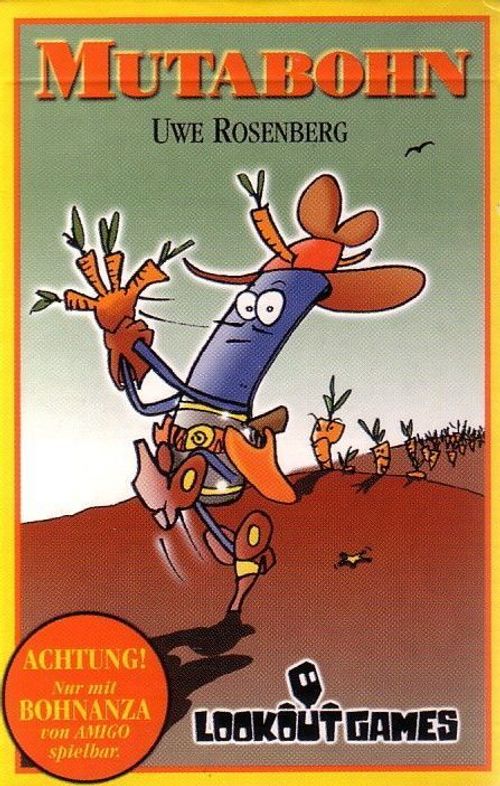
Mutabohn
Mutabohn Rulebook
Table of Contents
Table of Contents
Components
In the Bohnanza variant "Mutabohn", bean cards of different varieties may be planted on the same bean field. "Mutabohn" contains 33 bonus cards.
Each bonus card shows a pattern of beans of different varieties. The bonus card states a reward for a player's own bean field that shows the pictured pattern.
Setup
Mutabohn can only be played together with the game Bohnanza. Bohnanza was published by AMIGO Spiel + Freizeit. It is designed for 2 to 7 players and lasts about one hour. The setup for Mutabohn is the same as the setup for Bohnanza.
In addition, shuffle the bonus cards and place them as a face-down stack (the bonus deck). Each player takes two bonus cards into hand. In a two-player game, each player takes three. It does not matter where in their hand a player places the bonus cards. The bonus cards do not affect the Bohnanza-specific order of the bean cards.
Required Cards
- Always: For a game of two or three players, the Bohnanza base game is needed.
- From 4 players: In a four-player game, in addition to the cards from the Bohnanza base game, play either the Brandy beans from the Bohnanza Erweiterungs-Set (1997/2001) or the Cognac beans from AMIGO's High Bohn (2001).
- From 5 players: In a five-player game, the Coffee beans from the Erweiterungs-Set are also added. A game that wants to use the original Bohnanza ending will last about one hour. With the Mutabohn ending (see the Alternative Mutabohn Ending section below), the game can last over two hours.
- From 6 players: In a six-player game, the Wax beans from the expansion La Isla Bohnita (1998) are also shuffled into the draw pile. In a seven-player game, the Wax beans and the Mocha beans from La Isla Bohnita are shuffled into the draw pile. The Garden beans should be sorted, and the draw pile is still played through three times, according to the original rules.
Translator's note: the German "assortiert" for the Garden beans is terse. It is translated here as "sorted". The original gives no further detail.
Game Idea
Not only soybeans can be genetically manipulated in unsustainable ways, so that they become more durable, more nutritious or something else entirely. The other bean varieties are wide open too. In Mutabohn, the beans mutate while they are already on the bean fields. Garden beans become Red beans, Red beans become Black-eyed beans, and so on. Each bean field can be transformed into the next less valuable variety (that is, the next more frequent one) by planting a matching bean card.
Important: When a bean field is settled, the Bean Meter on the last card laid always applies.
Example: Anni lays onto her collection, which contains two Green beans (frequency 14), a Stink bean (frequency 16), and directly on top of that a Chili bean (frequency 18). With two more Chili beans, Anni's collection would be worth two bean coins. In the same way, the collection would also be worth two bean coins with either one Chili bean and one Blue bean, or with two Blue beans.
Attention! Unlike in Bohnanza, there is no "3rd bean field" to acquire in Mutabohn.
Translator's note: the original names the beans in German as follows. Blaue Bohne is Blue, Feuerbohne is Chili, Saubohne is Stink, Brechbohne is Green, Sojabohne is Soy, Augenbohne is Black-eyed, Rote Bohne is Red, and Gartenbohne is Garden. The frequencies in brackets are those printed in the original example.
Bonus Cards
Bonus cards show patterns such as AABBC. Instead of the letters A, B and C, the beans are shown in different varieties. A pattern describes the gencode, the code that a bean field should be built to. Attention! The gencode always refers to the most recently laid cards. For example, a five-bean gencode refers to the last five cards laid on a bean field. All other cards on that bean field are irrelevant for the bonus.
AABBC means that a bean field first gets two beans of the same variety, then two beans of the next less valuable (next more frequent) variety. The fifth bean must be of a third variety, again the next less valuable one. It is important that it really is always the next less valuable variety. No bean variety may be skipped. If a player wanted to lay a Green bean (14) on Black-eyed beans (10), they would wrongly skip the Soy beans (12).
Example: The bean field Red, Black-eyed, Black-eyed, Soy, Soy, Green has the gencode AABBC. The Red bean is not considered. A is Black-eyed, B is Soy, and C is Green. The bean field has not only the code AABBC but also the gencode ABBC.
The bonus cards a player holds in hand give them the possible gencodes. If a bean field matches the gencode on one of those cards, the player may, at any time in the game, reveal that bonus card, immediately place it with their bean coins, and take a new bonus card from the bonus deck into hand. The bonus card is worth a number of bean pennies, which is printed on the card. 100 bean pennies equal one bean coin.
If the bonus deck is empty, no more bonus cards can be drawn for the rest of the game. If several players claim the last cards of the bonus deck at the same time, only those who sit closer to the active player in the direction of play receive them.
Important: When a player reveals a bonus card and places it with their coins, they are not required to harvest the bean field they used to fulfil the bonus card. So a player may fulfil several bonus cards with the same bean field (see the examples with the gencodes AABBC and ABBC above). Bonus cards may be fulfilled immediately after they have been taken into hand.
Special rule: At any time in the game, a player who pays out a bean coin (which is shown by a regular bean card) may exchange bonus cards. Translator's note: the original parenthesis "(der mit einer regulären Bohnenkarte angezeigt wird)" is rendered literally here. The player places any number of their bonus cards from hand, in any order, under the bonus deck, and then draws the same number of bonus cards from the bonus deck into hand. This special rule matters most in a two-player game. In a two-player game, players should quickly get rid of bonus cards when many of them are in play that would be more useful than the ones in hand.
Turn Structure in a Two-Player Game
In a two-player game, the original phase order of Bohnanza is played with the new planting rules (see the Game Idea section). Changes apply to phases 2 and 4. In a two-player game, both players hold three bonus cards in hand, not two.
Attention! In a two-player game, bonus cards can be fulfilled not only with your own bean fields, but also with your opponent's bean fields.
Phase 1: The first part of the turn is unchanged. First the front card of the hand must be played. Then the second card in hand may also be played.
Phase 2: After the active player has revealed two cards, they must offer their opponent a bean as a gift. This is either a bean that was just revealed or a bean that they hold in hand. This offer is a forced gift. The opponent must accept the gift unless they make a gift offer of their own in return. The active player may in turn decline this forced gift by making a counter-offer, and so on.
Important: Each bean variety may be offered only once per turn. If the active player offers a Blue bean, the opponent may no longer offer a Blue bean. If the opponent then offers a Chili bean as a gift, the active player may give neither a Blue bean nor a Chili bean, and so on.
A player who must hand over a gift they do not have receives a penalty of one bean coin. The penalty is shown provisionally by a "3rd bean field" card and is settled with the bean coins won at the end of the game. The trading exchange is then repeated.
If both players wish, they may waive the forced gift and trade freely instead.
Phase 3: The third part of the turn is unchanged. The new beans are planted on the bean fields in any order. The active player plants first, then the opponent. It is important that the beans are planted one at a time, bean by bean, so that the respective opponent always gets a chance to fulfil bonus cards.
Phase 4: A player who holds 0 to 2 cards in hand draws three cards. A player who holds 3 or more cards draws two cards.
| Two-player game | Cards drawn |
|---|---|
| 0-2 beans in hand | 3 cards |
| 3 or more beans in hand | 2 cards |
The game ends as soon as the draw pile runs out for the first time.
Turn Structure in a Multiplayer Game
In a multiplayer game, the turn is changed compared with the Bohnanza base game as follows.
Phase 1: In the first part of their turn, the active player must first play and plant their front card in hand, and then also their second card in hand. After that, they may also play their third card in hand.
If the active player does not hold at least two bean cards in hand at the start of their turn, they receive a penalty of one bean coin. The penalty is shown provisionally by a "3rd bean field" card and is settled with the bean coins won at the end of the game.
Phase 2: The second part of the turn is unchanged from the Bohnanza base game. Two bean cards are revealed, and trading takes place.
Phase 3: Because the traded bean cards may be planted in any order, the players have many chances to fulfil bonus cards. Unlike in a two-player game, bonus cards may only be fulfilled with a player's own bean fields. The new planting rules apply (see the Game Idea section).
Phase 4: At the end of their turn, the player draws bean cards, which they take into hand behind their existing cards. The table below shows how many cards they may draw.
| Three- to four-player game | Cards drawn |
|---|---|
| 0-2 beans in hand | 4 cards |
| 3 or more beans in hand | 3 cards |
| Five- to seven-player game | Cards drawn |
|---|---|
| 0-2 beans in hand | 5 cards |
| 3 or more beans in hand | 4 cards |
Regarding the table: the active player, just as in the two-player game, is rewarded with an extra bean if they hold only two bean cards or fewer in hand at the end of phase 4 of their turn.
Alternative Mutabohn Ending
The original ending of Bohnanza says that the draw pile must be played through exactly three times. Under the new Mutabohn rules, the game is nowhere near its end at that point. With three or four players, the Mutabohn ending is always played. With five players, you may choose between the normal Bohnanza ending and the Mutabohn ending. With six and seven players, the original ending is always played.
The draw pile is played through as often as possible. The moment the draw pile is empty, the open discard pile is shuffled immediately. Important: The card shuffler asks the players whether they still want to harvest bean fields, so that more bean cards can be shuffled into the draw pile. In this way, the end of the game can be delayed again and again. When asking, the card shuffler proceeds in the following order: first the active player, then all other players clockwise (including themselves).
At any time, including while the new draw pile is being shuffled, a player may ask for the number of bean cards in the draw pile to be counted.
The game may end (a) after phase 3 or (b) in phase 4 of a turn.
a) The game ends in phase 3 if, in phase 2, the active player can reveal only one bean card. After the first card is revealed, both the draw pile and the discard pile are empty, and no player is willing to harvest a bean field so that bean cards return to the game and a second card can be revealed. Phases 2 and 3 are played to the end. After phase 3 is completed, the game ends, regardless of how large the discard pile is.
b) The game ends in phase 4 if the active player draws cards in phase 4 and no single card remains for the next player. If no player is willing to harvest a bean field so that bean cards return to the game, the game ends immediately.
Final Scoring
At the end of the game, each player harvests their remaining bean fields and counts their bean coins and bean pennies. Once more: 100 bean pennies equal one bean coin. The player with the most money wins.
Mutabohn Without Bohnanza Expansions
If no expansions are at hand, then for each bean variety that is missing, the bean coins (whole coins only) are shuffled back into the draw pile once the draw pile has become empty. Translator's note: this passage is terse in the original. It is rendered literally, and the original gives no further detail on what exactly is shuffled back. The players' bean coins are noted down. In this way the playing time is extended. Fulfilled bonus cards stay with the players when the bean cards are shuffled. The bonus deck likewise stays as it is. The Mutabohn ending is then played.
Example: The five bean friends Julia, Rick, Georg, Tim and Anni want to play a game of Mutabohn. Besides the Mutabohn cards they own only the Bohnanza base game. So they have to do without the intended Brandy and Coffee beans. Once the draw pile has run out for the first time, every player returns their bean coins in order to add extra bean cards to the draw pile. The coin totals are noted down beforehand. Once the pile has run out a second time, the players again return all bean coins they have won. Only from the third pile onward is the game played until both the draw pile and the discard pile are empty (see the Mutabohn ending above).
Warning
Warning! This variant is a demanding, not to say exhausting, trading game. For most of the beans that are offered, there are several bidders. Hard bargaining is therefore needed, and the whole game loses a little of its "lightness".