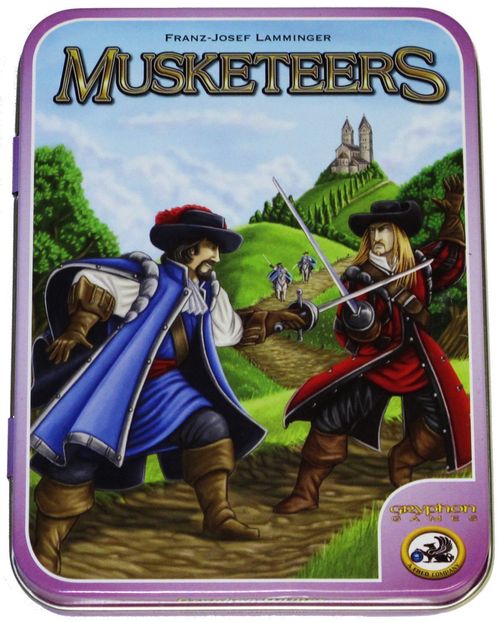
Musketeers
Musketeers Rulebook
Table of Contents
Table of Contents
Components
If you play more than one round, you also need paper and a pencil.
Setup
First, remove some Guard cards depending on the number of players:
- 2 players: 25, 30, 35, 40
- 3 players: 4, 35, 40
- 4 players: 4, 5, 7
Set the removed cards aside; they are not needed. Shuffle all remaining Guard cards and place them as a face-down stack in the middle of the table. Also place the gem and prison cards there.
Now shuffle all Musketeer cards and deal each player 12 of them face down. Set the rest aside; they are only needed again in a next round.
Each player looks at their 12 Musketeer cards and chooses 3 of them as pay cards, which they place face down next to each other in front of them. The values of these cards give the number of silver pieces a player can win in this round. Each player keeps the remaining 9 cards in hand to fight the Cardinal's Guard.
Gameplay
Reveal the top Guard card. Its value indicates how strong the Guard is in this fight. Now all players choose one Musketeer card from their hand face down and then reveal them simultaneously. Add up the values of all Musketeer cards.
If the sum is lower than the value of the Guard card, the Musketeers have lost this fight. The player with the lowest Musketeer card (lowest value; in a tie, the lower number of swords) receives a prison card as punishment, which they take from the middle of the table and lay crosswise on a free pay card.
If the sum of the Musketeer cards is exactly as high as the value of the Guard card or higher, the Musketeers have won the fight. The player with the highest Musketeer card of this fight (highest value; in a tie, the higher number of swords) receives a gem card as a reward, which they take from the middle of the table and lay crosswise on a free pay card. They may also decline to take a gem card and instead put one of their own prison cards back into the middle of the table.
Example: The revealed Guard card has the value 18. Athos chooses a Musketeer card with the value 7, Porthos also plays a 7, and Aramis a 5. The sum of the 3 cards is 19, so the Guard is defeated. Athos and Porthos played the highest Musketeer value; Porthos's card has 3 swords, Athos's only 2. So Porthos played the highest card and may place a gem card on one of his pay cards.
Had Aramis's Musketeer card had the value 3 or lower, the sum would have been less than 18. As punishment, Aramis, who would have played the lowest card, would have had to place a prison card on one of his pay cards.
Special Cases
- If you have to take a gem or prison card but none is left in the middle of the table, take the card from another player.
- If you win a fight but have no free pay card left, you cannot take a gem card; instead you put a prison card back into the middle of the table.
- If you lose a fight without a free pay card, you cannot take a prison card; instead you put a gem card back into the middle of the table.
After the fight, set the played Musketeer cards aside. Reveal a new Guard card and play the next fight.
In Prison
If all 3 of your pay cards are covered with a prison card, you still play Musketeer cards, but they are set aside immediately and are not added to the sum of the Musketeers! The other players must therefore fight without you. But as soon as another player has to take a prison card, you are freed and take part again in the fight against the Guardsmen.
End of the Game
A round ends when all players have played their 9 Musketeer cards or when one player owns all 3 gem cards. Now all players reveal their pay cards. Each of your pay cards earns you silver pieces equal to the value of the card. If a gem card lay on one of your pay cards, you even receive double the number of silver pieces for that card. However, all pay cards on which a prison card lay are worthless; you receive no silver pieces for them.
If you only want to play a short game, the player with the most silver pieces now wins. Otherwise, note on a piece of paper the silver pieces each player has won, and begin a new round. The game then ends as soon as at the end of a round at least one player has reached 100 silver pieces or more. The player with the most silver pieces is the winner.