Musketeer Chess
Musketeer Chess Rulebook
Table of Contents
Table of Contents
Rules of the new pieces
When the jump symbol appears, this means that the piece reaches the square by jumping from its original square to the marked square (similar to a knight, for example).
This piece is called a "leaper", jumping over any other man in the adjacent squares (it can jump over its own men or enemy pieces). Enemy pieces are captured only if they lie on one of the squares controlled by the new piece.
When the sweep symbol appears, this means that the square is reached by a "sweeping" movement.
The new piece moves through an unobstructed, defined path. When the path is obstructed by another man, the piece is blocked in the square before the blocking piece, unless the obstacle is an enemy man that can be captured. So, the new piece ends its path on the square of the captured piece.
Leopard
The Leopard is a new piece that combines moves of a Knight and a Bishop with a limited range of 2 squares. Compared to Archbishop (Bishop and Knight), it's a less powerful piece, but this limited Bishop range adds interesting strategic components and sharpens the game with many new tactics.
The Leopard cannot move orthogonally. It can control a maximum of 16 squares. Compared to the Cannon (see below), it has almost the same value, but it appears to be slightly more aggressive, as it has the ability to "sweep" forward more squares. It can checkmate a bare King without help.
From d4, the Leopard can control 16 squares: It can leap to c2, b3, e2, f3, b5, c6, e6, f5. It slides to: c3, b2, c5, b6, e5, f6, e3, f2. PGN Notation: Le
Cannon
The Cannon moves differently than the Cannon in Xiangqi, but it can be used to play like the Xiangqi Cannon.
In Musketeer Chess, the Cannon is classified as a leaper. It can leap two squares orthogonally in any direction. But it can also leap like the Knight, only moving 1 square forward then 2 squares horizontally. The Cannon can also move like the King, one square in any direction.
From d4, the Cannon can control 16 squares: It can leap to d2, d6, b4, b3, b5, f4, f3, f5. It slides to: c3, c4, c5, d3, d5, e3, e4, e5. PGN Notation: Ca
The Musketeer Cannon is an excellent defensive piece when near its own King. It's also a deadly piece for the opponent King, as it controls many nearby squares and can mate without the help of other pieces.
Unicorn
The Unicorn is an enhanced version of the Classic Chess Knight. It moves like a Knight but has expanded jumping capabilities.
It can move like the Knight (1+2 or 2+1), but it can also "jump" like an extended Knight (1+3 or 3+1), known historically as the Camel. It controls 16 squares. The Musketeer Chess Series 2 comes with a Camel. The rules proposed for the Musketeer Camel are different from the historic rules. But as always, the pieces are yours and you can use them to play your own games, or any known historical game. So don't hesitate to use your own rules.
The Unicorn from d4 can control 16 squares: It can leap to c2, c1, c6, c7, b3, a3, b5, a5, e6, e7, f5, g5, f3, g3. PGN Notation: U
Dragon or Amazone (Queen + Knight)
The Dragon, also historically known as the Amazone, combines powers of Queen and Knight, making it one of the most powerful pieces. Many historic or modern chess variants use this piece, and its name can be different: Amazone, Commander, etc.
The Dragon top is pegged. It can sometimes be removed (at your own risk), adding customisation possibilities.
From d4, the Dragon can control a total of 36 squares. PGN Notation: Dr
Archbishop and Chancellor
Archbishop and Chancellor combine respectively the moves of Bishop+Knight and Rook+Knight. They are sometimes referred to as Marshall, Empress, Princess, Cardinal, Concubine, Adjutant, Guard, Centaur, Equerry, Champion, among others.
It was former World Champion José Raúl Capablanca who used these pieces to reinvigorate the game of Chess, which he believed had been "played-out".
In Musketeer Chess, the Chancellor / Archbishop choice makes the game extremely sharp and tactical. Explosive combinations abound. Even with a large material advantage, the Archbishop and Chancellor are hard to contain, with brutal attacks. Both pieces can checkmate without the assistance of other pieces.
Chancellor
The Chancellor can move like a Rook or a Knight.
From d4, the Chancellor can control a total of 22 squares. PGN Notation: Ch
Archbishop
The Archbishop can move like a Bishop and a Knight. It can checkmate without any help.
From d4, the Archbishop can control a total of 22 squares. PGN Notation: Ar
Elephant and Hawk
These pieces were originally designed for Sharper Chess, better known as Seirawan Chess, a variant designed jointly by Grand Master Yasser Seirawan and Bruce Harper. The moves of Elephant and Hawk are significantly different for Musketeer Chess than for Sharper Chess. The Elephant in the Seirawan variant moves like Rook+Knight (the Capablanca Chancellor), and the Hawk combines the Knight and Bishop moves (the Capablanca Archbishop). Such beautiful pieces needed revisited rules!
Elephant
Similar to the King, the Elephant can move one square in all directions. It also leaps orthogonally or diagonally by 2 squares.
The Elephant is described in some historic Chess variants such as Xiangqi, but also in the majority of the Chess variants where it was used. This piece was most of the time of limited range and is a very weak piece (Shogi, Xiangqi, Shatranj, Shako, Courier Spiel, etc.). In Musketeer Chess, the Elephant is much stronger, controlling 16 squares and can mate a lone King single-handedly.
From d4, it can leap to d6, d2, b2, b4, b6, f2, f4, f6. It slides to: d5, d3, c3, c4, c5, e3, e4, e5. PGN Notation: E
Hawk
The Hawk is a pure leaper. In Musketeer Chess, the Hawk attacks by jumping over pieces 2 to 3 squares orthogonally or diagonally in any direction. The Hawk is a dangerous piece, but it's also vulnerable as it cannot protect itself from the short-range attacking pieces. You can imagine attacking the opponent King in the opening (especially before castling) with mating patterns.
The Hawk can control up to a total of 16 squares: From d4, it can leap to b2, a1, b4, a4, b6, a7, d2, d1, d6, d7, f2, f4, f6, g1, g4, g7. PGN Notation: H
Fortress
The Fortress is another heavy piece with different capabilities from the already available chess variants.
It can move in an unobstructed path, sliding diagonally in any direction, but limited to a maximum of 3 squares (for example from f1 it can slide to e2, d3, c4, g2 and h3 but cannot reach b5 or a6).
The Fortress can also "jump" like a Knight only 2 squares vertically and 1 square horizontally (from f1 it reaches g3 and e3 but cannot jump to h2 and d2).
The Fortress can also "jump" in any direction vertically or horizontally by two squares (from e3 it can jump to c3, g3, e5 and e1).
The top tower of the Fortress is pegged, so that the tops of the light and dark units can be interchanged (to handle with care).
From d4, the Fortress can control 20 squares: It can slide to e3, f2, g1, e5, f6, g7, f8, c3, b2, a1, c5, b6, a7. It can "jump" to: d6, d2, b4, f4 and c6, c2, e6, e2. PGN Notation: Fo
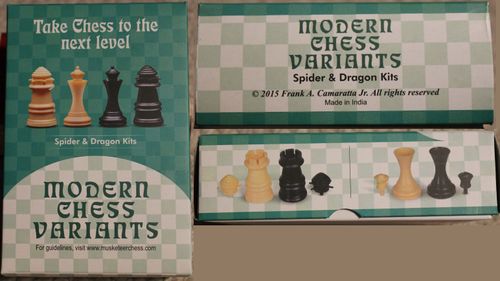
Spider
A map of the moves that are possible with the next variant reminds one of the web made by a spider, hence its name: Spider.
It can move in an unobstructed path, sliding diagonally in any direction, but limited to two squares.
The Spider can also "jump" like a Knight. It can also "jump" in any direction vertically or horizontally by two squares.
When starting from h1, for example, it can move to g2, f3. It can also "jump" to h3, g3, f1 and f2.
The top of the Spider is pegged, offering the possibility of creating two different variants with different moves (to handle with care).
When starting from d4, it can control 20 squares: sliding to e5, f6, e3, f2, c5, b6, c3, b2. It can "jump" towards: c6, b5, c2, b3, e6, f5, e2, f3, d6, d2, b4, f4.
PGN Notation: Sp
Initial placement of the pieces
Musketeer Chess begins like Orthodox Chess, by placing all the classic chess pieces on the 8×8 board.
White and Black have to agree on the new pieces to add. It's the PIECE SELECTION phase.
First, White makes a choice among the 10 new pieces. If Black agrees, Black must pick the same piece type. Then it's Black's turn to choose among the remaining 9 new pieces. White has no other choice than to pick up the same piece.
If Black does not agree with White's choice of the first additional piece, Black tells their disagreement either by saying so, by removing White's piece from the Chess arena, or by choosing another piece type. In either case, the default combination will be chosen as the additional pieces. The current default combination is Leopard and Cannon.
The default combination is subject to change by tournament directors, organisers, etc. Usually during the same event, the default combination is the same for the whole event. It can be convenient to play thematic tournaments with the same combination, or choose a different one before the start of the round. The choice should be pointed out to the players before the round starts, giving them sufficient time to become comfortable with the new piece rules, especially if the new pieces are different from a simple combination of Knights, Bishops and Rooks.
After the two new chess pieces are defined, both White and Black will place their new men respectively on the zero and ninth line.
It's the GATING SELECTION phase.
Each new man is placed behind one classic chess piece. It's strictly forbidden for players to place one man behind the King and the other behind a Rook at the same time (to prevent gating both pieces when castling).
After the first move, the new man must be placed on the board: on the empty square left by the piece which was previously in front of it.
For example: White will place their Leopard on square d0 (behind the White Queen). The Leopard will be placed on the board when the White Queen first moves away. However, if the White Queen is captured before making its first move, then White forfeits the right to introduce the new man.
If a King is in check, and it must move, gating is then forfeited (if there is a piece waiting behind the King to be gated, it cannot gate if the King moves because of a check threat), unless the King can capture the checking piece.
If the piece allowing the introduction of one of the new pieces is captured on its initial square before moving, the right to introduce (gate) the new piece is forfeited. This gives some interesting tactics where you can get rid of two pieces with the same capture or sacrifice. For example: a Bishop captures the White g1 Knight. White forfeits the right to introduce the Hawk.
If the new man is put behind the King, then it is introduced when castling, or when the King makes its first move (without being in check). The same is true when the additional man is put behind a Rook. However, it is forbidden to put the two extra new men behind a King and a Rook at the same time, preventing the introduction of the two new men at the same time when castling.
For example: a Fortress is on reserve square e9 behind the Black King. When Black castles, the Fortress gates on e8 square once the King moves for the first time.
PGN Notation: For short castle: 0-0 (Fo-e8).
If the King is in check and cannot capture the checking piece, it has to move, and this excludes any gating possibility.
In the above example, the Black King is checked and cannot capture the checking piece. If the Black King moves from e8 after this check, the waiting Fortress in the gating zone cannot gate, and thus Black loses the right of gating the Fortress in subsequent moves.
Another situation can arise: a pinned piece cannot move. It's not possible to move a pinned piece and gate at the same time, preventing check! It's like in Classic Chess, where pinned pieces cannot move.
Promotion
When promoting, a pawn can be promoted into any of the Classic Chess pieces (except the King), and also to the new pieces chosen at the beginning of the game, even if these pieces weren't gated.
For example, the game began with Cannon and Unicorn. If a pawn is promoted, it cannot be promoted to a Leopard, but it can be promoted to a Cannon or a Unicorn. If a second pawn is promoted, it can be promoted to a Cannon or Unicorn again (we can then see 2 of the same colored Cannons on the board, etc.).