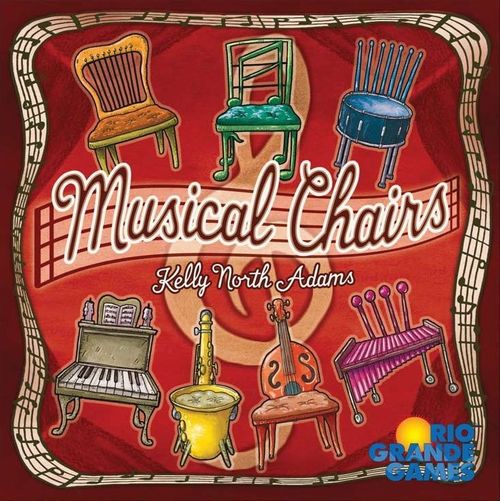
Musical Chairs
Musical Chairs Rulebook
Table of Contents
Table of Contents
- Goal of the Game
- Contents
- The Card Deck
- Setup
- How to Play
- Special Cards
- End of Round Phases
- Continue Play
- End of Game
- Frequently Asked Questions
- Chair Cushion Token Explanations
- Score a card from the top of the deck at the end of each round. (0 VP)
- +1 VP for every different Chair suit you scored at the end of the game. (0 VP)
- You may choose to score higher cards instead of lower ones during scoring (1x). (1 VP)
- All your 0 VP cards are worth 2 VP. (1 VP)
- +3 VP for every 3 different suits scored at the end of the game. (1 VP)
- +1 VP for each Rest card you played. (1 VP)
- Switch one of your scored Chair cards with one from your hand (immediately 1x). (1 VP)
- You may score a different vacant Chair space. (1 VP)
- Your hand limit is now +1. (2 VP)
Goal of the Game
In Musical Chairs, players take turns playing cards while moving their player markers around a musical themed board. Players gain victory points based on which chair they are on when the music stops. Cards left in their hands at the end of the round can potentially score the players even more points.
If multiple players end a round on the same space, they must battle for the chair. Chair Cushion tokens can be obtained by the players at the end of each round giving them special powers and extra victory points. The player with the most victory points by the end of the game is crowned the winner of Musical Chairs.
Contents
- 1 Circular Game Board
- 16 Chair Cushion tokens
- 104 cards:
- 10 of each Musical Chair card with 8 different suits
- 8 Rest cards (one in each suit)
- 10 white Repeat cards (not associated with any suit)
- 6 Player Reference cards
- 8 Player markers (2 each in pink, black, white, blue)
- 1 Music Stops Conductor token
The Card Deck
The card deck consists of Chair cards, Repeat cards, and Rest cards. Each card in the deck is worth zero to three victory points. The victory points (VP) are indicated by the number of treble clefs shown on the lower portion of the card. A Chair card with the (~) symbol is worth zero VP.
- Chair cards: Chair cards make up most of the card deck and represent different colors and types of "Musical Chairs." There are 8 different Chair card types called suits. Each suit contains ten cards numbered 1-10, with 10 being the highest valued card. Each Chair card is worth zero to three VP at the end of the game.
- Rest cards: There are 8 Rest cards in the card deck. Each Rest card belongs to a suit. These show the musical symbol for rest. Rest cards have no number value, and they are blank in the upper corners. Rest cards are worth one VP each at the end of the game.
- Repeat cards: There are 10 white Repeat cards in the deck. Repeat cards are not associated with any suit. These show the musical symbol for repeat. Repeat cards are worth either one or two VP at the end of the game.
Both Rest and Repeat cards have special rules, which are explained later in the "Special Cards" section of the rulebook.
Setup
- Set the circular game board in the middle of the table.
- Mix the Chair Cushion tokens and randomly place one face up on each cushion space below each Chair space on the game board. Place the unused Chair Cushion tokens back into the box.
- Shuffle the Chair, Rest and Repeat cards together and deal 8 cards to each player. The remaining cards form the draw pile.
- The Start Player is the person at the table who is considered to be the best musician. If this cannot be determined, then feel free to use whatever method the players choose to decide who goes first.
- In reverse player order, each player puts their Player marker next to the starting Chair space of their choice. Each player must choose a different Chair space as a starting position. The players place the other marker in front of them so it is easy to tell their assigned color.
- The first round begins with the Start Player. Play proceeds clockwise around the table from the start player.
How to Play
- The Start Player plays the LOWEST Chair card in their hand face up to a central play area. If they have multiple cards of the same number but in different suits, they choose which to play. Alternatively, they may play a Rest or Repeat card (see FAQ #3 on page 6).
- After playing a card, the player moves their Player marker one, two, or three spaces clockwise around the game board. They choose how many spaces to move, but they must move their marker at least one space.
- The next player has four possible options. They choose to do one of the following:
- They may play a card of the same value as the card that was just played.
- They may play a Rest card.
- They may play a Repeat card. (How the Rest and Repeat cards work is explained in the next section of rules.)
- If a player does not have or does not want to play a card that fits the options listed above, then they MUST play the lowest card in their hand that is HIGHER than the card just played.
- Chair and Repeat cards are played next to each other in a line in the middle of the table so all players can see their progression.
- A player is never forced to play a Rest card, a Repeat card, or a card with the same number as the one just played.
- If a player cannot play a higher card on their turn and chooses not to play a Rest, Repeat, or same value Chair card, then the Music Stops! (see below)
Play example 1: Megen is the start player and she plays her lowest card, a red (cello) 2 card. Stephany is the next player. Stephany has a green (rhythm) 2, a black (turntable) 3, and a blue (drum) 5 card in her hand. Stephany must play either the green 2 or the black 3. She cannot play the blue 5 because it is neither the same value as the card just played nor the next higher number in her hand. She cannot Stop the Music because she has a higher card than the last Chair card played.
Play example 2: Later in the game, Michelle has just played an orange (harp) 9 card. Amanda is the next player. Amanda does not have any cards left in her hand that have a value higher than 9. She does have a red (cello) 9 card, a Repeat card, and a Rest card. She could play the red (cello) 9 to keep the round going and move her player marker, the Rest (to skip a turn), or a Repeat (to copy the value of the card just played). But she has decided that her position on the board is advantageous to her. She wants the round to end. In this case, she can "Stop the Music!"
Special Cards
- Rest cards: If a player has a Rest card in their hand, they may choose to play it instead of playing a Chair card. The Rest card allows the player to pass their turn. If a player plays a Rest card, they do not move their player marker on the game board. Rest cards are not played to the central play area, instead, they are played in front of the player who played them. At the end of the round, they go into the player's score pile. Rest cards played in this way are worth 1 VP each at the end of the game.
- Repeat cards: If a player has a Repeat card in their hand, they may choose to play it to the line of cards in the middle of the table after the last played Chair card instead of playing a Chair card. The Repeat card copies the last card played in the central play area. Repeat cards have no Chair suit while in the player's hand, but once played, they take on the number and suit of the card that was played directly before it. The player then moves their player token as normal (1, 2, or 3 spaces clockwise). If scored, Repeat cards are worth the VP value shown on the Repeat card at the end of the game.
End of Round Phases
The source prints this sequence as an unnumbered diagram. Phase numbers follow the rulebook's own cross-references (Butt Battle is phase 3; Chair Cushion purchase is phase 6), and the step labels in bold are short titles taken from the diagram captions.
-
Music Stops! The player who stopped the music takes the conductor token. The round is over.
When the Music Stops!, the player who stopped the music takes the "Music Stops!" token and places it in front of them. This indicates that the round has ended.
-
Remove the Chair Cushion token. Remove the chair cushion token from the board matching the suit of the last played card in the central play area.
At the end of each round, the players will remove a Chair Cushion token which symbolizes removing a chair in the classic game Musical Chairs. Looking at the playing board, the Chair Cushion token that is removed is the one that matches the suit of the last played Chair card in the central play area (the highest-valued card). Remove the Chair Cushion token and place it off the board, next to the chair space. If the token from that chair space has already been removed during a previous round, then continue to the next highest card until players arrive at a card that still has a token on the board. Remove this one instead and place the Chair Cushion token next to the chair. If none of the cards in the central play area have a matching token on the board, then no token is removed that round. Players who end the round next to a removed Chair Cushion token will have the opportunity to purchase the token in phase 6. In future rounds, Chairs with removed Cushion tokens are still counted during movement and during end of round scoring.
-
Butt Battle! If two players are on the same space at the end of the round, they must battle for the space.
If two or more players end their turn on the same chair, a Butt Battle is required to determine the winner of the chair. The players involved in the battle may choose a card secretly from the cards still in their hands. All players participating in the Butt Battle reveal their cards simultaneously. The highest card played wins the battle. The suit of the card does not matter for Butt Battles.
Next, all players take the cards from the central play area that match the suit of the chair they are next to and place them in their score pile. Repeat cards are considered to be exact copies of the card played before them. So if any Repeat cards were played to the central play area, they are also placed in the appropriate players' score piles. Any player who lost a butt battle in this round cannot score cards this round.
Special notes about Butt Battles
- Players are not required to participate in the battle. If a player declines to participate in the battle, they cannot win the Butt Battle, nor can they enter the battle again if it continues.
- If there is a tie among two or more of the remaining players, the tied players battle again by playing cards as described in phase 3 until one player wins. A player may decline to play a card at any time and remove themselves from the battle.
- A Repeat card played during a Butt Battle will guarantee a tie with the highest card played, causing the Butt Battle to continue for another round. If all players involved play a Repeat card, they all tie, and the battle will continue.
- A Rest card played during a Butt Battle has no value and cannot win. If all players involved play a Rest card, it is considered a forfeit and all players lose the Butt Battle. A player playing a Rest card will never win even against a player who declines to participate.
- If all players decline to participate at any point or if all players run out of cards, the Butt Battle is considered to be a draw and no one wins.
- If there is a winner, the winner continues to end of round scoring. The player (or players) who loses the Butt Battle does not get to score.
- All of the cards used in the Butt Battle go to the discard pile.
Continue Play
- Any remaining cards in the central play area are placed in the discard pile. The player who stopped the music becomes the starting player.
- Before beginning the next round, all players may choose to keep the cards in their hands or discard their ENTIRE HAND. Players may not discard only some of their cards. The starting player decides first followed by the rest of the players in clockwise order around the table.
- After deciding whether or not to discard cards, the players refill their hands from the draw pile until they each have eight (8) cards.
- If the draw deck runs out of cards, shuffle the discard pile and this becomes the new draw pile. If, at any point, there are not enough cards to replenish all players' hands after shuffling, the game ends immediately.
- Once all players have 8 cards in their hands, play continues with the starting player. They will play the first card in the next round.
End of Game
- The game ends in one of two ways:
- a. When the last Chair Cushion token is removed from the board, the game ends after the End of Round Phases. The Chair Cushion tokens only have to be removed from the board in order for this condition to be satisfied. They do not have to be purchased.
- b. If, at any point, there are not enough cards to replenish all players' hands after shuffling, the game ends immediately.
- Players discard any cards left in their hands to the discard pile and add up their VP by counting all of the treble clefs on the cards in their score pile plus any bonus VP awarded by the Chair Cushion tokens they have acquired during the game.
The player with the most VP in their score pile is crowned the winner of Musical Chairs. If there is a tie, the involved players rejoice in their shared victory.
Frequently Asked Questions
- At the end of the round, if a player ends their turn next to a space that no longer has a Chair Cushion token, do they still score cards from the play area and their hands?
- a: Yes.
- Can a player score Repeat and/or Rest cards in their hand at the end of the round?
- a: Players do not score Repeat cards in their hand because Repeat cards do not have a Chair suit. Repeat cards only become a suit while in the central play area. Players may, however, score Rest cards in their hand if the Rest card matches the suit of the Chair space they are currently scoring.
- Can the Start Player play a Rest or Repeat card?
- a. Yes. If the start player plays a Rest card, they simply do not move their player token and play the Rest card in front of them. If the start player plays a white Repeat card to the central play area, they would move their token 1-3 spaces as normal. This card would just be discarded at the end of round because it did not copy any suit.
Chair Cushion Token Explanations
All Chair Cushion token powers are active only when they are held by a player. Once they are taken by a player, the powers become active for only that player. Chair Cushion tokens that are still on the board are not active and have no effect on the game. The same is true for those Chair Cushion tokens that have been removed from the board but have not been purchased by a player.
Score a card from the top of the deck at the end of each round. (0 VP)
Use: End of each round. At the end of each round, including round it was purchased, the player who holds this Chair Cushion token takes the top card of the draw deck, flips it over, and adds it to their score pile. This token gives no additional VP at the end of the game.
+1 VP for every different Chair suit you scored at the end of the game. (0 VP)
Use: End of Game. The player scores 1 VP for every different Chair suit that is in their score pile. This Chair Cushion token gives no additional VP at the end of the game. There are 8 different suits, so this token may score up to 8 points.
You may choose to score higher cards instead of lower ones during scoring (1x). (1 VP)
Use: One time during the game at the end of a round. At the end of a round, a player normally may score all the cards in their hand of the same suit that are LOWER than the highest card they just took from the play area. This Chair Cushion token lets the player add the higher cards in their hand to their score pile instead of the lower cards. This is a one-time effect. Flip this token after use to indicate that it cannot be used again. This token also gives the player who owns it 1 additional VP at the end of the game.
All your 0 VP cards are worth 2 VP. (1 VP)
Use: End of Game Scoring. Any cards worth 0 VP in the score pile of the player who owns this Chair Cushion token at the end of the game are now worth 2 VP. This also gives that player 1 additional VP at the end of the game.
+3 VP for every 3 different suits scored at the end of the game. (1 VP)
Use: End of Game Scoring. At the end of the game, the player scores 3 VP for every 3 different Chair suits in their score pile. Since there are only 8 suits in the deck, this can be scored twice in a game for a maximum of 6 VP. This token also gives the player 1 additional VP at the end of the game.
+1 VP for each Rest card you played. (1 VP)
Use: End of Game Scoring. This Chair Cushion token gives the player who owns this token an additional VP for every Rest card they have played during the game. This token also gives the player 1 additional VP at the end of the game.
Switch one of your scored Chair cards with one from your hand (immediately 1x). (1 VP)
Use: Immediate. This allows a player to discard one of their previously scored Chair cards and replace it with any one from their hand. This must be done when the Chair Cushion token is purchased. This is a one-time effect. Flip this token after use to indicate that it cannot be used again. This token also gives the player 1 additional VP at the end of the game.
You may score a different vacant Chair space. (1 VP)
Use: End of Round. On all future scoring rounds, the player may pick a different Chair suit to score instead of the one their player marker ends next to. The Chair suit they pick cannot have any player markers next to it. This token also gives the player 1 additional VP at the end of the game.
Your hand limit is now +1. (2 VP)
Use: Continuous. The player who owns this Chair Cushion token may draw up to 9 cards instead of 8 at the beginning of a round. This token also gives the player 2 additional VP at the end of the game.
You may choose between your next two lowest cards, announcing the skipped card. (2 VP)
Use: On the player's turn during a round of play. Normally players must play their next-lowest card to the central play area or, optionally, play the same number compared to the card that was just played (if they have it). If a player holds this Chair Cushion token, they may choose to play one of their next two lowest cards. The player must tell the other players the number and suit of the card that they did not play. This token also gives the player 2 additional VP at the end of the game.
You get +1 during butt battles and you win ties. (2 VP)
Use: Butt Battles. During a Butt Battle, if the player who owns this Chair Cushion token plays an 8 and their opponent plays a 9, they would win with the 8 because it is +1 value and it is a tie. However, if their opponent played a 10, then their opponent would win. This token has no effect on Rest cards. This token also gives the player 2 additional VP at the end of the game.
You may pass once per round. (3 VP)
Use: On the player's turn during a round of play. On all future rounds, the player who holds this token may use this Chair Cushion token to pass once. The player does not move their player marker or play any cards. The player flips the token over to signify that it has been played in that round. The token is flipped back over to its front side at the beginning of the next round. This token also gives the player 3 additional VP at the end of the game.
You may now move 1-4 spaces. (3 VP)
Use: On the player's turn during a round of play. The player who holds this Chair Cushion token may move 1-4 spaces instead of 1-3 spaces after they play a Chair or Repeat card. This token also gives the player 3 additional VP at the end of the game.
You may instead move backward one space. (3 VP)
Use: On the player's turn during a round of play. The player who holds this Chair Cushion token may move 1 space counterclockwise on the board after they play a Chair or Repeat card. This cushion may be used on any or none of a player's turns in a round. This token also gives the player 3 additional VP at the end of the game.
You may immediately Stop the Music (1x). (3 VP)
Use: Beginning of the player's turn during a round of play. On a future round, this Chair Cushion token allows the player to Stop the Music at the beginning of their turn instead of playing a card. This ends the round immediately. Flip this token after use, it can only be used once during the game. This token also gives the player 3 additional VP at the end of the game.
Hop over other players during your movement for free. (3 VP)
Use: On the player's turn during a round of play. The player who holds this Chair Cushion token may now optionally hop over other players ignoring the spaces the other players are on. They still must only move 1, 2, or 3 spaces, but spaces that contain other player's markers may be ignored in their movement. This token also gives the player 3 additional VP at the end of the game.