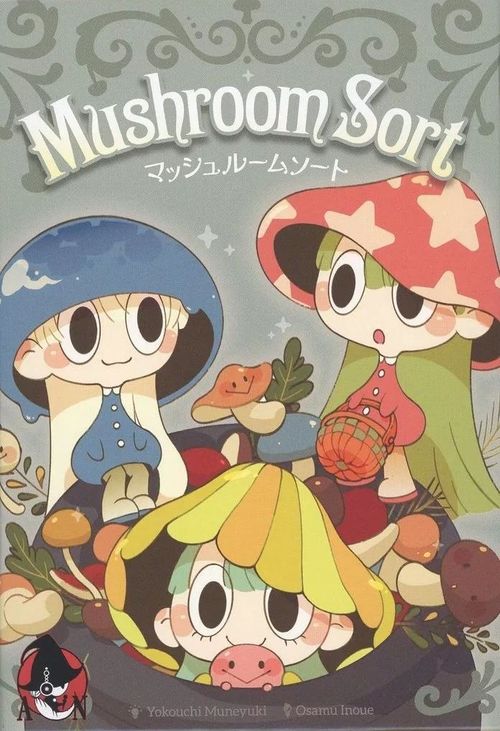
Mushroom Sort
Mushroom Sort Rulebook
Table of Contents
Table of Contents
- Game Overview
- Components
- Game Setup
- Round Flow (When playing with 3 or 4 players)
- Game End
- Optional Rules: The "Pig Card"
- When Playing with 2 Players
- Summary (When playing with 3 or 4 players)
Game Overview
"MUSHROOM SORT" is a game where players collect "Mushroom Cards" to create soups that match the given recipes. Mushroom Cards have unique features that:
- Their colors are visible even from the back.
- Each card exists only once in the game.
- They are arranged in ascending order.
Use these characteristics to skillfully locate the mushrooms you need! Earn high scores by outsmarting other players and creating the perfect soup!
Components
- 32 Mushroom Cards: Ranks 1 to 8 of 4 colors: Red, Blue, Yellow, Black. The card colors are identifiable from the back. Cards with ranks 3 and 6 have a ★ symbol.
- Player Tokens (Orange, Light blue, Green, Purple): Mushroom Tokens: 3 each; Pot Token: 1 each
- Recipe Card (Orange, Light blue, Green, Purple): 1 each
- Basket Card (Orange, Light blue, Green, Purple): 1 each
- Start Player Card: 1 card
- Pig Card: 1 card. This card is only used when playing with additional rules.
- A memo and a pencil (not included)
The number of Mushroom Cards used varies based on the player count. Any unused cards are returned to the box. Use the following cards:
- 4 players: All 32 cards
- 3 players: Ranks 1 to 7 of each color (28 cards total)
- 2 players: Ranks 1 to 5 of each color (20 cards total)
Shuffle the Mushroom Cards and place them face down on the table as a draw pile. Each player uses Player Tokens, a Recipe Card, and a Basket Card of matching color. Any unused components are returned to the box.
Game Setup
-
Each player sits on one side of the table and receives the following items.
- 3 Mushroom Player Tokens and 1 Pot Token of a color.
- Each player receives 1 Recipe Card and 1 Basket Card of the same color as their Player Token.
Place the Basket Card face up with the side showing two ★ marks, then place their Player Tokens on top of it. The Recipe Card should be placed with the appropriate side facing up depending on the player count.
-
When playing with the additional rules mentioned later, place the Pig Card in the center of the table. If not, then return it to the box. The Pig Card also has different sides depending on the player count.
-
The oldest player receives the Start Player Card and becomes the starting player for the first round.
Once the setup is complete, the game begins. During the game, players will repeat a sequence of actions called rounds. The game continues for a number of rounds equal to the number of players. At the end of the game, the player with the highest score wins.
Round Flow (When playing with 3 or 4 players)
For a 2-player game, please refer to "When Playing with 2 players" below.
Each round proceeds in the following order:
- Preparation Phase
- Gathering Phase
- Comparison Phase
- Game End Check
- Preparation for the Next Round
1. Preparation Phase
In the Preparation Phase, cards are mainly dealt from the draw pile. Follow the steps below.
Preparation Phase 1: Setting Up the Central and Tableau Cards
Each player is dealt Mushroom Cards ("cards" from here on) from the top of the draw pile. In a 3-player game, each player receives 8 cards. In a 4-player game, each player receives 7 cards. Only the receiving player may look at the face of their card.
Each player selects one card from their hand and places it face down in the center of the table. To keep track of who played which card, it's best to place them in front of where each player's set of cards will be arranged. These cards placed in the center are called "Central Cards." The card each player placed is referred to as "Their Own Central Card."
Next, players arrange their remaining cards face down in front of them. When placing these cards, check their ranks and arrange them in ascending order from left to right (with the smallest rank on the left and the largest on the right). If multiple cards have the same rank, their order does not matter.
The cards arranged in front of each player are called "Tableau Cards." The set of these cards a player arranges is referred to as "Their Own Tableau Cards."
Players may look at the face of Their Own Central Card and Their Own Tableau Cards at any time. However, they must ensure that other players do not see them. Place your Basket Card with your Player Token on it, and your Recipe Card on the left end of your Tableau Cards. This helps clarify which side has the lower ranks.
Example: Player A received the following cards: (Yellow 7, Yellow 5, Red 5, Black 5, and others). Player A places "Yellow 7" as Their Central Card in the center of the table. The remaining cards are arranged as Their Tableau Cards in front of them in ascending rank order. (Note: While the example shows the cards face-up for clarity, in the actual game, they should be placed face-down.) Since "Yellow 5," "Red 5," and "Black 5" share the same rank, they may be placed in any order.
Preparation Phase 2: Dealing Hands
Each player is dealt one card from the top of the draw pile. Only the receiving player may look at the face of their card.
This card becomes their Hand, which should be kept separate from the Tableau Cards. Players may hold it or place it in a way that prevents mixing with their other cards. The back of the card must remain visible to other players.
In a 3-player game, one card will remain in the draw pile after dealing. This card is placed face down in the center of the table as an extra Central Card. Since it doesn't belong to any player, no one is allowed to view its face.
Reference: Ensuring Fairness in Dealing. In "MUSHROOM SORT", since card colors are visible from the back, it is important to minimize any unintentional bias when dealing cards. Here's a recommended method to ensure fairness:
- Take the top card of the deck and insert it somewhere in the middle of the draw pile. Beginning with the Start Player, deal cards one at a time in 7 or 8 times (depending on the number of players). Deal the Hand cards in a similar process.
- When arranging Central Cards and Tableau Cards in Preparation Phase 1, the Start Player could see the top card's color before placing their own cards. To address this, after all cards have been dealt, slightly shift the top four cards of the remaining deck so their back colors are visible to all players.
Reference: After completing the Dealing Hands (4-player game). Central Cards are in the middle, each player's Tableau Cards are in front of them, and each Hand card is kept apart. All cards should be placed face down.
2. Gathering Phase
During the Gathering Phase, players take turns in clockwise order, starting from the Start Player. Each player takes 4 turns in total. The phase ends once every player has completed all 4 turns. On their turn, the active player must perform the following actions.
Gathering Phase 1: Selecting a Card
From another player's Tableau Cards (not their own), the active player selects 1 card they wish to obtain. When doing so, a card that already has a Player Token on it may not be selected.
Gathering Phase 2: Placing a Player Token
Place any Player Token on your Basket Card onto the selected card.
- If the Player Token you choose is a Mushroom Token, then reveal the selected card face-up before placing a token on it.
- If it's a Pot Token, then leave the selected card face-down and place the token on it without revealing the card.
Important: 4th Turn. On each player's fourth and final turn (when placing their last player token), the following two additional rules apply:
- During "Gathering Phase 1: Select a Card", the player may select a card from the Central Cards (including Their Own Central Card) in addition to selecting from other players' Tableau Cards.
- If the last remaining Player Token on the Basket Card is a Pot Token, then flip the Basket Card over after completing the turn.
Example: Player A can choose from the cards outlined in red in the diagram. They decide to select the second-largest card from another player's Tableau Cards and place a Mushroom Token on it. The selected card is flipped face-up and revealed. Since Tableau Cards are arranged in ascending order, it is now clear that the blue card to the right of it has a rank of 8.
Once each player has taken 4 turns, all Player Tokens will be placed on a card, either on a Tableau Card or a Central Card.
3. Comparison Phase
Comparison Phase 1: Gathering Cards
Each player gathers the 4 cards with their Player Tokens on them, and places all cards in front of themselves. Then, they reveal their Hand Card and add it to the gathered cards. The cards with Pot Token are revealed for the first time at this moment. These 5 cards (4 gathered + 1 Hand Card) should be kept separate from any remaining Tableau Cards.
Comparison Phase 2: Comparing Card Combinations
Each player examines the 5 cards from "Gathering Cards" to determine which card combination they have formed, and compare their strength with each other. If multiple combinations apply, only the strongest one is considered. There are 7 combinations, and the strength of each combination is indicated on the Recipe Card, where a lower number means a stronger combination. In order of strength, strongest first:
- Four of a Kind: 4 cards with the same rank
- Full House: 3 cards with the same rank and a different pair
- Straight: All 5 cards in numerical sequence (e.g., 2, 3, 4, 5, 6)
- Three of a Kind: 3 cards with the same rank
- Mini Straight: 4 out of 5 cards in a numerical sequence (e.g., 5, 6, 7, 8)
- Pair: 2 cards with the same rank
- Variation: Any other combination not listed above
Three of a Kind and Mini Straight have the same strength ranking.
Comparison Phase 3: Scoring
As a result of "Comparison Phase 2: Comparing Card Combinations", the player with the strongest combination earns points listed under the "1st place" on the Recipe Card. Similarly, the player with the second strongest combination earns points listed under the "2nd place". Players record their earned points for final scoring.
Reference: How to Read the Recipe Card. (1) Combination strength; (2) Combination name; (3) Combination details; (4) 1st place points; (5) 2nd place points. Points for the 1st and 2nd place vary depending on the player count.
Important: Comparing Combinations of the Same Strength.
- If multiple players have the same strength combinations, the player with the most ★ wins. ★ appears on cards with ranks "3" and "6". The face side of the Basket Card also has 2★. (If a player flips their Basket Card, then they lose the 2 ★.)
- If ★ counts are also tied, the player sitting farthest clockwise from the Start Player wins. (If players are seated A (Start Player) B C D, then D is the farthest and has the highest priority. If all tiebreakers still result in a tie, the ranking follows the priority order D C B A.)
Example: After "Comparison Phase 1: Gathering Cards", each player has the following cards. Each player's combinations are: A: Three of a Kind, B: Mini Straight, C: Full House, D: Pair. C has the strongest combination. A and B are tied for the next strongest combination, but A has 3 ★ while B has 2 ★. Therefore, A is ranked the second strongest. (If A and B had the same number of ★, then B would be the second strongest.) C earns 4 points for winning the 1st place with a Full House, according to the Recipe Card. A earns 2 points for winning the 2nd place with a Three of a Kind.
4. Game End Condition
If this is the third round (in a 3-player game) or the fourth round (in a 4-player game), the game ends. Skip "5. Preparing for the Next Round" and proceed directly to "Game End."
5. Preparing for the Next Round
Each player retrieves their Player Tokens and places them back on their Basket Card. If the Basket Card was flipped face down, turn it face up. Shuffle all cards face down and use them as the deck for the next round. The Start Player passes the Start Player Card to the player on their left. Return to "1. Preparation Phase" and begin the next round.
Game End
Compare each player's total score. The player with the highest score wins. If there is a tie, the player who had the stronger combination in the final round wins the game.
Optional Rules: The "Pig Card"
The "Pig Card" is an optional rule that provides additional choices, especially when a player believes they cannot form a stronger combination than others. This can be played by placing the Pig Card in the center of the table. This rule may not be played in a 2-player game.
The additional rules are as follows.
- During "Gathering Phase 1: Selecting a Card," players may also choose the Pig Card. However, it cannot be selected if a Player Token is already on it. Additionally, placing a Mushroom Token on it does not flip the card.
- A player who places their token on the Pig Card gets a chance to predict the card ranks of all other players before "Comparison Phase 2: Comparing Card Combinations."
- After declaring their predictions, all players reveal their cards.
- If all predictions are correct, the player earns 2 points in a 3-player game or 3 points in a 4-player game.
- Since the Pig Card does not count as a regular card, the player will only have 4 cards, limiting them from forming strong combinations. Even if they achieve the strongest or second-strongest combination, they do not earn points, and other players' rankings remain unchanged.
When Playing with 2 Players
When playing with 2 players, the following differences apply compared to playing with 3 or 4 players. The Recipe Card should be used with the same side facing up as in a 3-player game.
The rule changes are as follows.
- Before "Preparation Phase 1: Preparing the Central and Tableau Cards," randomly select 1 card of each color from the deck, keeping them face down, and place them on the table. These will serve as the Central Cards. These are not considered either player's Central Card, and their faces cannot be peeked.
- In "Preparation Phase 1: Preparing the Central and Tableau Cards," each player is dealt 7 cards. These cards are arranged as their own Tableau Cards in front of them, face down and in ascending order. Players do not select and place a Central Card.
- The Tableau Cards are arranged so that each player's cards face one another. (Reference, 2-player setup: Player B's Tableau on one side, Player A's Tableau on the other, and the Central Cards (1 of each color) beside them.)
- Among each player's Tableau Cards, the cards facing each other are considered a "pair." If a Player Token is placed on one of the paired cards, the other card may not be selected during "Gathering Phase 1: Selecting a Card."
- During "Gathering Phase 1: Selecting a Card," Central Cards may be chosen even before the fourth turn.
- In "Comparison Phase 3: Scoring," the player with the second strongest hand does not receive any points.
- In "Game End Condition," the game ends after the second round.
Summary (When playing with 3 or 4 players)
1. Preparation Phase: Each player is dealt 7 or 8 Mushroom Cards, from which they choose and place "Their Own Central Card" and arrange "Their Own Tableau Cards" in ascending order from left to right. After that, each player is dealt 1 additional card as their "Hand Card."
2. Gathering Phase: Starting with the Start Player and proceeding clockwise, each player takes their turn. The phase ends once all players have taken 4 turns each.
- Each player's 1st to 3rd turn: Choose 1 card from another player's Tableau Cards and place your Player Token on it. If you place a Mushroom Token, reveal the card.
- Each player's 4th turn: You may also choose a Central Card and place your Player Token on it. If you place a Pot Token, flip your Basket Card over.
3. Comparison Phase: Each player gathers and reveals the Mushroom Cards with their Player Tokens. Add your Hand Card and compare the formed combination. (If combinations are of equal strength, the number of ★ determines the winner.) The players with the 1st and 2nd strongest combinations score points according to the Recipe Card.
4. Game End Condition / 5. Preparing for the Next Round: If the number of rounds matches the number of players, the game ends. Otherwise, gather the Mushroom Cards, flip the Basket Cards face up, and return to Preparation Phase.