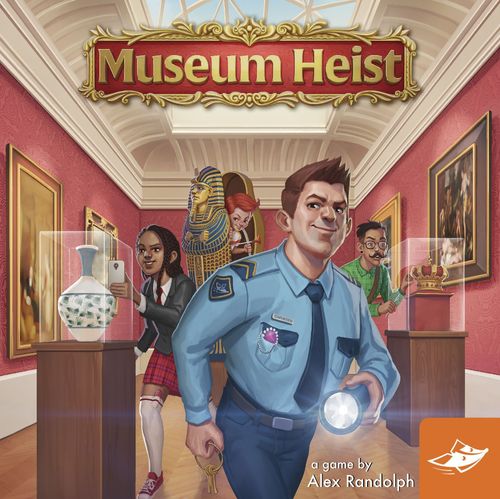
Museum Heist
Museum Heist Rulebook
Table of Contents
Table of Contents
Contents
- 4 sets of 7 Character cards (each set has a different back color for easy sorting)
- 9 Artwork tokens
- 7 Character pieces (The Artist, The Duchess, The Tourist, The School Girl, The Guard, The Granny, The Little Boy) with a sheet of 14 Character stickers
- A Game board
- 8 Swap tokens
Object of the Game
Each round, players will try to outfox their opponents and collect an Artwork token. The player who first collects 3 Artwork tokens is declared the winner. In a 2-player game, the winner is the player who has collected 4 Artwork tokens.
Game Setup
Before the first game, apply the Character stickers on both sides of the corresponding colored Character pieces.
The first round
- Each player receives an identical set of 7 Character cards and 2 Swap tokens;
- Place the board in the center of the table and distribute the 7 Character pieces randomly on any vacant playing spaces on the board;
- Select an Artwork token and place it on a vacant space non-adjacent to any Character pieces on the board. An Artwork token cannot be placed on a Secret Passage space;
- Each player secretly selects one Character card from their deck (to become their character for the round) and places it face down in front of them;
- The youngest player starts. Play continues clockwise.
Subsequent rounds
- The 7 Characters pieces remain in place from the previous round;
- Each player returns their character card used in the previous round back to their deck;
- The player to the right of the winner of the previous round places a new Artwork token on the board as per the above rules;
- Each player secretly selects a Character card (to become their character for the round);
- The winner of the previous round starts.
How to Play Museum Heist
On their turn, players may perform one of these three actions:
Move a Character piece
Direct move: Move any Character piece in any direction, provided that the move brings the piece closer to the Artwork token. Pieces can move into any vacant adjacent space (orthogonal or diagonal) OR jump over an adjacent piece in any direction (orthogonal or diagonal) to a vacant space. Several such jumps may be made in succession even if they are in different directions, provided that the Character piece ends up closer to the coveted Artwork token.
Note: When considering whether a Character piece has moved closer to an Artwork token, the measure is not necessarily the number of moves the piece still needs to make in order to reach the Artwork token, but is measured geometrically. This means that a diagonal distance to the Artwork token is considered greater than an orthogonal distance.
Example: The First player wants to move the Artist (green Character piece). The three possible moves are shown by the yellow arrows. The Character piece could not move to the other vacant spaces (crossed out arrows) as it would lead it further away from the Artwork token.
Example: The Second player moves the Guard (blue Character piece) by making a series of jumps over the Schoolgirl (red Character piece) and the Granny (white Character piece).
Moving through Secret Passages (see example on p. 4)
There are 4 Secret Passages spaces on the board. When landing a Character piece on a Secret Passage, the player may immediately move the piece to any other vacant Secret Passage space. This ends the move. Secret Passages may be integrated as an end move into jump successions, meaning that a jump or a series or jumps may end with a Secret Passage move. If a Character piece begins a round on a Secret Passage, it may use the Secret Passage as a move for their turn; choosing to use a secret passage this way ends the player's move.
Note: Players may choose not to use the Secret Passage when they move a Character piece onto a Secret Passage space.
When a player lands a character on top of an Artwork token, it does not necessarily mean that player has won the Artwork. Read "Collecting the Artwork token" (p. 4) to determine who wins the token.
Example: The Guard (blue Character piece) is moved one space left and lands on a Secret Passage. The player can choose to move to the vacant Secret Passage at the bottom left since it leads the Character piece closer to the Artwork token. The bottom right Secret Passage cannot be used since it is already occupied by the Granny (white Character piece). Moving on the other available Secret Passage is not allowed as the Character piece would end its movement further away from the Artwork token.
Remember: Character pieces must always end their move closer to the Artwork token than they were before the start of the move (diagonal distance is considered greater than orthogonal distance). If a series of jumps or the use of a Secret Passage would result in the Character piece ending up further away from the Artwork token, then that move is not allowed. Likewise, if through a series of jumps and/or a Secret Passage move a Character piece ends up closer to the Artwork token than where it started, the move is allowed even if sections of the movement may have temporarily brought the piece further away from the Artwork token.
Challenge another player
A player may decide to challenge one of the other players by naming the Character card they believe the player has chosen. To resolve a challenge, read "Collecting the Artwork Token".
Swap Characters
A player may play a Swap token. This allows the player to make two Character pieces swap places on the board. Note that Swap tokens are not replenished between rounds, so each player may only perform this action twice during the entire game.
Collecting the Artwork Token
There are two ways of collecting the Artwork token, thereby ending the round:
-
By a player moving the Character piece matching their secret Character card onto the Artwork token (the player then reveals their card): a. If the player is the only one with that Character card, that player wins the Artwork token. b. If one more opponent has chosen an identical Character for their play, that opponent ends up collecting the Artwork token. Example: First player moves the Artist Character piece on the Artwork token and reveals his Artist Character card. The Second player also reveals the Artist Character card. The Second player gets the Artwork token. c. If more than one opponent have chosen the same Character card (3 or more players in total), the player that landed on the Artwork collects it. Example: The First player moves the Artist Character piece on the Artwork token and reveals his Artist Character card. The Second and Third players also reveal the Artist Character card. The First player then gets the Artwork token.
-
By challenging another player: a. When a player challenges an opponent and correctly guesses their identity (the challenged player shows his card to the other players), the round ends and they collect the Artwork token. b. When a player challenges an opponent and incorrectly guesses their identity, they are out of the round (the challenged player shows him his identity card). If only one player is left with their secret identity intact, the round comes to an end and they win the Artwork token.
End of Game
The game ends when a player has collected 3 Artwork tokens (or 4 Artwork tokens, in a 2-player game).