Murus Gallicus
Murus Gallicus Rulebook
Table of Contents
Table of Contents
Components
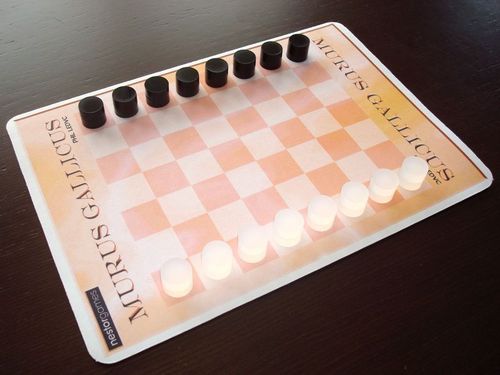
Murus Gallicus includes:
- Two sets of 16 tokens (referred to as stones); one light set (Romans) and one dark set (Gauls)
- One rectangular game board consisting of 8x7 cells.
- Carrying case
Setup
Set up the board between players so that there are seven rows and eight columns. Each player takes a set of stones and stacks two stones on each of their eight home cells – their nearest row.
Basic Units
Two stones of the same color stacked in one cell are referred to as a tower. Towers can block movement and can be disassembled into stones and redistributed. The stacking limit is two and opposing stones may not occupy the same cell.
A single stone occupying a cell is called a wall. Walls do not move. Their main function is to block the opponent's movement. Walls can be built up into towers.
Rules of Play
Starting with the Roman player, the players alternate taking turns.
On a player's turn he or she must perform one of the following actions:
- Move a tower by distributing its two stones from its initial cell into the two nearest cells in any one direction (orthogonal or diagonal). Each destination cell must be empty or contain a friendly wall.
Example of movement
- Sacrifice a tower stone to remove an adjacent (orthogonal or diagonal) enemy wall (remove both stones, yours and your opponent's). By doing so, your tower becomes a wall. Sacrifice is not forced by the presence of an adjacent enemy wall.
Example of sacrifice
A player may not pass a turn.
A player wins by reaching any cell of his or her opponent's home row, or by stalemating his or her opponent. An opponent is stalemated, if at the start of his or her turn, he or she cannot move or sacrifice any towers stones.
Enjoy the game. Many surprises await you.