Murderer's Row
Murderer's Row Rulebook
Table of Contents
Table of Contents
Game Material
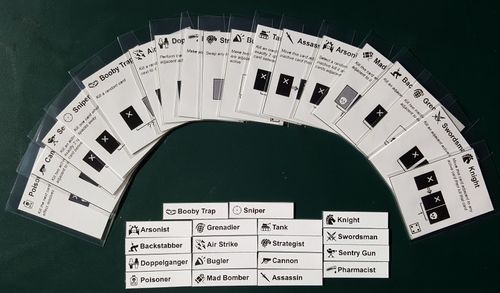
- 18 cards (on 2 sheets)
- these rules
In a Nutshell
Deal ten cards in a row; kill nine of them.
Setup
Shuffle the cards and deal 10 into a single row of face-up cards. Set the other 8 cards to one side. Begin.
Turns
Each turn, select one active card, resolve its effect, then make it inactive by flipping it face down. Notice that this means that a card is active for the purposes of resolving its own effect. Important: most effects have mandatory conditions: if those conditions are not met, the card cannot be activated (e.g. The Swordsman cannot be activated if it is not next to any active cards.)
If, as a result of resolving its effect, there is only one card left alive, you win. Otherwise, resolve another card. If you ever reach a situation in which no card may be legally activated (and you do not have exactly one card left) then you lose. (Thus, an active Assassin and an active Tank; an active Swordsman and an inactive card; and no cards remaining alive are all losing configurations.)
Active/Inactive
A face-up card is active; its effect may be used. A face-down card is inactive; its effect cannot be used.
Alive/Dead
All cards in the row, active or inactive, are alive. When an effect kills a card, remove it from the row. Slide the surrounding cards together to fill the newly empty space. Thus, killing a card changes adjacency and distance (at least for some cards).
Adjacency and Distance
The living cards are in a row. Two cards are adjacent if they are next to each other in the row.
Adjacent is also considered to be a distance of 1. If there is one card between two cards, they are a distance of 2 from each other, etc.
              4 3 2 1  X  1 2 3 4
                 Distances from Card 'X'
Randomness
Some effects will affect a random card. In these cases, choose a direction (right or left) and reveal the top card of the deck. The die face in the bottom right corner will show between 0 and 5 pips. The effect happens to the card that distance away in the chosen direction. If there is no card at that position, nothing happens. A distance of 0 is the active card itself.
Mandatory Effects
Most card effects have mandatory requirements; the card cannot be used if the requirement is not met. (e.g. If there are no cards 4 or more spaces from the Sniper, it cannot be activated.) However, some card effects have collateral damage; in particular the Arsonist and the Mad Bomber kill any (qualifying) cards adjacent to the target in addition to the target itself. If any such cards exist, they must be killed; you cannot volutarily let them live. However, if such cards do not exist, the primay effect still occurs. (Technically, the same applies to the Air Strike; for which you choose a card adjacent to the target. If there is only one card adjacent you do not have a choice. If there are no cards adjacent, you have already won; congratulations.)
Guide to the Icons
Card States
- Any card
- Inactive card
- Active card
Targetting (Top of Card)
- The currently activating card
- The next card to activate
Effects (Bottom of Card)
- Kill the card
- Make the card active
- Use the effect of this card, but center it on current active card
Distance
1Shows distance4+Four or more??Random distance
Notes
While the icons representing card actions show a relative positioning of several cards, distances are not directional. Thus, while the Knight shows its target at a distance of 1 to the right, an active card at a distance of 1 to the left is also a valid target. The one exception of note is that the second card killed by the Sentry Gun or the Tank must be the card in between the active card and its target.