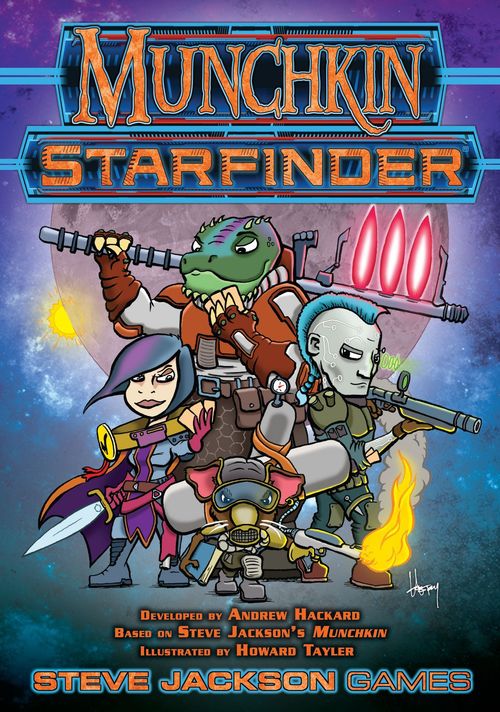
Munchkin Starfinder
Munchkin Starfinder Rulebook
Table of Contents
Table of Contents
- Setup
- Card Management
- Conflicts Between Cards and Rules
- Character Creation
- Starting and Finishing the Game
- Turn Phases
- Super Munchkin and Half-Breed
- Character Stats
- Treasures
- Items
- One-Shots
- Ships
- Other Treasures
- Combat
- Level Counters: It's Not Cheating, It's Using the Rules!
- Asking For Help
- Monsters
- Monster Enhancers
- Interfering With Combat
- Fighting Multiple Monsters
- The Swarm
- Rewards
- Undead Monsters
- Death
- Curses
- Running Away
- Super-Sized Munchkin
- Mixing Munchkin Starfinder With Other Games
- Faster Play Rules
Setup
Divide the cards into the Door deck and the Treasure deck. Shuffle both decks. Deal four cards from each deck to each player.
Card Management
Keep separate face-up discard piles for the two decks. You may not look through the discards unless you play a card that allows you to! When a deck runs out, reshuffle its discards.
In Play: These are the cards on the table in front of you, showing your Race and Class (if any) and the Items you are carrying. Continuing Curses and some other cards also stay on the table after you play them. Cards in play are public information and must be visible to the other players.
Your Hand: Cards in your hand are not in play. They don't help you, but they can't be taken away except by cards that specifically affect "your hand." At the end of your turn, you may have no more than five cards in your hand (see Charity, p. 2).
Cards in play may not be returned to your hand – they must be discarded or traded if you want to get rid of them.
Conflicts Between Cards and Rules
This rulesheet gives the general rules. Many cards add special rules, so in most cases when the rulesheet disagrees with a card, follow the card. However, ignore any card effect that might seem to contradict one of the rules listed below unless the card explicitly says it supersedes that rule!
- Nothing can reduce a player below Level 1, although card effects might reduce a player's or a monster's combat strength (p. 3) below 1.
- You go up a level after combat only if you kill a monster.
- You cannot collect rewards for defeating a monster (e.g., Treasure, levels) in the middle of a combat. You must finish the fight before gaining any rewards.
- You must kill a monster to reach Level 10.
Any other disputes should be settled by loud arguments, with the owner of the game having the last word. You could also read the Munchkin FAQ and errata pages at munchkin.game, or start a discussion at forums.sjgames.com/munchkin . . . unless it's more fun to argue.
Character Creation
Everyone starts as a Level 1 human with no class. Munchkin characters may be either male or female. Your character's sex is the same as your own at the start of the game, unless you declare otherwise.
Look at your initial eight cards. If you have any Race or Class cards, you may (if you like) play one of each type by placing it in front of you. If you have any usable Items (p. 3), you may play them by placing them in front of you. If you have any doubt about whether you should play a card, you could read below, or you could just charge ahead and do it.
Starting and Finishing the Game
The player who goes first is the one who most recently rolled a 20-sided die.
Play proceeds in turns, each with several phases (see below). When the first player finishes his turn, the player to his left takes a turn, and so on.
The first player to reach Level 10 wins . . . but you must reach Level 10 by killing a monster, unless a card specifically allows you to win another way.
Turn Phases
Your turn begins as soon as the previous player's turn ends. When your cards are arranged the way you want, go to phase 1.
(1) Kick Open The Door: Draw one card from the Door deck and turn it face up. If it's a monster, you must fight it. See Combat, p. 3. If the card is a Curse – see Curses, p. 5 – it applies to you immediately (if it can) and is then discarded (unless it has a persistent effect or you keep the card as a reminder of an upcoming effect).
If you draw any other card, you may either put it in your hand or play it immediately, if it is otherwise legal to do so.
(2) Look For Trouble/Loot The Room: If you fought a monster in phase 1, skip this phase and go to phase 3. If you did NOT draw a monster when you first opened the door, you have two choices: either Look For Trouble or Loot The Room.
Look For Trouble: Play a monster from your hand and fight it, just as though you had found it when you kicked open the door. Don't play a monster you can't handle, unless you're sure you can count on getting help (see p. 4)!
Loot The Room: Draw a second card from the Door deck, face down, and place it in your hand.
Class: Characters may be Envoys, Mechanics, Mystics, Operatives, Solarians, Soldiers, or Technomancers. If you have no Class card in front of you, you have no class. Each Class has special abilities, shown on the cards. You gain the abilities of a Class the moment you play its card in front of you, and lose them as soon as you discard that card. See the Class cards for when abilities can be used. Some Class abilities are powered by discards. You may discard any card, in play or in your hand, to power a special ability.
You can discard a Class card at any time, even in combat: "I don't wanna be a Mystic anymore." When you discard a Class card, you become classless until you play another Class card.
You may not belong to more than one class at once unless you play the Super Munchkin card.
You may perform these actions on your own turn:
- Play a new Class or Race card (at any time).
- Sell Items for levels (except when you are in combat).
- Play an Item (most Items cannot be played during combat, but some One-Shot Items can; see p. 3).
Race: Characters may be Androids, Kasatha, Lashunta, Shirrens, Vesks, or Ysoki. If you have no Race card in front of you, you are human with no special abilities.
The rules for Classes, above, also apply to Races. You may not belong to more than one race at once unless you play the Half-Breed card.
When You May Take Actions: You may perform these actions at any time:
- Discard a Class or Race.
- Play a Go Up a Level.
- Play a Curse.
You may perform these actions at any time, as long as you are not in combat:
- Trade an Item with another player (the other player may not be in combat, either).
- Change which Items you have equipped.
- Play a card that you have just received (some cards may be played even during combat; see above).
(3) Charity: If you have more than five cards in your hand, you must play enough cards to get you to five or below. If you cannot, or do not want to, you must give the excess cards to the player with the lowest Level. If other players are tied for lowest, divide the cards as evenly as possible, but it's up to you who gets the bigger set(s) of leftovers. If YOU are the lowest or tied for lowest, just discard the excess.
As soon as you are finished with Charity, the next player's turn begins.
Super Munchkin and Half-Breed
These cards may be played whenever it is legal to play a Class or Race, as long as you have an appropriate card (Class for Super Munchkin, Race for Half-Breed) to attach it to. You cannot have more than one of the same Class or Race card in play at once.
If you play Super Munchkin with a single Class, you get all the advantages of being that Class (the ability to equip Class-only Items, and monsters with penalties against that Class suffer those penalties) but none of the disadvantages (you may equip Items forbidden to that Class, and monsters do not get bonuses because of your Class). If the Class has an ability that has a cost, however, you must still pay it – you aren't that Super!
If you play Super Munchkin while you have two Classes, you have all the normal advantages and disadvantages of both Classes.
All of the above is also true for Half-Breed, just for Races.
Character Stats
Each character is basically a collection of weapons, armor, and magic items, with three stats: Level, Race, and Class. For instance, you might describe your character as "a Level 8 Android Technomancer with Falcon Boots, a Zero Pistol, and the Skyfire Sword."
Level: This is a measure of how generally buff and studly you are. When the rules or cards refer to your Level, capitalized, they mean this number.
You gain a level when you kill a monster, or when a card says that you do. You can also sell Items to buy levels (see Items, p. 3).
You lose a level when a card says you do. Your Level can never go below 1. However, your combat strength can be negative, if you get hit by a Curse or suffer some other kind of penalty.
Treasures
Treasure cards include permanent and One-Shot cards. Any Treasure card may be played to the table as soon as you get it, or at any time on your own turn except during combat (unless the rules below or the card itself says otherwise).
Items
Most Treasures are Items. Items have a Gold Piece value. ("No Value" is equivalent to zero Gold Pieces, and a "No Value" card is considered an Item.)
All Items you have in play are considered "carried." Items that are actually giving you a bonus are "equipped." You should indicate Items that are not equipped by turning the cards sideways. You may not alter the status of your Items during a combat or while running away.
Anyone can carry any Item (except for extra Big items; see below), but you may equip only one Headgear, one suit of Armor, one pair of Footgear, and two "1 Hand" Items (or one "2 Hands" Item) . . . unless you have a card that lets you ignore these limits, such as Cheat!, or unless one of the cards says otherwise. If you are carrying two Headgear cards, for instance, you can equip only one of them at a time.
Likewise, some Items have restrictions: for instance, the Electrovore Glove can only be wielded by a Solarian. Its bonus only counts for someone who is, at the moment, a Solarian.
You cannot discard Item cards "just because." You may sell Items for a level, trade Items with other players, or give an Item to another player who wants it (see below). You may discard Items to power certain Class and Race abilities. And a Curse or a monster's Bad Stuff (see p. 5) may force you to get rid of something!
Trading: You may trade Items (but no other cards) with other players. You may only trade Items from the table – not from your hand. You may trade at any time except when you or your trading partner are in combat – in fact, the best time to trade is when it's not your turn. Any Item you receive in a trade must remain in play.
You may also give Items away without a trade, to bribe other players – "I'll give you my Junklaser if you won't help Bob fight that Swarm monster!"
You may show your hand to others. Like we could stop you.
Selling Items for Levels: At any point during your turn except during combat or Running Away, you may discard Items worth a total of at least 1,000 Gold Pieces and immediately go up one level. ("No Value" cards are the same as zero Gold Pieces.) If you discard (for instance) 1,100 Gold Pieces worth, you don't get change. But if you can manage 2,000 worth, you can go up two levels at once, and so on. You may sell Items from your hand as well as those you are carrying.
You may not sell Items to go to Level 10.
One-Shots
A Treasure card that says "One-Shot" may be used once and then discarded. One-Shots may be played from your hand or from the table. Many of these are used during combat to strengthen the munchkins or the monsters, but some have other effects, so read the card carefully! Discard these cards as soon as the combat is over or their effect is resolved.
One-Shots with a Gold Piece value may be sold for levels, just like other Items.
Ships
Ships are a special kind of Treasure card. You may only have one Ship at a time unless you have a card that says otherwise. You may not play Ships sideways, unequipped.
If a Ship has a Run Away modifier, this replaces any modifiers you have from other sources. If a Ship gives you a Run Away penalty, you may discard the Ship before rolling. Otherwise, treat a Ship like any other Item.
Other Treasures
Other Treasure cards (like Go Up a Level cards) are not Items. Most of these cards say when they can be played, and whether they stay in play or are discarded. One specific example:
Go Up a Level cards may be played on yourself or any other player at any time, even during combat. Discard them once they are played. Exception: You cannot play a Go Up a Level card to give a player the winning level!
Combat
To fight a monster, compare its combat strength to yours. Combat strength is the total of Level plus all modifiers – positive or negative – given by Items and other cards. If the monster's combat strength is equal to yours, or greater, you lose the combat and must Run Away (see p. 5). If your combat strength totals more than the monster's – note that monsters win ties! – you kill it and go up a level (two levels for some big monsters). You'll also get the number of Treasures shown on its card.
Sometimes a card will let you get rid of the monster without killing it. This is still "winning," but you don't get a level. Unless the card says otherwise, you don't get the Treasures, either.
Some monster cards have special powers that affect combat – a bonus against a particular Race or Class, for instance. Be sure to check these!
You and the other players may play one-shot Treasures or use Class or Race abilities to help or harm you in your combat. Some Door cards may also be played into a combat, such as monster enhancers (see below).
Remember: while you are in combat, you cannot sell, equip, unequip, or trade Items, or play Treasures from your hand, unless these rules or the card says otherwise.
Level Counters: It's Not Cheating, It's Using the Rules!
If you have an iOS or Android device, you'll like our Level Counter app. Just search for "Munchkin level counter" or click the link at levelcounter.sjgames.com. Even better, it gives you personal in-game advantages to make your friends jealous . . . which is what being a munchkin is all about!
Asking For Help
If you kill a monster (or monsters!), discard the monster(s) and any other cards played, and claim your rewards. But note: someone may play a hostile card on you, or use a special power, just as you think you have won. When you kill a monster, you must wait a reasonable time for anyone else to speak up. After that, you have really killed the monster, and you really get the level(s) and Treasures, though they can still whine and argue.
If you cannot win a combat on your own, you may ask any other player to help you. If he refuses, you may ask another player, and so on, until they all turn you down or someone helps. Only one player can help you, adding his combat strength to yours. Anyone can play cards to affect your combat, however!
You'll probably have to bribe someone to help. You may offer your helper any Item(s) you are currently carrying, or any number of the Treasure cards the monster has. If you offer him part of the monster's Treasure, you must agree whether he picks first, or you pick first, or whatever. You may also offer to play any cards from your hand that you legally could, such as Go Up a Level cards, on your helper.
The special abilities or vulnerabilities of the monster also apply to your helper, and vice versa. For instance, if an Android helps you, you will (collectively) get +1 per monster when fighting multiple monsters. But if you are facing the Akata and an Envoy helps you, the monster's combat strength is increased by 4 (unless you, too, are an Envoy and the monster's combat strength has already been increased). Monster modifiers from different sources (a Race and a Class, for example) do stack!
If someone successfully helps you kill the monster, discard it, draw Treasures (see Rewards, below), and follow any special instructions on the monster card. You level up for each slain monster. Your helper does not go up any levels. You draw the Treasure cards, even if it was your helper's special ability that defeated the monster, and distribute them according to the agreement you reached.
Monsters
If drawn face-up, during the Kick Open The Door phase, monsters immediately attack the person who drew them. If you get a monster card any other way, it goes into your hand and may be played during your own turn to Look For Trouble, or played with the Wandering Monster card to join another player's fight. (See Fighting Multiple Monsters, below.)
Each monster card is a single monster, even if the name on the card is plural.
Monster Enhancers
Certain cards, called monster enhancers, raise or lower the combat strength of individual monsters. (Penalties to monsters are still considered enhancers.) They also affect the number of Treasures the monsters are worth. Monster enhancers may be played by any player during any combat.
All enhancers on a single monster add together. If there are multiple monsters in a combat, the person who plays each Enhancer must choose which monster it applies to.
Interfering With Combat
You can interfere with others' combats in several ways, including:
- Use a One-Shot. You could help another player by using a One-Shot to strengthen his side. Of course, you can "accidentally" strengthen the monster with it, instead . . .
- Play a monster enhancer. These cards (usually) make a monster stronger . . . and give it more Treasure. You can play these either during your own combats or during someone else's combat.
- Add a monster from your hand to join the combat, either with a Wandering Monster card or by using the special Swarm or Undead rules.
- Curse them, if you have a Curse card.
Fighting Multiple Monsters
Some cards (notably Wandering Monster) allow your rivals to send other monsters to join the fight. You must defeat their combined combat strengths. Any special abilities, such as forcing you to fight with your Level only, apply to the entire fight. If you have the right cards, you can eliminate one monster from the combat and fight the other(s) normally, but you cannot choose to fight one and Run Away from the other(s). If you eliminate one monster, but then run from the other(s), you don't get any levels or Treasure!
The Swarm
The Swarm is the "big bad" of the Starfinder Roleplaying Game, so of course we represented it here. You may play any monster that is tagged as Swarm to help any other Swarm monster, without using a Wandering Monster card. If you have a card that can be used to make a monster a Swarm monster, you may play it with a non-Swarm monster to use this rule.
Rewards
When you kill a monster, you get one level per monster, unless the Monster card says something else . . . and you get its Treasure! Each monster has a Treasure number on the bottom of its card. Draw that many Treasures, modified by any Monster Enhancers played on it. Draw face-down if you killed the monster alone. Draw face-up, so the whole party can see what you got, if someone helped you.
If you defeat a monster by nonlethal means, you do not get a level and you may or may not get the Treasure, depending on the method.
Treasure cards can be played as soon as you get them, even if you are the helper.
Undead Monsters
Several monsters in this set are tagged Undead. You may play any Undead monster from your hand into combat to help any other Undead, without using a Wandering Monster card. If you have a card that can be used to make a monster Undead, you may play it with a non-Undead monster to use this rule.
One monster, Interstellar Infection Vector, is both Swarm and Undead. Yes, it gets to use both rules!
Death
If you die, you lose all your stuff. You keep your Class(es), Race(s), and Level (and any Curses that were affecting you when you died) – your new character will look just like your old one. If you have Half-Breed or Super Munchkin, keep those as well.
Once you have died, you don't have to Run Away from any remaining monsters.
Looting The Body: Lay out your hand beside the cards you had in play (making sure not to include the cards mentioned above). If you have an Item attached to a Cheat! card, separate those cards. Starting with the player with the highest Level, everyone else chooses one card . . . in case of ties in Level, roll a die. Once everyone gets one card, discard the rest. If your corpse runs out of cards, tough. Looted cards go into players' hands.
Dead characters cannot receive cards for any reason, not even Charity, and cannot level up or win the game.
When the next player begins his turn, your new character appears and can help others in combat with his Level and Class or Race abilities . . . but you have no cards, unless you receive Charity or gifts from other players.
On your next turn, start by drawing four face-down cards from each deck and playing any legal cards you want to, just as when you started the game. Then take your turn normally.
Example of Combat, With Numbers and Everything: Fionna is a Level 4 Mystic with the Sandals of Spacewalking (which gives her a +3 to her combat strength). She kicks open the door and finds the Anhamut, a Level 10 monster that has -3 against Mystics. Fionna is at a combat strength of 7 (4 for her Level and 3 for her Sandals), but so is the Anhamut . . . and monsters win ties.
Fionna: Oh, drat! I didn't want to use this yet. She plays the Shock Grenade, giving her +4 for this fight. Now her combat strength is 11, beating the Anhamut's 7.
Max: Too bad he's a vac-breather . . .
Max plays Vacuum-Breather, adding 10 to the Anhamut's combat strength. Now Fionna is losing, 17 to 11.
Fionna: That sucks! Get it, because it's a vacuum . . .
Max: Very cute. Want some help? (Max is a Level 6 character with +4 in Items, making his combat strength 10.)
Fionna: Do I have a choice? Sure, but you only get one Treasure since you created this mess.
Max: First pick, though!
Fionna: Yeah, fine. Anyone else want to step in? No one says anything, so Fionna goes up a level and claims the Anhamut's treasures – three from the Anhamut card, and two extra because it was Vacuum-Breathing. The Treasures are drawn face-up and Max takes the one he wants, giving the rest to Fionna. And the game goes on . . .
Curses
If drawn face-up during the Kick Open The Door phase, Curse cards apply to the person who drew them. If acquired some other way, such as by Looting The Room, Curse cards go into your hand and may be played on any player at any time. ANY time, do you hear me? Reducing someone's abilities just as he thinks he has killed a monster is a lot of fun.
Usually, a Curse affects its victim immediately (if it can) and is then discarded. However, some Curses give a penalty later in the game or have a continuing effect. Keep these cards until you get rid of the Curse or the penalty takes effect. (Curse cards you keep as a reminder may not be discarded to power Class or Race abilities. Nice try!)
Note: If someone plays a "your next combat" Curse on you while you are in combat, it counts in that combat! The same is true for a "your next turn" Curse played during your turn.
If a Curse can apply to more than one Item, the victim decides which Item is lost or Cursed.
If a Curse applies to something you don't have, ignore it. For instance, if you draw Lose Your Armor and you have no Armor, nothing happens; discard the card. (Some Curses have alternate effects, though, so read the card!)
There will be times when it will help you to play a Curse or Monster on yourself, or to "help" another player in a way that costs him Treasure. This is very munchkinly. Do it.
Running Away
If nobody will help you . . . or if somebody tries to help, and your fellow party members interfere so the two of you still cannot win . . . you must Run Away. You don't get any levels or Treasure. You don't even get to Loot the Room. And you don't always escape unharmed . . .
Roll the die. You escape on a 5 or more. Some Class and Race abilities and some Treasures might make it easier or harder to Run Away from all monsters. And some monsters give you a bonus or penalty to your roll for that monster only.
If you fail to Run Away from a monster, it does Bad Stuff to you, as described on its card. This may vary from losing an Item, to losing one or more levels, to Death (see below).
If you are fleeing from multiple monsters, you roll separately to escape each one, in any order you choose, and suffer Bad Stuff from each one that catches you as soon as it catches you.
If two players are cooperating and still can't defeat the monster(s), they must both Run Away. They roll separately, and each player chooses in what order to Run Away. The monster(s) CAN catch them both.
Once you have resolved all Run Away rolls, discard the monster(s).
Super-Sized Munchkin
Studies have shown that 8.4 out of 9.7 Munchkin players just can't get enough of the game. Here are some ideas to take your Munchkin games to new heights – or lows:
Combining different Munchkin sets. You can mix two (or more) base sets and expansions together for a genre-crossing mega-Munchkin adventure! Space plus Old West? Time-traveling Pathfinder/Starfinder adventure? No problem!
Expansions. These add still more monsters to kill, new Treasure to loot, and sometimes entirely new kinds of cards. Ask for all the Munchkin sets and expansions at your local game or comic store – find it using our Store Finder, gamerfinder.sjgames.com – but if you don't have a local store, we'll be happy to sell them directly to you at warehouse23.com.
Turn it up to EPIC! Playing to Level 10 just isn't enough for some people. To satisfy their insane cravings, we've created Epic Munchkin, a new set of rules that gives all your Munchkin sets that high-octane boost you need to make it up to Level 20! Look for it at munchkin.game/epic – it's completely, absolutely FREE!
All of the above!!!
[Publisher contact and social-media lines from the rulesheet (website, forum, Twitter, Facebook and Instagram handles, and the set's URL) are omitted here as non-rules text. Where a rule refers to the set's own location, the printed URL munchkin.game/starfinder is retained below.]
The URL for this set is munchkin.game/starfinder.
Mixing Munchkin Starfinder With Other Games
You should be aware of a few wrinkles when mixing Munchkin Starfinder with other sets.
Ships are Big. Other Munchkin games include Big items, which are not included in Starfinder for simplicity. If you're mixing sets, treat all Ships as Big items whether or not they're marked as such.
Races are not Factions, Mojos, etc. Some other Munchkin games include character traits different from the Class and Race you have in Munchkin Starfinder. For instance, Munchkin Pathfinder has Factions instead of Races. Your character may have any or all of these traits. For example, in a Starfinder/Pathfinder mashup game, you can have a Class, a Race, and a Faction.
Overlapping Classes. Three Classes in Munchkin Starfinder share names with existing Classes in other Munchkin sets: the Mystic (Super Munchkin), the Soldier (Munchkin Oz), and the Mechanic (Munchkin Steampunk). Some of them work differently from their non-Starfinder versions, but any card that refers to that Class name means either version of that Class, and you may not have multiple Classes or Races with the same name (for instance, a Starfinder Mechanic/Super Munchkin Mechanic combo) . . . unless your group thinks it would be cool!
Faster Play Rules
For a faster game, you can add a "phase 0" called Listen At The Door. At the start of your turn before doing anything else, draw a face-down Door card, which you may play or not. Then arrange cards and Kick Open The Door normally. If you Loot The Room, draw a face-down Treasure, not a Door.
You can also allow shared victories – if a player reaches Level 10 in a fight where he had a helper, the helper also wins the game, no matter what Level he is.