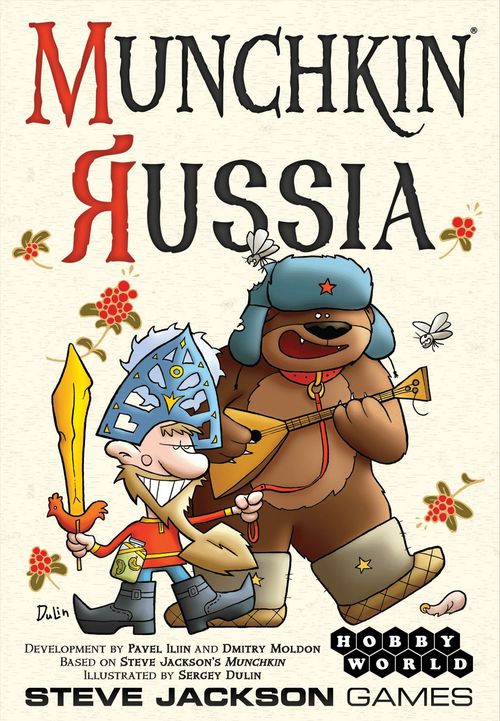
Munchkin Russia
Munchkin Russia Rulebook
Table of Contents
Table of Contents
- Setup
- Cards
- Conflicts Between the Rules and Cards
- Creating Your Character
- Start and End of the Game
- When Things Can Be Done
- Turn Phases
- Combat: Basic Rules
- Character Attributes
- Super Munchkin
- Treasures
- Combat
- Monsters
- Monster Enhancers
- Combat with Several Monsters
- Undead
- Dragons
- Calling for Help
- Interference in Combat
- Reward
- Running Away!
- Death
- Example of Combat with All the Calculations
- Hirelings
- Seasons of the Year
- Unlimited Munchkin
- Quick Game
- Curses
Setup
Three to six Munchkins fight. Besides the cards and the die, each of them needs 10 tokens (coins, chips) or anything else that counts to ten, for example a special set of level counters for Munchkin, to track the level of their character.
Separate the cards into the door deck (back: a door) and the treasure deck (back: a pile of loot), shuffle them, and deal each player four cards from each deck. Place the decks in the middle of the table.
If You Are a Seasoned Munchkin
You are no longer a novice in the Munchkin world and already know all the rules by heart? Then let's move on to the most important thing, the thing that sets this Munchkin apart from all the others.
Munchkin Russia introduces a new type of card: seasons of the year. They are in the door deck, and they carry a matching mark in the bottom right corner.
At the start of the game the season is "in-between" (not winter, not spring, not summer and not autumn; yes, that happens in Russia). But this will not last. As soon as you kick open a door and a season card comes up, immediately place it in the centre of the table, and it starts to work at once.
If a season card comes to you face down, you may either place it in the centre of the table right away, or keep it in your hand. In the second case you can play that season card from your hand at any time (even in combat).
There can be only one season card in play at a time. As soon as another one is played, the previous one is discarded. Summer may be followed by spring, and after a cold winter... an even colder winter may come. Get used to it, this is not a place for the faint-hearted.
Seasons affect the strength of some monsters and the bonuses of some gear, and they slightly change the rules of the game. Most importantly: forget about the calendar. It does not matter what month it actually is; Munchkins have their own way of counting time. Whenever a card text says "+X in winter / spring / summer / autumn", it refers to the season card lying in the centre of the table, not to the weather outside your window.
[Season card examples printed on page 2 of the rulebook:]
- Winter — Blizzard. All Munchkins get +2 to run away. Bad Stuff from all monsters is replaced with death. (Flavour line on the card: "In weather like this a bear cannot catch you. If you know where to run...")
- Summer — Holiday Time. When a combat is in progress, no new monsters may be added to it. (Flavour line on the card: "Don't you want to rest at the seaside instead of with crowds of monsters? Then get going, back to work!")
The printed card-text captions for the other example cards on page 2 are not legible in the source file and are not transcribed.
Cards
Cards are discarded face up; the door deck has its own discard pile, and the treasure deck has its own. You may look through a discard pile only if a card you played allows you to do so. In all other cases you see only the top card of each pile. When a deck runs out, shuffle the corresponding discard pile and place it where the deck was. If both the deck and the discard pile are empty, nobody can draw cards of that type.
Cards in play: these are the cards in front of you: your class and your gear. Also placed here are curses with lasting effects that have been played against you, and some other cards. Cards in play are public information; they must be visible to all players.
Hand: cards you hold in your hand are not in play. They do not help you, but they can be lost only because of special cards that directly affect the hand. At the end of your turn you may hold no more than five cards in your hand (see "Charity" on page 5). Cards in play cannot be taken back into your hand. If you want to get rid of them, sell them, trade them, or discard them by means of other cards.
Conflicts Between the Rules and Cards
These pages set out the basic rules. The text of some cards contradicts the basic rules, and in such a case the card usually takes precedence over the rules. However, feel free to ignore any instruction on a card if it contradicts one of the rules listed below (unless the card states, separately and unambiguously, that it overrides these rules!).
- Nothing can reduce a Munchkin's level below 1, although his combat strength (see page 8) may be zero or even negative.
- You gain a level after combat only if you killed the monster.
- You cannot receive a reward for defeating a monster (treasures, levels) in the middle of a combat. Win the combat before reaching for the reward.
- You can reach level 10 only by killing a monster, and you cannot force another player to help you in such a fight.
Disputed situations are resolved by loud argument, and the last word belongs to the owner of the game. If you wish, you may ask a question by e-mail or through the Hobby World website chat. Or ask in the Munchkin community group. But that is for when the arguing has become too tiresome.
Creating Your Character
At the start of the game your Munchkin is a 1st-level citizen with no class. Look at the eight cards you were dealt. If you wish, you may play from your hand onto the table in front of you one class card and as many gear cards as you like (if they do not require something special from you; see page 7). Unsure whether to play a card you were dealt? Look through the rules for an answer, or throw caution to the wind and play it.
Start and End of the Game
The player who most recently lay on the stove goes first. Or went to the ballet. Or settle the question in some other way, for example with alternating die rolls.
Each turn consists of several phases. When you have finished your actions in the last phase, pass the turn to the player on your left.
The winner is the first player to bring his Munchkin to level 10... but that level must be gained by killing a monster (or by means of a card that clearly and unambiguously allows victory another way).
When Things Can Be Done
At any time in the game you may:
- discard a class;
- play a season card;
- play a "Get a Level" card;
- play a curse.
At any time in the game when you are not in combat, you may:
- trade gear with another player (who must also not be in combat);
- "remove" some gear and "equip" other gear;
- play a card you have just received (some cards may be played in combat too, see above).
Only on your own turn may you:
- play a new class (at any moment of the turn);
- sell gear for levels (at any moment of the turn except during combat);
- play a gear card (most gear cannot be played in combat, but some one-shot items can, see page 8).
Turn Phases
Your turn begins as soon as the previous player's turn ends. At the start of your turn you may play cards, "remove" and "equip" gear, trade gear with other players, and sell gear for levels. When you have done everything you want with your cards, move on to Phase 1.
-
Kick Open the Door! Turn over the top door card of the deck. If it is a monster, you must fight it (see "Combat", page 8). If you turned over a curse card (see page 14), it takes effect on your Munchkin at once (if it can) and is discarded (or stays in front of you if it has a lasting effect). If any other card comes up, you may play it at once if this does not contradict other rules, or take it into your hand.
-
Look for Trouble / Clean Out the Stash: if in Phase 1 you met a monster, skip this phase and go to Phase 3. If, after kicking open the door, you did NOT meet a monster, you have two options: look for trouble, or clean out the stash.
- Look for trouble: play a monster from your hand and fight it by the usual rules, as if you had found it behind the door. Do not unleash an enemy you cannot handle unless you are sure you will get help (see page 10).
- Clean out the stash: take the second door card from the deck into your hand, without showing it to the other players.
- Charity: if you have more than five cards in your hand, either play the extra cards or give the surplus to the Munchkin with the lowest level. If several players dispute the status of the weakest Munchkin, divide the cards between them as evenly as possible. If the number cannot be split evenly, you choose who gets more cards. If your Munchkin is the lowest-level one (or one of them), simply discard the extra cards. If there are Oligarchs in the game (a class, see page 6), charity cards always go to them, and not to the lowest-level Munchkins.
As soon as your charity is exhausted, the turn of the next player begins.
Combat: Basic Rules
When you fight a monster, compare your combat strength (your level plus bonuses and penalties) with its strength. If your combat strength is higher than the monster's, you win. If it is lower or equal, the monster wins. Detailed combat rules are on page 8.
Character Attributes
A Munchkin is a walking collection of weapons, armour and gadgets. Besides gear, he has two characteristics: level and class. For example, a Munchkin can be described as: an 8th-level sportsman in footcloths, a padded jacket, and with a balalaika.
Level: a measure of the character's combat readiness and general coolness. A Munchkin goes up in level for killing monsters, using special cards, and selling gear (see "Gear"). Monsters' Bad Stuff, curses and some other cards can reduce the level. A Munchkin cannot drop below level 1, but his combat strength may be even below zero if he is affected by curses or other cards that reduce strength.
Class: your Munchkin may be a Cossack, an Oligarch, a Sportsman, or a Hacker. The properties of a class are printed on its card. A Munchkin gains them as soon as you play a class card, and loses them when that card is discarded. Class cards will tell you when to use their properties. Some properties require you to discard cards. If no source is specified, those cards may be discarded from the hand or from play.
You may discard a class at any moment of the game, even in combat: "I don't want to be a Hacker." You may play a new class card as soon as you receive it, or at any moment of your turn. A Munchkin may not belong to several classes at once without the Super Munchkin card, and even with it he may not belong to the same class twice.
Example class card: Cossack. "Not on duty, but as a friend: when you help in combat, you get an extra +3 bonus. Look for the wind in the field: at any moment of a combat in which you are helping, you may discard 3 cards from your hand to leave that combat."
Super Munchkin
This card may be played in the same situations in which a class is permitted, but you cannot play it if you belong to no class at all. You must belong to at least one class.
You may have two classes with all the advantages and disadvantages of both. Or you may rid your single class of all its disadvantages (so, for example, monsters with hatred of Hackers do not get a combat bonus against you if you are a Super Munchkin and a "pure" Hacker).
If you have played Super Munchkin with only one class, you gain all the advantages of that class (you may "equip" gear usable only by that class, and monsters with penalties against the class receive those penalties) and you get none of its disadvantages (you may "equip" gear forbidden to that class, and monsters do not get bonuses against your class). However, if a class property requires any payment, you must pay in full. You are not that super!
If you played Super Munchkin while having two classes, you get all the advantages and all the disadvantages of both classes.
Discard this card if you lose all your classes.
Treasures
Treasures are either permanent or one-shot. If you are not in combat, you may play any treasure card when you receive it or at any moment of your turn (unless the rules below or the card itself say otherwise).
Gear
Most treasures are gear. A card counts as gear if it has a price in roubles (if it says "No price", it is worth nothing, but it is still gear).
When you have played a gear card, it is considered that you are "carrying" it. But only "equipped" gear gives you its bonus. Turn the cards of unequipped gear sideways, so that everyone can see what you are wearing and what you are not. During combat and during running away you may not "equip" or "remove" gear.
You may carry any gear in any number, but you may "equip" no more than one headgear, one body armour, one pair of footwear, and one two-handed (or two one-handed) weapon, unless some card removes that limit (for example, "Cheat!" may do so). So you may have two headgear in play, but only one of them can be equipped. In addition, you may equip any number of gear items that do not have a specific type (headgear, footwear, and so on).
Some gear has restrictions: for example, the Crimson Jacket is useless to everyone except Oligarchs. If you are not an Oligarch, you get no bonus from the jacket (unless you use "Cheat!"). You may not simply discard a piece of gear just because you feel like it. Gear can be sold for levels, exchanged for another player's gear, or given to another Munchkin if he needs it more (see below). You may discard gear to activate certain properties of your classes. Also, a curse or a monster's Bad Stuff may take your gear away.
Large gear: you may have any number of small gear items in play, but only one large one. (Small gear is any gear card without the words "Large" in the bottom left corner.) You may not simply discard one large item in order to play another. The first large item must be sold, exchanged, lost to a curse, or lost to Bad Stuff.
If something (for example, "Cheat!") allowed you to keep more than one large item in play, and you lose that ability, you must either fix the situation at once or get rid of all large items except one. If this happens on your turn and outside combat, you may sell the extra items (their total value must be at least 1,000 roubles). Otherwise you must give them to the lowest-level opponents whose limit of large items has not yet been reached. If extra large items still remain after that, discard them.
Trading: you may exchange gear (but not other cards!) with opponents. Only gear in play may be traded; gear in hand may not be exchanged. You may trade at any moment when you and the other player are both not in combat. It is best to trade on someone else's turn. All gear received in an exchange stays in play, and you may not sell it unless it is your turn.
You may also bribe opponents with gear: "Here is my lollipop sword, just don't help Mashenka fight Vii!"
You may "show" your hand cards to opponents; we cannot forbid you that.
Selling gear: at any moment of your turn, except during combat or running away, you may discard gear with a total value of at least 1,000 roubles to gain one level at once (gear marked "No price" is worth 0 roubles). If you discard gear worth, say, 1,100 roubles, no change is given. But if you discard gear worth 2,000 roubles at once, you gain two levels. Gear may be sold either from play or from the hand. You cannot buy level 10 with gear.
One-Shot Treasures
Some treasure cards are marked "one-shot". Most of them are used in combat, to strengthen either the Munchkins or the monsters. Some have other effects, so read carefully what is printed on the card. If a one-shot card is a piece of gear, it may be used either from the hand or from play. Immediately after use, one-shot cards stop being yours and cannot be the target of curses, even if their effect has not yet been resolved. Used one-shot cards are discarded at the end of the combat (whatever its outcome) or immediately after their effect is resolved. If one-shot gear has a price, it can be sold for levels just like ordinary gear.
Other Treasures
Other treasures (such as "Get a Level") are not gear. On most of them it is stated directly when they can be used. The card also usually says whether it stays in play or must be discarded. A special case:
- The "Get a Level" card may be played on yourself or on another Munchkin at any moment, even in combat. Discard the card after use. Exception: you may not play "Get a Level" to reach level 10, the winning level.
Combat
When you fight a monster, compare its strength with yours. Your combat strength equals your level plus all modifiers (both positive and negative) from gear and other cards. If the monster's combat strength is equal to yours or higher, you lose the combat and must run away (see page 12). If your combat strength is higher than the monster's (note that monsters win ties), you may kill it and gain a level (or two, for defeating especially mighty opponents) and as many treasures as the monster card indicates.
Sometimes a card allows you to get rid of a monster without killing it. This also counts as a win, but you do not gain a level. Unless stated otherwise, you do not gain treasures either. If no monsters remain in the combat, the combat ends immediately.
Monsters have special properties that affect the balance of forces, for example bonuses against a certain class, and bonuses and penalties in certain seasons. Do not forget to take them into account. Each bonus (or penalty) against a given class is counted only once, even if two Munchkins matching that condition take part in the combat.
During combat, you and the other players may use one-shot treasures, play curses, and use class properties to help or hinder you. Some door cards, such as monster enhancers (see below), may also be used in combat.
Watch your opponents: they may use cards or special properties to change the outcome of the battle. When you are about to defeat a monster, give your opponents a chance to step in: wait a reasonable amount of time. If nobody has taken advantage of your patience, you now definitely kill the monster, go up a level, take the treasures, and enjoy the gnashing of teeth from the envious. In any case, when the combat ends, discard the monster(s), as well as all monster enhancers and one-shot gear played during the combat.
Monsters
A monster drawn face up in the Kick Open the Door phase attacks the Munchkin who disturbed it at once. A monster obtained in any other way goes into the hand. It may be played in the Look for Trouble phase of your turn, or added to a combat against an opponent together with the card "Wandering Monster" (see "Combat with Several Monsters" on the next page).
Each monster card counts as one enemy, even if its name is in the plural.
Monster Enhancers
Despite their name, these cards may not only increase but also decrease a monster's combat strength. They also change the number of treasures you receive for defeating the monster. Any player may play any number of monster enhancers in any combat.
Enhancers played on a single monster are added together. If there is more than one monster in the combat, the owner of the enhancer must state which monster the card is played on.
Combat with Several Monsters
Some cards (above all the infamous "Wandering Monster") allow opponents to send new monsters against you in combat. To win such a combat, you must exceed the total combat strength of all the enemies. Any special conditions (for example, a requirement to defeat the monster only with your level) apply to the combat as a whole. Some cards allow you to drive one monster out of the combat and fight the remaining ones, but you cannot fight one monster and run away from the others. Even if you get rid of one enemy with a card, but then run away from its surviving partner, you get no levels and no treasures!
Undead
This game contains undead monsters. Any undead may be played from your hand into a combat in which another undead is present, without the help of the "Wandering Monster" card. If you have a card that makes a monster undead, you may play it together with any monster under this rule.
Dragons
Like undead, dragons may be added to any combat in which a dragon takes part, without the help of the "Wandering Monster" card. Dragons are immune to fire/flame gear (unless the monster card says otherwise), but large gear gives a double bonus against dragons.
Calling for Help
If you cannot defeat a monster alone, try to call for help. You may ask anyone, but not everyone will respond. Nevertheless, keep asking until everyone has refused or someone agrees. You may take only one helper. Add the helper's combat strength to yours. Remember that any player may play cards into the current combat, and that this does not count as help!
You can (and often must) bribe a helper with gear in play (which you may give to them after combat under the trading rules), or with a promised share of the monster's treasures. If you choose the second option, agree in advance how you will divide the treasures after victory.
In addition, you may offer to play cards from your hand that you are allowed to play under the rules. For example, you may play the "Get a Level" card on a helper.
Special advantages and vulnerabilities of a monster apply to your helper, and vice versa. For example, if a Cossack helps you against Ivan the Terrible, the monster's combat strength increases by 5. But if you are a Cossack yourself, then its strength has already increased by 5 when it met you, and it is not increased again for a Cossack helper.
Remember that the bonuses and penalties of monsters from different sources, for example from class and season, are cumulative.
If you were successfully helped to win, discard the monster and take the treasures (see "Reward" below). Do not forget to carry out any special instructions on the monster card (if there are any). You gain levels for each enemy you kill, and your helper does not. You draw the treasure cards, even if the monster died because of your helper's special properties, and then you divide them according to the agreement.
Interference in Combat
There are several ways to spoil someone else's happiness. One-shot cards may help any participant in the combat, whether a Munchkin or a monster. Choose whom you support, and influence the outcome of the clash. Monster enhancers give the monster not only strength but also extra treasures. They can be played not only to bury an opponent, but also in your own combat, to get rich if the outcome is favourable. Monsters from the hand may be added to a combat with the "Wandering Monster" card, or under the rule for undead or dragons. Curses, if you have them, are simply a sin not to use.
Reward
When you win a combat, gain one level for each monster you killed (unless the monster card says otherwise), and take the treasures of all defeated monsters (unless some card says otherwise). The bottom of each monster card shows how many treasures the winner receives. If enhancers were played on the monster, there will be more (or fewer) treasures. If you fought one enemy alone, draw the treasure cards face down. If you had a helper, take the treasures face up, so that everyone can see what you got. If you defeated a monster but did not kill it, you do not gain a level. Whether you receive treasures depends on your methods of scaring the monster off. You may play treasure cards as soon as you receive them, even if you were not the one fighting, but only helping another Munchkin.
Running Away!
If nobody agrees to join your side, or even with help you lack the strength to beat the monster because of the schemes of other Munchkins, you must run away.
Running away from a combat brings no levels, no treasures, and no chance to clean out the stash. Moreover, even a successful escape does not always pass without consequences.
Roll the die. On a 5 or more, you escape. Some gear and properties make escape easier or harder, and monsters may be fast or slow, giving you a penalty or bonus to running away.
If a monster catches you, the Munchkin suffers the Bad Stuff printed on the card: losing gear or levels, or even death (see "Death" below). When running away from several enemies, make a separate roll for each of them, in any order, and accept the Bad Stuff from every monster that catches you, unless you die in the process. If two Munchkins fought in the combat, both must run away. Each has their own escape roll. A monster may catch both of them.
After you have dealt with all the rolls, you may discard the monster(s) and any other cards played during the combat.
Death
When a Munchkin dies, he loses all his possessions but keeps his level, his class (classes), the Super Munchkin card, cards that state they remain after death, and all curses that were affecting him at the moment of death. Your new character is no different from the one who died, except for the equipment. As soon as you die, you no longer need to run away from other monsters in the combat (if there were any).
Looting: place all the cards from your hand next to the gear and other cards of the fallen Munchkin (except the cards listed above that must remain). If you had any linked cards, for example a gear item with "Cheat!", those cards are separated. Each opponent takes one of these cards into his hand as he pleases, starting with the owner of the highest-level character (disputed situations are resolved by rolling the die). If there are not enough cards for everyone, that is just too bad. When all opponents have received one card each, the remainder is discarded. Dead characters cannot receive cards for any reason (not even from charity) and do not gain levels.
At the start of the next player's turn you get a new character. Now you may help others in combats with your level and class... but you have no cards (unless you receive cards through charity or as a gift). Begin your next turn by receiving eight cards, as at the start of the game (four from each deck). You may immediately play a class and gear, then continue the turn by the usual rules.
Example of Combat with All the Calculations
Avdotya is a 2nd-level Cossack with a rolling pin "Tooth-Scoffer" (which gives +3 to her combat strength). She kicks open a door and meets Toptygin, an 8th-level monster with -3 against Cossacks. Avdotya's combat strength is 5, Toptygin's is also 5, but monsters win ties, so Avdotya is still losing.
Avdotya: Oh, dear! And I was saving this thing for later. She plays a "Borscht Bag" giving her +4 for this combat. Now her combat strength is 9, which is more than Toptygin's 5.
Evsey: Bad luck for you, this Toptygin survived the wild nineties... Evsey plays the monster enhancer "...from the Wild Nineties", adding +10 to Toptygin's combat strength. Now Avdotya is losing again, 9 against 15.
Avdotya: I knew the nineties would come back to haunt me one day... Evsey: Do you need help? (Evsey has a 6th-level character with gear worth +4; his combat strength is +10.)
Avdotya: Do I have a choice? Agreed, but I'll give you only one treasure, because you set this trap yourself. Evsey: But I'll choose first! Avdotya: Fine. Does anyone else want to interfere?
Nobody does anything, so Avdotya gains a level and 4 treasures: the two shown on Toptygin's card and 2 more for him being from the Wild Nineties. She takes the treasures face up; Evsey chooses one, and Avdotya takes the rest. The game goes on...
Hirelings
Hirelings may appear in the door deck or the treasure deck. You may play a hireling at any moment, even in combat. You may have only one hireling in play at a time. You may take a hireling that was drawn face up into your hand if you cannot or do not want to bring it into play. A hireling may be discarded at any moment. Hirelings are not gear, so they cannot be traded. "Cheat!" may be used to take an extra hireling or to give a hireling a piece of gear it is not allowed to use itself (but then why not just play the card on yourself?).
A hireling can sacrifice itself. When you lose a combat, instead of rolling to run away, you may discard the hireling together with everything it carries, and then you automatically escape from all monsters in the combat (even if a monster's card says you cannot escape from it). If helpers were fighting with you, decide whether your helper escapes with you automatically or rolls for escape.
Seasons of the Year
This is a new game mechanic that appears only in Munchkin Russia. We told you about it at the very beginning; go back to page 2 and, just in case, reread it.
Unlimited Munchkin
British scientists have proven that 8.4 out of 9.7 Munchkins are not sufficiently satisfied with the game. Adopt our ideas and take your game to new heights (or new depths).
Combining Munchkins. Mix base sets and expansions. The Wild West in space? Cthulhu and zombies in Mother Russia? No problem!
Expansions. These small sets introduce new monsters, treasures and (less often) new types of cards.
Quick Game
To make the game go faster, add a Phase 0 to the standard turn: Listen at the Door. At the start of your turn, take a door card face down. Then play cards and trade gear as usual at the start of a turn, and then move on to Phase 1, Kick Open the Door. If you are cleaning out the stash, draw a face-down treasure card instead of a door card.
You may also use the shared victory rule: if a player reaches level 10 in combat with a helper, that helper, whatever his actual level, also wins the game.
Curses
A curse drawn face up in the Kick Open the Door phase has its harmful effect on the Munchkin who kicked open the door. A curse drawn face down, or obtained in any other way, may be played on any player at any moment of the game. At any moment, do you hear? What could be more fun than undermining an opponent's combat ability at the very moment he is sure of beating a monster?
Immediately after a curse has taken effect (or the Munchkin has avoided it), its card goes to the discard pile. As a rule. But there are curses that last for some time or have a delayed effect. Keep such a card with the Munchkin until you rid him of the curse or it expires on its own. Cards of curses affecting you that you keep in this way may not be discarded to activate a class property.
If you receive a curse in combat that acts "in your next combat", the current combat counts as that combat! The same applies to curses acting "on your next turn" that take effect during your turn.
If you have several gear items matching the effect of a curse, you choose which item you sacrifice. Ignore curses that hit gear or other cards you do not have. For example, the curse "Lose your equipped body armour" has no effect on a Munchkin who has no body armour. However, some curses have an alternative effect for such a case. Read the card carefully!
There are moments when it is useful to play a curse or a monster on yourself. It is also useful (sometimes) to weaken a monster that an opponent is fighting, in order to deprive him of part of the treasures. That is the essence and spirit of Munchkin. Do not deny yourself these pleasant little things.