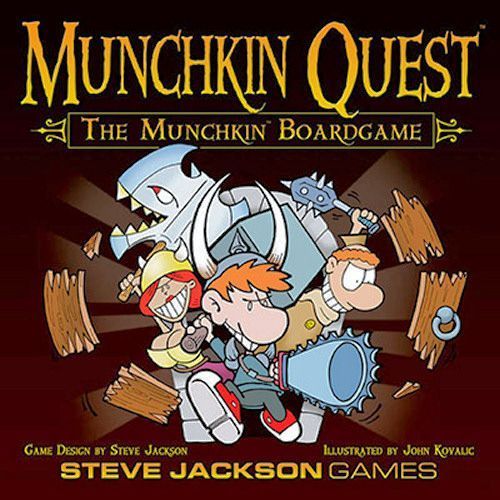
Munchkin Quest
Munchkin Quest Rulebook
Table of Contents
Table of Contents
- Components
- Setup
- Start and Finish
- Cards and Their Use
- Player's Turn
- Phases of a Turn (in detail)
- Combat
- Multi-Monster
- Monster Ownership
- Cards in Combat
- Rolling the Monster Die
- Rooms and Signs
- Results of Combat
- Fleeing!
- Help and Interference
- Boss
- Munchkin Toughguy vs. Giggling Geek — A Worked Combat Example, With Numbers and All
- Monster Turn
- Monstrous Terms
- Examples of Monster Movement
- Hero Stats
- Loot
- Discarding Loot to the Shared Pile
- Cards: Income and Expense
- Order of Application
- Glossary
- Search Table
- Phases of a Turn (Quick Reference)
- Junctions (Reference)
- Being a Munchkin
Components
- 200 cards, split into three decks by card back: Treasure, Deus ex Munchkin (DxM), and Monster.
- 30 Health tokens (red on one side, black on the other).
- 72 gold coin tokens, in denominations of 300, 500, and 100.
- 18 Step tokens (red on one side, green on the other).
- 12 Discarded Loot tokens, six matching pairs, lettered.
- 12 Search Result tokens, two-sided: "LOOTED (-10 to Search)" on one side, "CLEARED" on the other.
- Four Level counters — blue, green, red, and yellow — each a dial numbered 1 to 10.
- Four Munchkin pawns, in blue, green, red, and yellow, with 16 stands.
- 24 room tiles, each usable on either side, each showing: the room's name, a movement arrow, icons (not every room has one), the room's special rule text (if any), a joke illustration, and Entrance/Exit markings. Every tile is two-sided; the Entrance side is always pre-glued shut, so monsters can never start there.
- 38 standee Monster tokens (including eight Chihuahuas, eight Meelies, 14 lesser humanoids, and eight Ogres) — kill them and take their loot.
- 73 Junction tiles: one side is an open passage, the other a wall or door between rooms.
- 10 dice: one Monster Die (a d10 with a colored border, dedicated to rolling monster levels) and eight ordinary six-sided dice in two colors — four per player.
Setup
Munchkin Quest plays with 2 to 4 players.
Split the cards into their three decks by back design. Shuffle each deck. Once a deck runs low, shuffle its discard pile back in to form a new deck. If a deck runs out entirely with no discards to reshuffle, that deck simply produces nothing more for the rest of the game.
Build the board face-up in whatever arrangement the players agree on, using the room tiles and Junction tiles. When building, remember: a room's Entrance side (already glued) may never open onto another room's Entrance. Set the Entrance rooms out on the table first, then connect the rest of the layout around them.
Each player starts with:
- one Munchkin pawn and stand,
- four Health tokens (their starting Health value),
- three Treasure cards and four DxM cards,
- three Step tokens (green side up) and 300 gold.
Place the level counters on 1 and set the Monster Die and dice tray nearby. Every player enters the game at the Entrance and moves out from there when the game starts. Decide first player however you like — highest die roll, most recent dungeon crawl, whatever. Play proceeds clockwise.
Glossary
A full glossary of terms appears near the end of this rulebook, in case anything below is unclear. Read it once before your first game.
Start and Finish
Everyone rolls a die; highest goes first. Each player's turn consists of one or more phases (see Phases of a Turn, below). Then the turn passes to whoever is seated next in turn order (clockwise, unless a card says otherwise). And so on.
Winning
The goal of the game is to reach 10th level and leave the dungeon through the Entrance. Reaching 10th level anywhere else does not win the game. Other cards may create other ways to win — read them as they come up.
To leave through the Entrance and win, you must be at 10th level, in the Entrance room, and not currently be fighting a Boss (see Boss, below).
Unending Dungeon
If, at any point, the room deck runs empty and there are no monsters left in the dungeon at all, redistribute the room deck as the rules on the room deck itself describe.
Cards and Their Use
Each type of card is played at a particular time (Treasure and DxM cards each say when). Special rules — printed on the card itself — always override the general rules in this book.
- Loot: items you keep in front of you and equip. See Loot, below.
- Class and Race cards: worn face up in front of you; grant continuous benefits and modify how you level up (or don't) under particular circumstances. See Hero Stats, below.
- Curse: applied immediately when you draw or receive it. See Curses, below.
- Discard: comes with instructions telling you what to discard, provided it can legally be discarded. If you can't legally satisfy the discard, the card has no effect and you discard it instead.
Player's Turn
A player's turn is broken into phases. Each phase lets you take particular actions, in a set order, and (with the exception of combat) you can't skip back to an earlier phase once it's done.
Phases of a Turn
- Draw a DxM Card
- Steps
- Opening
- Deal (Trade)
- Combat
- From the Door...
After each combat, the Monster Turn happens (see Monster Turn, below). Then it's the next player's turn.
Terms
A card in play is a card lying on the table, either yours or a monster's, currently affecting the game. Rooms can also have their own special rules — for example "Огромный Страшный Демон" ("A Huge Scary Demon") or "Чудовищные Возможности Блистания" ("Monstrous Bling Opportunities"). See the glossary if you don't recognize a term.
At Any Time, Even Outside Your Own Turn
You may:
- play any DxM card marked "at any moment,"
- discard any Loot card so you can carry an item you just found,
- add a shmott(y) you're holding to your carried loot.
At Any Time, Except During Combat, You May:
- play a DxM card marked "at any moment" except "in combat,"
- discard shmotky to your maximum limit (usually four items in hand),
- barter loot with another player standing in the same room or an adjacent one,
- give away your gold — but only gold, never Steps.
Actions Only on Your Own Turn
You may only take the following actions during your own turn:
- open a purchased door (see below).
Phases of a Turn (in detail)
1) Draw a DxM Card
At the start of your turn, draw one DxM card. It's yours to keep; it says whether it's played immediately or held for later.
2) Steps
Move your pawn using your Step tokens. You get three Steps per turn by default.
Step tokens — spent at the start of your turn as you decide how far to move. One green-side Step token is spent per space of movement. Once a token is spent, flip it red-side up; it's unusable again until refreshed (see below, "Refreshing Your Steps").
Refreshing Your Steps: at the start of each of your turns, flip all your red Step tokens back to green — that restores your movement pool. Some cards and rooms change your Step supply — read them as they come up.
Beginning Your Turn In a Room With a Monster: if you're in a room and a monster stands there as your turn begins, you must fight it first (see Combat, below).
Moving Between Rooms: your Munchkin moves along the board, spending one Step per room entered, when moving through a normal corridor, a plain/ordinary door, or a junction that doesn't otherwise restrict movement. Some junction tiles cost more than one Step to cross, or are locked and can't be crossed at all until unlocked (see the Junction Types diagram, below).
If you can't finish paying for a move, you simply stop where your Steps run out — you don't have to spend every Step you have. You never have to move at all if you don't want to.
Junction Types
- Open corridor — 1 Step to cross.
- Plain/ordinary door — 1 Step to cross.
- Locked door — needs a key or a special action to open before it can be crossed.
- Secret door — a fixed cost of Steps shown on the tile to find and cross it.
- Wall — cannot be crossed at all.
3) Opening
If you end your movement on a purchased door, you can search the room, trigger its special rule if it has one, and reveal what's inside (draw the top Monster or DxM card, per the room's rules, or check what's already sitting in the room).
Automonsters: when a room is opened for the first time, place a monster in it automatically if the room says to. Otherwise it stays empty until someone brings a monster to it, or a card sends one there.
For example, opening a new room reveals a Monster card as the room's rules direct, or — for rooms marked "Automonster" — a preset monster standee is placed instead. Free-standing rooms with no special instruction remain empty on Opening, and any monster found here later has to have wandered in or been sent in by a card.
Search
Once in a room, you may spend one action to Search it (once per visit), by rolling the Search die.
Search Signs
- No sign — Search is not possible in this room.
- −1 — subtract 1 from your Search roll.
- −2 — subtract 2 from your Search roll.
- +1 — add 1 to your Search roll.
- +2 — add 2 to your Search roll.
Rolling for Search draws a card from the top of an appropriate deck (usually Treasure). Placing a "Looted" token on the room (−10 to future Search rolls there) or a "Cleared" token means the room is fully searched and can no longer be searched again.
Every room can only be searched once per visit.
3) From the Door...
If you have four or more shmotky in your hand once you enter a room and open it, you must discard down to your limit before continuing. Discard any excess shmotky. Some rooms and DxM cards raise or lower this limit — read the room and card text as you encounter it.
Discarded Loot Tokens
At any time, you can dig through the discard pile of shmotky (the pile of Discarded Loot tokens face up beside the play area) and pick up anything you find there — the discard pile is public and can be plundered by anyone, any time it's their turn to look, subject to your hand limit.
Combat
The dungeon is packed with monsters. Your goal is to kill them and take their treasure.
You may only start combat on your own turn. Combat begins in your turn if:
- you enter a room containing a monster, or
- a monster enters your room (usually because it was fleeing combat elsewhere), or
- someone plays a DxM card that sends a monster into your room.
Start of Combat
Determine the level of the monster you're fighting. Compare it to the sum of your own level (see Hero Stats, below) plus any bonuses from your actions or the items you're carrying (see the worked example, Munchkin Toughguy vs. Giggling Geek, below). This total is your combat strength at that moment.
- If your combat strength is greater than or equal to the monster's level, you win.
- If your combat strength is less than the monster's level, you must either run away (see Fleeing, below) or call for help (see Help and Interference, below).
Squeamish Monsters
Some cards or monsters state that a particular monster refuses to be affected by some combination of bonuses or effects until combat is fully resolved. In that case, ignore the disallowed combination for that fight — the monster still has to be dealt with normally otherwise.
To Win, Just Roll!
You win combat automatically if a card lets you win without a roll. Otherwise, once your combat strength beats the monster, the monster dies, and you gain any level or treasure reward it grants.
Combat Chains
Combat doesn't have to be resolved in a single pass; you can add bonuses, play cards, or call for help at any point before rolling or comparing totals, as long as it's still your turn (or you're helping someone whose turn it is). Once you commit to a resolution (a roll, or a straight comparison), that combat is done — you can't reopen it.
Death
Your Munchkin pawn dies when its Health token total reaches zero. When that happens, immediately discard all your loot back to the shared discard piles (Treasure to the Treasure discard, monster to the Monster discard, etc.) — it becomes fair game to anyone who cares to plunder it.
A Game For The Dead: even dead, you stay in the game. Roll to move a heartbeat/ghost token instead of your pawn until you're revived.
Coming Back to Life: at the start of your next turn after dying, roll to determine where you're revived — usually the Entrance — with a starting handful of gold (300, unless a card says otherwise) and no other belongings.
Suicide: it's legal to deliberately let your Munchkin die (for example, to escape a bad situation). It carries no bonus and no penalty beyond the loss of your gear.
Multi-Monster
More than one monster can be in a room at once, even monsters belonging to different players' collections, or ones that arrived by different routes (wandering monsters, ones placed by cards). Squeamish monsters remain squeamish regardless of who else is present.
Monster Ownership
Each monster belongs, for scoring purposes, to whichever player revealed it (Opening) or placed it (via a card). Ownership matters for who collects a monster's rewards, and for certain cards that reference "your monster."
Cards in Combat
Playing a Treasure or DxM card during combat (marked "in combat," or "at any moment") can add bonuses before you resolve a fight, per its text. Curse cards may modify combat as well; apply them immediately per their instructions.
Rolling the Monster Die
Battles against multi-level monsters, or where the rules call for it, are resolved by rolling the Monster Die and comparing (see the worked example, Munchkin Toughguy vs. Giggling Geek, below). The Monster Die is a d10 with a colored border — used only for these rolls.
Rooms and Signs
In most cases the room a fight takes place in doesn't affect combat directly, unless it says otherwise. Read a room's special rule (in the room, not on a card) before combat starts. Signs on rooms show which classes or races get a bonus there.
- All (star icon) — everyone benefits.
- Wizard, Cleric, Dwarf, Elf, Thief, Warrior, Halfling — icons matching the corresponding class or race benefit here.
Where a sign appears in a "curse" or "class" color (red, or the class' associated color), that room, if it grants a special rule labeled "class," applies only if you match, and applies its full effect for that matching class or race.
Results of Combat
Once combat resolves, discard all cards played that turn to their appropriate piles, unless a card specifically says to keep it in play. Adjust levels and gold as instructed.
Other Effects: some cards or rooms grant additional effects after combat — apply them exactly as printed, in the order given, before moving on.
Victory
If, after combat, you've beaten the monster (your combat strength equals or exceeds its level), you win. Collect the monster's Treasure card reward (draw as many Treasure cards as it specifies) and gain any levels it grants. Some monsters have special "on death" effects — check the card (marked "Level up" is common).
- Take the treasure listed on the monster card.
- Level up as instructed on the card, if any.
- Take back your combat cards to your hand, and discard used ones per their text.
Draw or Defeat
If your combat strength is exactly tied with the monster's level, that's a draw: nothing happens, and combat simply ends (no death, no reward) unless a card specifies otherwise.
If your combat strength is less than the monster's level and you can't or won't run or call for help, you lose. Apply the monster's "Bad Stuff" (its loss effect) exactly as printed.
Fleeing!
If you're losing a fight, you can try to flee instead of losing outright.
You may flee at any time before the fight is finally resolved. Fleeing has a cost — check the room and monster text for details; usually you roll a die and compare against a target number given on the monster card.
To flee: pick any adjacent room, then roll a die.
Repeated Flight: fleeing again from the same monster (after it caught you and combat resumed) requires you to try again; each successive escape roll uses the rules currently in force.
Nowhere to Run?: under some circumstances, all adjacent rooms are blocked (walls, locked doors, or full of other danger), and there's genuinely nowhere to flee — read the situation and monster's rules for what to do (often you must fight, or take the Bad Stuff automatically).
Escape Roll: fleeing is resolved by rolling and comparing against a target set by the monster or room. Rolling below the target roll means the monster catches you — read what "IT'S NOT GOOD ENOUGH" resolves to on that monster's card (usually the same as losing combat outright).
Help and Interference
Any Munchkin fighting a monster can ask another player, in the same room or an adjacent one, for help.
Requests For Help
You may only offer to help someone else's fight — no one is obligated to help you, ever. You can offer help freely; the two of you negotiate the terms of assistance (rewards, split of loot) between yourselves before it's given.
Rushing To Help
To come to someone's aid, you must be able to reach their room — from an adjacent room, or occasionally farther if a card allows it. Whoever comes to help spends the Steps to travel there, if needed, then adds their bonuses to the fight.
Once a helper arrives at the fight, they contribute exactly what's agreed — bonuses from their hand, or a share of the risk if the fight is lost. Both of you may play any legal combat cards.
Rewards for Help
Some monsters carry special bonuses for whoever helps in defeating them — check its card text (marked "Reward Level," "Reward Gold," or similar).
Everyone Flees!
If everyone in a losing fight decides to flee, each flees separately, rolling their own escape roll and taking their own consequences.
Boss
If a Boss stands in the Entrance on your turn, you must fight it before you can leave the dungeon. Its level is set independently of the normal level scale (usually shown directly on its card, e.g., "20").
No card's effect can change the Boss's level except by the special rules on the Boss card itself.
Victory
If the Boss is defeated, whoever landed the finishing blow immediately wins the game (leaving through the Entrance is not required if the Boss is the one blocking the way).
Defeat / Draw
If the Boss draws or defeats the challenger, the loser suffers exactly what the Boss's card specifies (often losing all Steps for the game, or another dungeon-scale penalty).
Example: The Golden Fish
When a Boss is defeated, the winner may swap its card for a "Golden Fish" reward marker if the Boss's card allows it — read the specific Boss card for the exact reward.
Munchkin Toughguy vs. Giggling Geek — A Worked Combat Example, With Numbers and All
Tinychkin opens one door onto an empty room, in which he needed only 2 Steps to arrive.
Tinychkin: Opening the door... nothing there, and it's an ordinary corridor.
Igor (as Referee): Wait, you're in the Coloring Room — hooray, cheating is legal! Mikhail Popov, you didn't get here right.
Tinychkin heads back into the corridor and pays 1 Step, entering an adjacent room instead. It's an Automonster room, so the standee for a Giggling Geek is placed automatically.
Tinychkin: Ugh, a Giggling Geek. He's a level 4 monster, base combat strength. I have my Warrior's +2 bonus and my Sword +4 bonus — that's combat strength 6.
Igor: Rules check — the Giggling Geek is Class 7, no bonus for you against it (per the room's sign), so it's still 4 vs. 6. You win.
Tinychkin: Yes! Level up and take the treasure.
Gilda: Wait, I want to help too — I still owed you 500 gold from earlier!
Tinychkin: Fine, but that gold is gone now — you've spent it already.
Gilda (playing a card): Ha! I play "Dwarven" on you, plus a +2 Steel Dagger card. Give me half your reward.
Tinychkin: OK, whatever, agreed. I keep my level, you get half the gold.
In the following turn, Igor and Gilda take on the Boss together.
Igor: I've got my Chainmail Kubok bonus +10, my "Legendary" card +5, my Sacred Dagger for Gilda's Wizard +5 — total combat strength should crush this Boss.
Gilda: Behold, my ridiculous stack of Discarded Loot! I dig up an old Amulet of Dexterity +4 (bonus vs. all) from the discard pile.
Igor: Rolling the Monster Die — 3. Combined with our +20, we're at 23 vs. the Boss's 20. Victory!
Gilda: Zombie Fish? That's not right, is it — oh, it's the Golden Fish. I want it as my prize.
Igor: Fine, take it, you devious munchkin.
(This example demonstrates: how to add bonuses, when class/race signs apply, how helper contributions are negotiated, and how the Monster Die resolves an uncertain fight.)
Monster Turn
At the end of every player's turn, the Monster Turn happens. The active player, whose turn it was, rolls the Monster Die to see which monster moves next.
Draw a DxM Card
If no monster is currently in play to move, the active player draws a DxM card and applies it if it's a "played immediately" card.
Monster Cards
Monster cards, drawn during Opening or when a room's rules call for one, describe both the monster's stats and behavior (level, race/type, special text, illustration). If a wandering monster's card has no target room specified, it wanders per its own written movement rule (see below).
Monster Movement
Almost every monster is capable of moving on its own. Each turn, roll to see whether it wanders into an adjacent room. If a monster is boxed in ("Caught!") by walls or a locked door, it doesn't move that turn.
Monsters don't move diagonally — only along legal room connections, exactly the way players do. A monster's color (matching a token or dial) is noted on its card if it matters for movement rules.
Usually, monster movement follows a simple direction check through legal connections. Some monsters have special movement rules — see "Monstrous Movement Traits," below, and the movement examples on page 14.
Monsters and the Entrance
Under no circumstances may a monster ever enter or stop in the Entrance room, unless a card explicitly forces it there. If a monster's normal movement would send it into the Entrance, it stops at the door instead and doesn't cross.
Interrupting Movement (You Can't!)
During the Monster Turn, players can't normally interfere with a monster's movement roll or path, unless a card specifically grants that power. For example, some cards let you redirect a monster once it's already been rolled for.
Exceptions
No Loop Through: over the course of one Monster Turn, a monster can't re-enter a room it's already passed through and stop there again — if its move would send it back, it stops early instead.
Caught!: if a monster can't legally move at all (every exit blocked), it stays where it is for that Monster Turn.
Monsters Leave Fields (When Applicable)
When a die roll sends a monster toward the (metaphorical) edge of the dungeon and there's nowhere left to place it, it's simply removed from play instead of being placed somewhere illegal. This doesn't happen often, but the rule exists for that edge case.
Monstrous Terms
A quick breakdown of what's printed on a monster card:
- Name: flavor only, no game effect.
- Race: some cards react to a monster's Race or Class (e.g., "Undead" or "Orcish"). Listed under the card's icon row.
- Level: the monster's numeric strength; this is what you compare your combat strength against.
- Special Text: bonuses, penalties, and unusual behaviors printed on the card — always follow them over the general rules.
- Type: whether it's a Standard or Extraordinary (special) monster; only Extraordinary monsters have unique art and rules.
- Banes: some monsters are especially deadly to a Race or Class — check for this label; those characters suffer worse consequences fighting it.
Gangs
A pack of monsters wandering together, moving as a group and, in some cases, fighting together against whoever encounters them. Read the specific gang's card text.
Examples of Monster Movement
(See the diagram on p. 14 in the original manual, showing worked movement paths for: Gazebo in Yellow Colors, Insufferable Recent Horror in Blue Colors, Psychowhelp in Purple Colors, Ominous Nose in Orange Colors, Lame Goblin in Green Colors, and Mushroom in Red Colors — each demonstrating how direction and room type constrain a wandering monster's path around the board.)
Hero Stats
Each Munchkin has a set of five stats that determine how the game plays for them: level, class, race, health, and step supply.
Level
Your overall progress toward victory (win by reaching level 10 and leaving through the Entrance). Level goes up when you win combat, up to a maximum of 10 — you can't level past 10 by any means except via the Entrance win.
Leveling Up: winning combat, per the monster's card, moves your Level counter up by however many levels the card grants. Some cards or effects grant a level directly, without combat.
Losing a Level: some cards or Bad Stuff results make you lose a level. You can never drop below level 1 this way.
Class
Warrior, Wizard, Cleric, or Halfling(-adjacent) roles are represented by Class cards; each grants a distinct, ongoing bonus. You may only wear one Class card at a time, unless a card says otherwise.
Discard a Class card at any time you like — you're immediately Classless (no bonus) until you draw or win a new one.
Race
Everyone starts Human unless they hold an Elf, Dwarf, or Halfling card. Only one Race card may be worn at a time. Some rooms and cards grant bonuses only to particular Races.
Strength d10
Each monster carries a level shown, in most cases, as a number from your rolled d10 combined with a fixed base. Read the specific monster's card for exactly how its level is calculated.
Health
Health tokens represent your character's hit points/wound track. Your maximum Health total is shown by a dial on the Health counter, but you always start with the standard four tokens unless a card says otherwise.
Losing Health: whenever you take damage (per the Bad Stuff text on a lost fight, or a card effect), remove the specified number of Health tokens.
Restoring Health: certain items, cards, and effects let you regain lost Health, up to your current maximum. Read the specific card.
Steps
Your per-turn movement pool, made of Step tokens; see Steps, above, and Movement, page 6.
Loot
Everything's for sale. Loot cards drawn or won are equipped or held as items.
Hands
Each character starts with two hands. Most weapons need one or two hands (per the card's text); read the icon showing how many hands an item occupies.
Belt
Every character has one Belt slot. Only one item may be worn there. Belt items are usually small bonus items (see the Belt-marked cards).
Head
Each character has one Head slot for a single helmet or headwear item.
Footwear
Each character has one Footwear slot, for a single pair of boots or shoes.
Worn Items
Any item card marked "Worn" occupies a slot as described above; unworn items sit loose in your hand until equipped.
Clothing and Shinies
Clothing and "shiny" accessory items (rings, cloaks, trinkets) do not occupy the Hands, Belt, Head, or Footwear slots and can be worn without limit, unless a specific card restricts it.
Gold
Gold coin tokens are the game's currency. There is no fixed limit to how much gold you may hold; however, gold is public knowledge — anyone can ask, and you must answer truthfully about how much you're carrying, if asked directly.
Loot Restrictions
Using an item requires meeting its listed Class or Race requirement, if it has one. A card marked "Any Class" can be used by everybody.
Item Limits
There's a limit to how many "shmotky" (miscellaneous small items) you can hold in hand at once — normally four (see From the Door..., above). Worn items don't count against this hand limit.
Item Properties
Some shmotky carry special properties, printed directly on the card — for example "Sticky" or "Big" — and follow whatever special handling instructions accompany that keyword.
Big Items
A "Big" item takes up more room than an ordinary one and typically can't be combined with other Big items, or has other restrictions — read its card.
Item Exchange
You may trade or give equipped and unequipped items to another player standing in your room or an adjacent one, at any time outside combat, subject to negotiation between you.
Discarding Loot to the Shared Pile
When you discard a shmotka (rather than trade it), place it in the shared Discarded Loot pile (see Components, above) rather than the deck's normal discard, unless a card tells you otherwise. Anyone may dig through it later and take what they find, per the hand-limit rules.
Metal Items
Items marked "metallic" interact with specific monsters and cards that reference metal — read the specific card's text when it comes up.
Cards: Income and Expense
Card Income
Cards enter your hand in various ways: normal draw, Treasure won from combat, cards played on you, and so on.
Deus ex Munchkin (DxM)
DxM cards are played from your hand at a specific moment named on the card itself. Most DxM cards are played immediately upon being drawn; some are held until their trigger condition is met.
Classes and Races
These special worn cards each grant one continuous bonus. Only one Class card and one Race card may be worn at a time, unless a specific card overrides this.
Monsters
Monster cards never enter a player's hand — they're placed directly into the dungeon (see Monster Cards, above) or drawn to see what's behind a door.
Treasure
Won from combat (Victory) or from a successful Search. Treasure cards represent equipment, gold, curses, and other one-off effects — read them as you draw them.
Playing Cards
The general rule: play cards as often as you like, whenever the card's own timing text allows it.
Bringing Shmotky Into Play
Any item card you're holding can be brought into play (equipped) at any moment you're allowed to take that action — usually any time it's your turn, or "at any moment" if the card says so.
Using Shmotky
Once equipped, an item's bonus applies automatically wherever the rules call for it (usually combat), as long as it stays worn or held.
Boosters and Summoners
Some cards add monsters to a fight already in progress, or summon fresh monsters into a room — read the specific card. A "Summoner" card, for example, may add a fresh monster directly to combat already underway.
Order of Application
Cards take effect in the order they're played, unless timing text says otherwise.
Any Moment
Cards marked "at any moment" can be played whenever you like, including during someone else's turn or combat, unless a more specific restriction (like "not in combat") applies.
- Once a "at any moment" card is played, its effect resolves immediately.
- If a card says "at any moment, except..." the exception is a hard restriction — you may never play it during the excluded circumstance.
Curses
Curses apply the moment you draw or are given them, and resolve completely before your turn continues. Read the specific curse card's text for its exact effect (loss of level, loss of Steps, discarding an item, etc.).
If a card says "Bring the strongest monster in the discard pile back into play," or similar, apply it exactly per its wording.
Glossary
- Automonster — a room tile that places a monster automatically the first time it's opened. See p. 6.
- DxM — Deus ex Munchkin; a deck and card type. See p. 4, 17.
- Gang — several monsters that move and act together. See p. 13.
- Bad Stuff — the penalty a monster inflicts on the loser of a fight against it. See p. 8.
- Free Bout — a bonus turn of combat granted by a card or room, without spending a normal action. See p. 8.
- Big (item) — an item type with special stacking restrictions. See p. 16.
- Combat — the phase where you fight a monster you've encountered. See p. 8.
- Combat Strength — your level plus all active bonuses, compared to a monster's level to determine the fight's outcome. See p. 8.
- Search — the action of rolling to look for treasure in a room. See p. 7.
- Winning — reaching level 10 and leaving via the Entrance. See p. 4.
- Weaker Monster — a monster with a lower level than you; still worth fighting for its treasure. See p. 9.
- Draw (a card) — take the top card of the named deck.
- DEAD — a Munchkin whose Health has hit zero. See p. 8.
- Discard — put a card into its matching discard pile; or, as an instruction, get rid of a specific card or item. See p. 4.
- Door (Open/Locked/Secret) — the different junction types between rooms. See p. 6.
- Friendly Monster — a monster that, per a card, won't attack you (or attacks someone else instead).
- Gold — the coin currency, freely tradeable. See p. 16.
- Health — your hit-point track. See p. 15.
- Level — your overall progress stat; see Level, above. See p. 15.
- Squeamish (monster) — a monster immune to a specific combination of bonuses until combat resolves. See p. 8.
- Class — Warrior, Wizard, Cleric, or other worn role cards. See p. 15.
- Junction (tile) — the connector piece between two rooms: corridor, door, locked door, secret door, or wall. See p. 6, 20.
- Trapped/Caught — a monster (or player) unable to move due to blocked exits.
- Curse — an immediately-applied negative card effect. See p. 18.
- — see above.
Search Table
Roll dice for a Search to see what a room gives up. As long as any die shows at least one pip, it means you found something, even if the total shown below is modest.
1 and below — nothing; the room gives up nothing this Search. 2 — 300 gold. 3 — 400 gold. 4 — 500 gold. 5 — 100 gold and a Treasure card. Room becomes Looted. 6 — 300 gold and a Treasure card. Room becomes Looted. 7 — a monster wanders in and starts combat. Room becomes Looted. 8 — 500 gold and a Treasure card. Room becomes Looted. 9 — two Treasure cards. Room becomes Cleared. 10 or higher — a Treasure card and Room becomes Cleared.
If your total after all bonuses/penalties comes out below zero, it's treated as a zero.
Search Signs
- No Search sign — this room cannot be searched at all.
- Search Rolls Modified — see the icons under Components/Search, above.
Phases of a Turn (Quick Reference)
- Draw a DxM card — p. 6.
- Move (Steps) — p. 6.
- Open — p. 7.
- Search — p. 7.
- Combat — p. 8.
- Deal (Trade) — p. 7. Then the Monster Turn — p. 13.
The next player begins their turn once the Monster Turn is fully resolved.
Junctions (Reference)
- Corridor — 1 Step.
- Ordinary Door — 1 Step.
- Locked Door — key or special action required.
- Secret Door — fixed Step cost shown on the tile.
- Wall — impassable.
Being a Munchkin
Remember: this is a game about backstabbing your friends and grabbing all the treasure! The best way to win is to fight only the monsters you can actually beat, and grab every advantage in your reach along the way.
The first rule, encoded in all this text, is simple: it's not cheating if the rules don't say you can't do it. Second rule: any pile of unclaimed gold left on the table by the end of a session belongs to whoever cleans it up first.
Sometimes you'll fall behind while everyone else races ahead. That's the spirit of the game. There's no such thing as a graceful loss here — and no such thing as bad sportsmanship either, so long as you're having fun.
Play the way you want, in the spirit intended.