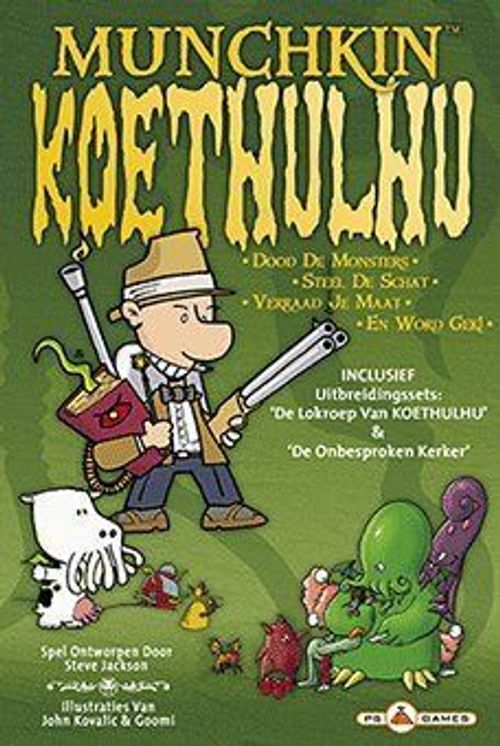
Munchkin Koethulhu
Munchkin Koethulhu Rulebook
Table of Contents
Table of Contents
- Setup
- Card Management
- Character Birth
- Start and End of the Game
- Turn Phases
- Combat
- Treasures
- Character Stats
- More Narrow Rules for Sectarians
- Items
- When You May Play Cards
- Other Munchkin Tidbits
- Interfering in a Fight
- Vocht
- Snelspel (Quick Game)
- Contradictions and Unclarities in the Rules
- Combining With Other Sets
Setup
3 to 6 players can play. (If you use more than one game, more players can join... but that slows the game down.)
You need the deck of cards and 10 tokens (coins, discs — it doesn't matter, as long as you can count to 10) for each player.
Divide the cards into Door cards (with a door and a tentacle on the back) and Treasure cards (with a pile of treasure on the back). Shuffle both decks. Give each player 2 cards from each deck.
Card Management
Keep two separate face-up discard piles, one for each deck. If a deck runs out, shuffle its discards to make a new deck. If a deck is empty and there are no discards, nobody may draw cards of that kind any more!
Sectarian cards have their own discard pile. See Sectarians below.
Your Hand
Cards in your hand take no part in the game. They do not help you and cannot be taken from you, except by cards that specifically affect "your hand" instead of the items you carry (cards lying on the table). At the end of your turn you may not have more than 5 cards in your hand.
Carried Items
Treasures can be played on the table in front of you, where they are called "carried items". See Items below.
When Cards Can Be Played
Each type of card can be played at a certain moment (see below). Cards in play may not be taken back into your hand — they must be discarded or traded away if you want to get rid of them.
Character Birth
Everyone starts as a Level 1 Human with no Class. Look at your first four cards. If you have a Class card (Investigator, Monster-Basher, Professor or Sectarian), you may, if you wish, play one Class by putting it on the table in front of you. If you have a card that allows more than one Class, you may play it as well. If you have Items, you may also play them and lay them down in front of you. If you are unsure whether you may play a card, read the rest of the rules or just do it.
Start and End of the Game
Decide who goes first in a way that everyone agrees with.
The game is played in turns, each with different phases (see below). When the first player has finished their turn, the turn passes to the player on their left, and so on.
The first player to reach Level 10 wins. But you must reach Level 10 by killing a monster. If two players kill a monster together and reach Level 10 at the same time, both of them win.
Two special ways to win are described under "More Narrow Rules for Sectarians" (Meer Enge Regels voor Sektariërs), below.
Turn Phases
(1) Open a Door
Draw a card from the Door deck and turn it face up. If it is a monster, you must fight it. See Combat. Resolve the whole fight before you continue. If you kill it, you go up one Level (or two Levels for a large monster, as stated on the card).
If the card is a curse (see Curses below), it applies to you directly (if possible) and is discarded.
If you draw a card other than a monster or curse, you may take it into your hand or play it directly.
(2) Look for Trouble
If you did NOT meet a monster when you opened the door, you now have the option to play a monster from your hand (if you have one) and fight it, as described above. Do not play a monster you cannot defeat, unless you are sure you will get help!
(3) Loot the Room
If you killed a monster, take the number of Treasures shown on the monster card. Draw them face down if you defeated the monster on your own, and draw them face up if you had help.
If you met a monster but then ran away as fast as you could, you get no Treasures.
If you did not meet any monster, or you met one that was rather too much for you, you may search the empty room. Draw a second card from the Dungeon deck (Kerkerkaarten), face down, and take it into your hand.
Translator's note: this step names the "Kerkerkaarten" (Dungeon cards) deck, while the rest of the rulebook calls the door cards the Deurkaarten (Door cards). The printed name has been kept as it appears in the source.
(4) Charity
If you have more than 5 cards in your hand, give the surplus to the player with the lowest Level. If several players share the lowest Level, divide the cards between them as fairly as possible, but you decide who gets the largest share. If YOU are the lowest (or jointly lowest), simply discard the surplus.
Now the next player takes their turn.
Combat
To fight a monster, look at the Level at the top of its card. If your own Level together with the Bonuses of the items you carry adds up to more than the monster's Level, you kill it. Some monsters have special powers that affect the combat, for example a bonus against a certain Class. Check these before you start the fight.
You may use one-shot cards from your hand during a combat. A card is a one-shot card when it says on it "Eenmalig bruikbaar" (one-time use), or when it changes a Level. Vocht cards and Wensring (Wish Ring) cards are played this way.
Translator's note: "Vocht" is a card type, explained under "Vocht" at the end of this rulebook.
You may not trade items during a combat.
If other monsters (a Wandering Monster or a "GOTH" monster) join the fight, you must defeat their total Levels. If you have the right cards, you may knock out one monster and fight the others normally, but you may not choose to fight one and run from the others. If you knock one out with a card but run from the others, you get no Treasure at all.
If you kill a monster or otherwise defeat it, you automatically go up one Level (or two Levels for some very dangerous monsters). If you fight several monster cards (see "Interfering in a Fight"), you go up one Level for each monster you kill! But if you defeat a monster without killing it, you NEVER go up a Level.
Discard the monster card(s) and draw Treasures (see below). Be aware that someone may play a hostile card on you, or use a special power, just when you think you have won. When you kill or defeat a monster, you must wait a reasonable time, which by definition is about 2.6 seconds, to give the others a chance to react. Only then is the monster really dead and do you really go up a Level and get your Treasures, though they can of course keep complaining.
If you cannot defeat a monster, you have two choices: ask for help, or run away.
Asking for Help
You may ask another player to help you. If that player refuses, you may ask another player, and so on, until everyone turns you down or someone helps you. Only one player may help you.
You may try to persuade someone to help you. You will probably have to. You may offer them items you carry or some Treasure cards that the monster has. If you promise them part of the Treasure, first agree who will choose first, or how the division will be made.
If someone helps you, add their Level and Bonuses to yours.
The special properties and weaknesses of the monster also apply to your helper, and the other way round. For example, if you are not a Monster-Basher but a Monster-Basher helps you, then the Anton Geestink has +3 against you. But if you fight the Reuzijnen and a woman helps you, your enemy's Level is reduced by 2 (unless you are also a woman and your enemy's Level has already been reduced by 2, in which case it does not stack).
If someone successfully helps you, the monster is defeated. Discard the monster card, draw Treasures (see below) and follow the instructions on the monster card. You go up one Level for each monster defeated. Your helper does NOT go up.
If nobody wants to help you, or if someone tries to help you but the others work against you or help the monster so that the two of you still cannot defeat it, then you must run away.
Running Away
If you run away, you get no Level and no Treasures. You cannot even loot the room (that is, draw a face-down Door card). And running away does not always work...
Roll the die. You escape only on a 5 or higher. Some Items make it easier to run away, and some monsters are fast or give you a penalty on your roll.
If you escape, discard the monster. You get no Treasure. There is usually no Bad Stuff (Portie Ellende)... but read the card anyway. Some monsters torment you even when you know how to escape!
If the monster catches you, you get Bad Stuff (Portie Ellende), as described on the card. This can range from losing an Item to losing one or more Levels, or even death.
If two players work together and still cannot defeat the monster, both of them must run away. They each roll separately. The monsters can catch both of them.
If you run away from several monsters, roll separately for each of them, in an order of your choice. You get Bad Stuff from each monster that catches you, immediately when it catches you.
Death
If you die, you lose all your Items. You keep your Class(es) and Level — your new character looks just like your old one.
Looting the Body: Place the cards from your hand face up next to the cards you had in play. (Additions to a Sectarian are discarded when a Sectarian dies.) Starting with the player with the highest Level, each player chooses one card... In case of equal Levels, roll the die. If your body has no cards left, tough luck. After everyone has received a card, the rest are discarded.
Your new character appears immediately and can help others in combat in the next turn... but you have no cards.
In your next turn you start by drawing cards: two from each deck, face down. You may immediately play Class or Item cards if you wish, exactly as at the start of the game.
Treasures
When you kill a monster, you get its Treasures. Each monster has a number of Treasures printed at the bottom of its card. Draw that many. Draw them face down if you defeated the monster on your own, and face up if someone helped you, so that everyone can see what you have got.
Treasure cards may be played the moment you get them. Items may be placed in front of you. "Go up a Level" cards may be used immediately.
Character Stats
Every character is basically a collection of weapons, armour and magic items with 3 stats: Level and Class.
Translator's note: the source says "3 stats" but names only Level and Class. The third stat is the character's gender, described in the paragraph below. The source's wording has been kept as printed.
You can describe your character, for example, as "a Level 9 Investigator with a Cult Membership card, a Wish Ring and a Dirty Smirk".
Your character's gender starts out the same as yours.
Level
The Level is a measure of how heroic and brawny you really are. (Monsters also have Levels.) Keep track of your Level by placing tokens in front of you. Levels run from 1 to 10. You will gain and lose Levels during the game.
You go up a Level when you kill a monster or when a card says so. You can also sell Items to buy Levels (see Items).
You go down a Level when a card says so. Your Level can never drop below 1. Your effective Level in a combat can, however, be negative, when enough bad cards are played on you.
Class
Characters may, with the right Class cards, be an Investigator, a Professor, a Monster-Basher or a Sectarian. Each Class has special properties, printed on its card. You have a Class's properties from the moment you play its card in front of you, and you lose them when the card is discarded.
For some properties you must discard cards. For this you may discard any card you hold in your hand, and also any card you have in play. NB: if you have NO cards in your hand, you cannot "discard your entire hand".
You may discard a Class card at any moment, even during a combat: "I don't want to be an Investigator any more." The exception is that you cannot simply discard a Sectarian card. See Sectarians.
You cannot belong to more than one Class at the same time, unless you play a Super Munchkin card.
Sectarians
You cannot voluntarily discard this Class! You can lose it through cards played on you, but you can never say "I don't want to be a Sectarian any more." It is not so easy to get out...
If for whatever reason you discard a Sectarian card, the card does not go to the ordinary Door discard pile. Instead you put it on a new discard pile. Do not treat these cards as "discarded cards", because:
If a card says "Becomes a Sectarian" and a Sectarian card is on top of the new discard pile, you take that card. If the discard pile is empty, you escape... for now. If you are already a Sectarian, there is no further effect; so you do not take an extra card.
There are more Sectarian cards in the game than of the other Classes. So don't be surprised if at the end of the game everyone is a Sectarian. But from that moment on, the game is over.
More Narrow Rules for Sectarians
If there is only ONE Sectarian, nothing can make him lose that Class, except Divine Intervention... which is not in this set. (Divine Intervention cures everyone of their Cult membership.)
If all players except one have become Sectarians, then the last non-Sectarian goes up a Level, and that may be the winning Level.
If ALL players have become Sectarians, the game ends and the victory goes to the player(s) with the highest Level.
Items
Each Item card has a name, a power and a value in gold pieces.
An Item in your hand does not count until you bring it into play. From that moment it is "carried". You may carry as many small Items as you like, but only one large one. (Every Item that is not marked as large is small.)
Some Items have restrictions on their use. For example, the Tentacle can only be used by a Sectarian. Its bonus counts only for someone who is a Sectarian at that moment.
Furthermore, you may wear only one headgear, one armour, one pair of footwear and two "hand" Items (or one "two hands" Item), unless cards or special powers let you carry more, or the other players do not notice. If you wear two helmets, for example, only one of them can help you.
You must indicate which Items cannot help you by placing the card sideways. You may NOT switch between (for example) different helmets during a combat or while running away.
Selling Items
During your turn you may turn in Items with a total value of 1,000 gold pieces and immediately go up one Level. If you turn in (for example) 1,100 gold pieces' worth, you get no change. But if you manage to get 2,000 gold pieces' worth, you go up 2 Levels, and so on. You may turn in Items from your hand or ones you carry.
During a combat you may not sell, trade or steal Items. As soon as you reveal a monster card, you must finish the combat with the cards you have.
When You May Play Cards
Instructions on the cards always take precedence over the general rules. However, no card can bring a player or a monster down to Level 0 or lower, and no player can reach Level 10 except by killing a monster.
Monsters
When you draw Monster cards face up during the "Open a Door" phase, they apply immediately to the person who drew them, and they must be fought at once.
If a Monster is obtained in another way, it may be played during "Look for Trouble", or against another player with a Wandering Monster card.
For clarity, each Monster card counts as a single monster, even if the monster's name is in the plural.
Monster Additions
"Indescribably Feral", "Ranting", "Stinking" and "Dalimensional" raise the Level of monsters. ("Beauty Nap...." lowers the Level.) "Wandering Monster" makes one of your opponents add an extra monster to a combat. These cards may be played during a combat.
All additions are added together, and anything added to a monster is also added to its partner. If Indescribably Feral, Stinking and Dalimensional are played together, in any order, you face an indescribable, horrible, stinking, four-dimensional monster. However, if several monsters are already in play as a result of a Wandering Monster card, the player who plays the addition must choose which monster it applies to.
Playing Treasures
Most Treasures are Items. Items have a value or "No Value". They may be played on the table as soon as you get them, or during your own turn.
Some cards are special (such as a "Go Up a Level" card). You may play these at any time, unless the card itself says otherwise. Follow its instructions, then discard the card.
Using Treasures
Each one-shot ("eenmalig bruikbaar") card may be played during a combat, whether it is in your hand or lying on the table.
Other Items cannot be used unless they are in play. If it is your own turn, you may play them and use them at once. If you help someone, or fight outside your turn for some reason, you may not play new Items from your hand onto the table.
Curses
If you draw Curses face up during the "Open a Door" phase, they apply immediately to the person who drew them.
If they are obtained face down, or in some other way, they may be played on ANY player, of your choice, at ANY moment of your choice. It is of course very Munchkin to take away someone's options just when they think they have defeated a monster.
A curse takes direct effect on its victim (if that is possible) and is then discarded.
Exception: if a card gives penalties "in your next combat" and you were not in combat when you got it, keep this card as a reminder until your next combat.
If a curse can apply to several Items, the victim decides which Item is lost or changed.
If a curse applies to something you do not have, ignore it. For example, if you draw "Loss of Form" and you have no armour, nothing happens; discard the curse.
Madness
Madness cards are played as Curses: if you draw them face up, you get them. If you get them face down, you may play them on another player whenever you like. Also for Madness cards, every disadvantage has its advantage.
A Wish Ring can be used to get rid of a Madness (just like Curses). A Corrective Slap removes, in addition to the effects on the card, ALL Madness cards from a victim.
Classes
These cards may be played on the table as soon as they are obtained, or at any moment during your own turn, taking into account the restrictions on the number of Classes (one, unless you are a Super Munchkin).
Super Munchkin
This card gives you the option of having two Classes.
You may play Super Munchkin at any moment when you have a Class in play and can add a second Class. You now have two Classes, with the advantages and disadvantages of both. You lose Super Munchkin if you lose either of the two Classes.
Other Munchkin Tidbits
There may be moments when it makes sense to play a Curse or a Monster on yourself, or to "help" another player in such a way that it costs them a Treasure. This is very Munchkin. Do it.
Trading
You may trade Items (but no other cards) with other players. You may only trade Items that are on the table, not from your hand.
You may trade at any moment, except when you are in a combat. In fact, it is the best moment to trade when you are not on turn. An Item you acquire in a trade must be played on the table; you may only sell it in your own turn.
You may also give Items away without a trade, to bribe other players: "I'll give you my Slijm lijm if you don't help Maikel defeat Koethulhu!"
You may show the cards in your hand to other players. As if we could stop you.
Interfering in a Fight
You can interfere with a combat in several ways:
- Use a one-shot card. For example, if you have a Dirty Smirk, you can help someone by playing it against their enemy. Of course you can also "accidentally" hit your friend with the goo, and then it counts against him.
- Play a card to add something to a monster. See Monster Additions above. You may play these during your own combats or during the combats of anyone else.
- Play a Wandering Monster. This sends a monster from your hand into the fight.
- Curse your opponents, if you have a Curse.
"GOTH" Monsters
Monsters with a name ending in "goth", or of the type "Goth", have the power to summon similar monsters. When a Goth monster appears in a combat, the player who played or drew that monster may add another Goth monster to the combat. If he chooses not to, then, clockwise, each player may add a Goth monster to the combat until one has been added. Once a Goth monster has been added to the combat, the combat continues.
A Goth monster that is added to the combat in this way does not summon other Goth monsters. However, a Goth monster that is added to a combat by means of a Wandering Monster card, or by another card or ability, DOES summon a Goth monster.
Vocht
Some cards refer to Vocht cards. These are the Items of the type Vocht, as well as every Item with the word "vocht" in its title.
Snelspel (Quick Game)
Want an even faster game? For a quick game, each player starts with four cards from each deck, and you get four cards from each deck when you return from the dead.
Each time a Class or a Super Munchkin lies on top of the discard pile, each player may discard a "Go Up a Level" card from their hand and take that card (the Class or Super Munchkin). If several players want the card, they must roll dice for it. The winner gets the card, and the loser keeps his "Go Up a Level" card.
Contradictions and Unclarities in the Rules
If the cards contradict the rules, follow the cards. Any other unclarity must be settled by loud arguments between the players, in which the owner of the game has the last word.
Combining With Other Sets
- Go wild! Your Dwarf Professor, or your Half-Elf Thief Sectarian, can scare any monster.
- Combine all Treasure cards into one deck. Combine all Door cards into another deck. You now have two large decks.
- Use the Quick Game rules. If reference is made to card types you do not know, do not panic.
- Curses (Vloeken) and Traps (Vallen) are considered the same card type. Every reference to a Trap also refers to a Curse, and the other way round.
- All characters may have Races, Classes and Powers.
- Hirelings (Uitzendkrachten) and Henchmen (Dienaren) are the same as the type Uitzendkracht.
- Some monsters in Munchkin Koethulhu are marked as Undead. There are no rules for the Undead in this game. They exist purely so that Priests from Munchkin can use their special ability against them.
- Horses (Rossen): the Flail (Dorsvlegel) counts as a Horse if you have a Munchkin game with the rules for Horses. If not, you simply follow the rules on the card.
Translator's note: the source prints the card-type words "Vloeken", "Vallen", "Uitzendkrachten", "Dienaren" and "Dorsvlegel" in Dutch; the English glosses are the transcriber's, and the Dutch words are kept in brackets.