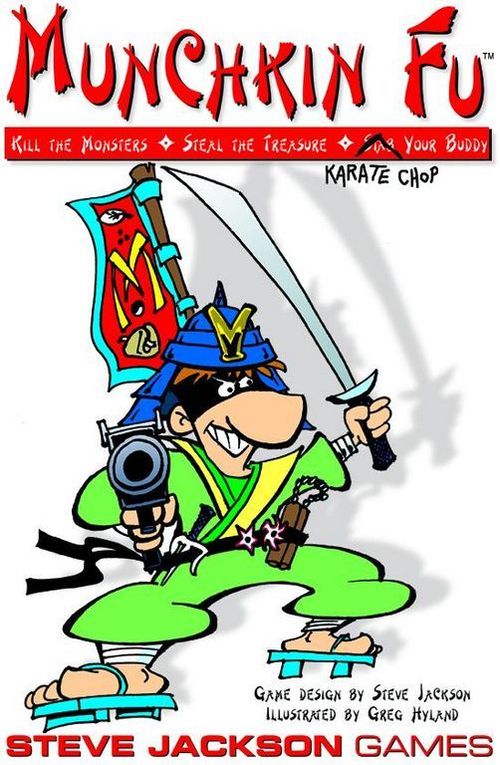
Munchkin Fu
Munchkin Fu Rulebook
Table of Contents
Table of Contents
- Setup
- Card Management
- Character Creation
- Starting and Finishing the Game
- Turn Phases
- Combat
- Asking For Help
- Running Away
- Death
- Treasures
- Character Stats
- Items
- When To Play Cards
- Monsters
- Monster Enhancers
- Treasures: Getting Them
- Using One-Shots
- Traps
- Classes and Styles
- Super Munchkin and Super-Style
- Mercenary
- Other Munchkin Themes
- Interfering With Combat
- Hong Kong
- Faster Play Rules
- Conflicts And Disputes
- Combining With Munchkin And Star Munchkin
Setup
Three to six munchkins can play. Each player needs 10 tokens (coins, poker chips, whatever – or any gadget that counts to 10).
Divide the cards into Doors (with a door on the back) and Treasures (with a pile of loot on the back). Shuffle both decks. Deal two cards from each deck to every player.
Card Management
Keep separate discard piles for the two decks. If a deck runs out, reshuffle its discards. If a deck runs out and its discard pile is also empty, nobody may draw cards of that kind!
Hand: the cards in your hand are not in play. They don't help you, and nobody can take them away from you except with cards that specifically affect "your hand." At the end of your turn, your hand may not hold more than five cards.
Items taken into use: Treasure cards can be played on the table in front of you to make them "taken into use." See "Items," below.
When can a card be played? A card of a given type can only be played at a specifically defined time (see below).
Cards cannot be returned to your hand once they leave play – they must be discarded, or traded away if you need to get rid of them.
Character Creation
Everyone starts the game at Level 1 with no Class and no Style (heh heh heh).
Look at your four starting cards. If you were dealt a Class card (Ninja, Samurai, Monk, Yakuza) or any Style, you may (if you want) lay down one card of each type in front of you. You may also play any cards that let you have two Classes or Styles.
You may also play Items and Mercenary cards. If you're unsure whether to play a card, read on below. Or just charge ahead and do it.
Starting and Finishing the Game
Decide who goes first by any method you find acceptable. The game proceeds in turns, each made up of a series of phases (more on that later). The turn passes to the right around the table.
The first player to reach Level 10 wins. To reach Level 10 you have to kill monsters. If two players are helping each other kill a monster and both reach Level 10, they both win.
Turn Phases
(1) Kick Open The Door: draw and turn face up a card from the Door deck. If it's a monster, you must fight it. See "Combat." Resolve the fight to its conclusion before doing anything else. If you kill the monster, you gain a Level (two for a super-monster – this is noted right on the card).
If the card is a Trap (see "Traps" below), it takes effect immediately (if it can) and is discarded.
If you drew any other kind of card, you may either take it into your hand or play it at once.
(2) Look For Trouble: if you have NOT just encountered a monster by opening a door, you may play a Monster card from your hand and fight it, following the rules above. Don't play a monster you can't beat, unless you're sure you can count on help!
(3) Loot The Room: having killed a monster, take as many Treasures as its card specifies. If you killed the monster alone, take the Treasures face-down without showing them to the other players; if someone helped you, draw the cards face-up.
If you fled the monster, you get no Treasure! If you didn't meet a monster at all, or ran into some friendly creature, you may look around instead: draw a second Door card face-down, without showing it to anyone.
(4) Charity: if you have more than five cards in hand, give the excess to the player with the lowest Level. If several players are tied for lowest, split the excess cards between them as evenly as you can; you decide who gets any larger leftover pile. If YOU are the lowest, or tied for it, just discard the excess.
The turn then passes to the next player.
Combat
To fight a monster, look at the Level shown at the top of its card. If your Level plus any bonuses from Items you've taken into use are greater than the monster's Level, you've killed it. Monsters can have special properties that change the outcome of combat, such as a bonus against a particular Class – be sure to account for those before the fight.
During combat you may play one-shot cards from your hand, such as Powders or the Great Wall. A one-shot card says "Usable Only Once" or "Get A Level" on it.
If a card (Wandering Beast, Double Strike) drags a new monster into the fight, you must beat their combined Level. Some cards let you drive one monster out of a fight so you can deal with another one; but you cannot fight one monster while fleeing from another (or others). If you drive a monster off with a card and flee the rest, you get no Treasure.
Killing a monster gains you a Level (killing an especially dangerous monster gives 2 Levels). If you kill several monsters in one fight (see "Interfering With Combat"), you gain a Level for every monster killed! But if you defeat a monster without killing it, your Level does NOT go up, under any circumstances.
Discard the monster card(s) and draw Treasures (see below). Remember, someone may play a hostile card on you, or use a special ability, even when victory already seems to be in your pocket. Once you've killed or otherwise defeated a monster, give your rivals a reasonable amount of time (about 2.6 seconds) to speak up. After that, you have genuinely won: you gain a Level if you killed the monster, and you take its Treasure – though everyone else is still free to argue and complain all they like.
If you can't beat a monster, you have two options: call for help, or flee.
Asking For Help
You may ask other players for help. If one refuses, you may ask another, and so on, until either everyone has refused you or someone agrees to help. Only one player may help.
Help is bought with a bribe. You may have to bribe even if there's no Yakuza among the players. Offer your taken Items or a share of the monster's Treasure as payment. If you're buying help with the monster's Treasure, agree in advance who chooses their share of Treasure first – you or your helper.
In combat, add the helper's Level and bonuses to yours.
A monster's special properties and drawbacks apply to your helpers too, and vice versa. So if you're not a Monk but a Monk is helping you, the Ghost Tiger attacks you both with a −2 penalty. But the Hong Kong Viet Cong attacks a pair including a Samurai with a +4 bonus. These modifiers only apply once per fight: if the Viet Cong is attacking two Samurai, its Level still only goes up by +4.
If the help succeeds, the monster is killed. Discard the monster, take the Treasure (see below), and follow the instructions on the monster card. You gain one Level for every monster killed. Helpers do not gain Levels.
If nobody helped, or the help of one player was undone by the sabotage of the rest, and you still can't beat the monster . . .
Running Away
Fleeing? Forget about Levels and Treasure. And no looking around either (drawing a second face-down Door). And not everyone manages to get away.
Roll the die. You escape on a roll of 5 or better. Ninja flee automatically if they discard a hand of at least 2 cards. Some Items and Styles make fleeing easier or harder. Fast monsters impose a penalty on your roll.
If you escape, discard the monster. You get no Treasure. There's no bad consequence to running away, but read the card anyway – some monsters can hurt even a munchkin who gets away.
If a monster catches you, it inflicts the Bad Stuff described on its card. Because of this you might lose Items, Levels, or even your life.
If two players working together failed to beat a monster (or monsters), they must both flee. Roll separately. Each monster CAN catch both players.
If you're fleeing from several monsters, you must roll once for each monster, in any order, and suffer their Bad Stuff as each one catches you (if it does).
Death
Dying, you lose all your stuff. You keep your Classes, Styles, and Level (your new incarnation looks no different from the last one).
Looting the corpse: lay the cards from your hand down next to the ones you had in play. Starting with the highest-Level hero, the other players take turns choosing one card each. If Levels are tied among several players, a die roll determines who goes first. If nothing is left on the corpse, so much the better. Once everyone has taken one card, the remainder is discarded.
Your new character appears immediately, and can already help in fights on the very next turn – except you have no cards.
On your next turn, you must draw two cards face-down from each deck, and may play any Class, Style, or Item cards you like, just as at the start of the game.
Treasures
Killing a monster gets you Treasures. The number of Treasures you take is printed at the bottom of the monster's card – take exactly that many. Take the cards face-down if you killed the monster alone. Draw them face-up if someone helped you in the fight.
Treasure cards can be played the moment they reach your hand. Item cards can be laid down in front of you. "Get A Level" cards can be used immediately.
Character Stats
Every character is a set of weapons, armor, and gadgets, with three stats – Level, Class, and Style. So, you might describe your character as a "9th-Level Rope-Fu Ninja with Five-Year-Aged Nails and the Katana Fang of the Dragon." Your character's sex matches your own at the start of the game.
Level: this is the measure of your coolness and general worth (monsters have Levels too). Lay down tokens in front of you to keep exact track of your Level. Levels range from 1 to 10. You'll constantly gain and lose Levels over the course of the game.
You gain a Level by killing a monster or by playing a special card. You can also buy Levels with Items (see "Items"). You lose a Level as instructed by a card. Your Level can never drop below 1. During combat, your Level may go negative if enough nasty cards have been played on you.
Class: you can become a Monk, Ninja, Yakuza, or Samurai with the appropriate Class card. The card describes the Class's special abilities. You gain them the moment you lay the card down in front of you, and lose them the instant you discard that card.
Many Class abilities work by discarding. Discarding a card from your hand or from play activates the Class ability. Note that you may NOT "discard your whole hand" if you have no cards in hand.
You may discard a Class card at any time, even during combat: "I don't want to be a Ninja anymore!"
You may not belong to two or more Classes at once unless you've played a Super Munchkin card.
Styles: there are 12 of them in the game – unique fighting techniques that give their owner advantages. These advantages take effect the moment you lay a Style card down in front of you. Discarding a Style card means losing all of its advantages immediately.
You can only hold one Style at a time. Exception: Monks may learn two Styles, and there are also cards that grant the right to an extra Style. A Style card can be discarded at any time, even during combat.
Items
Every Item has a name, a power, and a value in gold. An Item in your hand is useless until played; play it, and it becomes "taken into use." You may "take" as many Items as you like.
Some Items have restrictions on their use. For example, only a Ninja may wear the Ninja Mask. Its bonus is useful only to a character who is currently a Ninja.
You may wear only one headpiece, one set of armor, one pair of footwear, and two "hand" Items (or one "two-handed" Item), unless you have a card or ability that lets you wear more, or unless other players can't catch you. So if you've taken two helmets, only one of them actually benefits you. You must mark Items that can't help you, or that aren't currently being worn, by turning the cards sideways. You may NOT swap out, say, your helmets during combat or while fleeing.
Selling Items: on your turn you may discard Items worth 1,000 gold and immediately gain one Level. If you sell Items worth 1,100 gold (say), you get no change. But if you manage to gather Items worth 2,000 gold, you can go up two Levels at once, and so on. You may turn both taken Items and Items in your hand into Levels this way.
You may not sell, trade, or have Items stolen from you DURING combat. Once you've drawn a monster card, you must finish the fight with the equipment you already have.
When To Play Cards
Instructions printed on a card always override the general rules. However, no card can ever bring a player or a monster to 0 or below, nor can any player reach Level 10 without killing a monster.
Monsters
A monster that appears during the Kick Open The Door phase immediately goes after the player who drew it. Combat begins.
If a monster arrives in your hand by some other means, it can be sent onto the field during the Look For Trouble phase, or it can be aimed at another player with the Wandering Beast card.
For rules purposes, a monster card is a single creature, even if its name is plural.
Monster Enhancers
The cards Doped Up On Lotus, Demonically Possessed, Raised By A Master, and Evil Little Pets raise a monster's Level (while Miniaturized lowers it). Wandering Beast and Double Strike drag a second monster into the fight. These cards can be played during any combat.
Enhancers stack, and anything that enhances a monster also enhances its double . . . if the cards In A Dose Of Lotus, Demonically Possessed, and Double Strike are all played, in any order, you're facing a Demonically Possessed monster In A Dose Of Lotus and its Demonically Possessed double In A Dose Of Lotus. If two monsters are in a fight, one of them brought in by a Wandering Beast card, the player playing an enhancer must choose which monster it enhances.
Treasures: Getting Them
Most Treasure cards are Items. Some Items have a price, some are "priceless." Items can be laid on the table either the instant you get them, or at any point during your turn.
There are also special Treasures (such as "Get A Level"). Use these at any time, unless the card itself says otherwise. Follow the instructions, then discard the card.
Using One-Shots
Any one-shot ("Usable Only Once") card can be played during any combat, from your hand or from the table.
Other Items can't be used until played. On your turn, you may play these cards onto the table and use them immediately. If you're helping someone else, or fighting out of turn for some other reason, you may not play new Items from your hand onto the table.
Traps
If a Trap is drawn during the Kick Open The Door phase, it immediately affects the player who drew it.
A Trap drawn face-down, or otherwise acquired, can be played on ANY player at ANY time. Playing it in the middle of someone's fight is a lot of fun.
A Trap affects its victim instantly (if it can) and is then discarded. Exception: "Change of Sex" imposes a penalty on your next fight. If you're hit with this Trap outside of combat, hang onto the card as a reminder until your next fight.
If a curse could hit more than one Item, the victim decides which Items are lost or changed.
If a curse targets something you don't have, it has no effect on you. So if you drew "Lose Your Headgear" but have no headgear, the Trap is discarded with no effect.
Classes and Styles
These cards can be brought into play as soon as you get them, or at any point on your own turn.
Super Munchkin and Super-Style
These cards let you hold two Classes, or an extra Style, respectively.
Super Munchkin can be played at any time you have a Class card in play plus another Class card to combine with it. You get all the benefits and all the drawbacks of both Classes. Super Munchkin is discarded if you lose either Class.
Super-Style can be played even if you have no Style, to raise by 1 the number of Styles you're allowed to hold.
Mercenary
Having drawn a Mercenary, face-up or face-down, you may play it at once or keep it in hand. It can be played even during combat, but you may not hire more than one Mercenary at a time. It can be discarded at any time. A Mercenary cannot be sold – after all, it isn't exactly an object.
Any Monster Enhancer can be played on a Mercenary, and stays with the Mercenary for the rest of its life. Only one such card may be played on any one Mercenary.
A Mercenary can sacrifice itself for you. If you lose a fight, you may discard your Mercenary instead of rolling to flee, and you automatically escape all the monsters in that fight, even if a monster card says escape is impossible. If you had help in the fight, your helper decides whether to roll to flee, or to let the Mercenary take the fall for them too.
Other Munchkin Themes
Sometimes it's to your advantage to play a Trap or a Monster on yourself, or to "help" another player just to strip them of their Treasure. That's the munchkin way. Do it.
Trading: players may trade Items (but no other kind of card). You may trade Items that are on the table, but not ones in your hand. You can trade at any time except during combat, though it's best to trade on someone else's turn. Any Item you receive through a trade goes straight into use; you may not sell it until your next turn.
You may give away Items to bribe other players – "I'll give you the Everlasting Friendship Bracelet if you don't help Bob fight the Lord of the Dragons!"
You may show your whole hand to the other players . . . we can't stop you.
Interfering With Combat
You can interfere in someone else's fight in several ways. Play a one-shot card. If you have a Powder, you can throw it at the monster. That the Powder just "happens" to get all over the munchkin fighting it . . . well, that's not your fault, is it?
Play a card that enhances a monster. These cards make the monster more dangerous . . . but also more rewarding. You can play such a card during your own combat or someone else's.
Send in a Wandering Beast. A monster from your hand joins any ongoing fight.
Play Traps, if you have any.
Hong Kong
When a Hong Kong (HK) monster comes into a fight, any player may immediately play any other HK monster from their hand into the same fight.
A player may give an HK monster any HK Item, whether from their hand or from their own set of taken Items. They must specify exactly which HK monster receives the Item. The usual restrictions on the number of hands, and other Item restrictions, don't apply to HK monsters – an HK monster gains only the Level bonus from an HK Item. After the fight, the Item is discarded.
Example: Mahnya kicks open the door and runs into the Hong Kong Gang. Sly Dryun throws the Hong Kong Kong into the fight from his hand. Yurik takes the HK Bong from his hand and gives it to the Kong; the monster gets a +2 bonus. Even Rita doesn't spare the Hong Kong Tangs she herself was wearing, and gives them to the Kong too. Now the Kong, wearing the Tangs (+2) and holding the Bong (+2), is helping the Gang with a combined bonus of +4.
Faster Play Rules
Want the game to move faster? To speed things up, every player starts with four cards from each deck, and draws four cards from each deck after dying.
Whenever a Class, Style, or a card that lets you hold more than one Class, Style, or Race is on top of the discard pile, any player may discard a "Get A Level" card from their hand and take the card instead. If several players want the same card, roll the die. The winner takes the card; the loser keeps their Level card.
Conflicts And Disputes
When cards contradict the rules, follow the instructions on the cards. Any other dispute is settled by a loud argument between the players, and the game's owner has the final word.
Combining With Munchkin And Star Munchkin
Now that's a mash-up! Elf Cleric-Ninjas and Elf-Kotay Rope-Fu Wizards are ready to clear out the dungeons of the distant planet New Hong Kong . . .
Shuffle all Treasures and Loot into one deck. Shuffle all Doors, Dungeons, and Sluices into another. Now you have two big decks. If you're combining several sets, you'll get two VERY big decks.
Use the "Faster Play" rules (see above).
Traps and Curses count as the same kind of card. Anything that applies to Traps also applies to Curses, and vice versa. Yes, a Tinkerer can "break" Curses just the same. Likewise, Credits and gold are the same thing, and can be combined to buy Levels, pay taxes, and so on.
Everyone can have a Class, a Race, and a Style!
Mercenaries, Sidekicks, and Hirelings all count as the Class "Hireling," and a Mercenary can sacrifice itself just like a Sidekick, but each card only carries the Items, or is only enhanced, according to the rules of its own original set.
Any demon from Munchkin Fu gets a +5 bonus against Munchkin Clerics. In return, Munchkin Clerics can turn Gaki as if they were undead.
Munchkin Fu contains cards that reference elements not present in this game (rabbits and frogs from In A Dose Of Lotus, for instance) that tie the different games together into a single whole. And, of course, the Sword Of Slaying Everything (Except Squids) is helpless against the Baby Squid Karate Master from Unnatural Axe – time to run!
Big Items from Munchkin and Combos from Star Munchkin are not the same thing. All the rules of both games apply in their own way. An ordinary character may carry only one Big Item, and use only one Combo.