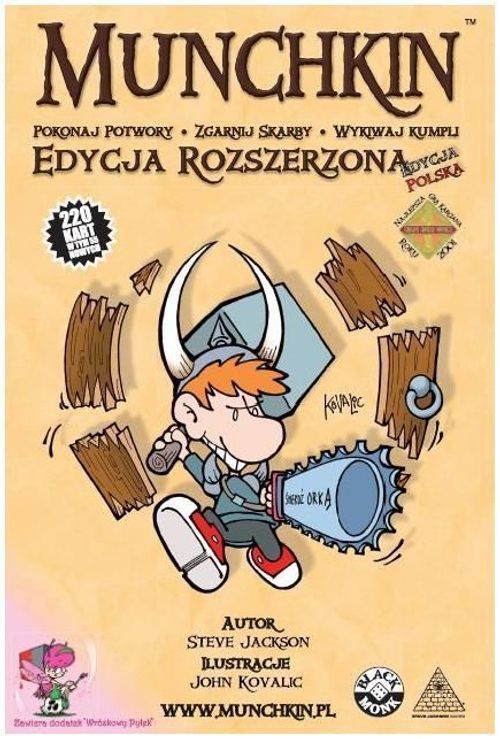
Munchkin Edycja Rozszerzona
Munchkin Edycja Rozszerzona Rulebook
Table of Contents
Table of Contents
- 1. Box Contents
- 2. Setting Up the Game
- 3. Handling Cards
- 4. Creating Your Character
- Card Text and These Rules
- 5. Starting and Ending the Game
- 6. Turn Phases
- 7. Combat
- 8. Character Statistics
- 9. Treasures and Items
- 10. When to Play Cards
- Munchkin XXL: Ways to Take the Game Further
- Munchkin Fairy Dust
1. Box Contents
- 165 playing cards
- One six-sided die
- This rulebook
2. Setting Up the Game
The game is for 3 to 6 players. Two players can also play, but the game is more fun with more players.
You will need 10 tokens for each player (coins, poker chips, or anything else that lets you count to 10). Instead of tokens you can use one ten-sided die per player, or the special Munchkin Level counters. Tokens or k10 dice make it easy to keep track of each character's current Level. A regular six-sided die is also useful (one is included in the box).
First, separate the cards into Door cards (with the picture of a barred door) and Treasure cards (with the picture of a pile of precious "junk"). Shuffle both decks. Then deal each player eight cards: 4 Door cards and 4 Treasure cards.
3. Handling Cards
Keep the Door and Treasure cards in two face-down piles. Each of these piles needs its own discard pile, kept face up. You may not look through the discard piles unless a card you play allows you to. If a draw pile runs out, shuffle the matching discard pile and use it again. If a draw pile runs out and there are no discards of that type, nobody may draw cards of that type, but the game goes on!
Your hand: Cards you hold in your hand are not in play. They do not help you, and they cannot be taken from you, unless the text of an opponent's card clearly says it affects your hand.
At the end of your turn you may not have more than 5 cards in your hand (6 if you are a Dwarf).
Carried Items (cards "in play"): You may play Treasures from your hand onto the table. They become Items you carry (see "Items"). Races and Classes may also be played this way. Such cards are now considered to be "in play."
When you may play cards: Cards may be played at particular moments, depending on the type of card (see "When to Play Cards").
Cards in play cannot return to your hand. If you want to get rid of them, you must discard or sell them.
4. Creating Your Character
You start the game as a first-level Human with no class (ha, ha). At the start of the game your character's gender is the same as yours.
Look at the eight cards you start with. If any of them are Races or Classes, you may, if you like, play one of each type now: put it on the table in front of you. If you have any Items in your hand, you may also play them in front of you on the table.
If you are unsure whether it is worth playing a card now, read on, or simply go for it and play everything you can.
Card Text and These Rules
This is a sidebar printed beside section 5 of the Polish rulebook.
This rulebook contains the general rules of the game. Cards may add special, additional rules, so in the vast majority of cases, if this rulebook disagrees with a card, use the rule on the card. Card rules take precedence over this rulebook. However, ignore any effect a card might give if it conflicts with one of the following rules, unless the card clearly states that it is an exception and these rules do not apply to it.
- Nothing can reduce a character's Level below Level 1, but card effects can reduce a character's or a Monster's combat strength below 1.
- You gain a Level after combat only if you killed the Monster.
- You may not collect the reward for defeating a Monster (that is, Treasures and Levels) during the combat. You must finish the combat before you collect the loot.
- You must kill a Monster to gain Level 10. You may not buy the winning Level or gain it through cards of the type "You gain 1 Level," and so on.
All disputes should be settled during a loud argument in which the owner of the game has the final word. You can also look for answers to your questions and doubts on the publisher's websites and in the community groups listed in the published edition.
5. Starting and Ending the Game
To choose the first player, consult an oracle, read the stars, roll the die, or decide in any other way that suits the players. The game is played in turns made up of phases (see "Turn Phases"). When a player finishes a turn, the turn passes to the player on his or her left, and so on.
The first player to reach Level 10 wins. However, you can reach Level 10 only by killing a Monster, unless a card clearly states that you can win through it. If several players reach Level 10 at the same time, they win together.
6. Turn Phases
At the start of your turn you may play cards from your hand onto the table, decide which Items you want to use and which you cannot use (for example because they are reserved for another Class). You may also trade Items with other players and sell Items for Levels. Once you have prepared your character for combat and tidied up your cards, you may move on to Phase 1.
(Phase 1) Open the Door: Draw one card from the Door deck and place it face up on the table (revealed to everyone). If it is a Monster, you must fight it (see "Combat"). Finish the combat before moving on to later phases.
If you meet and kill a Monster, you gain 1 Level (or, for more powerful opponents, 2 Levels, which will be marked on the Monster's card). You also gain the appropriate number of Treasures, which is also marked on the Monster's card. You draw Treasures face down if you killed the Monster alone, and face up if someone helped you. If you met a Monster but ran away, you get no Treasures. If the card you drew is a Curse, immediately follow the instructions on it, and then discard it. If you drew any other card, you may take it into your hand or play it immediately.
(Phase 2) Look for Trouble: If in the previous phase you did NOT meet a Monster, you may now play a Monster from your hand (if you have one, of course) and fight it under the normal rules (see "Combat"). Do not play a Monster if you know you will not kill it, unless you are counting on help from the other players or have some extremely clever plan.
When You May Act
At any time you may:
- Discard a Class or a Race.
- Play a "You Gain 1 Level" card or a Henchman (Przydupas).
- Play a Curse.
At any time... as long as you are not taking part in a combat, you may:
- Trade Items with another player (who also may not be in a combat at that moment).
- Swap Items you are currently using for others.
- Play a card you have just received (some cards may also be played during a combat, see above).
During your turn:
- Play a new Class or Race (at any time).
- Sell Items to gain 1 Level (not during a combat).
- Play an Item (most Items may not be played during a combat, but some single-use Items may be, see "Single-Use Items").
(Phase 3) Loot the Room: If you did not meet a Monster and did not Look for Trouble, you have the right to loot the room: draw one face-down card from the Door deck and take it into your hand. If you met a Monster but had to run away, you may not loot the room.
(Phase 4) Show Mercy: If at the end of your turn you have too many cards in your hand (more than 5), it is better to play those you can immediately. Otherwise you must give the excess to a living player on the lowest Level. If there is a tie, divide the cards as evenly as possible (but you decide who gets the larger share). If you yourself have the lowest Level (or are one of the players on the lowest Level), simply discard the excess. Then the turn of the player on your left begins.
7. Combat
Combat starts immediately when you draw a Monster from the deck in the Open the Door phase, or when you play one from your hand in the Look for Trouble phase.
To resolve a combat, compare your combat strength (Level plus bonuses) with the combat strength (Level plus bonuses) of the Monster. The Monster's Level is shown at the top of its card. If your combat strength (your Level, together with all positive and negative bonuses from the Items you use, your class abilities, and other cards) is higher than the Monster's combat strength (its Level together with its bonuses and other modifiers), you kill it. If it is a tie, or the Monster has higher combat strength, you lose and must Run Away or suffer Bad Stuff! If you kill the Monster, you collect the number of Treasures and Levels shown on its card (if the card does not state a number of Levels, defeating such a Monster gives 1 Level).
Sometimes a Monster's card will say that it can be defeated without combat. This still counts as a "victory," but you do not gain Levels for it. You also do not gain Treasures, unless the card clearly says otherwise.
Some Monsters have special abilities that affect combat (for example a bonus against a particular Class). Remember to take them into account.
You may also use single-use Items during a combat. These are Items marked "single-use" and played from your hand, or cards that give you a Level. You may also use single-use Items you have on the table. Discard them after the combat, whether you won or not.
Note that both your character and the Monster may be affected by various cards that modify your combat strength, giving positive and negative modifiers. Other players may also affect your combat strength by playing various cards. Specific modifiers and rules are described on those cards. Some Door cards may also be played during combat, for example Monster Enhancers.
During combat you may not steal or trade. You also may not sell Items, equip your character with Items from your hand (except by playing "single-use" cards), or discard Items. If a Monster has already appeared, you must fight it with the equipment you have in play, plus any number of single-use Items. Be careful, though: someone may play a nasty card or use a special ability even if you were already sure of your victory.
When you announce that you have defeated a Monster, you must wait long enough to give the other players time to react (2.66 seconds is long enough). Only then do you kill the Monster, gain a Level, and take the Treasure. The other players will of course keep complaining and arguing.
If you cannot defeat a Monster, you have two options: ask for help, or try to Run Away.
Multiple Monsters: If additional opponents join the combat (for example through the Wandering Monster card), you must defeat the sum of their combat strength (Levels plus bonuses). Any special abilities (for example ones forcing you to fight only using your Levels) apply to the whole combat. You fight all the Monsters at once or Run Away from all of them. You may not decide to fight one and try to Run Away from the other. Certain cards may allow you to discard one Monster from the combat; you then fight the remaining one(s) normally. If you discard one Monster with such a card and run away from the remaining Monsters, you get no Treasures. If you kill a Monster, you immediately gain 1 Level (or two, for some very dangerous Monsters). If you killed several Monsters, you gain Levels for each of them!
Interfering in Combat: This is a sidebar printed beside the combat text in the Polish rulebook.
You may interfere in other players' combats in several ways:
- Play a single-use card: if you have an Item with such a description, you may use it against the Monster that your friend is fighting. Of course, accidents happen and you may "quite by chance" use the same card against your friend...
- Play a Monster Enhancer card: these cards make the combat harder, but victory brings greater rewards. You may play them either during your own combat (carefully!) or during someone else's combat.
- Play a Wandering Monster: this card lets you add a Monster from your hand to any combat.
- Put a Curse on your buddy, if you have one, or Stab Him in the Back, if you are a Thief.
Help: If you know that you cannot defeat a Monster alone, you may ask any player for help in the combat. If they refuse, you may ask another player, and so on, until everyone has snubbed you or someone decides to help. Only one player at a time may help you in a combat.
You may try to bribe other players to help you. You will probably even have to. You may offer any (or all) of your carried Items (in play) or any number of the Monster's Treasures. If you agree to divide the Monster's Treasures, decide who chooses first. When someone helps you in a combat, you add their combat strength to yours.
Special abilities of Monsters also work against the player who helps you, and vice versa. For example, if a Warrior helps you, you win if the sum of your combat strength (your Levels and bonuses) is greater than or equal to the sum that the Monsters have. A Warrior wins ties even when helping someone. He may also discard cards to increase his combat strength (but only once per combat, not once per Monster).
If you are fighting an Almost-Vampire and a Priest helps you, he may automatically chase it away. And if you face a Drooling Slime and an Elf helps you, the Monster's combat strength increases by 4 (if you are an Elf too, the Monster does not get the bonus twice).
If the sum of the combat strength (Levels and bonuses) of you and your helper is greater than the combat strength of the Monster, the Monster is killed. Discard its card and take its Treasure. You gain Levels for the killed Monster, your helper does not.
Running Away and Bad Stuff: If no one wants to help you, or if someone tried to help you but you lost (usually thanks to the collective effort of the other players), you must Run Away (your not-very-helpful helper too).
If you try to Run Away, you gain no Levels or Treasures. You also do not Loot the Room (that is, you do not draw a face-down Door card in the Loot the Room phase). And you do not always succeed in getting away...
Roll the six-sided die. Running away succeeds on a result of 5 or more. Some Items increase the chance of a successful escape, while the special abilities of some Monsters decrease your chances. If you succeed in running away, discard the Monster. You do not gain its Treasure. Usually nothing bad happens, but just in case, read the card: some Monsters can still make your life difficult even if you ran away!
If you fail to run away, the Monster catches you and the Bad Stuff described on its card takes effect. Its effects vary, from having to discard Items, through losing Levels, all the way to Death.
If two players fought together against a Monster and lost, both must Run Away. They roll the dice separately. The Monster catches only those whose roll failed.
If you are running away from several Monsters, roll separately for each of them, in an order you choose, and apply the Bad Stuff of each one that catches you. After the combat and the resolution of the escape, discard the Monsters.
Death: When you die, you lose your entire possessions, and the Monsters leave you alone. You keep only your Races, Classes, Levels, and Curses (if they are still in effect), so that your new character looks exactly like the previous one. You also keep the Half-Breed and/or Super Munchkin cards if you have them. Your buddies may loot your corpse of all its goods.
Looting the Corpse: Place the cards from your hand face up next to the cards you had in play. Starting with the player at the highest Level (ties are resolved by rolling the die), each player chooses and keeps one card. If you run out of cards, the other players must make do without. If any cards are left over, discard them.
Dead characters may not receive any cards, even through Show Mercy, nor gain a Level.
After death, your new character appears in play at the very start of the next player's turn and may immediately help others in combat, but for now has no cards. Begin your next turn by drawing four cards from each deck, face down, and playing any Class, Race, and Items you wish (just as if you were starting the game).
Rewards: When you kill a Monster you gain 1 Level, unless the Monster's card says otherwise. You also get all the Treasures it guards! Each Monster has a Treasure count printed on its card. Draw the stated number of Treasures, remembering any changes from Monster Enhancers you have played. If you fought alone, draw face down. If someone helped you, draw face up, so that everyone can see what you got. You may play the drawn cards immediately, even if you only helped in the combat.
If you defeated a Monster using a special ability or card, you do not gain Levels, and you may not get Treasures either. Check what the card says about it.
Combat Example: This is a sidebar printed beside the escape rules in the Polish rulebook.
Arek is a 4-Level Warrior with the Chainsaw of Bloody Dismemberment (Piła Łańcuchowa Krwawego Rozczłonkowania), which gives him +3 to combat strength. He opens a door and reveals a Forum Troll, a Monster of Level 10. Arek has a strength of 7 (4 Levels + 3 from the Chainsaw), the Troll has 10, so Arek is losing...
For now.
Arek decides to play Magic Missile (Magiczny Pocisk), which gives him an extra +5 in this combat. Now his combat strength is 12, which is higher than the Troll's 10.
Arek: Troll, die!
Zuza: Not so fast. The Troll becomes Enraged.
Zuza plays the Enraged card, which gives the Monster a +5 bonus. Now Arek loses 12 to 15.
Arek: Oh, come on!
Zuza: Do you need help? (Zuza is a 2-Level Elf wearing Boots of Butt-Kicking, so her combat strength is 4. Together with Arek's 12, they have 16, just enough to beat the Troll's 15.)
Arek: Let you help me and gain a Level? No way! I'm going into a Battle Frenzy.
Arek uses the special ability of the Warrior and discards three cards: a Thief and a Wandering Monster from his hand, and Elfish Igristoje (Elfickoje Igristoje) from his carried Items. Each card discarded this way gives him +1 more.
Zuza: Not the Elfish Igristoje! No...
Arek: That gave me +3, so it's a tie, 15 to 15. But since I am a Warrior, I win ties. So I kill the Troll, unless anyone else wants to pick a fight with me. Volunteers?
The team stays silent, so Arek gains a Level and takes the Troll's treasures: three from the Forum Troll card, and one extra, because it was Enraged.
The game goes on...
8. Character Statistics
Each character consists of Weapons, Armour, fancy Items, and three attributes: Level, Race, and Class. For example, you might describe your character like this: "I am an 8-Level Elf Wizard with Boots of Butt-Kicking, the Wand of Apocalypse, and Knee Pads of Enchantment."
At the start of the game your character's gender is the same as yours.
Level: Shows how buff you are (although Monsters also have Levels). You mark your current Level by placing tokens in front of you or by turning a ten-sided die so that it shows the appropriate number. A Level can be between 1 and 10. During the game you will gain and lose Levels. You gain a Level if you kill a Monster or if a card you play says so. You may also sell Items to buy a Level (see "Items"). You lose a Level if a card you play says so. Your Level can never fall below 1. Even so, during combat your combat strength (the sum of your Level and all modifiers) can be negative.
Race: Player characters may be Humans, Elves, Dwarves, or Halflings. If you have no Race card in front of you, you are a Human. Humans have no special abilities. Every other Race has special abilities described on its card. They start working as soon as you play the Race card, and stop as soon as you discard it. Using most special abilities requires discarding cards. To use an ability, you may discard any card of yours, from your hand or from the table. You may discard your Race card at any time, even during combat ("I don't want to be an Elf any more!"). After discarding a Race card you become a Human again. You may not have more than one Race at a time, unless you play a Half-Breed. You may not have two identical Races.
Class: Characters may be Warriors, Wizards, Thieves, or Priests. If you do not have a Class card, you have no class. (Yes, this joke has already been made here...)
Each Class has special abilities described on its card. They start working as soon as you play the Class card, and stop as soon as you discard it. Using most special abilities requires discarding cards. To use an ability, you may discard any card of yours, from your hand or from the table. However, if you have no cards in your hand, you cannot "discard your whole hand."
The Class card says when its special abilities can be used. For example, a Thief cannot steal Items from a player who is in combat. A combat lasts from the moment the Monster card is drawn.
You may discard a Class card at any time, even during combat ("I don't want to be a Wizard any more!"). After discarding a Class card you become a classless character (the joke about having no class will not be repeated this time).
You may not have more than one Class at a time, unless you play Super Munchkin. You also may not have two identical Classes.
9. Treasures and Items
Treasures are both those Items that give you a permanent bonus, and single-use Items, as well as certain special cards that are not Items. Each Treasure card may be played immediately when you receive it, or at any time during your turn, as long as you are not in combat (unless the card's rules clearly say otherwise).
Items: Most Treasures are Items. All Items have a value expressed in Gold Pieces (Worthless Items are worth 0 Gold Pieces). Items that currently give you bonuses are your Items in use. Items you are not using should be turned sideways. You may not change the Items you are currently using during combat or while attempting to Run Away.
You may carry any number of Small Items, but only one Large Item. Each Item that is not described as Large is Small. You may not simply discard one Large Item in order to play another. You must sell it, trade it, or lose it as a result of a Curse or Bad Stuff, or discard it as part of using a special ability of your Class or Race. Each character may use at the same time only one Helmet, one Suit of Armour, one pair of Boots, up to two One-Handed Weapons, or one Two-Handed Weapon... unless a card allows you to ignore these limits, for example the Cheater or the Henchman. Some Items have restrictions. For example, the Cloak of Shadows may be worn only by Thieves. Only members of that Class will get the bonuses from using that Item.
Items that have no restrictions listed may be used by everyone. You may not simply discard an Item. You may sell Items to buy a Level, trade them with other players, or give an Item to another player. You may also discard Items to activate special abilities of Classes. Some Curses or Monsters' Bad Stuff may also force you to discard something.
Trading: You may exchange Items (but not other cards) with the other players. You may trade only Items from the table (that are in play), never cards from your hand. You may trade at any time, as long as neither you nor the player you are trading with is taking part in a combat. Really, the best time to trade is outside your own turn. Each Item being traded must be in play.
You may also give an Item to someone without getting anything in return, for example to bribe other players: "I'll give you this sword if you don't help Jas." You may show your cards to the other players. Why would we forbid that?
Selling Items: At any time during your turn, apart from combat and running away, you may discard Items with a total value of 1000 Gold Pieces in order to gain 1 Level (cards "Worthless" count as 0 Gold Pieces). You do not get change if you discard more. However, if you can discard 2000 Gold Pieces at once, you get 2 Levels, and so on. You may sell Items both from your hand and from the table. You may not buy the winning 10th Level; you must win it in combat.
Single-Use Items: A Treasure card on which it says "single-use" is treated as an Item that may be used only once. Most of these cards are used during combat to help either the players or the Monsters. Some have other effects, however, so read the cards carefully! They may be played from your hand or from the table. Discard them as soon as the combat ends.
Other Treasures: Other Treasure cards (such as "You Gain 1 Level") are not Items. Most of these cards say when they may be played and whether they stay in play or are discarded. "You gain 1 Level" cards may be played on yourself or on any other player, at any time, even during combat. Discard them right after use. You may not use a "You gain 1 Level" card to get the winning Level in this way, unless the card clearly says you can win with it!
10. When to Play Cards
Monsters: Monsters drawn face down during the Open the Door phase attack the player who drew them. Combat starts immediately. Monsters obtained in another way may be played from your hand during the Look for Trouble phase, or on another player with a Wandering Monster card. For the purposes of rules, each Monster card represents one Monster.
Undead Monsters: Several Monsters in the deck are marked as Undead. You may play any Undead Monster from your hand into a combat to help another Undead Monster, without having to use a Wandering Monster card. If you have a card that can turn a Monster into an Undead, you may play it on a normal Monster and apply the rule above.
Monster Enhancers: One type of card, called Monster Enhancers, may raise or lower the combat strength of a Monster. They may be played by any player during any combat. All modifiers that change a Monster's Level are added together. If two different Monsters take part in a combat (through a Wandering Monster card), when you play an enhancer you must choose which Monster it applies to.
Playing Items: Treasures may be played immediately after you receive them, or at any time during your turn, but outside combat, unless the card says otherwise. Some Treasures are "special" cards (such as "You Gain 1 Level"); you may play them at any time, unless the text on the card says otherwise. Once you have carried out the instruction, discard them.
Using Items: All single-use Items may be used from the table or played straight from your hand. The other Items may be used only if they lie on the table. On your turn you may play them onto the table and use them at once. However, if you help someone in combat, or otherwise fight outside your turn, you may not play new non-single-use Items onto the table. You may keep on the table Items you are not legally allowed to use (for example because of Race or Class restrictions). Turn such Items sideways. They are "carried" but unused: their bonuses and rules do not affect you. Exception: you may have only one Large Item in play at a time, unless you have a Class or other card that lets you have more.
Curses: Curses drawn face down during the Open the Door phase immediately affect the player who drew them. Curses obtained in another way may be played later, at any time, on any player: during your turn or during another player's turn. At absolutely any time, yes? There is nothing more fun than casting a Curse on someone at the moment they think they have killed a Monster, right?
Curses must be resolved immediately (if possible), and then discarded. The exception is Curses that last until the next combat, or whose effect goes on and on and on... This will be described on the specific Curse card. Keep those cards until you get rid of them. When someone plays a Curse on you that works "in the next combat," during your combat, its effect counts in that very combat! (Curse cards you keep on the table as a reminder of their effect cannot be discarded by the abilities of Races or Classes, but well done for the idea!)
If a Curse may affect more than one Item, the victim chooses which Item is discarded or cursed.
If a Curse refers to something you do not have, ignore it. For example, if you draw a Curse that makes you discard your Boots and you are not wearing any boots, nothing happens. Discard that card.
It may happen that it pays to cast a Curse on yourself. This is allowed. And very Munchkin.
Races and Classes: You may play these cards onto the table immediately after you receive them, or at any time during your own turn. Similar rules apply to Half-Breed and Super Munchkin cards, but remember that you must have one Race/Class card in order to play them.
Mixed Super Munchkin: Super Munchkin and Half-Breed cards may be played at any time when a Class or Race card may be played, as long as you have a Class (for Super Munchkin) or a Race (for Half-Breed) to attach them to. You may not have more than one of the same Class or Race at a time. If you play Super Munchkin while you have only one Class, you get all its advantages (the ability to use Items reserved for that Class, and the negative modifiers Monsters have against it) and none of its disadvantages (you may use Items that the Class normally cannot use, and Monsters do not get bonuses against you). However, if the Class has an ability that requires paying some cost (for example, discarding cards), you must keep paying it all the time: you are not that Super! (All of the above rules also apply to a Half-Breed with respect to Race cards.)
Munchkin XXL: Ways to Take the Game Further
Research shows that 8.4 out of 9.7 Munchkin players cannot tear themselves away from the game and stop playing it. Here are a few tips for taking your game of Munchkin to a slightly different level.
Mixing Munchkin Games: You may combine two or more base games or expansions from different Munchkin worlds to create a multi-cult mix. Fantasy and Pirates? Pirates and Cthulhu? Zombies and Cthulhu? No problem! All of these games are built on almost identical mechanics and are compatible with each other. Combining the specific rules of the expansions should not be a problem. If in doubt, you can always argue about who is right.
Expansions: Every Munchkin base game has, or will have, further expansions that add extra Monsters, Levels, Treasures, and plenty of other cards.
Faster Game: To play a faster Munchkin, you may add a "Phase 0," called "Eavesdropping at the Door." At the start of your turn, draw one new Door card; you may use it at once, or keep it for later. After that you may move on to the normal opening of doors. If you are searching a room, draw a new Treasure instead of a Door card.
Shared Victory: You may also allow shared victory: if players defeat a Monster together, both of them may gain 1 Level, just as with the helping elf in normal Munchkin.
Munchkin Fairy Dust
Source note: the Fairy Dust rules below are the official English rules of Munchkin Fairy Dust (Steve Jackson Games, Rules version 1.0, August 2009), reproduced as published. They are not from the Polish edition, which includes Fairy Dust in the compilation without a Polish rules text. Credits and the copyright notice are omitted.
Meet the Sparkly Good Fairy. She is powerful, cute, and sickeningly sweet. She will hide in the shadows and sprinkle Fairy Dust on you . . . but only if you're nice. Fortunately, when you catch the interfering little twit, you can kill her. Maybe.
This expansion can be used with just the Munchkin core set, or with as many expansions as you like. However, the more expansions you use, the less likely you are to encounter the Sparkly Good Fairy during the game. If you want to improve your chances, leave the SGF out of the Door deck while you are shuffling. When you are done, take the top inch or so of Door cards, shuffle the SGF into that stack, and replace it on top of the Door deck.
Shuffle the Sparkly Good Fairy card into the Door deck.
The other cards are Fairy Dust cards. They have their own special back. Shuffle them and put them out as their own mini-deck.
Discarded Fairy Dust cards are not reshuffled. They're out of the game. When the Fairy Dust deck is empty, that's that.
Getting Fairy Dust Cards
The SGF rewards the munchkins for being nice to each other.*
Draw a Fairy Dust card when either:
- You help another player in combat, and your side wins. You earn one card per combat, not one per monster. Or . . .
- You cancel a Curse cast at another player.
Fairy Dust cards with values are Items and can be traded. Other Fairy Dust cards cannot be traded. Unlike other cards, you keep FD cards if you die. FD cards in your hand count toward your hand size, just like any other cards.
Killing the Sparkly Good Fairy
The SGF is a monster and can be killed. If you kill her, the treasure you draw is four regular Treasure cards and two Fairy Dust cards (unless all the FD cards are gone).
If any FD cards are left after that, they can no longer be drawn in the regular way. Instead, put them on top of the Treasure deck!
Failing to Kill the Sparkly Good Fairy
If you can't defeat the SGF, she does not vanish. She'll be back soon. Take the top 10 Door cards, shuffle the SGF with them, and put them back on top of the Door deck.
Sparkly Good Bad Stuff
If you try to Run Away from the SGF and fail, then you are charmed until your next turn. If anyone asks you to help in a combat, you must help. They don't have to reward you, and you do NOT get a Fairy Dust card. (Elves still get a level if they help kill a monster.)
* This seems very non-Munchkin, but relax . . . it's munchkinly to be nice to others if you are REWARDED for it.