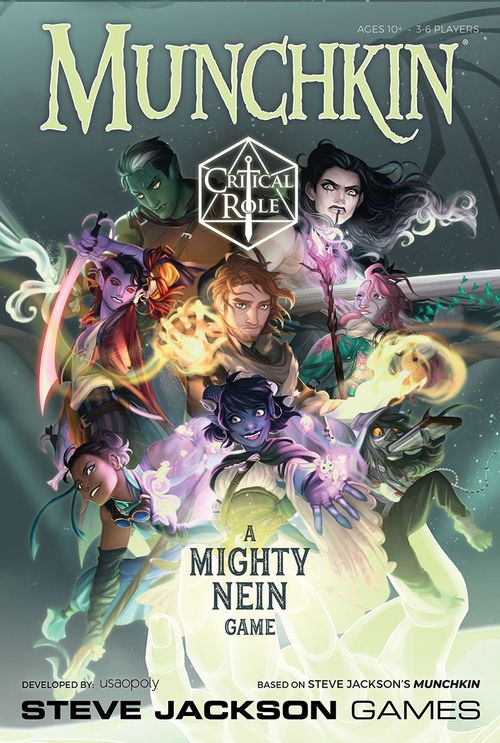
Munchkin: Critical Role
Munchkin: Critical Role Rulebook
Table of Contents
Table of Contents
- Game Contents
- Setup
- Card Management
- Character Creation
- Starting and Finishing the Game
- Conflicts Between Cards and Rules
- Turn Phases
- Character Stats
- Equipping Items
- When You May Take Actions
- Treasures
- Combat
- Interfering with Combat
- Monsters
- Rewards
- Running Away and Bad Stuff
- Curses
- Death
- Example of Combat, with Numbers and Everything
- Faster Play Rules
- Combining Other Munchkin Sets
- Super-Sized Munchkin
- The Munchkin Network
Game Contents
- 172 cards
- 7 oversized Character cards
- 6 plastic trackers
- 1 D20
- 1 six-sided die
- these rules
Setup
Three to six can play. Divide the cards into the Door and Treasure decks, as indicated by card backs. Shuffle both decks and deal four cards from each deck to every player. Also, deal one Character card at random to every player.
Card Management
DOOR AND TREASURE DECKS: Place the Door and Treasure decks face-down in the middle of the table. Keep separate face-up discard piles for the two decks. You may not look through the discards unless you play a card that allows you to do so!
CARDS IN PLAY: These are the cards on the table in front of you showing your Role and Drive (if any), Guest Stars working with you, and the Items you are carrying, equipped or not. Persistent Curses and some other cards also stay on the table after you play them. All cards in play must be visible to other players.
YOUR HAND: Cards in your hand are not in play. They don't help you, but they can't be taken away except by cards that specifically affect "your hand." At the end of your turn, you may have no more than five cards in your hand (see Charity, below).
Cards in play may not be returned to your hand – they must be discarded or traded if you want to get rid of them.
Character Creation
Each member of the Mighty Nein starts at Level 1, each with special abilities as described by their Character card. Look at your starting eight cards. If you have any Role or Drive cards you may (if you like) play one of each by placing them in front of you. If you have any usable Items or Guest Star cards, you may play them by placing them in front of you. If you have any doubt about whether you should play a card, you could read on, or you could just go ahead and do it.
Note, Character cards are double-sided. The special abilities are the same on both sides, and either side may be used.
For example, Nott the Brave's character ability, Drinking Solution, means that anytime a helper other than you draws a Treasure, you also draw one Treasure card.
Starting and Finishing the Game
We suggest rolling the 20-sided die to see who has the highest initiative, but it's up to you.
Play proceeds in turns, each with several phases (see Turn Phases, below). When the first player finishes his or her turn, the player to the left takes a turn, and so on.
The first player to reach Level 10 wins . . . but you must reach Level 10 by defeating a monster, unless a card specifically allows you to win another way.
Conflicts Between Cards and Rules
This rule sheet gives the general rules. Many cards add special rules, so in most cases when the rules disagree with a card, follow the card. However, ignore any card effect that might seem to contradict one of the rules listed below unless the card explicitly says it supersedes that rule!
- Nothing can reduce a player below Level 1, although card effects might reduce a player's or a monster's combat strength below 1.
- You go up a level after combat only if you defeat a monster.
- You cannot collect rewards for defeating a monster (e.g., Treasure, levels) in the middle of a combat. You must finish the fight before gaining any rewards.
- You must defeat a monster to reach Level 10 and win, unless otherwise stated by a card. You cannot force another player to help you reach Level 10.
Any other disputes should be settled by loud arguments, with the owner of the game having the last word.
Turn Phases
Your turn begins as soon as the previous player's turn ends, and it is broken up into a number of phases. First, equip and arrange your cards the way you want, then go to phase 1 – Kick Open the Door.
(1) KICK OPEN THE DOOR: Draw the top card from the Door deck and turn it face-up. If it is a monster, you must fight it (see Combat, below). If it is a Curse, it applies to you immediately and is discarded, unless it has a persistent effect or you keep the card as a reminder of an upcoming effect (see Curses, below). If you draw any other card (Role, Drive, Guest Star, monster enhancer, etc.), you may either put it in your hand or play it immediately if you want to and it is legal to do so.
(2) LOOK FOR TROUBLE OR LOOT THE ROOM: If you fought a monster in phase 1, skip this phase and go to phase 3. If you did NOT draw a monster when you Kicked Open the Door, you have two choices: either Look for Trouble or Loot the Room.
Look For Trouble: You may play a monster card from your hand and fight it, just as if you had found it by kicking open the door. Don't play a monster you can't handle, unless you think you can get some help (see Asking for Help, below)!
Loot The Room: If you don't have a monster you want to fight, you draw a second card from the Door deck, face-down, and place it in your hand. If it is a monster, you can save it for later, either to fight when you Look for Trouble or to join a combat by using a Wandering Monster card. If it is a Curse, save it to play on a player when the time is right! You can play a Role, Drive, or Guest Star immediately, if you want, or save it in your hand for later.
(3) CHARITY: If you have more than five cards in your hand, you must play enough cards to get you to five or below – for instance, you can play Curses, sell Items from your hand, or play Items to the table. If you cannot reduce your hand to five cards, or do not want to, you must give the excess cards to the player with the lowest Level. If other players are tied for lowest, divide the cards as evenly as possible, but it's up to you who gets the bigger set(s) of leftovers. If YOU are the lowest or tied for lowest, just discard the excess. As soon as you are finished with Charity the next player's turn begins.
Character Stats
Your character, in addition to the Character card itself, is basically a collection of Guest Stars, weapons, armor, and Items, and you have three key stats: Level, Role, and Drive. For instance, you might describe your character as "a Level 6 Rogue, driven by Redemption, armed with a Glove of Blasting and Dwueth'var, wearing Nott's Mask, and accompanied by Pumat Sol."
LEVEL: When the rules or cards refer to your Level (capitalized), they mean this number. You gain a level when you defeat a monster, or when a card says you do. You can also sell Items to buy levels (see Items, below). You lose a level when a card says you do. Your Level can never go below 1.
ROLE: Players may be a Rogue, Fighter, Priest, or Mage. Each Role has special abilities, shown on the card. You gain the abilities of a Role the moment you play its card in front of you, and lose them as soon as you discard that card. Some Role abilities are powered by discards. Unless the card specifies, you may discard any of your cards, in play or in your hand, to power a Role ability. You can discard a Role card at any time, even in combat: "I don't want to be a Fighter anymore." You may play a new Role card at any time on your own turn, or as soon as you get it if it's not your turn.
For example, the Fighter's Reckless Attack ability lets you, once on your turn, discard one card at random from your hand to gain a +2 bonus in combat, while the Fighter's Flurry Blows ability gives you a +2 bonus if you play more than one card when you are in combat.
DRIVE: Characters may be motivated by one of four Drive cards: "Freedom, Protection, Vengeance or Redemption." The rules for Roles also apply to Drives.
CRITICAL ROLE AND DRIVEN: These cards may be played whenever it is legal to play a Role or Drive, as long as you have an appropriate card (Role for Critical Role, Drive for Driven) to attach it to. You cannot have more than one of the same Role or Drive card in play at once. If you play Critical Role with one Role, you get all the advantages of being that Role (monsters with penalties against that Role suffer those penalties) and none of the disadvantages (monsters do not get bonuses because of your Role). If the Role has an ability that has a cost, however, you must still pay it – you aren't that Critical! If you play Critical Role while you have two Roles, you have all the normal advantages and disadvantages of both Roles. The same rules apply to Driven and the Drive cards. You may have two Role cards, and have all the advantages and disadvantages of each. Or, you may have one Role card, and have all the advantages and disadvantages of one, and suffer none of the disadvantages.
GUEST STAR: You may have one Guest Star accompany your character. When you draw a Guest Star, either face-up or face-down, you may play it immediately or keep it in your hand to play later, at any time, even during combat. While in play, your Guest Star may grant you combat bonuses or special abilities. For example, Yeza Brenatto's Guest Star ability grants an additional +1 for the Protection Drive. You can choose to play a new Guest Star and discard the old one whenever you like as well, but you may not trade a Guest Star away to another player.
Guest Stars can be sacrificed to allow automatic escape for you from all monsters in a combat, by discarding the Guest Star instead of rolling to Run Away. If someone was helping you in combat, you can even decide whether or not your helper automatically escapes when you sacrifice a Guest Star. The choice is yours!
Optional Rule
You can only win the game once a total of 3 Boss Monsters have been defeated. Boss Monsters are denoted by the Boss icon. You must be Level 10 to win and it is not possible to reach Level 10 by any means other than killing a Monster, unless a card explicitly states that you may reach Level 10 using it. If more than one player is Level 10 once 3 Boss Monsters have been defeated, the player with the highest total Treasure value is declared the winner.
Equipping Items
A character may equip only: one Headgear, one Armor, one Footgear, two 1-Handed Items, or one 2-Handed Item . . . unless you have a card that lets you ignore these limits, such as a Guest Star or Cheat!, or unless a card says otherwise. If you are carrying two Headgear cards, for example, you can equip only one of them at a time.
You cannot discard Item cards "just because." You may sell Items for a level, trade Items with other players, or give an Item to another player who wants it (see below). You may discard Items to activate some special abilities. And a Curse or a monster's Bad Stuff may force you to get rid of something!
When You May Take Actions
AT ANY TIME:
- Discard a Role.
- Play a Go Up a Level or Guest Star.
- Play a Curse.
AT ANY TIME AS LONG AS YOU ARE NOT IN COMBAT:
- Trade an Item with another player (the other player may not be in combat, either).
- Change which Items you have equipped.
- Play a card that you have just received (some cards may be played even during combat; see above).
ON YOUR OWN TURN:
- Play a new Role (at any time).
- Sell Items for levels (except when you are in combat).
- Play an Item (most Items cannot be played during combat, but some One-Shots can; see One-Shots, below).
Treasures
Treasure cards include both permanent and One-Shots, as well as some special cards not considered Items. Any Treasure card may be played as soon as you get it, or at any time on your own turn except during combat (unless the rules below or the card itself says otherwise).
ITEMS: Most Treasures are Items. All Items have a Gold Piece value.
All Items you have in play are considered "carried." Items that are currently giving you a bonus or some other benefit are "equipped." You should indicate Items that are not equipped by turning the cards sideways. You may not alter the status of your Items during a combat or while Running Away, so make sure you are happy with what you have equipped before entering combat.
Anyone can carry any Item, but there are limits to what you can have equipped and actively use (see Equipping Items, above). Some Items have icons to identify their types.
TRADING: You may trade Items (but no other cards) with other players. You may only trade Items from the table – not from your hand. You may trade at any time except when you or your trading partner are in combat – in fact, the best time to trade is when it's not your turn. Any Item you receive in a trade must remain in play.
You may also give Items away without a trade, to bribe other players – "I'll give you my Headband of Intellect if you won't help the Priest fight The Lost." You may show your hand to others. Dunno why you'd want to, but whatever.
ONE-SHOTS: A Treasure card that says "Usable Once Only" is considered a One-Shot Item. Many of these are used during combat to strengthen the munchkins or the monsters. Some have other effects, however, so read the card carefully! Discard these cards as soon as the combat is over or their effect is resolved. One-Shots may be played directly from your hand. One-Shots that are Items may also be carried and played from the table, or sold for levels just like other Items.
OTHER TREASURES: Other Treasure cards (like Go Up a Level cards) are not Items. Most of these cards say when they can be played, and whether they stay in play or are discarded. Go Up a Level cards may be played on yourself or any other player at any time, even during combat. Discard them once they are played. Exception: You cannot play a Go Up a Level card to give a player the winning level, unless specifically noted otherwise! For example, the Level Nine! card lets you gain a level, or gain two levels if you're Level 7.
SELLING ITEMS FOR LEVELS: At any point during your turn except during combat or Running Away, you may discard Items worth a total of at least 1,000 Gold Pieces and immediately go up one level. If you sell Items worth 1,100 Gold Pieces total, you don't get change. But if you can manage 2,000 worth, you can go up two levels at once, and so on. You may sell Items from your hand as well as those you are carrying. You may not sell Items to go to Level 10.
Combat
A monster enters combat against you if you find it when you Kick Open the Door or play it from your hand to Look for Trouble.
To resolve combat, simply compare the monster's combat strength to yours. Your combat strength is equal to your Level plus any bonuses or penalties you receive from Role abilities, Drives, Items, Guest Stars, and Curses. You and the other players may play One-Shots or use Character abilities to help or harm you in combat. Your combat strength can be negative, if you get hit by a Curse or suffer some other penalty. A monster's combat strength is its Level, plus or minus any modifiers it has from its powers or cards played on it. Some Door cards may also be played into a combat, such as monster enhancers (see Monsters, below).
Optional Rule
When everyone has added all the bonuses they are going to add, the active player rolls the d20.
- 1 – Critical failure; fight is lost, Run Away auto-fails and Bad Stuff happens for all monsters.
- 2–19 – Add this amount to combat strength.
- 20 – Critical hit; automatic victory.
The player to the active player's right also rolls the d20. This is for the monster. There are no critical effects – the result is added to the monster's combat strength.
Now the active player may consult with their helper, if any. The two of them may play ONE MORE CARD if that card would change the result of the combat either by beating the monster(s) directly, by removing a monster from the combat to leave the monster combat strength too low to win, or, of course, by canceling the whole combat somehow. The other players may not respond to that card. If it ends the combat successfully, it is legal to play. If not, it goes back into the owner's hand.
If the monster's combat strength is equal to yours, or greater, you lose the combat and must Run Away (see Running Away and Bad Stuff, below). If your combat strength is greater than the monster's, you defeat it and go up a level (two levels for some big monsters). You'll also get the number of Treasures shown on the monster card.
Sometimes a card will let you overcome a monster without defeating it. This is still "winning," but you don't get a level. Unless the ability says otherwise, you don't get the Treasures, either. If the last monster is removed from a combat, the fight ends immediately.
If you defeat a monster (or monsters!), discard them and any other cards played, and claim your rewards. Note: someone may play a hostile card on you, or use a special power, just as you think you have won. When you are about to defeat a monster, you must wait a reasonable time, defined as about 2.6 seconds, for anyone else to speak up. After that, you have really defeated the monster, and you really get the level(s).
Interfering with Combat
You can interfere with others' combats in several ways, including:
USE A ONE-SHOT ITEM: You could help another player by using a One-Shot to strengthen their side. Of course, you can "accidentally" strengthen the monster with it, instead . . .
PLAY A MONSTER ENHANCER: These cards (usually) make a monster stronger . . . and give it more Treasure. You can play these either during your own combats or during someone else's combat.
ADD A MONSTER FROM YOUR HAND: to join the combat, by using a Wandering Monster card.
CURSE THEM: If you have a Curse card.
Monsters
If drawn face-up, during the Kick Down The Door phase, monsters immediately attack the person who drew them. If you get a monster card any other way, it goes into your hand and may be played during your own turn to Look For Trouble, or played with the Wandering Monster card to join another player's fight (see Fighting Multiple Monsters, below). Each monster card is a single monster, even if the name on the card is plural.
MONSTER ENHANCERS: Certain cards, called monster enhancers, raise or lower the combat strength of individual monsters. (Penalties to monsters are still considered enhancers.) They also affect the number of Treasures a monster is worth. Monster enhancers may be played by any player during any combat. All enhancers on a single monster add together. If there are multiple monsters in a combat, the person who plays each enhancer must choose which monster it applies to. For example, the Nein! enhancer gives +9 to a single monster during any combat, and if that monster is defeated, its owner draws two extra Treasures.
FIGHTING MULTIPLE MONSTERS: Some cards (notably Wandering Monster) allow other monsters to join a combat. You must defeat their combined combat strengths in one fight to defeat them. Any special abilities, such as forcing you to fight with your Level only, apply to the entire fight. If you have the right cards, you can eliminate one monster from the combat and fight the other(s) normally, but you cannot choose to fight one and Run Away from another. If you eliminate one monster, but then run from the other(s), you don't get any levels or Treasure!
ASKING FOR HELP: If you cannot defeat a monster on your own, you may ask any other player to help you. If the first player refuses, you may ask another player, and so on, until they all turn you down or someone helps. Only one player can help you; add that player's combat strength to yours. Anyone can play cards to affect your combat, however! You'll probably have to bribe someone to help. You may offer your helper any Item(s) you are currently carrying, or any number of the Treasure cards the monster is worth. If you offer your helper part of the monster's Treasure, you must agree which of you gets first pick. You may also offer to play any cards from your hand that you legally could, such as Go Up a Level cards, on your helper. The special abilities or weaknesses of the monster also apply to your helper, and vice versa. For instance, if a Rogue helps you fight a Hill Giant, you gain +2 in that Combat. The bonus or penalty is not applied twice if the helper is the same Role as the current player.
If someone successfully helps you defeat the monster, discard it, draw Treasures (see Rewards, below), and follow any special instructions on the monster card. You level up for each monster defeated in combat. Your helper does not go up any levels. You draw the Treasure cards, even if it was your helper's special ability that defeated the monster, and distribute them according to the agreement you reached.
A few cards or abilities allow you to compel another player to help you in combat. These abilities do not work if you are fighting for the win – and if you force someone to help you and then the fight becomes one for the win, your helper gets to back out without penalty. However, if you voluntarily help someone, you don't get to back out just because they're about to win the game – so pay attention!
Rewards
When you defeat a monster, you go up one level per monster, unless the monster card says otherwise. You also get all its Treasure! Sweet! Each monster has a Treasure number on the bottom of its card. Draw that many Treasure cards, modified by any monster enhancers played on it, face-down if you defeated the monster alone, but face-up, so the whole party can see what you got, if someone helped you. Treasure cards can be played as soon as you get them, even if you are the helper.
If you defeat a monster through use of a card or special power, you do not get the level and might not get the Treasure, so be sure to check the card.
Running Away and Bad Stuff
If nobody will help you . . . or if somebody tries to help, and others interfere so you still cannot win . . . you must Run Away. You don't get any levels or Treasure. You don't even get to Loot the Room. And you don't always escape unharmed . . .
To Run Away, you roll the 6-sided die. You successfully Run Away on a 5 or more. Some Character abilities, Role abilities, Drives, and Items make it easier or harder to Run Away from monsters. If you fail to Run Away from a monster, it does Bad Stuff to you, as described by its card. This may vary from losing an Item, to losing one or more levels, to Death (see Death, below). For example, The Laughing Hand has a +2 bonus against Priests, will not pursue anyone Level 3 or below, and its Bad Stuff makes you lose two levels.
If you must flee from multiple monsters, you roll separately to escape each one, in any order you choose, and suffer Bad Stuff from each as soon as you fail to Run Away from it.
If two players are cooperating and still can't defeat the monster(s), they must both Run Away. They roll separately, and each player chooses in what order to Run Away. The monster(s) CAN catch them both.
After resolving all Run Away rolls, discard the monster(s).
Curses
If drawn face-up during the Kick Open the Door phase, a Curse card applies to the player who drew it.
If acquired some other way, such as by Looting The Room, Curse cards go into your hand and may be played on any player at any time. Usually, a Curse affects its victim immediately (if it can) and is then discarded. However, some Curses give a penalty later in the game or have a persistent effect. Keep these cards until you get rid of the Curse or the penalty takes effect. (Persistent Curse cards may not be discarded to power Role abilities. Nice try!)
Note: If someone plays a "your next fight" Curse on you while you are in combat, it counts in that combat! The same is true for a "your next turn" Curse played during your turn.
If a Curse can apply to more than one Item, the victim decides which Item is affected.
If a Curse applies to something you don't have, ignore it. For instance, if you draw Career Change and you don't have a Role card, nothing happens; discard the Curse card. (Some Curses have alternate effects, though, so read the card!)
There will be times when it will help you to play a Curse or monster on yourself, or to "help" another player in a way that costs that player Treasure.
Death
If you die, you lose all your stuff. Once you have died, you don't have to Run Away from any remaining monsters. You keep your Roles, Drives, and Level (and any persistent Curses on you) - your new character will look just like your old one. If you have a Driven or Critical Role, keep those as well. At this point, you may choose to play as a different character by swapping your Character card for another one not in use.
LOOTING THE BODY: Lay out your hand beside the cards you had in play (except the cards listed above). If you have an Item attached to a Cheat! card, separate those cards. Starting with the player with the highest Level, everyone else chooses one card. In case of ties in level, roll a die. Looted cards go into players' hands. Once everyone gets one card, discard the rest. If you run out of cards, tough. Dead characters cannot receive cards for any reason, not even Charity, and cannot level up or win the game.
At the beginning of the next player's turn, you are no longer dead, and your new character appears and can help others in combat with your Level, Character ability, Role and Drive . . . but you have no cards, unless you receive Charity or gifts from other players.
At the start of your next turn, draw four face-down cards from each deck and play any legal cards you want to, just as when you started the game. Then take your turn normally.
Example of Combat, with Numbers and Everything
Nott is a Level 3 Fighter accompanied by Guest Star Yeza Brenetto (+1). She is wearing Maelstrom Gloves (+4 for Fighter), has Step of the Wind (+1) for Footgear and Elven Chain Armor (+3), for a total combat strength of 12.
She Kicks Open the Door and finds a Hydra. The Hydra is Level 8. Nott is winning 12-8.
Nott rolls the 20-sided die and gets a 4, bringing her total combat strength to 16. The player to Nott's right, Fjord, rolls the die for the Hydra and gets a 10, bringing its combat strength to 18! Nott is now losing 16 to 18.
Nott: "Whose side are you on, Fjord?"
Nott has no other cards to add in the battle, and did not request a helper before the die roll. She must try to Run Away. She rolls the 6-sided die and gets a 3; she is unable to Run Away.
Fjord: "I think you lose this one."
Nott admits defeat and suffers the Bad Stuff from the Hydra (Discard 5 cards). Nott discards 3 cards from her hand as well as Step of the Wind and Yeza Brenatto.
Faster Play Rules
For a faster game, you can add a "phase zero" called Listen At The Door. At the start of your turn before doing anything else, draw a face-down Door card, which you may play or not. Then arrange cards and Kick Open The Door normally. If you Loot The Room, draw a face-down Treasure, not a Door.
You can also allow shared victories – if you reach Level 10 in a fight where you had a helper, the helper also wins the game, no matter what Level that player is.
Combining Other Munchkin Sets
Munchkin: Critical Role is based on the same game play found in the original Munchkin game, Super Munchkin, and dozens of Munchkin expansions and accessories. When integrating Munchkin: Critical Role into any Munchkin set, use the combining rules from Munchkin 7 – Cheat With Both Hands as a guide. You can always download the most up-to-date version of those rules, and all others, at munchkin.game/gameplay/rules/
Super-Sized Munchkin
Studies have shown that 8.4 out of 9.7 Munchkin players just can't get enough of the game. Here are some ideas to take your Munchkin games to new highs – or lows:
COMBINING DIFFERENT MUNCHKIN SETS: You can mix two (or more) base sets and expansions together for a genre-crossing mega-Munchkin adventure! When combining sets, we recommend playing without the optional rules from this set.
EXPANSIONS: These add still more monsters to defeat, new Treasure to loot, and sometimes entirely new kinds of cards. Ask for all the Munchkin sets and expansions at your local game or comic store – find it using our Store Finder, storefinder.sjgames.com – but if you don't have a local store, we'll be happy to sell them directly to you at warehouse23.com.
The Munchkin Network
Visit munchkin.game for news, errata, updates, Q&A, and much more. To discuss Munchkin with our staff and your fellow munchkins, visit our forums at forums.sjgames.com.
Use the #PlayMunchkin hashtag on social media to get our attention! Our Twitter feed often has Munchkin news (or bonus rules!): twitter.com/SJGames.
Connect with other fans on our pages for Munchkin (facebook.com/sjgames.munchkin) and Steve Jackson Games (facebook.com/sjgames).
Instagram. We post lots of pictures of new Munchkin stuff to Instagram.com/stevejacksongames.
The URL for this set is munchkin.game/products/games/munchkin-critical-role/