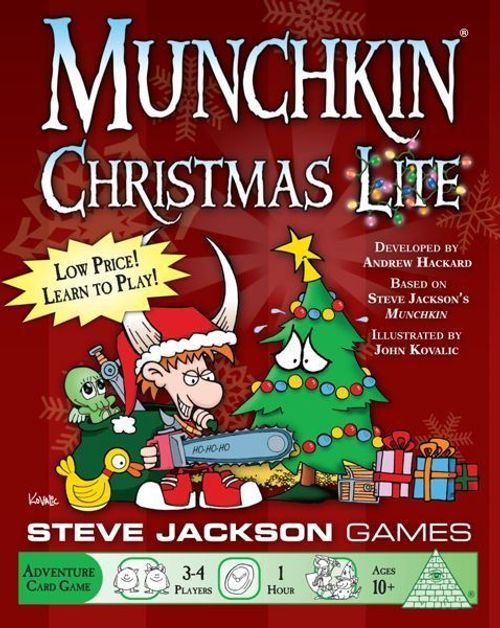
Munchkin: Christmas Lite
Munchkin: Christmas Lite Rulebook
Table of Contents
Table of Contents
Setup
Three to four munchkins go to the party. Besides the cards and the die, each player needs 10 tokens (coins, chips) or some other thing that counts to ten, to track the level of their character.
Divide the cards into the Door deck (a door on the back) and the Treasure deck (a pile of treasure on the back), shuffle them, and deal each player four cards from each deck. Place the decks in the middle of the table.
Cards
Cards are discarded face up; Doors have their own discard pile, and Treasures have theirs. You may look through a discard pile only if a card you played allows you to. At all other times you see only the top card of each pile.
When a deck runs out, shuffle the corresponding discard pile and put it in place of the deck. If both the deck and the discard pile are empty, nobody can draw cards of that type.
Cards in play: these are the cards in front of you: your race, class and items. Curses with a lasting effect that have been played against you, and some other cards, also lie here. Cards in play are public information; they must be visible to all players.
Hand: cards you hold in your hand are not in play. They give no help, but you can lose them only because of special cards that affect the hand directly. At the end of your turn you may hold no more than five cards in your hand (see "Charity" on page 5).
Cards cannot be taken from play back into your hand. If you want to get rid of them, sell them, trade them, or discard them at the cost of other cards.
Conflicts Between the Rules and the Cards
These pages set out the basic rules of Munchkin Christmas Lite. The instructions on some cards contradict the basic rules, and in that case most often the card outranks the rules. However, boldly ignore any instructions on a card if they contradict one of the rules listed below (unless the card separately and unambiguously says that it outranks these rules!).
- Nothing can reduce a munchkin's level below 1, although their Combat Strength (see page 8) can be zero or even negative.
- You gain a level after combat only if you killed a monster.
- You cannot collect the reward for defeating a monster (treasures, levels) in the middle of combat. Finish the combat before reaching for the reward.
- You can reach Level 10 only by killing a monster.
Disputed situations are resolved by a loud argument, in which the last word belongs to the owner of the game. If you wish, you can read the site munchkin.sjgames.com or start a discussion at forums.sjgames.com or vk.com/munchkinofficial. But that is for when you are completely tired of arguing.
Character Creation
At the start of the game your munchkin is a Level 1 character with no class and no race. Munchkins are male or female. At first your munchkin's sex is the same as your own, unless you declare otherwise.
Look over the eight cards you were dealt. If you wish, you may play (lay out from your hand onto the table in front of you) one race card, one class card, and as many item cards as you like.
Starting and Ending the Game
Decide who goes first. Each turn consists of several phases. When you finish your actions in the last phase, pass the turn to the neighbor on your left.
The winner is the first to bring their munchkin to Level 10... but that level must be gained by killing a monster (or with a card that clearly and unambiguously allows you to win some other way).
When You Can Do What
At any time in the game you may:
- discard a race or class;
- play a "Go Up a Level" card;
- play a curse.
At any time in the game except during combat you may:
- trade items with another player (who also must not be in combat);
- "unequip" some items and "equip" others;
- play a card you have just received (some cards can also be played in combat, see above).
Only on your own turn may you:
- play a new race or class (at any moment of the turn);
- sell items for levels (at any moment of the turn except combat);
- play an item (most items cannot be played in combat, but some One-Shot items can, see page 8).
Turn Phases
At the start of your turn you may play cards, "unequip" and "equip" items, trade items with other players and sell items for levels. When you have done everything you wanted with your cards, go on to Phase 1.
1) Kick Open the Door! Turn over the top card of the Door deck. If it is a monster, you must fight it (see "Combat," page 8). If you turned up a curse card (see page 13), it immediately affects your munchkin (if it can) and is discarded (or stays in front of you, if it has a lasting effect). If any other card comes up, you may play it right away or take it into your hand.
2) Look for Trouble / Loot the Room: if in Phase 1 you met a monster, skip this phase and go to Phase 3.
If after kicking open the door you did NOT meet a monster, you have 2 options: look for trouble or loot the room.
Look for Trouble: play a monster card from your hand and fight it by the usual rules, as if you had found it behind the door. Do not unleash an enemy you cannot handle unless you are sure you will be helped (see page 10).
Loot the Room: draw a second Door card from the deck into your hand, without showing it to your opponents.
3) Charity: if you have more than five cards in your hand, either play the extra cards or give the excess to the character with the lowest level. If several players tie for the weakest munchkin, divide the cards among them as evenly as you can. You choose who gets more cards if they cannot be divided equally. If your munchkin is the lowest-level one (or one of them), simply discard the extra cards.
As soon as your generosity is exhausted, another player's turn begins immediately.
Hero Characteristics
A munchkin is a walking collection of weapons, armor and artifacts. Besides items, he has three characteristics: level, class and race. For example, a munchkin can be described like this: "a Level 7 Elf Wizard in Boots of Mighty Kicking and with a Licorice Whip."
Level: a measure of the character's battle readiness and general coolness. A munchkin grows in level by killing monsters, by using special cards and by selling items (see "Items"), while Bad Stuff from monsters, curses and some other cards can lower the level. A munchkin cannot fall below Level 1, but his Combat Strength can be even lower than zero if he is subject to curses or other cards that reduce strength.
Class: your munchkin can be a Warrior, a Wizard, a Thief or a Bard. The class's properties are given on its card. A munchkin gains them the moment you play the class card, and loses them when that card is discarded. Some properties require you to discard cards. If it is not stated where exactly to discard from, you may discard either from your hand or from play.
You can discard a class at any moment in the game, even in combat: "I don't want to be a Wizard." You may play a new class card as soon as you get it, or at any moment of your turn. Remember that a Thief cannot steal other people's items if he or his victim is in combat, and as soon as a monster card is revealed, combat is considered to have already begun!
Race: your munchkin can be a Human, an Elf, an Orc or a Halfling. If there is no race card in front of you, you are a Human. Humans have no special abilities. Everything said above about classes is also true for races.
Treasures
Treasures are either permanent or one-use. Any Treasure card can be played as soon as you receive it or at any moment of your turn except combat (unless the rules below or the card itself say otherwise).
Items
Most Treasures are items. A card counts as an item if it has a price in gold pieces (if it says "No Price," it is worth nothing, but it is still an item).
If you play an item, it is considered that you are "carrying" it. But only "equipped" items give you a bonus. Turn the cards of any "unequipped" items sideways, so it is clear what is on you now and what is not. During combat and while running away you cannot "equip" or "unequip" items.
You may carry any items, but you may "equip" no more than one headgear, one armor, one footgear, and one two-handed item (or two one-handed items), unless some cards cancel one limit or another, as "Cheat!" can. For example, you can have two headgear cards in play, but you may "equip" only one of them.
You cannot simply discard an item just because your left heel itches.
Items can be sold for levels, traded for other people's items, or given to another munchkin if he needs them more (see below). You can discard items to activate certain properties of your race and class. A curse or a monster's Bad Stuff can also deprive you of an item.
Trading: you may trade items (but not other cards!) with opponents. Only items in play can be traded; items from your hand cannot be traded. You may trade at any moment when you are both not in combat. It is best to trade when it is not your turn. All items received in a trade stay in play, and you cannot sell them until the start of your own turn.
You can also bribe opponents with items: "Here is my snow hat, just don't help Makar beat the hippogriff!"
You may "show" your opponents the cards in your hand; that we are powerless to forbid.
Selling items: at any moment of your turn, except during combat or running away, you may discard items with a total value of at least 1,000 gold pieces to immediately gain one level (items marked "no price" are worth 0 gold pieces). If you discard items worth, say, 1,100 gold pieces, you get no change. But if you discard items worth 2,000 gold pieces at once, you gain two levels at once. You may sell items both from play and from your hand. Level 10 cannot be bought with items.
One-Shot Items
One-Shot items (like one-shot moves) are found among the Treasure cards. They can be used either from your hand or from play. Many of them can be played during combat to strengthen either the munchkins or the monsters. Some One-Shot items have other effects as well, so read carefully what is written on the card. At the end of combat, regardless of its outcome, all One-Shot cards that were used in that combat are discarded.
Other Treasures
Other Treasures (such as "Go Up a Level") are not items. Most of them say directly when they can be used. The card also usually says whether it stays in play or must be discarded.
Special case:
- A "Go Up a Level" card can be played on yourself or another munchkin at any moment, even in combat. Discard the card after use. Exception: you cannot play "Go Up a Level" to reach Level 10, the winning level.
Combat
When you fight a monster, compare its strength and yours. Combat Strength is equal to the sum of your level and the modifiers (both positive and negative) from items and other cards. If the monster's Combat Strength is equal to or higher than yours, you lose the combat and must run away (page 12). If your Combat Strength is higher than the monster's, you kill it and gain a level (or two for defeating especially mighty opponents) and as many Treasures as are indicated on the monster's card.
Sometimes a card lets you get rid of a monster without killing it. That is also a victory, but you do not gain a level. Sometimes you will not get Treasures either, but that depends on the card.
Monsters have special properties that affect the balance of power, for example bonuses against a certain class or race. Do not forget to take them into account. Each bonus (or penalty) against a particular class (sex, race) is counted only once, even if two munchkins of that class (sex, race) take part in the combat.
During combat both you and the other players may use One-Shot Treasures, play curses, and use class or race abilities to help or hinder you in combat. Some Door cards, such as Monster Enhancers (see page 9), can also be used in combat.
During combat you cannot sell, "equip," "unequip" or trade items, or play Treasure cards from your hand, unless these rules or the cards themselves say otherwise.
Keep an eye on your opponents: they may use cards or special abilities to change the outcome of the fight. When you defeat a monster, give your opponents a chance to intervene: wait some reasonable time, for example 3.75 seconds. If no one has taken advantage of your patience, now you definitely kill the monster, go up a level, take the Treasures and enjoy the gnashing of the envious's teeth. Discard the defeated monster(s), as well as all Enhancers and One-Shot items played during the combat.
Monsters
A monster drawn face up in the Kick Open the Door phase immediately attacks the one who disturbed it.
A monster obtained in any other way goes into your hand. It can be played in the Look for Trouble phase of your turn or sent into an opponent's combat together with a "Wandering Monster" card (see "Combat with Multiple Monsters" below).
Each monster card counts as one enemy, even if the name is plural.
Monster Enhancers
Despite their name, such cards can not only increase but also decrease a monster's Combat Strength. They also change the number of Treasures you will get for defeating the monster. Any player may use a Monster Enhancer in any combat.
Enhancers played on one monster are cumulative. If more than one monster takes part in the combat, the owner of the Enhancer must say which one the card is played on.
Combat with Multiple Monsters
Some cards (above all the infamous "Wandering Monster") allow opponents to throw new monsters into combat against you. To win such a combat, you must exceed the total Combat Strength of all the enemies. Any special conditions (for example, a requirement to defeat the monster by level alone) apply to the combat as a whole. There are cards that let you drive one monster out of combat and fight the rest, but you cannot fight one and run away from the others. Even if you get rid of one enemy with a card, but then run away from its surviving partner, you will receive no levels and no Treasures!
Santa Monsters
There are Santa monsters in this game. Any Santa monster can be played from your hand into a combat where there is another Santa, without the help of a "Wandering Monster" card.
Interfering in Combat
There are several ways to spoil someone else's happiness.
- One-Shot cards can help any participant in the combat, munchkin or monster alike. Choose whom you are rooting for and influence the outcome of the fight.
- Monster Enhancers give the monster not only strength but also additional Treasures. They can be played not only to bury an opponent but also in your own combat, to get richer on a successful outcome.
- Monsters from your hand can be added to combat with the help of a "Wandering Monster" card or by the Santa monster rule.
- Curses: if you have them, it is simply a sin not to use them.
- Backstabbing: backstab an opponent, if you are a Thief.
Asking for Help
If you cannot defeat a monster alone, try asking for help. You can ask anyone for help, but not everyone will respond. Nevertheless, keep asking until everyone refuses or someone agrees. You may take only one helper. Add his Combat Strength to yours. Do not forget that any player may play cards into the current combat, and this does not count as help!
A helper can (and most often must) be bribed with your items in play (which you can give him after the combat by the trade rules) or with a promise of a share of the Treasures the monster has. If the second option is used, agree how you will divide the Treasures after the victory.
You can also offer to play from your hand cards that you can play by the rules. For example, you can play a "Go Up a Level" card on the helper.
The monster's special advantages and vulnerabilities apply to your helper, and vice versa. Suppose a Warrior has agreed to help you. His Berserker ability will help increase your combined Combat Strength. If you met a pit bull, any player can throw a stick so that it gets distracted and you run away automatically. But when an Elf helps you against the Sleepy Mouse (Мышонок Спросонка), the monster becomes stronger by 4 (unless you are an Elf yourself, or the monster has already increased its Combat Strength).
If you were successfully helped to victory, discard the monster and take the Treasures (see Reward on page 12). Do not forget to carry out the special instructions on the monster card (if there are any). You gain levels for each enemy killed, and your helper does not, unless he is an Elf. If he is an Elf, he gets one level for each monster killed. You draw the Treasure cards, even if the monster died because of your helper's special properties, and then divide them according to your agreement.
Reward
Having won a combat, gain one level for each monster killed (unless the monster card says otherwise) and take the Treasures of all defeated monsters (unless some card says otherwise). At the bottom of each monster card it says how many Treasures the winner is due. If Enhancers were played on the monster, there will be more (or fewer) Treasures. If you fought an enemy one-on-one, draw the cards face down. If you had a helper, draw the Treasures face up so everyone can see what you got.
If you defeated a monster but did not kill it, you do not gain a level. Whether you get Treasures depends on your methods of monster-scaring.
Treasure cards can be played immediately after you get them, even if you did not fight yourself but only helped another munchkin.
Running Away!
If no one agreed to join the combat on your side, or even with help you lack the strength to defeat the monster because of other munchkins' scheming, you will have to run away.
Fleeing from combat brings no levels, no Treasures, and no chance to loot the room. Moreover, even a successful escape does not always pass without consequences.
Roll the die. On a 5 or higher, you get away. Some items and properties make escaping easier or harder. Also, monsters can be fast or slow and can give you a penalty or bonus to running away.
Having caught a munchkin, the monster does to him the Bad Stuff indicated on the card: it deprives him of items or levels.
When running away from several enemies, make a separate roll for each of them in any order and suffer the Bad Stuff from every one that catches you.
If two munchkins fought in the combat, both must run away. Each has his own escape roll. The monster can catch both.
After you have dealt with all the rolls, you may discard the monster(s).
Example of Combat
Denis is a Level 4 Wizard with a Snow Shovel (+3 to Combat Strength). He is fighting a Level 10 Network Troll. Devin plays a Christmas Coral to raise his Combat Strength to 11. Now he defeats the Troll and, if no one intervenes, will win this combat and take a level and Treasures.
Curses
Drawn face up in the Kick Open the Door phase, a curse has its harmful effect on the munchkin who kicked open the door.
Drawn face down or obtained in some other way, a curse can be played on any player at any moment of the game. At any moment, do you hear? What could be more fun than undermining an opponent's fighting ability at the very moment he became sure of victory over a monster?
Right after a curse has taken effect (or the munchkin managed to avoid it), its card goes to the discard pile. As a rule. But there are curses that last for some time or have a delayed effect. Keep such a card with the munchkin until you rid him of the curse or it passes by itself. The cards of curses currently affecting you that you keep with you in this way cannot be discarded to activate a class or race property. If in combat you receive a curse that works "in your next combat," that combat is the current one! The same goes for curses that work "on your next turn" if they affected you during your turn.
If you have several items that fit a curse's effect, you decide which one to sacrifice.
Ignore curses that hit items or other cards that you do not have. So the curse "Lose Your Armor" will have no effect on a munchkin who has no armor anyway.
There are moments when it is useful to play a curse or a monster on yourself. It is no less useful (sometimes) to weaken the monster an opponent is fighting, in order to deprive him of some of the Treasures. This is the essence and spirit of munchkinism. Do not deny yourself such pleasant little things.
Mixing with Other Munchkins
The cards of Munchkin Christmas Lite have the same back as regular and Legendary Munchkin, so it is ideal for mixing both with them and with any expansions for them. In addition, by mixing sets you can play Munchkin Christmas Lite with five and six players.
You can mix Munchkin Christmas Lite with any Munchkin decks you like! Use the mixing rules from Munchkin 7: Cheat with Both Hands ("Двуручный чит"); the rules can always be downloaded from the site hobbyworld.ru. If after the game you are sorting the decks back apart, bear in mind that Munchkin Christmas Lite cards are marked with a special symbol.