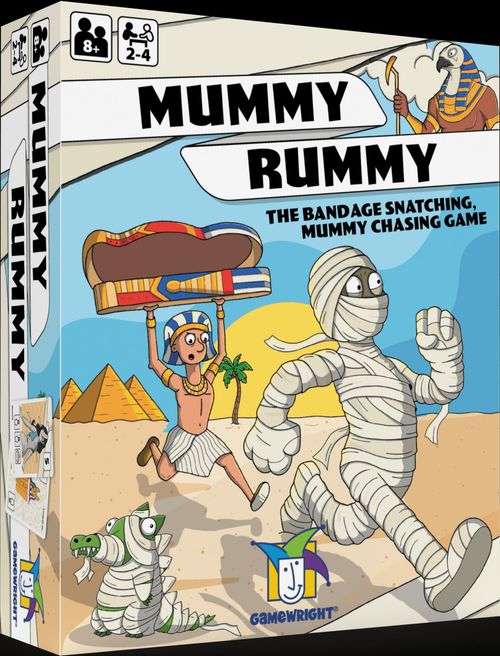
Mummy Rummy
Mummy Rummy Rulebook
Table of Contents
Table of Contents
Playing Directions
The object of the game is to achieve the most points by assembling pictures (Trios) of ancient Egyptian treasures.
The Mummy Rummy deck contains 45 cards:
- 30 are Double Image Cards. Each double image card has two images, one with a black background and one with a white background. The two images are separated by a band of color.
- 15 are Single Image Cards. Each single image card has one image on a black background.
Color-Suits. The 45-card deck is made up of 5 color-coded suits, with each color-suit containing 9 cards. Around the edge of each card is a band of color, its color-suit. The 5 color-suits are: red, blue, green, yellow, and purple. Each 9 card color-suit has 6 double image cards and 3 single image cards.
Forming the Trios
A Trio is made when three cards of the same color-suit fit together to form a complete picture of an ancient Egyptian treasure.
To form a Black Trio, use one single image card and two double image cards of the same color-suit. The picture below shows a Black Trio.
[Illustration: Black Trio, four cards of one color-suit.]
To form a White Trio, use three double image cards of the same color-suit. The picture below shows a White Trio. Note that all White Trios have the remainder of a Black Trio on the bottom.
[Illustration: White Trio, four cards of one color-suit.]
Beginning Play
Shuffle and deal the cards. The number of cards dealt to each player depends on the number of players in the game, as shown below.
- 2 players get 13 cards each
- 3 players get 10 cards each
- 4-5 players get 7 cards each.
After the cards are dealt, place the remaining cards in a pile, face down, in the middle of the table. This is called the Dig Pile. Turn the top card of the Dig Pile over, and place it face-up next to the Dig Pile. This face-up card begins the Sift Pile. Sift Pile cards are placed in a line next to one another, so that each card's face is visible.
Game Play
Play begins with the player to the left of the dealer and continues in a clockwise direction. For each turn, players are attempting to fit together three cards of the same color-suit to form White Trios or Black Trios.
Whenever a player holds a Trio in his hand, he must, during his turn, place it on the table in front of him.
The first player's turn begins by drawing the top card from the Dig Pile or taking from the Sift Pile.
On subsequent turns, players may choose to:
- draw the top card from the Dig Pile, or
- pick up the last card of the Sift Pile, or
- select any card from the Sift Pile, but all cards that follow the selected card also must be taken into hand. With this move, a player must immediately place on the table either a Black or White Trio using the selected card. (See illustration on next page.) At the end of each turn, a player must discard one card into the Sift Pile.
[Illustration: Dig Pile, and a Sift Pile in which the Selected Card is taken along with the cards that must also be taken; the resulting Trio Formed is placed on the table.]
When the Dig Pile is used up, the Sift Pile remains face-up in the middle of the table. On each subsequent turn, players draw one or more cards from the Sift Pile according to the game's rules. If only one card is taken from the Sift Pile, the card discarded at the end of the player's turn must be different from the one drawn.
Mummy Rummy Capture
Players gain extra points, and the outcome of the game can change dramatically if a special move called a Mummy Rummy Capture occurs. During a regular turn, a player may make a Mummy Rummy Capture if:
- the player possesses all three single image cards of the same color-suit, &
- two White Trios of the same color-suit have already been placed on the table by any player(s), including the player who holds the three single image cards.
For example, a player holds three single image cards of the same color-suit. Already on the table are two White Trios with the same color-suit as his three single image cards. The player then shows his three single image cards, and takes into hand the two White Trios. After disassembling the White Trios, the nine cards of the color-suit are reassembled to form the Black Trios.
[Illustration: three single image cards held by the player; two White Trios on the table; the nine cards of the color-suit reassembled into Black Trios.]
Important Note About Forming Trios
- Only cards of the same color-suit will form Trios.
- It is not possible for both Black Trios and White Trios of the same color-suit to be laid out at the same time.
Thus, once one player lays out a White Trio of a color-suit, the rest of the Trios in that color-suit must also be White Trios. Similarly, once a player lays down a Black Trio, only Black Trios can be formed in that color-suit.
End of Game
The first player to knock on the table brings an end to the game. A player knocks when he has laid out all his cards on the table as Trios, or he may choose to knock when only one card remains in his hand. Each player then draws and discards once in turn. The game is over when play returns to the player who knocked.
Scoring
Each player adds up points for his Trios on the table, and subtracts points for all cards remaining in hand.
- Each Black Trio on the table is worth 50 points.
- Each White Trio on the table is worth 60 points.
- Subtract 10 points for each unused single image card remaining in hand.
- Subtract 20 points for each unused double image card remaining in hand.
The player with the most points wins the game.
Tournament Play
- Play successive rounds with the first player to reach a cumulative point total of 500 as the winner.
- Play as many rounds as there are players so each player has dealt once. Each player adds his points from all rounds of play, and the player with the most points wins.
Ancient Egyptian Treasures Descriptive Guide
In most instances, our artist's images of the Egyptian treasures are representations of the actual object. Dates are provided whenever known. Each suit's cards are listed from left to right, as printed in the guide.
Purple Suit
- Painted wood lid of coffin of Isis, wife of Sennedjem, wearing pleated tunic and holding a clump of liana. 1290-1224 BC
- Terra cotta vase with painted decorations. 3500-3100 BC
- Earring with cowrie shells from tomb of Tutankhamen. c.1350 BC
- Painted sandstone statue of King Mentuhotep II with red crown. 2061-2010 BC
- Painted ivory plaque from lid of coffer showing the Queen of Tutankhamen in a garden. c.1350 BC
Yellow Suit
- Mummy case depicting a noblewoman with pink face, found with male mummy (Nesperennub) inside. 800 BC
- Canopic jar in shape of Duamutef, a jackal, to hold the mummy's stomach. c.1000 BC
- Mirror handle from tomb of the princess Sat-Hathor-Yunet. 1842-1798 BC
- Cosmetic jar shaped as a servant with a vessel on his shoulders, from coffin of Lady Siamon. 1360 BC
- One of eight votive shields in carved, gilded wood, showing Tutankhamen slaying a lion, symbol of his enemies. c.1350 BC
Green Suit
- Horse mummy.
- Faience drinking cup with lotus flower decoration.
- Pectoral (chestpiece) decorated with sacred scarab, eye of Horus, falcon's wings and cobras' heads; found on mummy of Tutankhamen. c.1350 BC
- Bronze statue of cat goddess Bastet, daughter of the sun god Re.
- Painted sandstone stela, dedicated by Ptolemy V to the sacred Buchis bull of the god Montu. 181 BC
Red Suit
- Cat mummy. Cats were sacred to Bastet, and were usually mummified.
- Painted earthenware jar.
- Royal uraeus (insignia) of Sesostris II, worn on front of a headdress. 1897-1878 BC
- Glazed amulet, representing one of the four sons of Horus; guarded a mummy's organs. c.1000 BC
- Gold-plated, inlaid unguent box in the shape of a double cartouche; from tomb of Tutankhamen. c.1350 BC
Blue Suit
- Inner wooden coffin of lady Seshepenmehit with green face, linking her with Osiris, the god of vegetation. c.550-450 BC
- Painted earthenware canopic jar, containing mummified liver. c.2000 BC
- Sacred scarab beetle, symbol of rebirth, in veneer on gilded wood. Graeco-Roman period.
- Carved wooden offering bearer, carrying three wine jars in basket. c.2000 BC
- Cartouche with hieroglyphs, including an ankh, the symbol of everlasting life.
Mummies on Box Cover
- Mummy with mask from reign of Tutankhamen. c.1350 BC
- Shawabti holding amulets and resting in miniature sarcophagus. 1380 BC
- Priestess mummy with lotus blossoms decorating her hair. 1000-800 BC