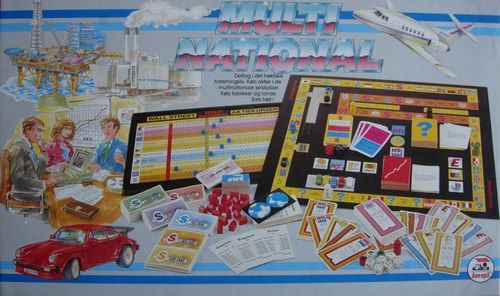
Multinational
Multinational Rulebook
Table of Contents
Table of Contents
Components
- 1 game board
- 1 price board
- 11 price markers
- 18 free shares (red frame), divided among 4 companies
- 76 shares in various companies
- 19 country cards
- 55 yellow "Try Your Luck" cards
- 66 red share situation cards
- 28 yellow action cards
- 270 banknotes in various denominations
- 50 factories
- 50 factory cards
- 6 game pieces
- 6 cars
- 6 airplane tokens with matching adhesive markers (round, in various colors)
- 8 dice (6 white, 1 blue, 1 red)
- 6 booklets of game rules
Number of players: 2-6
Each board is made up of one player who leads a multinational company.
About the Game
Multinational is an exciting game in which the goal is to expand your company. This is achieved by buying shares in the 10 companies listed on Wall Street. Afterwards you can influence share prices through factory purchases, to sell later at a higher price. The game requires concentration and some patience when learning it, but it can be played many times, and the course of events changes from game to game.
All players should read the rules thoroughly. Since buying and selling takes a little time at the start, it is best to have 3 players (boards) the first time you play. To make learning the game easier, you should follow the points under "Preparations" closely.
Preparations
- Place the game board on the table.
- Place the bank (the tray) next to the board.
- A: The money is sorted into its own compartment.
- B: The country and factory cards are also placed in their respective compartments.
- C: The 76 shares are sorted by company (placed in the 10 compartments).
- Shares with a red frame are shuffled and dealt out, with the back side facing up. Each player receives the same number of shares. Any leftover shares are placed in the bank together with the other shares.
- Place the price board next to the bank so that everyone can see it.
- Place the price markers on the price board at price 100.
- Place one car per board on the parking spaces, to the left of the game board.
- Place the airplanes on the airport spaces (see the rules).
- Place one game piece per board on the Start space. (The game starts with the game pieces.)
- The following cards are shuffled separately and placed face down with the text facing up on the respective spaces of the game board:
- Try Your Luck (yellow cards with a blue question mark).
- Share situation cards (red cards). NOTE: remove the top 15 cards.
- Action cards (yellow $ cards).
- Each board receives $ 25,000,000.
- Each board has received a rule booklet. The booklet contains the information needed when buying. Among other things, it contains an overview of which countries are for sale. Use the booklet before you remove the cards from the bank. There is also an overview of share prices - distribution - number of shares, etc.
Rules of Play
- Before starting, all boards take a Try Your Luck card and carry out what the card says.
- After that the game starts for real. Each board throws a die and moves its game piece the corresponding number of steps clockwise. You cannot begin buying and selling (including cars and airplanes) until all boards have thrown and moved once.
- The game is underway. Remember: from now on, the boards must take a share situation card after each time they have thrown and moved.
- You may buy countries when you land on them or on Wall Street. Shares may only be bought on Wall Street.
- Every time you pass or land on Start, you receive $ 15,000,000 from the bank.
Game Rules
Trading
On Wall Street you may make one "deal" twice before you throw the dice. You may buy from space 44 onward. Buying is a "deal", but selling is not. You may therefore sell wherever your game piece stands. You trade freely with each other without involving the bank; only fantasy sets limits (see under Shares). When all players know the game, a "deal" may take no more than 30 seconds. You should know in advance what you want to buy when it becomes your turn.
Bank of Switzerland
Here you may make a "deal". If you are in the Bank of Switzerland, you may therefore make a total of 3 purchases (2 on Wall Street and 1 in the Bank of Switzerland).
Cars and Airplanes
Cars and airplanes can be bought at any time except on the first throw. Purchases are made at the bank before you throw. By buying a car or airplane you get to throw with more dice. When you buy, you exchange your game piece for the car/airplane and pay the bank.
You place the car/airplane where your game piece stood at the time of purchase.
- Car: entitles you to throw 2 dice. PRICE: $ 5,000,000.
- Airplane: entitles you to throw 3 dice. PRICE: $ 15,000,000.
When you sell a car/airplane, it is placed back on the parking/airport space; the game piece is placed where the car/airplane stood when it was sold.
- Sale price: Car: $ 4,000,000. Airplane: $ 12,000,000.
Buying and selling a car/airplane is not counted as a "deal".
No more than half as many airplanes as there are boards may be in play. (Round down when the number is odd.)
Share Situation Cards
The cards affect share prices up or down. After each throw you draw one share situation card. You never draw a card when you are sent to prison.
When the cards are shuffled, you remove the top 15 cards and place them on the "used cards" space. (Some important cards may be among those 15 and will first come up the next time the cards are shuffled.)
Free Shares
Free shares work exactly like the other shares, but they are distributed before the start. (See item 3.)
Shares
Shares may be bought on Wall Street at the price shown on the price board. All shares start at price 100. If a share's price falls to 0 or below, you lose it and it is removed from the game; you also lose any factories belonging to it. (You may also choose to let the lost shares start again from the beginning at price 100, which lengthens the game.) To calculate the price of a share, divide the price marker by 100 and multiply the quotient by the current share price.
E.g.: Current price: 5,000,000 price marker: 140 price: 5,000,000 x 1.4 = 7,000,000
Share Sales
You may sell your shares at any time, regardless of which space your game piece stands on. The sale takes place at the current price on the price board. If you have factories in the company you are selling, the factories are sold to the bank at the purchase price. If you own less than 20% of a company and there are factories in that company, these must be sold at purchase price.
E.g.: Current price: 5,000,000 price marker: 70 price: 5,000,000 x 0.7 = 3,500,000
When you own 70% of the shares in a company, the other shareholders must sell if you want to buy their shares. The price: the current price.
Buying shares from another player is not regarded as a "deal" and can therefore be done wherever you are on the board.
When you own 100% of the shares in a company, its price marker rises 100 points and the shares must then be sold to the bank. Any factories are redeemed at the purchase price. The company then leaves the game and is no longer listed on the stock exchange (the price marker is removed from the price board).
It is a "deal" to buy a share from the bank.
Countries
You may buy a country when you arrive at the country's space or when you are on Wall Street (as a "deal"). When another board's game piece lands on a country owned by someone else, you may demand rent, which rises depending on how many factories are in the country. If the next player has already thrown the dice, it is too late to demand rent. Anyone who discovers that another player is standing on a country without having paid rent must pay the rent themselves.
Factories and Factory Cards
Price: see the individual countries.
A factory for a country (company) may be bought when you own 20% of a company. This raises the income for the country. The factory is placed on the country. The factory card is placed beneath the shares of the company to which the factory was bought.
When you buy a factory in a company, the price marker rises 10 points.
If you sell a factory in a company, the price marker falls 10 points. If a country is sold, its factories are sold to the bank (at purchase price minus $ 200,000). If you own less than 20% of a company and there are factories in the company, these are sold at purchase price.
Factories from different companies may be found in the same country.
There may never be more than 6 factories in each country.
Factory Purchase Spaces
Here you may buy as many factories as you want for one "deal". Otherwise, buying a factory costs one "deal".
Action Cards ($)
When you land on a $ space, one of the other players draws an action card and reads it aloud. You never draw an action card yourself.
Procedure
- A: The first side is read aloud; the player must choose the red or the blue action.
- B: If the blue action is chosen, you roll the blue die, and the reply that matches the number of eyes rolled is read aloud.
- C: If the red action is chosen, you do the same with the red die.
- D: You act or trade on red or blue unless you have been given other instructions.
Note: If payment is required, you pay before throwing the blue/red die. When you have thrown, you pay or take out everything according to the result.
Prison
When you are in prison you may not trade, demand money, or take share situation cards.
Space 44
Wall Street start: The bank pays out money, determined by 1 throw of the die.
You receive:
- roll 1-2: 1,000,000
- roll 3-4-5: 10,000,000
- roll 6: 20,000,000
You are now on Wall Street and may buy again the next time it is your turn. You must always stop on space 44 regardless of how many steps the dice told you to move.
Bankruptcy
If two boards are about to leave the game, they may join together in a trust. You continue to move with 2 game pieces, but share a common economy (this lengthens the game). If you cannot pay and no one will lend you money, you leave the game.
All the board's assets are handed over to the bank, which pays out - up to the value of the shares. The bank does not, however, pay old debts; it has lost the lender's money. If a person wishes to leave the game, all of their assets are handed over to the bank.
Winner
The winner is the board that is most wealthy when:
- All companies except 2 have been bought.
Or
- The time you agreed to play has ended.
(Shares are valued at the share price.)
Country Prices
Each country lists its land cost (Land kostar), a factory figure (U. fabrik), a column of figures labelled only "1.-" to "6.-" (the source does not name what these figures are for, so they are reproduced as printed, without a label), and the cost of each additional factory (Varje fabrik kostar). The abbreviations are reproduced as printed in the source. Where the source notes a per-plot price for a factory, this is shown in italics.
| Country | Land cost | U. fabrik | 1.- | 2.- | 3.- | 4.- | 5.- | 6.- | Each factory costs |
|---|---|---|---|---|---|---|---|---|---|
| MALI - 4 + 5 | 30,000,000 | 6,000,000 | 14,400,000 | 17,150,000 | 20,000,000 | 28,000,000 | 40,000,000 | 60,000,000 | 6,000,000 (price for 1 factory per plot) |
| AUSTRALIEN - 14 | 11,000,000 | 2,100,000 | 5,000,000 | 7,000,000 | 9,000,000 | 15,000,000 | 21,000,000 | 27,000,000 | 2,500,000 |
Share Table
Each company lists its shares by percentage held. The columns are: nominal value (Nominellt värde), dividend (Utdelning), number of shares (Antal aktier), number of free shares (Antal fria aktier), and total price for all shares (Totalpris för samtliga aktier).
| # | Company | Holding | Nominal value | Dividend | Shares | Free shares | Total price for all shares |
|---|---|---|---|---|---|---|---|
| 1 | ELECTRONICS OF JAPAN | 5% | 250,000,000 | 25,000,000 | 6 | 5,000,000,000 | |
| 1 | ELECTRONICS OF JAPAN | 10% | 500,000,000 | 50,000,000 | 5 | ||
| 1 | ELECTRONICS OF JAPAN | 20% | 1,000,000,000 | 100,000,000 | 1 |
Note on the share table: the source prints the "free shares" column per company and per holding as shown; blank cells mean no entry was printed for that row.