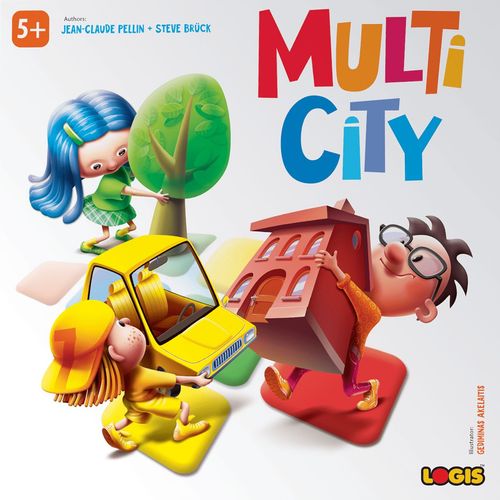
Multicity
Multicity Rulebook
Table of Contents
Table of Contents
Components
- 36 city tiles
- 24 standees:
- 6 x trees (green)
- 6 x residents (blue)
- 6 x cars (yellow)
- 6 x houses (red)
- 24 transparent holders
- The Rules
Object of the Game
The object of the game is to be the first to place all their 6 standees on the city tiles. But beware! Standees placed by other players will limit your options sooner or later.
Before the First Game
Carefully mount the 24 standees on the transparent holders.
Details of a City Tile
A city tile consists of 9 city squares, each showing exactly 1 player color, or marked by an X.
Example: (illustration)
Setup
The 36 city tiles are shuffled and placed face down, as a common draw pile, slightly outside the center of the table. The top tile is then drawn and placed face up in the center of the table. It represents the start of the common cityscape. Each player chooses a color and takes the according 6 standees.
Example: (illustration)
How to Play
The player who last saw a cat in the city becomes the first player. After that players take turns clockwise.
The active player must choose one of the following two actions:
Either
-
He draws exactly 1 city tile from the common draw pile and places it face up to continue the existing cityscape (tiles already in play).
- Each new city tile must be placed so that at least one of its edges borders with a previously placed city tile.
- City tiles cannot be placed diagonally.
Illustration: (illustration)
Or
-
He places exactly 1 one of his standees on the existing cityscape.
- A standee must fit entirely on the existing cityscape (no part of it may protrude).
- Only the first and last item (resident, tree, car or house) depicted on the standee must be placed on a city square of its own color. Items in between can, but must not match the underlying city squares.
- A standee can only be placed either horizontally or vertically on the existing cityscape (not diagonally).
- A standee cannot be placed on an occupied city square (each city square can only be used exactly once).
- A standee cannot 'bridge' over another standee.
Illustration: the first and last house of this row of houses (red) are each placed above a red city square.
Editor's note: the printed text reads "exactly 1 one of his standees"; transcribed as printed.
Easy Version
City squares marked with an X don't have to be avoided, they can house a standee or can be 'bridged' by one.
But: nor the first nor the last item depicted on the standee may be placed on a city square marked with an X, only items in between may.
Normal Version
City squares marked with an X must be avoided at all times, they can never house a standee nor can they be 'bridged' by one.
The Game Ends When
The game ends when either:
a) A player successfully places his last standee on the existing cityscape.
- The player to do so first immediately wins the game.
or
b) The last city tile has been added to the cityscape.
- Each player in clockwise order, starting by the player left of the one that placed the last tile, and also including him, may now try to place exactly 1 of his leftover standees on the existing cityscape.
- Should this be a player's last standee this player immediately wins the game.
- If after this last placing turn all players still have 1 (or more) standee(s) left over, the player with the lesser total of items depicted on his leftover standee(s) wins the game.
- In case of a tie, the player who has fewer standees left over wins the game.
- In case of a new tie, all players participating in the tie win the game.