Mucca Pazza
Mucca Pazza Rulebook
Table of Contents
Table of Contents
Materials and Game Set-up
- 1 gameboard
- 30 sliding tiles (10 each of head, body and legs)
- 12 wooden stars
- 30 animal cards and 1 ghost card
Mucca Pazza can be played from 4 years on. For this, you use 5 animals and only half the gameboard. If you manage it well or are older than 4, bigger challenges await you: Mucca Pazza from 6 years on is played with all animals, the wooden stars, the entire gameboard, and slightly different game rules. Both game variants have their own appeal. Try them out!
Object of the Game
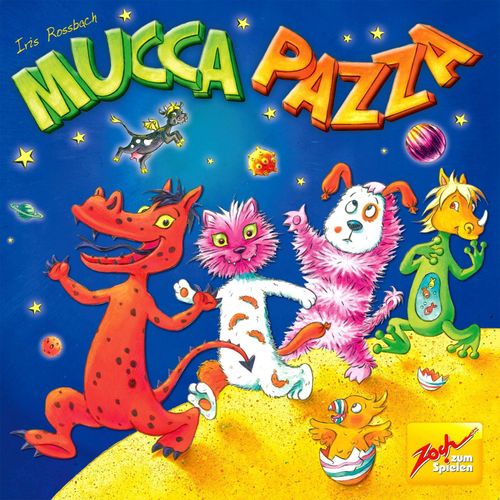
These 10 animals are hiding in this game. Each of them consists of a head, body and legs. At the beginning of the game, the animals' body parts are completely mixed up. Your job is to slide the animals back together correctly.
Before you play for the first time, carefully punch out all the pieces from the die-cut sheets. For the game from 4 years on, you insert 4 strips in the punched-out holes of half the gameboard. For the game from 6 years on, you stick 8 strips into the holes of the completely unfolded gameboard. Keep the strips in the gameboard when you put the game back in the box!
The remaining strips are spare parts.
Mucca Pazza from 4 Years On
Flip over one animal card and then try to slide together the animal depicted, using the appropriate tiles.
Set-up
- Put the folded-together gameboard in the middle of the table with the strips upward.
- Choose 5 animals with which to play. In the game from 4 years on, you play only with 5 animals.
- Pick out all the sliding tiles of these animals (head, body and legs). The other 5 animals and the 12 wooden stars are not needed; put them back into the box.
- Place the 5 heads of these animals next to one another in the top row.
- Put the bodies and legs of these animals below them in such a way that wild crossbreeds come into being.
The three tiles forming such a crossbreed always need to be from three different kinds of animals.
- Now select the 15 animal cards that show these 5 animals (3 cards per animal).
Shuffle the ghost card into these animal cards and put them all face down on display next to the gameboard. The other animal cards are not used.
Now you can begin! The youngest player starts.
Course of the Game
Play proceeds clockwise. On your turn, you flip over an animal card. Slide the tiles so that the matching head, body and legs of the animal fit together.
Sliding rules:
- You may "slide" up to three times.
- Sliding means: You always slide the outermost tile of any row. You use this tile to slide all the other tiles in this row exactly one place ahead.
- The tile that falls off the end of the row is placed at the other end of the row.
- You may slide from left to right or from right to left.
- You may slide a different row each time or the same row several times.
- Once an animal has been slid together completely, your turn successfully ends.
If, after a maximum of three slides, the animal is completely showing, you get the animal card as a reward and put it down in front of you. Now it's the next player's turn.
If the animal is not "complete" after three slides, you turn over the animal card again in the same place. Now it's your left neighbor's turn. He is allowed to reveal the same card.
The Same Animal
If you reveal an animal that is already showing as a complete animal on the gameboard, you turn the animal card back over again. Then you immediately reveal another card (until a different animal comes up).
Ghost Card
If you reveal the ghost card, you may slide together any animal that has not yet been completely put together on the gameboard. If you succeed, you put the ghost card down in front of you.
Ending and Winning the Game
When you have distributed the last card, the game ends. In case the final animal card shows an animal that is already complete on the gameboard, the lucky guy who has revealed this card just takes it. This ends the game.
The player who has collected the most animal cards is the winner. Of course, the ghost card is counted, too. There can be more than one winner.
Mucca Pazza from 6 Years On
By sliding the tiles, try to slide together laid-out animals.
Set-up
- You play with the complete unfolded gameboard and with all animals.
- Place all animal heads in the top row. Lay the bodies and legs of these animals below so that wild crossbreeds are created. No body part in the middle row may fit with the head above or the legs below.
- The ghost card is not used.
- Shuffle the 30 animal cards and form a face-down pile. Flip over 10 cards and place them on the landing place above the top row of tiles. Animals of the same kind are laid out partly overlapping; different animals are laid out next to one another.
- In addition, each of you takes 3 wooden stars.
Course of the Game
Play proceeds clockwise.
On your turn, you try to slide one of the animals visible on the landing place together on the gameboard, so that the head, body and legs of this animal fit together. With this, the sliding rules from page 8 apply.
If, after the sliding, one or more animals are completely showing, you get all displayed animal cards of these animals as a reward and put them down in front of you. Now it's the next player's turn.
Wooden stars: The wooden stars allow you to slide more than three times. For each wooden star that you give up during your turn, you may slide one additional time. So, in one game, each player may additionally slide up to three times if he wishes. The wooden stars you have used up are put back into the box.
If there is no completed animal showing after the sliding, you don't get any card and it becomes the next player's turn. This applies also in the case where you slide together an animal for which no card is lying out on the landing place.
Replenishing the Landing Place
After taking animal cards from the landing place, you immediately put the same amount of cards back there from the face-down pile. If there are not enough cads left in the pile, you lay out whatever is remaining.
Ending and Winning the Game
As soon as the final animal card from the pile has been revealed, each player has one turn left; then the game ends. The player who has collected the most animal cards is the winner. In case of a tie, the player with the most wooden stars left wins. There can more than one winner.