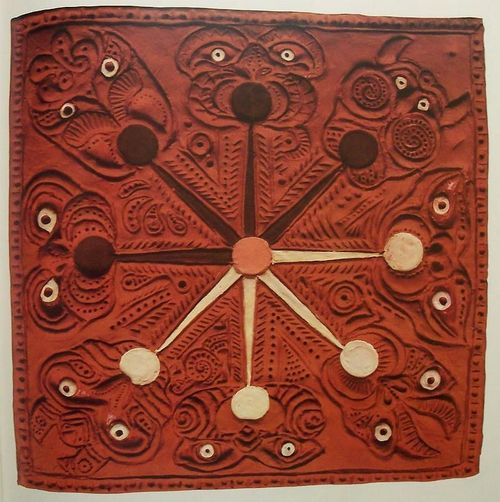
Mu Torere
Mu Torere Rulebook
Table of Contents
Table of Contents
Introduction and History
Maori culture has brought forth a variety of games and pastimes, but among them is only one board game. The Maori generally favour more active pursuits, and string games, but at some point they saw fit to invent mu torere, a blockade game of pure strategy. Mu torere is played mainly by the Ngati Porou tribe on the east coast of North Island, but it has spread over time to other tribes.
The board is a star with 8 points or arms (kewai), the pieces (perepere) being placed at the ends or in the centre. Boards are sometimes marked with charcoal on a stone slab, or occasionally marked with a stick in the ground. More permanent boards are made of the bark of the evergreen Totara tree, which is marked when green such that the markings remain when dry. A stick tied to each end of the bark fragment stops it from warping as the game dries.
Some in the west have tried to demonstrate that mu torere derived from draughts, which the Maori call mu. There is no basis for this, however, as the two games have no similarity to each other. Mu torere is therefore most likely a native Maori game.
How to Play
Mu torere is played by two people using the board shown in Illustration 1, with eight points, the points being called kewai by the Maori. The board is often drawn as a star, rather than the wheel shown here. The central point is called the putahi. Each player has four pieces of his colour, black or white, the pieces being called perepere.
Beginning the Game
-
The game begins with the pieces filling the eight kewai, pieces of each colour being grouped together as shown in Illustration 2. The putahi starts empty.
-
Black makes the first move. Players then alternate in making a move.
Moving the Pieces
-
A player in his turn moves one piece along a marked line to an adjacent empty point, according to the following rules.
-
A piece on the putahi can be moved to an empty kewai.
-
Alternatively, a piece of a kewai may be moved to an adjacent empty kewai, as shown in Illustration 4.
-
Or finally, a piece may be moved from a kewai to the putahi if it is empty (see Illustration 3).
-
A piece moving from a kewai to the putahi must be flanked by at least one enemy on an adjacent kewai.
-
Pieces may not leap over each other.
-
There are no captures in this game.
Ending the Game
-
The game is ended when one player is blocked in and cannot move. He loses the game and his opponent is declared the winner.
-
The players swap colours for the next game, so that each gets a chance to move first.
Variation
Some sources expand on rule 7, which prevents an immediate victory by the first player:
7(i). This rule applies only to the first two turns for each player; subsequently any piece may move from a kewai to the empty putahi.
Illustrations
- Illustration 1: the empty board.
- Illustration 2: the pieces set out for play.
- Illustration 3: black's first move. Neither of the two middle pieces may move to the putahi, as they are not flanked by enemies (see rule 7, and also variation rule 7(i)).
- Illustration 4: examples of available moves when the putahi is occupied. Note that the move from the bottom kewai would be fatal for black: white would block him by moving a piece from the adjacent kewai on the lower right.
Further Information
Mu torere is a popular subject for compilations of board games. The following books all give an account of the rules:
- Astrop, J. The Pocket Book of Board Games, game #13. Harmondsworth: Kestrel Books/Penguin Books Ltd., 1980.
- Bell, R. C. Board and Table Games from Many Civilizations, vol. 2, pp. 149-151. New York: Dover Publications, Inc., 1979.
- Bell, R. C. Discovering Old Board Games, pp. 48-49. Aylesbury: Shire Publications Ltd., 1980.
- Botermans, J. et al. The World of Games, pp. 143-145. New York: Facts on File, Inc., 1989.
- Loader, J & J. Making Board, Peg & Dice Games, pp. 42-45. Lewes: Guild of Master Craftsman Publications Ltd., 1993.
- Murray, H. J. R. A History of Board-Games Other Than Chess, p. 93. Oxford: Oxford University Press, 1952.
- Parlett, D. The Oxford History of Board Games, pp. 160-161. Oxford: Oxford University Press, 1999.