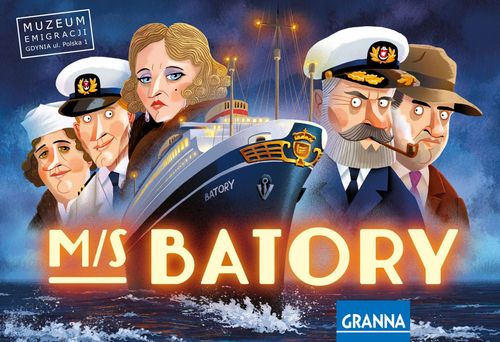
MS Batory
MS Batory Rulebook
Table of Contents
Table of Contents
Game Components
- 12 character figures
- 13 character cards
- 9 event cards
- 33 question cards
- 4 player screens
- Three-level board
- Pad of investigation sheets
Each player will need a pen or pencil, not included in the game.
Game Preparation
- Prepare the three-level ship board. Detailed assembly instructions are on pages 30-31. Place the board in the center of the table.
- Place the 12 character figures onto the ship. The board has 12 locations marked with a white circle. Each of these locations receives a random character figure.
- Each player receives a player screen, an investigation sheet, and a pen or pencil. The investigation sheet should be hidden behind its owner's screen, so that it is not visible to other players.
- Shuffle the deck of 13 character cards. Place the top card from the deck face down under the board, without showing its character. This card is the thief, and should not be seen by any player. Then deal the remaining cards equally among the players. In a 3-player game, each player receives 4 cards; in a 4-player game, each player receives 3 cards. In the 2-player variant, set aside 3 hidden cards, and then each player receives 5 cards. Each player looks at their own cards, but does not show them to other players. On their investigation sheets, players can cross out the characters in their own hand. Those are characters which were easily ruled out as suspects during the initial investigation.
- Shuffle the event card deck. Then turn the top card face up: this is the first event. Leave the remaining deck in an easily accessible place.
- Shuffle the deck of question cards. Each player receives 2 cards and looks at them without showing them to other players. Then draw 3 cards from the question deck and place them face up on the table.
YOU ARE READY TO PLAY!
Characters
There are 13 characters in the game. Each has 3 characteristics: gender (male or female), role (crew member or passenger) and age (young, middle-aged, or old).
Each character has a unique set of these 3 characteristics. This will allow players to deduce which characters are in other players' hands. The pool of suspects will shrink until some player can correctly identify the thief and win the game.
The Captain's parrots are a unique character. They have their own character card, but they do not have their own figure because they sit on the Captain's shoulders. Therefore they are always in the same location as the Captain. The parrots are both male and female, and they are crew members. They do not have a specific age. They count as one character when answering questions.
Sequence of Play
Whoever was last on a ship or boat is the starting player.
A player performs these three steps in order during their turn:
- Move characters on the board and gain cards.
- Play one or more question cards from their hand.
- Ask another player a question.
1. Move Characters
A player can spend from 0 to 4 movement points to move characters on the board. The following rules apply:
- A player can move any characters.
- A character moves from location to adjacent location, spending 1 movement point. There must be a passage in the wall connecting adjacent rooms.
- Movement points may be freely divided among characters, e.g. moving 2 characters each twice, or moving 4 characters each once, or moving a single character 4 times, etc.
- A character can enter a stairwell for 1 movement point, but must then enter any room adjacent to the stairwell on any of the 3 levels of the ship, spending 1 additional movement point. A character cannot stop in a stairwell; a character entering a stairwell must immediately exit, spending a total of 2 movement points. The ship has 2 stairwells.
- During a player's turn, a character cannot enter the same location twice.
- No more than 3 character pieces may occupy a location. (The captain and his parrots are a single piece.)
- If a character's movement fulfills a condition on an event card, then the player gains a question card. The player can choose one of the 3 visible cards, or can draw a random card from the deck. The 3 visible cards are replenished after the player's turn.
Events which name a location are fulfilled when a character enters that location from a differently named location. (For example, moving from a Promenade location to an adjacent Promenade location will not fulfill the "Sunny Day" event, so the player would not earn a question card.)
Events which name a type of character are fulfilled when a character enters a location where there is already a character of the named type. If there are already 2 (or 3) characters of the named type in the location, then the player takes 2 (or 3) question cards.
Example: "Dance in the Social Room" is in effect. The player moves the Journalist to the Cabin where the Purser and First Stewardess are. Thus the Journalist meets 2 crew members, so the player gains 2 question cards.
A player cannot have more than 5 cards in hand. If a player has more than 5 after drawing cards, then excess cards (of the player's choice) must be discarded.
Whenever any card deck becomes empty, shuffle the discarded cards to make a new deck.
2. Play Question Cards
The player must play one or more question cards from their hand. The cards are placed face up on the table so that opponents can see which cards were played. If at least one played card has a red bar at the bottom of the card, then immediately discard the current event card and draw another event card to replace it. If more than one card with a red bar is played, only 1 new event card is drawn and played.
A player with no cards, or with only Number cards, must draw a random question card (discarding any Number cards drawn) until they get a non-Number card, which they must then play.
3. Ask a Question
The player asks a question, directed to any chosen opponent other than the previous player (who just asked this player a question). Exception: in a 2-player game, a player always directs a question to their unique opponent.
The question uses the cards played in step 2.
- The question must be such that the answer is YES or NO.
For example, if the player plays a Location card, the question could be:
-
Do you have any characters who are in a Cabin?
-
Do you have more characters in the Social Room than in the Smoking Room?
-
Are at least 2 of your characters on the Promenade?
-
If a player plays several different question cards, then they ask a single question concerning those several categories. The question must be such that the answer is YES or NO. If there is a Number card among the question cards, then the question can be such that the answer is a specific number, i.e. the question may be of the form "How many...?"
For example, if a player plays a Gender card and an Age card, the question could be:
- Do you have any middle-aged women?
- Do you have more old men than young men?
- Do you have exactly 1 young man?
For example, if a player plays a Deck and a Number, the question could be:
-
How many characters do you have on the Promenade Deck?
-
If a player has played at least 2 cards of the same category, then they may direct the question to the previous player (who just asked this player a question). Exception: in a 2-player game, a player always directs a question to their unique opponent. As usual, the question must be such that the answer is YES or NO (or a number, if a Number card was also played.)
Other Rules About Questions
- The question can never mention a specific character's name.
- At least one non-Number card must be played.
- The Captain's parrots are always in the same location as the Captain (sitting on his shoulders), but they are a different character from the Captain. The Captain has a male parrot and a female parrot, so when answering a question about gender, the parrots are both male and female. For example, if a player with the Countess, the Captain and the parrots is asked whether he has more women than men, then the correct answer is "No" because he has 2 women (Countess and female parrot) and 2 men (Captain and male parrot).
Answer
Players must answer questions truthfully. All players (not just the asker and answerer) should hear every question and answer.
Next Player's Turn
After one player's turn ends, the player who answered the question becomes the active player who takes the next turn. I.e. players will take turns in variable order, depending on who is asked questions!
How to Use an Investigation Sheet
The investigation sheet is divided into two parts. The upper part has 3 spaces for the names of the other players, spaces with icons showing the various characteristics of the suspects, and spaces for notes. The lower part has a list of all the characters and the icons which are on their cards. Above each character is a square space. If a player deduces that a character did not steal the Countess's pearls, then the player can write an X in that character's square. If a player decides to accuse a character, then they should write a check mark in that character's square. A player can make any kind of notes as desired.
Sample record:
- Tomek has at least one character who is a crew member and two who are men.
- Marek has more than one character who is a crew member.
- Tomek has at least two characters who are women.
End of the Game
At any time during play (not necessarily during one's own turn!), any player can try to unmask the thief. The player loudly declares "I accuse!"
The game is interrupted, and on their investigation sheet the accusing player secretly makes a check mark in the square above the character they believe stole the pearls. The accusing player then looks at the face down card which was set aside as the thief during setup. If the card is indeed the accused character, then the accusing player wins! If the accusing player is mistaken, then they admit their failure and return the card face down under the board, without showing it.
This player will still answer questions from other players, but they cannot win and are no longer an active player: they no longer take turns. I.e. they will not move characters on the ship, play question cards, or ask questions. If an inactive player is asked a question, they answer it. The first active player to the left of the person who asked, takes the next turn. Of course an inactive player may not make another accusation!
The game ends when some player makes a correct accusation, or when all but one player have made incorrect accusations. In the latter case, the last player (who has not yet made an accusation) wins the game.
The 2-Player Variant
There are 3 criminals in the 2-player variant. In order to win, a single accusation must correctly name all 3 thieves. If even 1 character is wrong, then the player who made this wrong accusation loses!
The game is set up almost the same as for 3 and 4 players. The only difference is that 3 cards are dealt face down under the board (instead of 1 card), and each player receives 5 cards. A player always directs their question to the unique opponent (unlike in a multi-player game).
Board Assembly
M/S Batory's board has one side in Polish and one side in English. Construct the board so that all pieces show the same language.
Note: It is not necessary to assemble the complete ship model to play M/S Batory. Players can simply place the 3 decks flat on the table and play on them like a traditional game board.