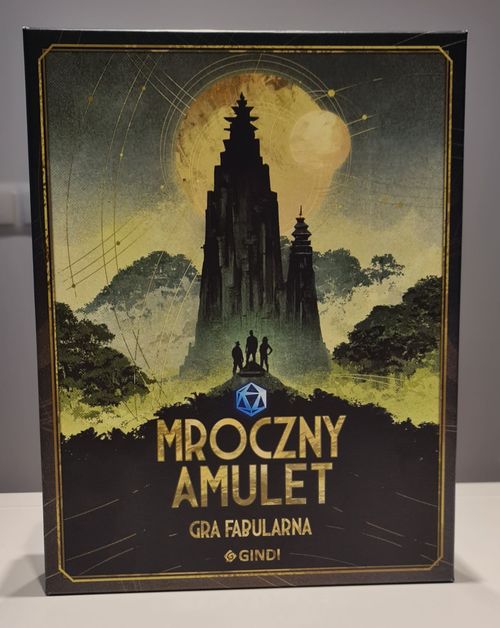
Mroczny Amulet
Mroczny Amulet Rulebook
Table of Contents
Table of Contents
Components
The box contains:
- Rulebook
- Cards (63×88 mm), 350 in total as printed in the rulebook:
- 110 Solution cards
- 110 Problem cards
- 50 Challenge cards
- 14 Character cards
- 1 Prologue card
- 35 Location cards
- 21 Living Curse cards
- 6 Rules Summary cards
- 1 Finale/Epilogue card
- 1 Dark Amulet token
Setup
The setup below is for 3–12 players. Setup for 1–2 players is done the same way, but requires the rules described in the Modules section (page 14 of the printed rulebook).
- The first player is the person who most recently read a book, or is chosen at random: each player draws one Solution card, and the player with the highest number wins.
- Shuffle and form the decks: Problems, Solutions, Characters, Challenges, Locations and Living Curses. Place the Rules Summary cards and the Dark Amulet token on the table so that everyone can reach them.
- Deal each player 3 Solution cards and 1 Character card.
- Lay out face down, in a row, 2 Location cards, 1 Living Curse card and the Finale card.
- Return the remaining Location and Living Curse cards to the box; they will not be needed.
- Start the game by reading the Prologue card aloud.
Your Turn
In your turn you become the Keeper of the Amulet and receive the Dark Amulet token. While you hold it, you choose which Problem the rest of the players must deal with during this turn.
1. Start of the turn
If you have defeated 3 Problems in the current Location, move on to the next Location. If you are in the last Location, read the Finale card.
2. Introduce a Problem
Draw 3 random Problem cards. Play 1 of them under the Location and discard the rest. Based on any element of the card, describe why you cannot or do not want to go further. Treat the cards as inspiration, not as a task to complete. Do not describe at length; a few sentences at most is enough.
- Gates block the way further down the corridor – an example of when we cannot go further.
- Cries for help come from across the river – an example of why we do not want to go further.
Create a situation to be solved, do not narrate a story. Do not create too many details, because the other players will add their own in their Solutions.
When creating a Problem you cannot deny or negate earlier events. You may complicate them and build on them. An introduced Problem becomes part of the story. It can be referred to later in the game – it is part of the set of events, characters and places that you agree are part of the world you are playing in.
Each player may ask for further explanation, point out that a Problem contradicts something established earlier, or suggest something. Try to take everyone's remarks into account.
Basic questions: Why is this a problem for us? How does this solve our problem?
Example: Justyna, the first Keeper, draws 3 Problem cards (shown in the printed rulebook). The group has reached the Location "Mountain Stream – where a bear is catching fish right now." Justyna plays the third card and describes that the stream's sandy bed is unstable and that the group sinks up to their waists in it. She briefly considers using only the card's category and saying that a bear attacked them, but chooses something she considers more interesting.
3. Ask for Solutions
Ask the other players to play Solution cards and to explain how they overcame the Problem and what good came of it for them.
When the Keeper asks for a solution, play a Solution card and place it in front of you. Based on any element of the card, describe how your character or the whole team solves the Problem. Treat the cards as inspiration, not as a task to complete. Do not describe at length – a few sentences at most is enough, especially since others are waiting for their turn and your Solution may not be chosen.
Tell your Solution in the past tense.
- "We push through the wall and jump to the other side, landing softly in the hay" – a good Solution.
- "I try to climb the wall" – an insufficient Solution; if it is chosen, it will have to be made more precise.
- "I dance" – a bad Solution, because it does not describe how we overcame the Problem.
You may also pass: discard 3 cards and draw new ones.
A Solution proposal is not part of the story until the Keeper chooses it. As when playing Problems, each player may raise doubts or suggestions.
Example: Zosia plays the card "We broke through the whole detachment by force" and explains that they simply climbed out of the sand, all soaking wet. Natalia plays the card "Subtle perfume that adds charm to everyone": a bear, lured by the scent, comes up to us and praises our perfume. In exchange for the flask, it helps us get out.
Leaving a Location: It may happen that the description of a Problem or Solution suggests you have gone beyond the boundaries of the Location. That does no harm, because the Location is primarily meant to provide a context for action.
4. Choose a Solution
Choose one of the proposals; it becomes part of the story. Place the chosen Solution card on the Problem it defeated.
When choosing a Solution, reward:
- references to earlier events,
- enrichment of the world with details,
- original ideas,
- people who have not been chosen for a long time.
Example: In the previous step Zosia proposed forcing a way through, and Natalia proposed buying their way out with perfume. Justyna likes the simplicity of Zosia's solution, but chooses Natalia's, because it expands the world by adding interesting facts.
When the Keeper chooses your proposal, it may turn out that not everything is clear. This is a good moment, for example, to describe the final effect of your Solution.
5. End of the turn
Clean up the cards: discard the unchosen Solution proposals and Problems. Draw Solution cards until you have 3 in hand. Pass the Dark Amulet token to the player on your left.
Finale and Epilogue
Finale
After you defeat the last Problem in the Final Location, read the Finale card aloud. In this turn there is no Keeper and no Problem card is played. Instead, you jointly undo the Living Curse by playing Solution cards. The first person who thinks of how to begin plays their card. Each of the other players must continue the description by playing their Solution cards. The description ends when the Curse is undone.
Example of the Finale: We stand at the main altar of the Workshop–Temple. In front of us floats a sphere with rings orbiting it. Justyna plays first, the Solution "We sent a message by carrier pigeon". She describes that the cult of the Black Hand used clockwork birds, so she sent one straight into the heart of the mechanism to make it switch off the rings. Natalia plays the card "Dusty book bound in living wood". She describes grabbing the sacred book and smashing the outer shell of the sphere with it. Zosia places the card "We lit up the interior of the hall with a torch". Her description: "The light went out, so I lit a torch. Inside the sphere there was pure darkness, and under the light it collapsed in on itself!"
Epilogue
In the Epilogue you learn what became of your characters. Each player draws a random Solution card, checks its die result, and compares it with the Epilogue Table (on the following page of the printed rulebook).
The Table includes results outside the range 1–20 because of the Modules, which allow values outside the usual scale.
Example of the Epilogue: Justyna draws a random Solution card with a die result of 7 and reads aloud:
"You return to your world. Government agencies torment you with interrogations about your adventures. How did you manage to avoid them?"
"I think they had nothing on me in the end. I was tough, because after such adventures a mere interrogation does not impress me. Who's next?"
Epilogue Table
| Result | Description |
|---|---|
| –0 | A fragment of the curse you undid turned you to stone. Describe the pose in which your statue stands. |
| 1 | You wake up and notice that not even a second has passed. It was a truly strange dream, but it is time to return to work. |
| 2 | You stay in Veiran, but over time a new curse grows around you, connected with your previous life. Say what curse it is. |
| 3 | You return to your world, but one of your opponents comes with you. Say which one. |
| 4 | You stay in Veiran, but your enemy returns to your world instead of you. Say which one. |
| 5 | You return to your world, carrying part of a malicious curse with you – it never stops haunting you. Say what effect it has. |
| 6 | You stay in Veiran, but you cannot leave the last Location you visited. Describe what your home looks like. |
| 7 | You return to your world. Government agencies torment you with interrogations about your adventures. How did you manage to avoid them? |
| 8 | You stay in Veiran and start a family. You settle in one of the Locations you visited – say which one. |
Example of Play
Justyna, Natalia and Zosia play Mroczny Amulet. After choosing their characters and reading the Prologue, they learn that the Living Curse they will face is the Cult of the God Boriasz. At the start of the game they arrive at the Location "Fishing Village. The inhabitants' tracks lead to the water, and do not return." Justyna is the first Keeper of the Amulet, so she draws three Problem cards and plays one of them.
Justyna: "They won't let us leave this place while the preparations for the celebration are going on" – in fact, a ritual for the whole village is taking place in the lake at this very moment, and from between the huts a priest with empty eyes comes out, knife in hand, inviting us to join in!
Zosia: Ugh, creepy!
Natalia: Don't worry, I've got a card for him! [From the three Solution cards in her hand, Natalia plays "We overpowered them using martial arts."] He is one, we are three. We overpower him and question him on the side about the road ahead.
Justyna: Zofia, do you have other proposals?
Zosia: No, thanks, the overpowering appeals to me. [Zofia had ideas, but decided Natalia's proposal was good and did not want to compete with it. She therefore discards all Solution cards from her hand and draws three new ones.]
Justyna: Natalia, your solution becomes true! [In the order in which they sit at the table, Natalia is the next Keeper. Justyna passes her the Dark Amulet token.]
Natalia: And on top of that I'm now the Keeper? Well, we managed to avoid being sacrificed at the offering, but our next problem is… [She draws three Problem cards and plays one of them.] "Desperate, they attacked us by surprise." Of course! The priest stirred up the villagers, and now they are chasing us!
Next, Zofia is the Keeper. This time the Problem is "Someone sabotaged it: a stream is pouring out of a pipe."
Zofia: From the start I didn't like this place! [Plays "We sneaked up right behind their backs."] We won't break through by force. I suggest we weave between the huts until we break out to freedom!
Justyna: And what do you say to this? [Plays "Because of our clothes and behaviour they took us for part of their legends."] That would be pretty good. They act as if they recognise us, and they really believe they must ferry us across the lake to the other side!
Natalia: Wow! I like it! Sorry, Zofia, I'm taking the legendary solution.
Zofia: So we sail across this lake, right? Then suddenly the boat starts filling with water! You can hear the priest laughing from the shore…
Natalia: Perfect, I have a card for this occasion! We strip off the unnecessary clothes and plug the leak! [Plays "We improvised repairs to the most serious damage."]
Justyna: Okay, I can't top that, it's too absurd. [Passes, i.e. discards the Solution cards from her hand and draws three new ones.]
Zofia: In that case – Natalia, thanks to you we reach the shore safely. Maybe we're a bit cold… That was the last Problem in this Location. So, what's the next place?
Tips
Introducing new players
Here is a sample text you can use to encourage people to try the game:
"Mroczny Amulet is a roleplaying game in which we take on the roles of people transported to another world, trying to get home. A game lasts at most an hour. It doesn't matter whether you have played such games before. The rules are simple, and we use cards that suggest what can be done at a given moment."
Once you know the game well, you may be tempted to introduce all the Modules you know and like. There is a reason, however, why the basic version of the game is simple. Start by playing these rules. Depending on how well the new players cope, you can introduce the remaining Modules during play.
The first turn serves to show how Problems are played and then solved. I stress that I draw inspiration from the cards: I show the cards I have in hand and describe my train of thought. In the second turn, as a Solver, I show how to use a Character card. In the third turn I show combined Solutions.
When we leave a Location, I add the rules for Challenges. I do this carefully, however – for some people in a first game, the difficulty will be coming up with Solutions and Problems. Do not hesitate to remind such people of the possibility of passing and exchanging cards. Sometimes the trouble comes from cards in hand that players cannot adapt to the situation. A good idea is to suggest descriptions. When someone is having trouble in the game, ask them to show their hand and then together suggest what they could do with those cards.
In the first game I almost never use the rules "That's Not So Simple", unless I am playing with two people. I pay little attention to the consistency of the world. At the end of the game, laugh together with the others at the absurdities, and then ask: do you want to play again, but a little more seriously?
It's not a storytelling game
Of course it is a game in which we tell a story! So where does this heading come from?
Many roleplaying games have a central person, i.e. a Game Master, who is the equivalent of a "permanent" Keeper of the Amulet. Such a person has the right and the duty to prepare scenarios or situations that the players then encounter. People used to this method may, instead of briefly describing an encountered Problem, impose many details and images of the world. That is not bad in itself – but it simply does not fit the rules of Mroczny Amulet.
That is why you do not tell stories here; you only create Problems and solve them. The story creates itself that way. Such is the paradox.
Consistency of the story
Your first game will almost always resemble a strange dream or an episode of a zany cartoon. Since this may bother some of you, I want to reassure you: subsequent games usually become more coherent on their own and come to resemble adventure films.
If you want to actively keep events as coherent as possible, you must pay attention to it. When someone proposes a Solution or introduces a Problem and you see an inconsistency, point it out aloud. If you want more realism, do not introduce falls from several storeys' height.
Violence
The basic level of violence in Mroczny Amulet is describing its existing effects, or announcing it when describing a Problem that is about to happen. Implicitly, violence does not occur, because you stop it with one of your Solutions.
When solving, try not to describe violence. There are few cards in the game that refer to it closely (such as a knife). There are also no characters such as a Policewoman or a Soldier, or other professions strictly tied to using violence. You do not need to use force if you are clever enough!
When you want to play more aggressively, remember to establish what exactly you mean. Will it be violence at the level of superhero films, where blood usually does not appear? Or rather scenes straight out of horror?
Modules
Modules add optional rules. The rules for Modules are recommended once players know the basic game.
Character cards as Solutions
You may draw inspiration from any part of your Character card in the same way as from a Solution card. When you describe such a Solution you must say what your character did, not what a group or a local ally did.
Play a Character card together with a face-down Solution card. You will place the Solution card on the Problem or discard it, instead of the Character card. The Character card returns to you at the end of the turn.
Example: Zosia plays her Character card, the Librarian: "I have spent my whole life in books. I never make noise, and I help others be quiet." She plays it in a Problem concerning a large number of guards, and adds under it a face-down Solution card – the one she least regrets discarding.
Zosia: "We sneak past, because I can be really quiet."
Her Solution is chosen, so she places the face-down Solution card on the Problem, and the Character card returns to her. Had it not been chosen, the Character card would have returned to her and the Solution card would have been discarded.
Combined Solutions
You may add your Solution to another player's Solution, if that player agrees. When the Keeper chooses Solutions, they treat such combined Solutions as one option.
When you complete someone else's Solution, you can use the moment to add details, expand the description, and so on, instead of focusing on coming up with a Solution of your own.
Example: Justyna: "We push through the wall and jump to the other side, landing softly in the hay." Natalia, adding her card "We rode on horseback": the hay was there because there is a stable on the other side of the wall. Does that fit? Justyna: "Sure!"
Challenges
Listed as the recommended module for the solo and two-player games.
At the start of the turn, reveal a random Challenge, read it aloud and place it in a visible spot. If, during this turn, anyone fulfils the Challenge while describing a Problem or a Solution, they take that card for themselves. If the Challenge is still unfulfilled at the end of the turn, place it under the Finale card.
In the Epilogue, all players subtract 1 from their result for each unfulfilled Challenge card. Add 1 to your result for each Challenge you have fulfilled.
Example: Justyna, who is the Keeper in this turn, draws the Challenge "Calmly talk it through" at the start of the turn. "Just to make it not too easy, listen up – a huge bat attacks us from the ceiling, thirsty for our blood." [Justyna could have introduced a Problem that would have made it easier to fulfil the Challenge, but she wanted to see how the other players would cope.] [Natalia plays the card "We understood their motives, and realised it was a misunderstanding."] Natalia: "I let the bat drink my blood and I stroke it. It turns out the bat can talk; it thanks me for the refreshment and flies away." [If Justyna chooses this Solution, the current Challenge is overcome.]
That's Not So Simple
Module that adds an element of uncertainty to the game. Thanks to it, a chosen Solution may end in failure or a critical success. In addition, the rules force you to refer more often to events, characters and places already established, and to solve Problems with your characters yourselves, instead of being rescued by the surroundings.
Rule: Once per Location, any one player may say "That's not so simple!" after a Solution by any person has been chosen. The player who played the Solution card rolls a d20 (K20) or uses a random Solution card, and then checks the result of the roll. You get +2 for each bonus whose requirement you meet.
Bonuses:
- The character who is solving the Problem is specifically your own: e.g. a player who plays a Librarian describes how she climbs up a rock ledge.
- You refer to facts established in your story before the current Problem: e.g. a player describes returning to a room earlier, where water had already been described as collecting.
- Someone helped you.
Result of the roll:
- 21+: Critical success.
- 11–20: Success.
- 10 or less: Failure.
Success means that the Solution becomes part of the story, as usual.
Critical success allows you additionally to take a Challenge card (a random one, or one from under the Finale card) and place it face down in front of you, next to your Character card. If you are playing without Challenges, use a Problem card instead. Each such card gives you +1 to your Epilogue test at the end.
Failure: the player who said "That's not so simple!" adjusts the description of the Solution so that it takes into account the attempt made, and explains why it did not succeed. What matters is that the attempt happened, but it did not have the effect that was planned. The Problem may have changed, but it remains in play. Add a random Challenge card under the Finale card. If you are playing without Challenges, use a random Problem card instead. Each such card gives everyone –1 to their Epilogue test at the end.
After making the roll and carrying out its result:
- Everyone except the Keeper draws a Solution card.
- Play new Solution cards.
- The same Keeper chooses a Solution once more.
Example: Zosia wanted to kick the doors open, but they turned out to be too strong! [Justyna, who is the Keeper in this turn, decided the Problem would be closed doors. She then chose Natalia's Solution, in which her character, a Cosmetician, kicks the closed doors open.] Zosia said "That's not so simple!" Natalia gets a +2 bonus to the roll for the clear use of her character. Unfortunately, she draws a card with a result of 7, which even with the +2 bonus gives only 9. Failure! Natalia and Zosia draw Solution cards. Justyna remains the Keeper of the Amulet. The Problem stays the same, but the doors clearly cannot be kicked open any more. They are too strong! Both play new Solution cards, from which Justyna chooses which one becomes part of the story.
Tip: You may drop the limit of once per Location, but "That's not so simple!" can be said only once per Problem.
Solo game
Required module: That's Not So Simple. Recommended module: Challenges.
During your turn in a solo game you create a Problem and then solve it. The difference is that you always make a test after playing a Solution card. When you pass, treat it as an automatic failure in the test. At the end of the turn, top up your cards to three.
Two-player game
Required module: That's Not So Simple. Recommended module: Challenges.
In this version you skip the Solution-choice step, since there is always only one Solution.
When you pass, treat it as an automatic failure in the test.
The Keeper should pay attention when, in their opinion, a Solution makes no sense at all. Let them say why. They may also propose a modification of the idea. If the Solver insists on their original assumption, apply a –4 penalty to the roll. If it succeeds, however, it was evidently possible after all.
Put more emphasis on creating coherent fiction: ask yourselves questions, think aloud and throw ideas at each other. If this is your first game, we suggest playing with more people.
Six or more players
Required module: Combined Solutions.
With more players, proposing Solutions alone may take too much time, and the Keeper may forget the first players' proposals. Therefore, with six or more players an additional rule applies: in one turn no more than 4 people may propose their Solution. You may also make sure that you use Combined Solutions as often as possible.
Only the first four people may propose a Solution (choose whether it is first come first served, or the next four people clockwise from the Keeper). The remaining players must pass or use the Combined Solutions rules.
Scoring
If you like competing with each other, count (e.g. on paper with a pencil) how many times someone was chosen as the Solver. At the end, that person receives +3 to the roll in the Epilogue and may consider themselves the winner of the game.
Permanent Keeper
In games such as Dungeons & Dragons or Warhammer, there is a permanent person who describes the world around the characters, called the Game Master. If you want, you can take on such a role here too. Players still have much more influence on the surroundings and the plot than usual in such titles. However, it will be easier to keep the world consistent, because Problems will then come from one person only. If you want to play with younger people, consider this option.
Rules Summary Cards
The game includes 6 Rules Summary cards. Their text is transcribed below as printed on the card sheet. Where a card's wording differs from the main rules above, a note follows the card; the main rules text is the transcribed rule.
Card: Always
- Cards are inspiration: use any element of a Solution card or a Problem card.
- Ask and suggest: at any moment you may ask when you do not understand something, or suggest something to the others. Your story will be better the more you care about its consistency.
- When you introduce a Problem – Clarity: explain why we must overcome the Problem and cannot ignore it. Use a few sentences, unless you are asked for details.
- When you solve – Action and effect: tell how you overcome the Problem, not how you try to do it.
Card: Rules Summary
- [All players] Start of the turn: move to the next Location if in the current one you have defeated 3 Problems.
- [Keeper] Introduce a Problem: draw 3 Problems, play 1 under the Location and discard the rest. Inspired by the card, explain why you cannot go further.
- [Other players] Play a Solution: play 1 Solution in front of you. Inspired by the card, describe how you dealt with the Problem. You may also pass – place 1–3 face-down cards.
- [Keeper] Choose a Solution: choose which Solution becomes part of the story.
- [Keeper] End of the turn: clean up the cards. Top up your Solution cards to 3 in hand. Pass the Amulet to the next person.
Note: The card's pass wording ("place 1–3 face-down cards") differs from the main rules, which say to discard 3 cards and draw new ones. The card also reads "1–10" for failure where the main text reads "10 or less". The main rules text governs.
Card: Module – Characters
You may play a Character as a Solution card. When you do, play it together with a face-down Solution card. After use, take the Character back.
Card: Module – Challenges
At the start of the turn, reveal 1 Challenge card. At the end of the turn, the person who fulfilled the Challenge places it in front of them. Unfulfilled Challenges go under the Finale card. When drawing for the Epilogue, each Challenge you hold gives you +1 to the roll. Each unfulfilled Challenge gives –1 to the roll for all players.
Card: Module – Cooperation
You may add your Solution to another player's Solution, if they agree.
Card: Module – That's Not So Simple
After your Solution is chosen, once per Location any person may say "That's not so simple!".
- Test: roll a d20 or use a random Solution card.
- +2 if it was specifically your character solving the problem.
- +2 if someone helped you.
- Result:
- 21+: Success, and additionally take a Challenge – from under the Finale card or a random one.
- 11–20: Success.
- 1–10: Failure. Describe at which moment the Solution went not as you planned. Draw Solution cards and finish the Problem.
Note: On the failure band, the card says "finish the Problem", whereas the main text says the Problem may have changed but remains in play. The main text governs.