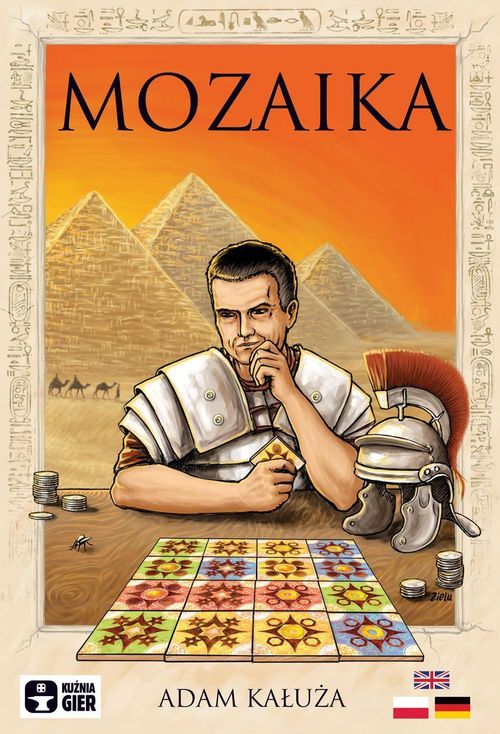
Mozaika
Mozaika Rulebook
Table of Contents
Table of Contents
II. What's in the Box?
- 120 mosaic tiles (108 + 12 extra)
- 60 coins
- 16 fly counters
- 5 boards
- 1 bag
- Rule booklet
III. Game Setup
Depending on the number of players, a different number of mosaic pieces is required for the game – they are specifically marked on the reverse. For four players you need 84 tiles (7 tiles of each kind), which means that 24 tiles (2 of each kind) are returned to the box. With three players the number of tiles is 60, so 48 pieces (4 of each kind) stay in the box.
Tile reverse – 3, 4 and 5 players
Put the selected tiles into the bag enclosed with the game and place the coins in the middle of the table – they are going to be your bank. Next to the bank you should put the flies.
Each of the players receives:
- 1 board on which they will be arranging their mosaic
- 10 coins
- 4 random mosaic tiles
The youngest player begins and takes the bag with the tiles.
IV. Game Overview
Mozaika is played over successive turns. Each turn consists of five stages:
- Drawing the tiles
- Bidding and buying the tiles
- A fly for the miser
- Laying the pieces and collecting income
- Changing the starting player
Note: Stages 1-3 are omitted in the first turn – the play starts with laying the first mosaic piece, i.e. stage 4.
1. Drawing the Tiles
The person having the bag with pieces – the starting player – draws the number of tiles equal to the number of players plus one.
Then the tiles are placed face up in the middle of the table so that every player can see them.
Example: The players are Adam, Iza, Klaudia and Weronika – 4 people altogether. That is why 5 mosaic pieces need to be drawn. Weronika is the one to draw the tiles in the first turn since, being the youngest participant, she received the bag before the start of the game.
2. Bidding and Buying the Tiles
Now the players start to bid. Each person covertly decides how many coins they would like to spend and hides them inside their fist. Then all the players stick out their hands and simultaneously reveal their coins.
The player who has bid the most is the first one to choose one mosaic piece from the tiles drawn. The second highest bidder is the next one, then the third one, etc., until every player has received one piece.
If two or more players have bid the same, the one sitting closest clockwise to the starting player selects a tile first.
Example: The players are Adam, Iza, Klaudia and Weronika and in such order they are also sitting at the table. Weronika is the starting player. The bidding stage begins. All the participants hide the coins in their hands. On the agreed signal the players show the number of coins they decided to spend. Adam offered 2 coins, Weronika 4, while both Iza and Klaudia offered 3. Weronika, as the highest bidder, is the first to choose a tile. Iza and Klaudia are tied. Iza is sitting closer to the starting player, since to Weronika's left, counting clockwise, only one person separates her from Iza and two people from Klaudia. That is why Iza selects a tile as the second player, Klaudia is the third and Adam – who has bid the fewest – the last one.
A player can bid with an empty hand (no coins). Naturally, it is more than likely that they will lose the bidding and be the last to choose a tile – unless a few players decide to do so. In such a case the procedure is exactly the same as with any other tie: the players who have bid no coins choose tiles beginning from the player sitting closest to the left of the starting player.
After the bidding stage every player should have 4 tiles in hand.
3. A Fly for the Miser
The person who has bid the fewest takes 1 fly as punishment. The moment of introducing this stage depends on the number of players:
- 5 players – starting from the 2nd round
- 4 players – starting from the 3rd round
- 3 players – starting from the 4th round
If it comes to a tie, the fly goes to the player sitting furthest from the starting player, counting clockwise.
Example (continuation): Since in the above-mentioned situation Adam was the last to choose a tile, he has to take one fly.
The mosaic piece which is left on the table after the bidding stage is returned to the tile pool (the bag).
4. Laying the Pieces and Collecting Income
Having purchased a mosaic piece, the players lay one of the four tiles they own on their boards. The tile can be placed on any free space on the board. Tiles already placed cannot be moved or discarded.
Income
Players receive money for a placed tile if at the moment of placement it borders another tile with at least one side. In that case the following payments are possible:
- 1 coin for each bordering tile of the same colour
- 1 coin for each bordering tile with the same symbol
- 2 coins for each bordering tile with the same pattern (the same colour and the same symbol)
If none of the bordering pieces is of the same colour or has the same symbol, there is no payment. The same happens if the tiles touch each other only with their corners.
Example: Adam has placed the tile outlined in red on the board. For this move he receives 4 coins: 2 coins for the bordering tile above, which has the same symbol and the same colour, 1 coin for the tile on the left (the same symbol) and 1 coin for the tile on the right (the same colour). For the piece in the top left corner he receives nothing because none of its sides borders the tile just placed.
Placing a Fly
At the end of this stage the player who has received a fly has to put it on any of the mosaic pieces on their board. There can be only one fly on a single tile!
5. Changing the Starting Player
After each player has laid a tile on their mosaic, the starting player should hand over the bag to the player on their left. This person becomes the starting player for the next turn.
Example: After everybody has finished laying the tiles, Weronika hands over the bag to Adam, who is sitting on her left.
V. Ending the Game
The game ends after 16 turns, when all the players have completed their mosaics by laying tiles on all the spaces on their boards.
There may be some tiles left in the players' hands and in the bank.
Now it is time for the players to sum up the victory points (VP) for their mosaics according to the following rules. The player who has reached the highest score is the winner. If the game ends in a tie, the player with more coins left wins.
A Bonus for the Thrifty
For every 5 coins left at the end of the game you receive 1 VP.
Victory Points for Tile Arrangements
Victory points are awarded for different arrangements of the mosaic pieces and for their combinations.
Line
For every four similar tiles forming a vertical, horizontal or diagonal line you can receive:
- 2 VP if all four tiles are of the same colour but have different symbols
- 2 VP if they have the same symbol but are of different colours
- 4 VP if they have the same pattern (the same colour and the same symbol)
The tiles forming a diagonal line can be arranged as in the picture, starting in the bottom left corner, or the other way round – starting in the top left corner.
Square
For every four similar tiles arranged in a square in the middle, on the side or in one of the corners of the board the players are awarded victory points following the same set of rules:
- 2 VP if all four tiles are of the same colour but have different symbols
- 2 VP if they have the same symbol but are of different colours
- 4 VP if they have the same pattern (the same colour and the same symbol)
Combinations
If two arrangements overlap, e.g. if two lines cross, the player receives the sum of VP for both lines (the vertical and the horizontal). A square may also overlap with a single line or with a few lines – in such a case it is necessary to add up the victory points for all the possible combinations.
Example: The red vertical line includes tiles of the same pattern (so it is worth 4 VP) and the blue horizontal line includes tiles of the same colour (so it is worth 2 VP). Therefore the player receives 6 VP altogether.
If diagonal lines cross (as illustrated above), the player can receive extra VP for the arrangement of tiles in the centre of the board (the area framed in green and marked with the letter "A"). If the four central elements form any kind of arrangement (they are of the same colour, they have the same symbol or pattern), the player also gets victory points for this square.
What If There IS a Fly in the Ointment?
If there are some flies on the tiles forming an arrangement, the player loses the number of VP equal to the number of flies. However, the difference between points awarded and penalty points cannot be a negative number. Each score which is below zero is treated as 0 VP. If the tile with a fly on it is involved in a few different arrangements, the player receives penalty points for each of them.
You will find an exemplary victory points count at the end of the rule booklet.
Symmetry Bonuses
If the layout of the tiles is symmetrical, the player can receive a symmetry bonus – additional victory points. You can get this bonus only if the tiles on both sides have the same pattern (the colour and the symbol). There are four kinds of symmetry possible.
- Vertical or horizontal – the player receives 12 VP
- Diagonal – the player receives 8 VP
- Central – the player receives 12 VP
The printed model diagrams and example mosaics for each symmetry kind are not reproduced here.
Note: Flies have no influence on symmetry bonuses.
VI. How to Count Points for a Complete Mosaic
The picture below shows Adam's mosaic after the 16th turn but before counting victory points. Let us see, how many VP Adam is going to receive for his mosaic.
- Adam receives 2 VP for every vertical line of tiles with the same symbol (but not of the same colour!). That makes 4 VP altogether for two arrangements.
- One horizontal line of tiles of the same colour gives Adam 2 VP minus 1 VP for the fly, so the difference is 1 VP.
- Next, Adam receives 2 VP for 4 tiles with the same symbol forming a square.
- Here comes another square of 4 tiles with the same symbol and another 2 VP for Adam.
- Once again 4 tiles with the same symbol form a square, which brings another 2 VP.
- 4 VP for tiles of the same pattern (colour and symbol) which form a square.
Adam has received 15 VP altogether. The two top flies from the last column of the mosaic have had no influence on the scoring.
But it could have been different… Adam could have bought different tiles. The picture on the left shows a situation which is similar to the above-mentioned. However, the tile in the bottom right corner is red, not blue.
There is a line worth 2 victory points on the board (it contains 4 tiles of the same colour). Unfortunately, it also contains 3 flies, which means losing 3 VP. Since a score for an arrangement cannot be a negative number, Adam would get 0 VP for this arrangement.