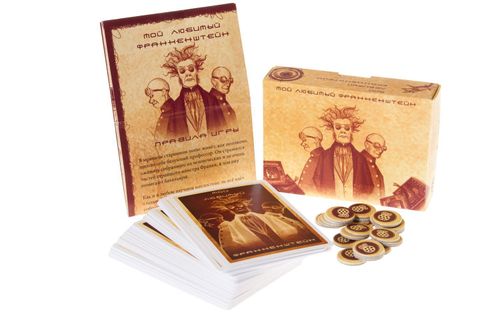
Мой любимый Франкенштейн
Мой любимый Франкенштейн Rulebook
Table of Contents
Table of Contents
Goal of the Game
To win, a player must score 25 respect points. The game consists of several experiments (games), during which you will be either the professor or a bachelor. In each experiment the players face one task: to assemble Frankenstein. In an experiment, the player who first assembles a correct and viable monster wins. For this he receives respect points.
Components
- 54 cards with parts of Frankenstein's body. You will assemble your monster from these. Body parts fall into two categories: mandatory (head, torso, leg and arm cards), without which Frankenstein cannot be assembled, and additional (all other cards), which add interesting anatomical features to the assembled monster.
- 24 respect tokens. They mark players' current respect in the experiment.
Pay attention to what is written on the cards. For example, a claw is an arm, and all the rules for arms apply to it.
Setup
- Shuffle the deck of cards.
- Draw cards one at a time, in turn. Whoever draws a card showing a head will be the professor during the first experiment.
- Give 4 respect tokens to each bachelor and 12 tokens to the professor.
- Deal 3 cards to each player. The bachelors keep their cards face down. The professor turns his cards face up and places them in the middle of the table; this is the professor's worktable (Рабочий стол). Already at this point he may decide to put all of his cards into the fridge (see the Glossary).
Setup diagram labels: Bachelor No. 1, Bachelor No. 2, Worktable (Рабочий стол), Fridge (Холодильник), Professor, Card deck (Колода карт), Respect tokens (Жетоны).
Turn Structure
Each new experiment begins with the bachelor sitting to the left of the professor. Turns then pass clockwise. The professor completes the round with his own turn. The process repeats until someone assembles a finished Frankenstein.
Bachelor's Turn
A bachelor's turn always consists of two stages: the stage of the professor's assignments and the stage of the bachelor's own research.
Stage of the Professor's Assignments
At this stage the professor gives the bachelor a task, and the bachelor must carry it out. There are 3 types of task, but the professor must choose only one of them.
a) The professor may demand a certain part of the body from the bachelor. If it is a mandatory part (head, torso, leg or arm), the bachelor must either hand over that card or, instead of the card, give the professor a respect token (see the picture). If the professor takes the bachelor's last respect token, the bachelor retires (see the Glossary).
If the professor asked for an additional part, the bachelor may simply refuse without any loss to his reputation. After all, bachelors are not obliged to keep fangs or wings on hand.
The professor may ask for a card that the bachelor holds in hand (not one lying on the table; see the bachelor's table). The professor may quite deliberately ask for the part of the body the bachelor is most likely not to have.
If the bachelor copes with the task and hands over a card of a mandatory or additional part of the body, he immediately receives one respect point from the professor and draws one card from the deck as a bonus.
b) The professor may demand that the bachelor take an "extra part" from the worktable for himself. This task cannot be refused: the bachelor takes the card, places it face up in front of himself, and receives one respect point from the professor.
c) The professor may give the bachelor a day off (отгул) as his subordinate. In this case the bachelor takes one card from the deck.
Stage of Own Research
At this stage of the turn there are three options; the bachelor must choose one of them.
a) Take 2 cards from the deck. The cards are taken into hand and shown to no one.
b) Discard one of your cards. You may discard a card from your hand or one that lies face up in front of the bachelor.
c) Exchange a card, that is, take one card from the worktable and replace it with one card from your hand (not from the table). The card taken must be placed face up in front of you.
You may take only a card from the worktable (not from the fridge).
Professor's Turn
The professor's turn consists of one stage. In this stage he must choose what to do: add a new part to the worktable or cut off an extra one.
- Add a part, that is, take 1 card from the deck and place it on the worktable.
- Cut off the extra, that is, move 1 card from the worktable to the discard pile.
The professor may leave the newly received card face down on the worktable. However, he cannot have more than two face-down cards at the same time. Therefore, if the professor wants to leave the newly received card face down, and already has two face-down cards, one of them must be turned face up (see the picture).
Face-down cards may not be placed in the fridge.
End of the Experiment
A bachelor may announce the creation of Frankenstein only during his own turn, before the next player has started to move. The professor may announce the creation of the monster at any time. If the bachelor and the professor assembled Frankenstein at the same time, the professor wins.
It is important to remember that Frankenstein consists of all the body-part cards the player currently has: for the professor, these are the cards on the worktable (including face-down ones) and in the fridge; for a bachelor, these are the cards on his own table and in his hand. If some body parts get in the way, they must be got rid of in advance.
How to Determine Whether Frankenstein Has Been Assembled
Firstly, he must have at least one head, two arms, two legs, and exactly one torso.
An extra torso must be deliberately discarded or given away, otherwise the monster will not come out. For arm and leg cards there is one common rule: a finished Frank must have at least two arms and two legs. Each subsequent limb gives the player a penalty: 3 arms/legs = −1 respect point, 4 = −2, 5 = −4, 6 = −8.
The player also receives a penalty for other "extra" body parts. But for useful parts (for example, eyes) the player can receive additional points.
Secondly, after announcing the creation of Frankenstein, the player adds the number of points on the cards of the assembled Frankenstein to the number of his respect tokens.
- For a bachelor to win, this sum must be 4 or more.
- For the professor to win, this sum must be 13 or more.
If a player made a mistake and laid out an unfinished Frankenstein, the game continues as if nothing had happened. Cards that were face down remain face down. If the players do not remember which cards were face down and which were face up, all the cards are placed face up.
Example 1. The professor, having 13 respect points, announces the creation of Frankenstein. However, since the monster obtained has two eyes, a tail and horns, the total is 13 + 2 − 2 − 2 = 11 points, which is less than 13. Therefore the experiment does not count for the professor, and the game continues.
Results of the Experiment and Determining the Winner
For creating Frankenstein, the bachelor, in addition to the points he has scored, receives an additional 6 respect points "for innovation".
For example, if at the end of the experiment a bachelor has 6 points, he adds 6 more to them and receives 12 points.
The professor receives no bonus for creating the monster, since nothing else was expected of him. The other players receive no points.
Example 2. A bachelor with 2 respect points announces the creation of Frankenstein. He receives 1 point for an eye, 4 points for two wings, and loses 1 point for a third leg. Total: 2 + 4 + 1 − 1 = 6. The sum exceeds 4 respect points, so the bachelor wins this experiment.
New Experiment
In the next experiment the new professor is the player who assembled Frankenstein. If the monster was assembled by the professor himself, the new professor is the first bachelor following him clockwise who has not yet been in this role or who has been the professor the fewest times. The new experiment starts from zero: respect tokens, cards and so on are dealt out again. Respect points scored in previous experiments are remembered or written down, but are not used in the current one.
If a player scored 15 respect points at the end of the previous experiment and is now playing as a bachelor, he starts with the 15 points from the previous game and 4 tokens on the table. If at the end of this experiment he scores at least 10 more respect points in addition to the 15 he has, he wins. If anyone has scored 25 respect points in total, that player wins the game.
Game Glossary and FAQ
The Professor's Fridge
The professor has a fridge in which he keeps the most valuable body parts (his 3 favourite cards), so they are unavailable to pushy bachelors. The professor may move cards from the fridge or into it both during a bachelor's turn (while that bachelor carries out his assignment) and during his own turn.
Since the professor initially holds 3 cards, he may place all of them in the fridge (even before the start of the first round). During the game the number of cards in the fridge may be less than or equal to three.
The fridge is also considered part of the professor's worktable, but it must be strictly separated from the other cards of the worktable.
The Bachelor's Table
These are the face-up cards that appear in front of a bachelor as a result of exchanging cards with the professor's worktable or carrying out the professor's assignments. The professor disdains taking anything from the bachelors' tables, so a bachelor has no right to give a card from there to carry out a professor's assignment.
The Bachelor's Retirement
For a bachelor this is not an end but a beginning. Literally! A bachelor who has lost all respect leaves (discarding all cards from his hand and from his own table), but another bachelor appears in his place at once. The renewed bachelor receives 3 cards and takes 4 respect points from the professor, as at the start of the game. After this the turn immediately passes to the next player.
FAQ
Has the deck run out? Shuffle the discard pile and make a new deck from it.
Has the professor run out of respect tokens? The game continues under the usual rules. Bachelors do not receive respect tokens for carrying out the professor's assignments.