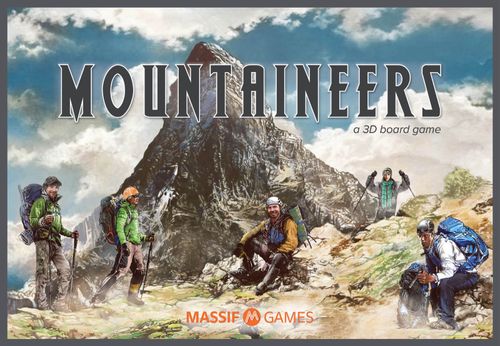
Mountaineers
Mountaineers Rulebook
Table of Contents
Table of Contents
Game Overview
Mountaineers is a strategy board game where players compete to earn climbing points through a total of 10 rounds (8 rounds for faster games). Players earn points by climbing and placing route markers, completing their special climbing routes, and by earning extra points through certain event cards. During the game, various events and condition changes happen, and the mountain slowly fills up with markers, requiring a player to not only have a good initial strategy, but also adapt their strategy as the mountain changes. Key to a good climb is balancing the number of supply tokens you spend against where you climb and the climbing upgrades you purchase.
Complete the majority of your climbing routes, avoid sabotage by locking your markers, use your upgrades and abilities efficiently, and you just might have enough climbing points to take a win!
Game Components
- 5x Double-sided Mountain Sides
- 1x Mountain Side Holder
- 1x Game Board Base
- 1x Game Spinner
- 1x Rubber Band
- 1x Vertical Conditions Board with stand
- 1x Conditions Board Marker
- 6x Climber Markers
- 6x Upgrade Boards / Character Holders
- 186x Route Markers (with spares)
- 60x Route Locks
- 55x Climbing Route Cards
- 120x Supply Tokens
- 80x Event Cards
- 11x Automated Climber Cards
- 12x Double-sided Character Cards
Game Setup
- Connect the mountain-side holder to the large game base using the game spinner.
- Shuffle and/or choose 3 mountain sides. Insert them into the mountain-side holder, and place the rubber band around the top of the mountain sides where the small grooves are located.
- Set the Conditions Board in its stand. Set the black and yellow Conditions Board marker nearby.
- Obtain all the event cards. Separate the conditions change, 1-3 player, and 4-6 player event cards into 3 separate stacks. Conditions Event Cards have text saying "Conditions Change!" in the middle. 4-6 player event cards have the double ice axe symbol.
- Shuffle and prepare event cards, according to the number of players in a game. Regular length games will have 10 event cards per person (1 conditions change event card and 9 regular event cards). Use the table below to help set up event cards for regular length games.
| # Players | # Condition Cards | # 1-3 Player Cards | # 4-6 Player Cards |
|---|---|---|---|
| Solo | 1 | 9 | 0 |
| 2 | 2 | 18 | 0 |
| 3 | 3 | 27 | 0 |
| 4 | 4 | 26 | 10 |
| 5 | 5 | 25 | 20 |
| 6 | 6 | 24 | 30 |
After you have obtained the correct quantities of various event cards, perform the following steps:
a) Shuffle the 1-3 player and 4-6 player cards into 1 combined stack. b) Divide this stack into equal piles, 1 pile for each player in the game. c) Add 1 condition card to each pile. d) Shuffle each pile separately. e) Finally, combine all piles without shuffling them and place face down on the table.
For a 4 player game, make 4 stacks of the combined 1-3 and 4-6 player event cards. Add 1 condition card to each stack, and shuffle stacks separately!
For 5-6 player games, you can opt to use 1 Conditions Change card and 7 regular event cards per person. See the following table for setup:
| # Players | # Condition Cards | # 1-3 Player Cards | # 4-6 Player Cards |
|---|---|---|---|
| 5 | 5 | 25 | 10 |
| 6 | 6 | 24 | 18 |
-
Shuffle and deal 6 climbing route cards to each player. They must choose 4 climbing routes to keep. Discard the remaining route cards into the box. Keep your climbing routes secret! For 5-6 player games using only 8 event cards total/person, deal 5 climbing route cards to each player. Players must choose only 3 climbing routes to keep.
REMEMBER! Some climbing routes may not be possible on your particular mountain. Choose carefully!
-
Give each player 1 upgrade board, 30 markers (numbered 1-30), 10 marker locks, 1 climbing marker, and 2 supply tokens.
-
Beginning with the starting player and proceeding clockwise, each player must place their climbing marker in a position at the very bottom of the mountain. Make sure you choose a starting position that works well with your climbing routes! The last person to climb a mountain or win the game goes first! Try to have less experienced players start last.
-
For 1-2 player games, see the Setup for Game Variants section. Otherwise, proceed to Game Play. You are ready to start mountaineering!
Setup for Game Variants
Mountaineers comes with several variants, including game mechanics for solo player games, 2 player games, character cards, and advanced difficulty games.
1-2 Player Variant
To play Mountaineers solo or for 2 players, you will need to set up the game with automated climbers (ACs) and their associated cards. To do this:
- Obtain 2 additional sets of route markers and climber markers.
- Obtain the AC cards and sort so that Turn 0 is on top and Turn 10 is on the bottom. The AC cards are double-sided; you may randomly choose which side is displayed up.
- Using the d6 dice, follow the cues on the Turn 0 Card to randomly set up the AC on the mountain at the start of the game, BEFORE other players have placed their climber markers. Roll the dice 2x for each AC to determine both the mountain side and the starting position on that mountain side. If you get the same position for both ACs, roll again until a different position is given.
Setup Example: You wish to play the Mountaineers solo version. You obtain 30 blue and 30 yellow route markers for the ACs, along with their climber markers. (You will not need locks or cards for them.) Using the AC card for Turn 0, you roll the dice for the blue climber. The first roll is a 1 and the second roll is a 5. You place the blue climber marker on mountain side 1 in the "E" position (mountain sides and positions are marked on the mountain side holder). You repeat the process again for the yellow climber. By random chance, the yellow climber is also to be placed in the "E" position of mountain side 1. Hence, you roll the dice once more, obtaining a 2. Place the yellow climber in the "B" position of mountain side 1.
Easier 2 Player Variant: If you wish a faster and less challenging 2 player game, you may choose to set up 1 AC instead of 2 ACs on the mountain at the start of the game.
Character Cards Variant
For additional variety and game complexity, you may choose to use a character with special abilities as you climb. To do this:
- Shuffle the character cards. The character cards are double-sided. Each character has a different ability or special action.
- Give each player 2 character cards when the route cards are dealt. Each player should choose 1 of the 4 characters as they choose their climbing route cards.
- Discard the extra character card, and indicate to the other players which character you have chosen to be. You may not change your character during the game. You may place your character card in the long horizontal slot in your upgrade board, with the chosen character facing you.
Advanced Difficulty Variants
For more challenging and flavorful games, you may decrease the number of 1-3 player event cards, and increase the number of 4-6 player event cards in a given game. This will decrease the number of supply tokens players get, requiring better resource management and climbing efficiency. Remember, 4-6 player event cards are marked with the double ice axe symbol.
Below is a table of suggested ratios of event cards for a more difficult 10 round game. You may adjust the number of 4-6 player event cards slightly, depending on your preferences and the desired difficulty level.
| # Players | # Condition Cards | # 1-3 Player Cards | # 4-6 Player Cards |
|---|---|---|---|
| 1 | 1 | 7 | 2 |
| 2 | 2 | 14 | 4 |
| 3 | 3 | 21 | 6 |
| 4 | 4 | 20 | 16 |
| 5 | 5 | 19 | 26 |
| 6 | 6 | 18 | 36 |
Additional Automated Climbers
For any game (except those with 6 players), you may choose to use the automated climber mechanism to add more climbers to the mountain. Simply set up the game following the steps outlined in the 1-2 Player Variant with the number of automated climbers you wish to have on the mountain. You could set up a 3 player game to have 3 automated climbers, giving the difficulty and feel of a 6 player game.
Game Play
For any game, a regular turn will consist of the following 3 steps. Games using the automated climbers will have additional steps (see Game Play with Automated Climbers).
-
Draw an event card. (See Event Cards for more info.) Read the top number and text of the event card to the other players. Note that some event cards will affect other players (not just you) so inform them accordingly.
-
Draw or pay the required number of supply tokens, indicated by the symbol on the top left and/or by the card text. If a player has 0 supply tokens, they are not required to pay the indicated amount. Resolve any special actions, condition changes, or events taking place on the mountain. After resolving the top section of the event card, lay it face up on the table next to your character. You can use the bottom section of the card later on during the game. If an event card is a conditions change event, you MUST discard it at the end of your turn.
Example event card: "+2 — Permit Required: Movement to or through alpine terrain positions not allowed." Special Action: "Move 1 space to a rock position for free. Discard after use."
-
Perform 0 to 2 regular actions and 0 to 1 special actions. (See Regular Actions and Special Actions for what they allow.) Regular actions include:
- Pay supply tokens to move 1 space (and place/lock route markers)
- Pay supply tokens to purchase an upgrade
- Pay supply tokens to use an upgrade
You may also do 1 special action. If you have an event card on the table that says "special action" at the bottom, you may perform that action, and then discard the event card. You may only do 1 special action per turn.
You may do regular and special actions in any order you wish. You may also repeat the same regular action. For example, you could pay to use an upgrade, use a special action to move, and then pay to use the same upgrade again.
Game Play with Automated Climbers
For games using the automated climbers (ACs), player turns are nearly identical to 3-6 player games. However, for any variant that uses the ACs, the following rules apply.
Automated Climber Guide (solo player mode):
- Draw 4 tokens.
- Roll the dice for the first automated climber.
- Move the climber as directed on the automated climber card.
- Roll the dice for the second automated climber.
- Move the climber as directed on the automated climber cards.
- Discard that turn's automated climber card.
Note: Always perform the automated climber turn first.
NOTE: The starting player should always perform the AC's actions first, BEFORE beginning their turn. The starting player will do this at the beginning of every round. The starting player should roll the dice for each AC, then move each AC as indicated on the AC card for that turn. Most ACs will perform 2 actions each (each action is either a "sabotage" or a "move" in the indicated direction).
Draw supply tokens at the start of the AC's turn. In a 1 player game, draw 4 supply tokens. In a 2 player game both players draw supply tokens each at the start of the AC's turn. In games with 3-6 players using the ACs, no supply tokens are drawn during the AC turns.
As ACs are moved, the starting player should place the corresponding colored route markers in the positions they leave. You do not need to place the AC route markers in numerical order.
Discard the AC's card for that turn, then proceed as normal with your regular turn. For more information on how to perform the AC actions, see Automated Climbers.
Game Play with Characters
If you are using the character cards in a game, you may have a character that gives you additional actions or abilities to use during your turn. As indicated by the card, you may use your character's action or ability at the same time as you perform your other regular and special actions.
You may NOT use a character's action or ability to ignore the climbing restrictions of a current event card or the Conditions Board, unless specifically stated on the character card.
Regular Actions
During their turn, a player may choose to do 0-2 regular actions. There are 3 different types of regular actions a player may do during their turn, including paying supply tokens to climb 1 space, purchasing a climbing upgrade, or using a climbing upgrade.
1. Climbing
To move on the mountain, you may pay 1 supply token to move to an adjacent position surrounding your climber marker. A player may climb over other players and markers, and may move around to different sides of the mountain.
Every position on the mountain has 6 surrounding positions that a player may move their climber marker to or through (except at the bottom). You may move to the 2 positions directly above your climber, the 2 positions horizontally on either side of your climber, or the 2 positions directly below your climber.
Climbing to a different mountain side requires moving up or sideways. You can not move to a new mountain side in a downward direction. To climb to an adjacent position, discard 1 supply token, and move your character to that position.
Climbing:
- Pay supply tokens for the terrain position you are moving to (1 of 6 adjacent positions).
- Move your climber marker to that position.
- Optional: Place a route marker in the position you just left.
- Optional: Pay 1 extra supply token to place a lock on the route marker as you place it.
If the position you are climbing to is in an area with a special condition (shown on the Conditions Board) you must pay the stated number of supply tokens before moving!
After moving your climber, you may choose to place a route marker immediately in the position you moved from, behind you. Most climbing routes require that you place a marker behind you, every time you climb. However, you may strategically choose to NOT place route markers. Unless you are an experienced player and/or have climbing routes that require you to conserve your route markers, it is recommended to place route markers behind your climber EVERY time you climb.
Helpful Tip: When placing route markers, start with the lowest numbered route marker, and place sequentially. This will assist you in determining which climbing routes you did and did not complete at the end of the game.
When you place a route marker in the mountain, you may choose to pay 1 supply token to place a lock on the route marker. This prevents other players from sabotaging that route marker.
You can only place route markers and locks during the turn you are moving in. You cannot retroactively place a route marker and/or lock a route marker on a different turn.
Climbing Over Other Players
You may climb over other players' route markers and climber marker. You must still pay the same amount of supply tokens as if they were not there, however, you cannot place your markers in those positions.
If you climb over another player, you must make sure that you have enough actions and resources to place your climber marker in an open position by the end of your turn.
You may use combinations of regular actions, special actions, and character actions to climb over players.
In the illustration in the guide book, the blue player used a regular climbing action to move to rock, the skis upgrade to move over the snow, and a special action from an event card to move to the alpine position which had no route markers in it.
2. Purchasing Climbing Upgrades
Climbing upgrades are essential to playing this game. You must purchase the upgrades before you can pay to use their actions. Pay the indicated amount of supply tokens, and place a route marker in the corresponding upgrade position. Once an upgrade has been purchased, it is "activated" for the rest of the game. Using the ability of an upgrade is a separate action with a separate cost.
Once you have purchased an upgrade, you may not sell it or use the route marker for climbing on the mountain, unless indicated by a certain event card.
When placing a route marker in the upgrade board, use the highest numbered marker available.
3. Using Climbing Upgrades
Once an upgrade has been purchased (activated), you may use subsequent regular actions during your turn to use its ability for the rest of the game.
The cost to use an upgrade is separate from its purchase cost and is listed to the right of it. Pay that amount of supply tokens to use the upgrade's ability. (Example from the illustration: Repellent — Move 1 or 2 spaces on forest terrain.)
You may use an upgrade multiple times in a turn. However, each upgrade use counts as 1 regular action. For upgrades that allow climber movements, you may perform the allowed movements in combination with other upgrades.
Using the illustration as an example, if on a previous turn, you had purchased the Skis and Harness upgrades, on this turn, you could spend 6 supply tokens total and move to snow, to rock, to snow, then to rock in a single turn.
Additionally, you are not required to move the total space allowed by use of an upgrade. If in the example above you only wanted to move 1 space on snow, you could still use the Skis upgrade to do this.
Climbing Upgrades override the effects of the current mountain conditions indicated on the Conditions Board. Upgrades do NOT override the top text of an event card.
For example, if Deep Snow is in effect and you already have the Skis upgrade, you could move 2 spaces to snow terrain for 3 supply tokens in 1 action, instead of paying 4 supply tokens to move 2 spaces in 2 actions. Use the table below to learn more about the upgrades.
Climbing Upgrades
Winning players typically will have purchased at least 2 upgrades by the end of the game. Purchasing early can be risky, but it can also be a better investment for climbing efficiently.
| Upgrade Name | Cost to Use | Upgrade Ability | Guide Notes |
|---|---|---|---|
| Repellent | -3 Supply Tokens | Move 1 or 2 spaces on forest terrain. | Overrides Grizzly Alert on Condition Board. Increases climbing efficiency on forest terrain. |
| Guide | -3 Supply Tokens | Move 1 or 2 spaces on trail terrain. | Overrides Heavy Rainfall on Conditions Board. Increases climbing efficiency on trail terrain. |
| Skis | -3 Supply Tokens | Move 1 or 2 spaces on snow terrain. | Overrides Deep Snow on Conditions Board. Increases climbing efficiency on snow terrain. |
| Harness | -3 Supply Tokens | Move 1 or 2 spaces on rock terrain. | Overrides Icy Rock on Conditions Board. Increases climbing efficiency on rock terrain. |
| Sunblock | -3 Supply Tokens | Move 1 or 2 spaces on alpine terrain. | Overrides Strong Wind on Conditions Board. Increases climbing efficiency on alpine terrain. |
Special Actions
During your turn, you may perform 1 special action using 1 event card. Follow the text and discard after you are finished.
You may NOT use a special action to ignore the climbing restrictions of a current event card. However, you MAY use a special action to override the restrictions/penalties of the Conditions Board.
Some special actions allow you to move your climber to a certain terrain feature and are marked with a helicopter symbol. For these, you may only place a route marker in the position you leave from, and the position you land. You may not place route markers in between those two positions.
Mountain Terrains
Most mountain sides have 7 main terrain types and 9 terrain features. Terrain features are "on top" of the terrain types.
- Terrain types: Rock, Alpine, Forest, Snow, Glacier, Trail, Hüttes
- Terrain features: Bridge, Cave, Bivouac Shelter, Grizzly, Snow Bridge, Crevasse, River, Waterfall, Lake
All mountain sides will have rock, alpine, forest, snow, and glacier positions. Trail terrain can co-exist with the 5 main terrain types.
You can cross lakes like any other terrain. Bridge and lakes have dotted boundaries to indicate which positions are associated with them. Waterfalls also have dotted lines, to indicate where waterfall crossings are located.
Throughout the game, various conditions, events, and movements will occur on various terrain types. In the majority of cases, these scenarios apply to the terrain position you are moving to, not the terrain position you are moving from.
Climbing Routes
Climbing Route Cards show patterns and goals for you to complete. Each route is worth a different amount of points, depending on its difficulty. It will have a text description, along with an illustration of a completed route.
IMPORTANT: The illustrations are meant only as a guide, not as an exact pattern to match. ONLY the text descriptions will indicate the exact route requirements and stipulations.
Watch out for the "In A Row" symbol. This requires routes to be completed sequentially by placing markers "in a row" and not moving to any positions not allowed by that card.
For example, the Cliff Hanger route means that a player may not place 6 markers in a row on rock, then 1 marker in another terrain, then 2 markers back in rock. Rather, the player MUST place all 8 markers on rock, without moving to any other type of terrain during that time. Note that the player can climb on trail positions, as long as they remain on rock terrain.
When a player is completing an "in a row" card, they MUST place route markers in every position they climb from. For Cliff Hanger, you may NOT place 6 markers in rock on 1 side of the mountain, climb to another section of the mountain without placing route markers, and then place 2 route markers in rock at that location to complete a route card.
If a climbing route has the "in a row" symbol and requires placing a certain number of markers in a row, you may NOT climb over another player's markers while completing that route.
Some climbing routes will have a "No Helicopter" symbol. You may not use any climbing upgrade or event card action that contains the helicopter symbol while completing that route.
You are allowed to complete multiple route cards at the same time. For example, if you have a route card that says "place 12 markers in a row without climbing on rock" and another card that says "place 12 markers in a row without climbing on alpine", you can complete both routes at the same time by climbing only on snow, glacier, forest, and Hütte terrain.
In completing a route, only the terrain directly underneath a marker or climber counts. For example, suppose you have a climbing route requiring you to place 8 markers in a row on rock terrain. If a river or snow patch runs between two of your markers on rock terrain, don't worry! As long as there is rock directly underneath your markers, you are still completing the route. The same rule applies to trail positions which are adjacent to each other, even if the trail is not connected.
Do NOT reveal your routes till game end. Another player could intentionally block or sabotage you!
Climbing routes are an important aspect of the game. It is difficult to win without completing at least 3 routes by the end of the game!
Completed routes which are sabotaged before the end of the game are worth 1/2 as many points. For example, a 7-point climbing route would be reduced to 3.5 points. You may try to re-complete a route card to gain back the points. Unfinished climbing routes are worth 0 points.
Your climber marker will count towards the completion of a route, at the end of a game.
Event Cards
An event card is drawn every turn. Event cards are important for obtaining supply tokens, scoring additional points, and finding more ways to climb efficiently through special actions and abilities.
There are 3 types of event cards: conditions change, 1-3 player, and 4-6 player event cards. You can identify the conditions change and 4-6 player event cards by their respective symbols.
Example conditions change card: "+3 — Conditions Change! Move the marker in the Conditions Board to Grizzly Alert: movement to forest terrain now costs 2 supply tokens per space." Example special ability card: "This turn only, disregard the effect of all Conditions."
Event Card Top Section
The top section of an event card indicates a mountain event taking place. It only applies to that particular turn (unless it is a conditions change) and can indicate the following in a game:
- How many supply tokens ALL players draw OR pay. Some event cards may have a symbol that tells you to draw or pay tokens. Other events will have a question mark symbol indicating that the number of tokens is determined only by the text. Some event cards may indicate that no supply tokens are to be drawn.
- A special condition, restriction, or action that applies to all players or only the player with the card. Players must follow the instructions on the card. If you have a card that forbids you from moving to a certain type of terrain, you must obey that instruction, EVEN if you have a character ability or climbing upgrade for that type of terrain.
- A change in mountain conditions. These events indicate a new condition that now exists on the mountain. After players have drawn/paid the correct number of tokens, you must update the conditions board by moving the marker to the matching condition. Event cards with "Conditions Change" must be discarded immediately after that turn.
Event Card Bottom Section
The bottom section of event cards is an action or ability that you can use that turn, or at a later point in the game. The bottom section of event cards can indicate the following:
- A special action. Some event cards allow special actions or movements, including "flying" to certain positions on the mountain. Any time you use a special action, you must discard that event card immediately after use.
- A special ability. Some event cards indicate an ability you may use with your character. These abilities (similar to character cards) may be used multiple times.
- An opportunity for extra points. Some event cards may indicate a way for you to earn extra climbing points at the END of the game. You are not required to earn these extra points, but they can be helpful in taking the win.
Conditions Board
The Conditions Board shows the current mountain conditions and makes climbing on certain terrains or areas of the mountain more costly and challenging. At the start of the game, no mountain conditions exist. However, as the game progresses, the conditions will change, once per each player in the game.
When the mountain conditions change, mark the event by placing the black and yellow marker in the hole by the corresponding condition. Regular climbing to that terrain or in that area now requires the indicated number of tokens per space.
Certain special actions and climbing upgrades override the movement cost of the conditions board.
| Condition | Effect | Cost |
|---|---|---|
| Icy Rock | Movement on rock terrain costs 2 supply tokens per space. | -2 |
| Heavy Rainfall | Movement on trail terrain costs 2 supply tokens per space. | -2 |
| Deep Snow | Movement on snow terrain costs 2 supply tokens per space. | -2 |
| Warm Front | Movement on glacier terrain costs 2 supply tokens per space. | -2 |
| Grizzly Alert | Movement on forest terrain costs 2 supply tokens per space. | -2 |
| Strong Wind | Movement on alpine terrain costs 2 supply tokens per space. | -2 |
| Bad Access | Movement on terrain below 2000 meters costs 2 supply tokens per space. | -2 |
| Storm Danger |
Automated Climbers
The automated climbers (ACs) are controlled by rolling the dice, and then moving them in the pattern as indicated on the corresponding card for that round of the game.
The AC cards are numbered Turn 0 through Turn 10 and are double-sided. It does not matter which side is face-up for a turn. If desired, you can use both sides for 2 different automated climbers, for added game variety.
ACs move and sabotage similar to regular climbers. They can move to and/or sabotage 1 of the 6 positions surrounding their current position. They can also sabotage their own route markers.
Except for Turn 0, roll the dice 1x per AC, then perform the 2 actions indicated on the card.
For example, if you rolled a "5", the AC sabotages (or removes) any marker in the position immediately to the right as its first action. For the second action, the AC moves into that same position, and leaves a route marker in the space it moved from.
Always place route markers behind the ACs as they move around the mountain.
Sometimes an AC's movement in a certain direction may be blocked by other markers. In that case, move the AC over those markers in the indicated direction to the next available position. If movement in an indicated direction is impossible, leave the AC where it is, and proceed with the next action, if any.
Likewise, an AC's sabotage action may be blocked by the presence of another player's climber marker. In that case, no sabotage action takes place, and the AC continues with its next action, if any.
If any unique scenarios occur in which the action or movement of an AC is unclear, leave the AC in its current position, and proceed to the next action, if any.
Additional Guide Tips
- When choosing your climbing routes at the beginning of a game, make sure they are physically possible for that particular mountain configuration. If you are dealt impossible climbing routes, you may discard them into the box, and draw new replacement routes.
- Make sure you aren't too ambitious in choosing your routes. Ensure you will have enough route markers to complete all of the climbing routes you choose! Good mountaineers always plan ahead!
- Try to complete multiple climbing routes at the same time. It will save you supply tokens and route markers!
- Remember that the mountain will fill up with markers. If you see someone climbing towards the only spot on the mountain that works with your climbing route, it's time to get competitive!
- Over the course of a game (depending on the difficulty level you chose), you will draw roughly 60 supply tokens. Plan accordingly!
- Mountain karma is a thing. Be careful who you sabotage. Or wait till the end of the game!
Winning the Game
A game ends after all of the event cards have been drawn. Players should count up their climbing points and track them on the circular scoring track on the game base.
Your game score includes climbing points from your climbing route cards, your markers on the mountain, your event cards worth extra points, minus any negative points from cards or upgrades.
- Each completed route is worth the number of points indicated on the card. Show other players how you completed your route. Routes that were completed, then sabotaged, are worth 1/2 as many climbing points. Routes that are not complete, were sabotaged before being complete, or were performed incorrectly are worth 0 climbing points.
- Each route marker on the mountain, including your climber marker, is worth 1 climbing point. You do NOT score climbing points for markers in your upgrade board.
- Count any climbing points you earn from completing the specifications of event cards with extra point options.
- Subtract any negative points from cards or certain upgrades (like sabotage).
The player with the highest number of climbing points wins the game and is the best of the Mountaineers!
Ties
In event of a tie, the player with the fewest number of route markers on the mountain takes the win. If after this point, a tie still exists, you must agree on a date and time, and race each other to the top of the nearest real mountain. You may decide your own definition of a mountain. Please be safe!
Winning the Game - Solo Player Mode
For the 1 player variant, you must have at least 55 climbing points by the end of 10 rounds to win. Players who can achieve 60 climbing points should consider starting a career in mountaineering.