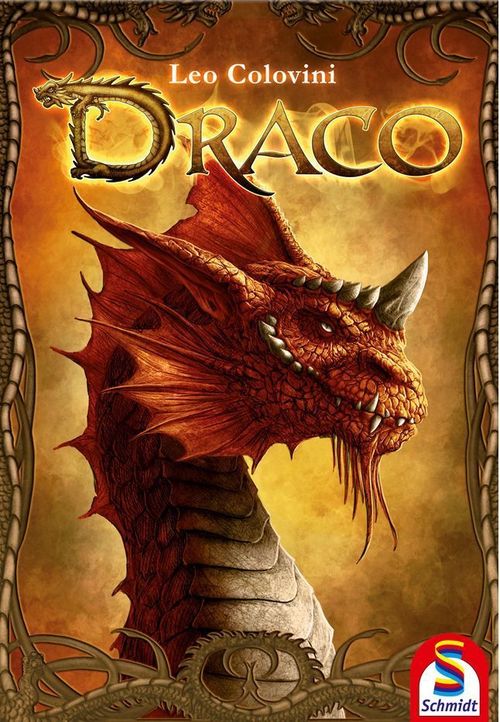
Mount Drago
Mount Drago Rulebook
Table of Contents
Table of Contents
Components
- 10 dragons
- 10 dragon rider stones (2 per symbol)
- 110 playing cards
- 1 double-sided game board
Object of the Game
The players ride changing dragons up to the summit of Mount Draco. To do so they play cards of the corresponding dragons. But whether it is the right dragon only becomes clear when a scoring occurs, because the scorings provide the points needed to win. The player who has collected the most points at the end of the game wins.
Setup
Depending on the number of players, use the board side for 2-3 players or the side for 4-5 players, and place the board in the middle of the table with the correspondingly marked side up.
At the start of the game all 10 dragons are placed on the start space at the bottom left. The colours of the dragons only serve to tell the dragons apart and correspond to the colours of the playing cards. They are not player colours. Instead, each player chooses a dragon symbol and takes the two matching dragon rider stones from the supply. One stone is placed in front of him, the other on space 0 of the victory point track. It is used to show his victory points.
Each player takes a differently coloured dragon card and lays it face up in front of himself (the number value is unimportant). The cards lying in front of the players show which player is currently riding which dragon.
The playing cards are shuffled. Each player receives 6 cards face down, which he takes into his hand. The remaining cards are placed face down as a draw pile.
Sequence of Play
The youngest player begins. Play then continues clockwise. On his turn, the player whose turn it is must carry out the following steps in order:
- Play a card - move a dragon
- Change of dragon
- a) Scoring b) If necessary, draw card(s)
1. Play a card - move a dragon
On his turn a player may play only one card. The colour of the card played determines which dragon is moved. The number on the card indicates how many spaces the dragon is moved towards the summit. Any number of dragons may stand on one space.
A player may move any dragon, including dragons that belong to other players.
2. Change of dragon
The following situations can occur when playing a card:
- The player plays a card in a colour that another player has lying in front of him. In this case he places his played card underneath his own face-up card. The dragon cards lying in front of the other players always remain untouched.
- The player plays a card in a colour that no other player has in front of him. Then he must place the newly played card face up on top of his card lying in front of him. By playing a colour that no other player has in front of him, a player therefore changes the dragon he is currently riding.
A player can ride only one dragon at a time. Therefore only one open card is ever visible in front of each player.
Example: Lukas plays a blue 1 and thereby moves the blue dragon 1 space forward. Since no other player has a blue card in front of him, he lays his blue dragon card on the red dragon card that is still lying face up in front of him from an earlier turn.
Exception: When moving dragons that belong to no player and that stand in the rearmost position on the path, the player may decide whether or not he wants to ride that dragon from now on. If he does not want to ride the dragon, the card currently lying in front of him stays there, and the newly played card goes underneath his open card. The corresponding dragon is nevertheless moved as normal.
Example: The black and the white dragon are in last position. Lukas moves the black dragon 4 spaces forward. Since it is one of the last dragons, Lukas can decide: either he takes over the colour and lays the black card on his blue one, or he keeps his blue card and puts the black card down. He decides to keep the blue dragon card and lays the black 4 underneath his blue card.
3a. Scoring
Whenever a dragon has been moved onto a blue or green space, a scoring occurs. The type of scoring depends on the colour of the space onto which the dragon was moved.
Blue space = small scoring: When a dragon is moved onto a blue space, there is a small scoring. All dragons standing on a space whose number is 3 or lower are scored.
The dragons bring their riders as many victory points as the number on the space on which the dragon stands. The dragon rider stones are moved forward on the victory point track by this number. All players whose dragons stand on a space with a higher number receive no points. Dragons standing on the start space bring 0 victory points.
Example: Lukas plays a black 4 and thereby moves Nina's black dragon onto a blue space, causing a small scoring. Since his blue dragon stands on a 3 space, he moves his dragon rider stone forward 3 spaces. Nina's stone is moved 2 spaces further, since her black dragon now stands on the 2 space. Marie's white dragon stands on a 6 space. She comes away empty-handed in this scoring. Her dragon rider stone is not moved.
Green space = large scoring: When a dragon is moved onto a green space, there is a large scoring. All dragons are scored. This means that all players receive as many points as shown on the space on which their dragon stands. The dragon rider stones are moved forward on the victory point track by this number.
Example: Marie moves the blue dragon 3 spaces forward. Since Lukas already has a blue card in front of him, Marie's card goes underneath her white card. Because the blue dragon was moved onto the green space, a large scoring occurs. Marie gets 6 points for her white dragon and Lukas 4 points for his blue one. Nina again receives 2 points for her black dragon.
Summit spaces: Every time a new dragon is moved onto one of the four summit spaces, there is a large scoring. If the dragon would have to move beyond the last space, these surplus movement points are forfeited. Dragons may be moved on the summit spaces as normal. However, players also have the option of discarding any number of cards of dragons that stand on a summit space before they draw cards.
3b. If necessary, draw card(s)
- The player has not triggered a scoring. At the end of his turn the player draws cards from the draw pile until he again has 6 cards in hand.
- The player has triggered a scoring. The player may not draw cards. (It can happen that a player triggers scorings in several consecutive rounds. A player who, for example, has triggered a scoring 4 rounds in a row then has only 2 cards left in hand.)
A player may only draw cards again once he has taken an entirely normal turn without a scoring.
Special case: If a player has played his last card, he may immediately refill his hand to 6 cards, regardless of whether or not he thereby triggered a scoring.
End of the Game
The game ends as soon as the third dragon has been moved onto a summit space and the large scoring has been carried out. The current round is not played to its end. The player with the most points wins. In case of a tie there are several winners.