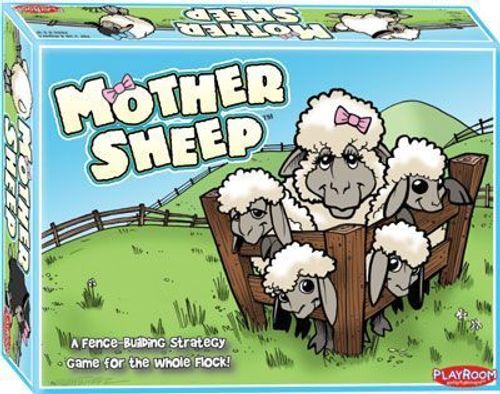
Mother Sheep
Mother Sheep Rulebook
Table of Contents
Table of Contents
Contents
1 Mother Sheep, 10 Sheep Tiles (Annabelle, Bob, Dusty, Francesca, Gertie, Langston, Millard, Norman, Princess & Tabitha), 10 Sheep Pawns, 80 Fences, 1 Corral Board, 1 Fence Bag and 18 My Sheep Cards.
Object of the Game
Be the first player to Fence In all five of the Sheep listed on your secret My Sheep Card.
Setup
Clear off a playing area on a table and place the Mother Sheep in the center. Place the Corral Board off to one side.
Scatter the ten Sheep Tiles face down on the table, making sure that no Sheep Tile is further than three Fence lengths from the Mother Sheep, or closer than one Fence length. The Sheep Tiles also should not be closer than the width of three Fences to each other. Feel free to experiment with layouts; more distant Sheep make for a longer game. Turn the Sheep Tiles face up. Notice that each Sheep Tile has the name of its Sheep printed on it. Place a Sheep Pawn on each Sheep Tile.
Shuffle the My Sheep Cards and have each player take one. Do not show your My Sheep Card to anyone else! Put all of the Fences in the Fence Bag and have each player take three at random, placing them face down in front of them. These are their only Secret Fences for the entire game, and while players can look at their own Secret Fences, they should not show them to anybody else. The player wearing the most wool goes first, takes three Fences from the bag and places them face up on the table as Community Fences.
(Setup diagram: the Corral Board sits at the left edge of the play area, the Mother Sheep is in the center surrounded by Sheep Tiles, each player's My Sheep card and Secret Fences are placed at their seat, and the Community Fences are placed on the table near the bottom left. The diagram is not to scale.)
Game Play
On each player's turn, they must choose one of the three Community Fences and place it on the table (see "Placing Fences," below). They may also choose one of their Secret Fences, and place them both in the same turn, but the two Fences used must touch each other. After placing, the player immediately draws a Community Fence from the Fence Bag to replace the one used (Secret Fences are never replaced). If the player Fenced In a Sheep (see "Fencing In a Sheep," below), then they remove that Sheep, put it in the Corral, and play another Community Fence (plus a Secret Fence, if they wish). A player's turn ends when they have placed a Fence (or Fences) but have not Fenced In a Sheep. Play continues with the player to the left.
Placing Fences
There are a few rules to follow when placing Fences. Each Fence is divided into multiple color segments.
- Any one unused color segment from each Fence may overlap the Mother Sheep (she counts as any color), and any number of Fences may overlap her. Segments touching the Mother Sheep may not be overlapped.
- A player must lay their Fence so that it overlaps with either the Mother Sheep and/or another Fence (or Fences) already on the table. It must overlap the entire width of the Fence it is connecting to.
- When overlapping a Fence with another Fence, they must match colors (red on red, blue on blue, etc.), but the same color segment on a Fence can't be used twice.
- No part of a color segment can overlap (or be overlapped by) a segment of a different color.
- If a player is laying both a Community Fence and a Secret Fence, the Fences may be placed in any order, but they must touch each other.
- No Fence may touch a Sheep other than the Mother Sheep.
- A player may not lay a Fence if it would Fence In more than one Sheep inside one Fenced In area at a time.
- A player may not lay a Fence if doing so would make it impossible to Fence In a Sheep (see "Impossible Sheep," below).
(Diagrams: "Incorrect (two color segments on the Mother Sheep)" and "Correct" show a Fence crossing the Mother Sheep; "Incorrect (the blue segment is used twice)" and "Correct" show Fences joined at a corner; "Correct (each color segment is only used once)" and "Incorrect (the purple segment is used twice)" show Fences meeting at a junction; "Overlaps the entire width of the Fence" is correct and "Does not overlap the entire width of the Fence" is incorrect.)
Fencing In a Sheep
A Sheep is Fenced In if its Tile is completely surrounded by a chain of connected Fences and/or part of the Mother Sheep (remember, two Sheep may never be Fenced In together).
When a player Fences In a Sheep, they place the Sheep in the appropriate spot on the Corral. The player then places another Fence (or Fences) and continues to place more Fences if they Fence In another Sheep.
It does not matter if the Sheep that is Fenced In is on that player's My Sheep Card or not; it is still placed in the Corral.
(Diagrams: "Correct" shows a Sheep completely surrounded by connected Fences; "Incorrect (colors do not match)" shows a chain where the Fences do not connect by matching colors.)
(Example: "It is the beginning of Player 1's turn. Francesca is almost Fenced In." Player 1 takes the blue/purple fence from the three Community Fences and places it so that Francesca is Fenced In. Francesca is removed from the Fenced In area and placed in the Corral, and the tile is removed from the game.)
Impossible Sheep
At any point during the game, if a player sees that it is impossible to Fence In a Sheep, even with unlimited Fences, stop the game to fix the situation. The player must point out that Sheep, and if no player can come up with a way to Fence In that Sheep, adjust it, and any nearby Fences, as necessary. Players may not adjust more than it takes to make it possible to Fence In the Sheep.
(Example: "Impossible Sheep Example" shows a Sheep (Millard) whose surrounding Fences cannot be closed.)
Winning the Game
At the end of each player's turn, if all five of the Sheep on any player's My Sheep Card are Fenced In, that player wins the game immediately. The winner must show their card to the other players so they can check if all five Sheep are Fenced In and confirm victory.
A player may choose to declare a win as soon as they see that all five of their Sheep are Fenced In. However, if an opponent is already in the middle of their turn, they have one last opportunity to try to Fence In all of their remaining Sheep by the end of their turn (by using the extra Community Fences they get to play each time they Fence In a Sheep and any Secret Fences that they wish to play, according to the Placing Fences rules). If that player succeeds, they win the game instead!
If players run out of Community Fences (and the Fence Bag is empty), the winner is the player with the most Fenced In Sheep on their card.
Tie Rule
If two or more players complete their cards at the same time (or tie for most Fenced In Sheep), the winner is the one who just ended their turn. If that player isn't involved in the tie, the winner is the player whose turn is coming up soonest.
End-game Example
Player 1 plays a Community Fence, and Fences In "Annabelle". He places the Sheep Pawn in the Corral. Player 2 sees that all five of her Sheep are now Fenced In. She declares, "I won!" Player 1's turn is not finished, as he gets to play an additional Community Fence (and optional Secret Fence) since he Fenced In a Sheep. Player 2 has not won the game yet, and Player 1 can try to finish Fencing In the rest of the Sheep on his My Sheep Card during his turn. If he succeeds, he wins the game. Otherwise, Player 1 will win. If, during the course of Player 1's turn, he Fences In another Sheep which causes another player to complete their My Sheep Card, but still does not succeed himself, then the two (or more) players that have completed My Sheep Cards at the end of his turn follow the "Tie Rule" (above). Because Player 1 (whose turn just ended) was unsuccessful and Player 2's turn is next, Player 2 wins.
Helpful Hints
- It is perfectly fine to try to block another player by purposely laying Fences to make it more difficult (but not impossible) to Fence In their Sheep.
- Since it does not matter who Fences In your Sheep, as long as they are on your My Sheep Card, it is a good idea to let others do the work for you if you see them heading for one of your Sheep. If you wait too long, though, someone else might block you!
- It is a good idea to be secretive about which Sheep you are trying to fence in, and at the same time try to guess which ones your opponents are after. However, you might want to reveal your intentions if it means a temporary alliance with another player.
- If it seems like you cannot place any of the Community Fences on any existing Fences, remember that you may always play a Fence on the Mother Sheep!
- A player does not have to declare that they are about to win the game when an opponent has Fenced In their last Sheep. They may wait until after the opponent has finished their turn, but if they forget to declare the win and the next player has already begun their turn (by placing a Fence), then they must wait until after that player's turn is over to win.