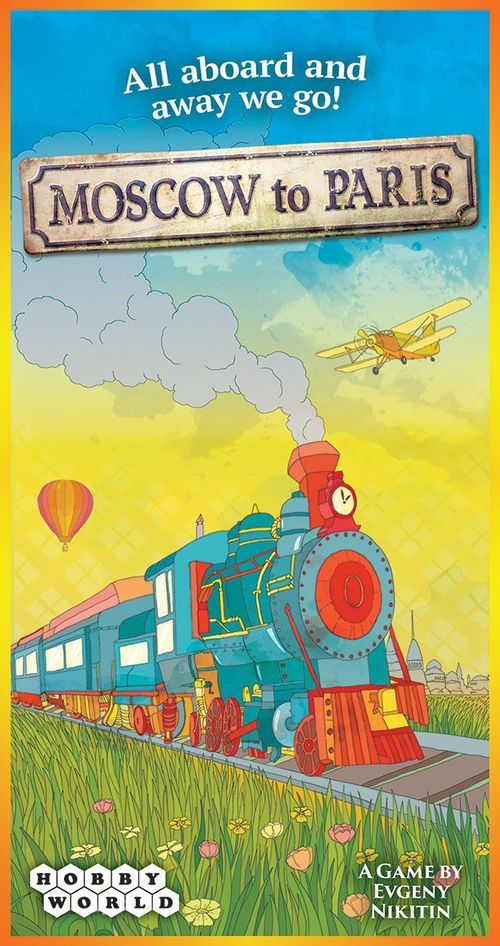
Moscow to Paris
Moscow to Paris Rulebook
Table of Contents
Table of Contents
Game Contents
- 88 car cards: 8 different car cards, 11 of each (×11).
- 16 action cards: one card type ×8 and four card types ×2 each.
- 16 city cards: Capital Cities and Cities.
- 2 special city cards: Istanbul and Hometown.
- Game rules.
Setting Up
Decide who will go first before the game begins. The first player is whoever has most recently been to a railroad station.
The first player shuffles all the car and action cards together, and deals five cards face down to every player (including themselves). The players take the cards they were dealt, keeping them secret from everybody else. The remaining car and action cards are placed in a single deck face down in the middle of the table so that everyone can reach them.
The first player proceeds to shuffle the city cards and carefully stacks them face down in a deck next to the car and action cards. The player then turns over four city cards and places them in a column face up. Each of these cards is a city line. The car cards will be played to the right and left of the city cards.
The initial layout for three players is shown on page 6 of the rulebook. A layout for three players with the cards in play is shown on page 7.
The first player begins the game.
How to Play
Action
A player's turn must include one of the following four actions:
❶ Play one car card to the left or right of a city card and take a card.
All the car cards that make up a city line must be different. In other words, if a city line already has a car card you cannot play the same car card again in that line.
The number of cards in a city line (to the left and right of the city card) cannot exceed the maximum number of cards on the city card.
(City card diagram on page 4 labels: Victory points; Country flag; The maximum number of cars in the city line.)
If the car and action deck runs out, re-shuffle the discard pile and use it to make another deck.
❷ Play an action card and take a card.
Action cards' effects are described in detail on the last page of the rules.
If the car cards adjacent to a city were discarded during the game, the remaining cards of this city line are moved to the city.
The action card that was played goes to the discard pile.
❸ Play a car card in front of you.
A maximum of four car cards can be played in front of a player.
Unlike city lines, a player can play multiple versions of the same card in front of them.
❹ Return one of the cards in front of you to your hand.
Keep track of the number of cards! The total number of the cards in front of a player and in their hand must always be five.
Taking a city card
At the end of a turn, you can take a city card following any action if the cards in the city line fully correspond to some or all of the cards in front of you. When you take a city card you must discard the corresponding city line and the matching car cards that you have in front of you. Place the city cards you have collected face up next to you in such a way that you and your opponents can see them.
Once you have taken a city card, take as many cards from the deck as you need to have a total of five cards (in front of you and in your hand). Replace the city card you took with another card from the city deck.
The next player moving clockwise then takes a turn.
End of Turn
The next player moving clockwise takes the next turn after a player performs an action (and takes a city card, if applicable).
DEAD END
If the game goes into an endless cycle, i.e. players keep taking turns without any progress, all the players discard their cards after the second repeating turn. The car cards in front of the players and the car cards from the city lines are also discarded. The city cards stay where they are. Each player then takes five cards and the game continues.
End of the Game
The game ends when the city card stack has been depleted and there are three city cards left on the table. The players then calculate their total scores.
Scoring and Determining the Winner
Once the game is over, each player tallies up the points from the city cards they have collected, then puts city cards with various flags (one with each flag) aside and adds the number of city cards remaining in front of them to the total (one point for each repeating flag on their city cards).
Example: a player collects the following cards over the course of a game. Their results: five points for city cards and two extra points for repeating flags. So seven points in total.
If two or more players have the same score, they compare the number of capital city cards they have collected. The player with the most capital city cards wins. In the event of another draw, the players compare the number of city cards they have collected. The player with the most city cards wins.
If this also leads to a draw, the game is a tie and everybody with the same score wins.
Team Game
If there are four players, you can form two teams. The seating arrangements should be such that teammates alternate, i.e. teammates should not sit next to one another. In this case, the players on the same team combine the city cards they have collected before performing the final calculations.
Special City Cards: Istanbul and Hometown
Istanbul
Ride the famous Orient Express from Paris to Istanbul.
The Istanbul card is unique in that the player who receives it earns three victory points. Since there are no other Turkish cities in the game, this card cannot earn points for repeating flags. Shuffle it into the city deck before the game begins (if you like).
Hometown
If you like, you can write the name of your own hometown and draw a corresponding flag on this card. You can use it like a regular city card.
Action Cards
Action cards' effects, as printed on the last page of the rules:
❶ You can swap any two cards within the game area (cards next to cities and cards in front of players). A city line cannot contain two identical car cards.
❷ You can discard any two car cards that are located in different city lines, one of which is on top of the other. You cannot discard less than two cards.
❸ You can discard any three car cards that are located in different city lines, one of which is on top of the other. You cannot discard less than three cards.
❹ You can swap one car card for any other car card belonging to the player to your left or right. The player you swap cards with can also swap cards with their neighbor and so on until your second neighbour swaps a card. So the player who plays this action card can only swap cards once. Should any player refuse to continue swapping car cards, the effect of the action card ends.
❺ You can discard a city card with all the car cards from the corresponding city line. The discarded city card is not returned to the deck.