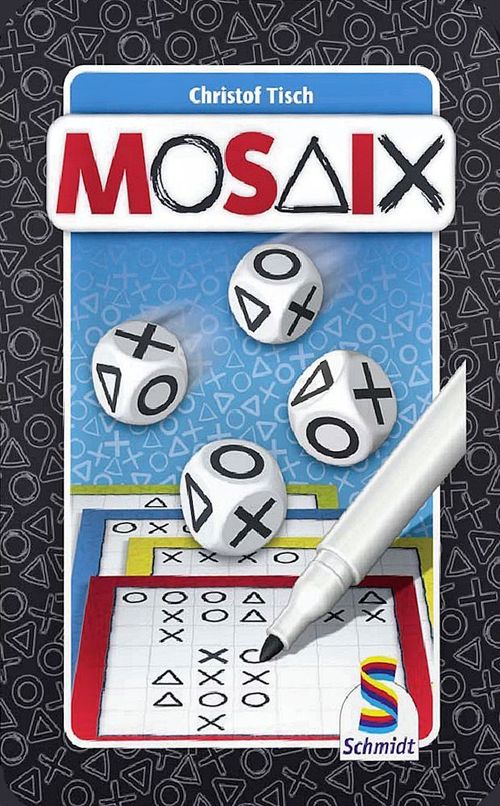
Mosaix
Mosaix Rulebook
Table of Contents
Table of Contents
Contents
- 4 washable boards (You can wipe them with a dry cloth.)
- 4 symbol dice
- 4 pens
- 1 set of playing instructions
Aim of the Game
In turns, one player rolls the four dice, arranges a formation with them and all players fill the symbols of this formation in the grid of their board. Players try to assemble numerous areas with as many spaces of the same symbol as possible in order to get the most points at the end of the game.
Preparations (2 to 4 players)
Each player receives a pen and a board. Use the coloured side of the board. Determine a starting player who takes the four dice and begins.
How to Play
1. Roll the dice and arrange them
The player whose turn it is rolls the four dice. Then he arranges the dice so that all four dice are connected. He can freely choose the arrangement of the symbols. The player can build one of the following formations (illustration without the symbols):
The rulebook illustrates seven formations. Described in words (the diagrams show outlines only, no symbols):
- Formation 1 — a 2×2 block of four dice.
- Formation 2 — a vertical column of three dice, with one die attached to the left of the middle die.
- Formation 3 — two dice side by side, and two more dice side by side below them, offset one space to the right.
- Formation 4 — two dice side by side, with a column of two further dice running down from the right-hand die.
- Formation 5 — two dice side by side, with a column of two further dice running down from the left-hand die.
- Formation 6 — two dice side by side, and two more dice side by side below them, offset one space to the left.
- Formation 7 — a vertical column of four dice.
2. Fill in the symbols
Now, all players fill the displayed symbols in their board's grid. In doing so, they have to observe the following rules:
- The formation of the displayed symbols on the dice must remain the same.
- Players may fill the symbols in any place of the grid. They do not have to be connected with other symbols.
- While filling in the symbols, players may also rotate the formation. To keep track of things, they turn the dice formation or their board. (Example: cast of dice rotated through 90°.)
- Players are not forced to fill in all the symbols, if the formation is arranged so that some symbols jut over the grid's margin. (Example: the symbols that fall outside the grid are not filled in.)
- It is not allowed to fill in a formation if a symbol would have to be entered into a space that is already occupied. (Example: you may not fill in the formation like this, since this space is already occupied.)
- Each player must fill in at least one symbol per round, if it is possible.
Next round
The next player in a clockwise direction receives the dice and rolls them. He arranges them in a formation before all players fill the symbols in their grid, and so on.
End of the Game
The game is over after the round in which the first player has completed his grid or has no more possibilities to fill in symbols — for example since the remaining spaces are isolated. Now, players proceed to the scoring. (Example for scoring: you may not fill anything in the space marked with an asterisk.)
Scoring
Each player encircles on his board all the areas with identical symbols. An area comprises spaces with the same symbol that adjoin each other horizontally or vertically. The pre-printed symbol is included. Identical symbols in spaces that adjoin only diagonally do not count. If an area consists of less than 5 identical symbols, players cross out these spaces.
For each symbol, players count the number of areas that consist of at least 5 spaces. They fill the number of areas in the first column of the scoring table. Then they count the total number of spaces in these areas and fill it in the second column. Spaces in areas consisting of less than 5 spaces are not considered.
Players multiply the number of areas with the total number of spaces and add up the three symbols' results. The player with the highest overall score wins the game.
Scoring table example
The scoring table has one row per symbol (circle, triangle, cross), a first column for the number of areas and a second column for the total number of spaces in those areas:
| Symbol | Areas | × | Spaces | = | Score |
|---|---|---|---|---|---|
| Circle | 2 | × | 14 | = | 28 |
| Triangle | 2 | × | 11 | = | 22 |
| Cross | 3 | × | 17 | = | 51 |
| Total | 101 |
Variation for a Single Player
Use the grey back of one board and observe the rules for the basic game. However, you may only leave out dice on the board's margin eight times. Whenever you do not fill in one to three symbols, you cross out one space of the solo scale above the grid for each symbol (the solo scale is the row of spaces printed above the grid). You may only leave out symbols of a formation, if there is still an equivalent number of spaces on the scale. When all spaces of the scale are crossed out, you must always fill in all symbols. If this is not possible any more, the game is over. You may also end the game anytime.
You score points according to the basic rules. In addition, each empty space of the solo scale is worth 1 point. (These points are filled in the separate solo scoring space and added up with the other points.)
From 120 points on, the solo game is won. And 130 points are really super!