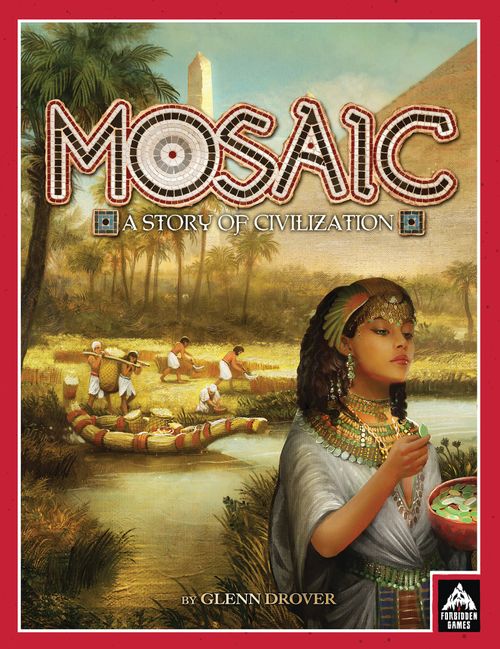
Mosaic: A Story of Civilization
Mosaic: A Story of Civilization Rulebook
Table of Contents
Table of Contents
- Game Overview
- Contents
- The Nine Pillars of Civilization
- The Currencies
- Setup
- Select a Player Board
- Seed the Map: Fish, Trade Goods and Cache Tiles
- Create the Technology Deck and Starting Technologies
- Create the Build Deck
- Create the Population Deck
- Create the Tax & Tariff Deck
- Special Setup Rules for 2 and 3 Players
- Place the Wonder, Golden Age, and Government Tiles
- Civilization Achievements Tiles
- Starting Player
- Select Leader
- Draft Starting Technologies
- Place Starting City
- Game Rounds
- Golden Age & Civilization Achievement Tiles
- Empire Scoring Cards
- Game End
- Appendix
- Strategy
Game Overview
At its core, Mosaic is a straight forward action-selection game. However, you'll find that the results of your actions throughout the game allow you to pursue deep, interlocking strategies in your pursuit of victory points (VPs) to win the game.
Prior to starting play, you'll perform the following steps:
- Populate the Mapboard with Trade Good Tiles and Cache Tiles.
- Each Player will select a Unique Leader that has a special power and starting assets.
- Each player will draft 5 Starting Technology Cards.
- Each Player will place their Starting City in a hex on the board, taking the Trade Good or Cache Tile there.
Play will then begin with the Starting Player. On each of your turns, you'll choose one of the 8 possible actions. Throughout the game, you'll attempt to maximize the efficiency of the actions while:
- Building your production 'engine' on your player board by taking Technology Cards that will increase your production bonuses, or by increasing your Population with Food.
- Producing one of the 3 Standard Currencies using the Work action (Your Population + That Currency Production Bonus) so that you'll have enough to perform actions on future turns.
- Building Cities, Port Cities, and Towns on the map to gain the Trade Goods and Cache Tiles there, while increasing your Influence (Area Majority) in a Region. Having the most Influence in a Region will allow you to score Victory Points (VP's) during Empire Scoring Events.
- Building/ Moving Military Units that act as mobile Influence.
- Constructing Wonders to gain influence and score VP's. Each Wonder scores at the end of the game in unique ways.
- Developing a Government for your Civilization that gives you unique benefits and a unique way to earn VPs during Empire Scoring events.
- Taxing/ Tariffing to gain Money, which can be used as a replacement for any of the 3 Standard Currencies, but at double the cost. Taxing/ Tariffing increases 'Unrest', which must be offset before the end of the game to avoid losing VP's.
- Spending Food to increase your Population, which you'll need to maximize production (Work) and to build Cities.
Throughout the game, you'll also be earning VPs by acquiring Civilization Achievements, Golden Ages, Projects, Wonders, and Technologies that score points at the end of the game, as well as achieving Area Majority in as many Regions as possible to score during Empire Scoring events. The race for these scoring opportunities is the driving tension in the game. Managing all of these competing requirements will determine your Civilization's success or failure.
All Technologies and Projects give your Civilization unique abilities, as well as symbols that represent the increase in one of the 9 Pillars of Civilization:
- Science
- Population/ Health
- Government
- Economy
- Building
- Military/ Empire
- Food Production
- Culture
- Urbanization
Acquiring these Pillars is important in creating the unique mosaic of your civilization. They are used as prerequisites for many new technologies, as well as for scoring. Also, by pursuing specialization in one or more Pillars of Civilization, you may be able to claim a 'Golden Age' of that type.
As the game goes on and your Civilization grows, Empire Scoring cards are eventually revealed from the four decks. Each time an Empire Scoring card is revealed, your civilization will score for the Regions in which you have the most Influence.
Contents
1 Game Board
The map has a hex grid and is divided into seven regions: Hispania, Gaul, Italia, Greece, Assyria, Egypt, and Numidia. It also has spaces for the four decks and the card offer areas from each deck (Build, Technology, Population, and Tax & Tariff), and spaces to represent the other four actions available in the game (Work, Military, Wonders, and Government).
The board is marked with: the Wonders area, the Build Offer, the Population Offer, the Technology Offer, the Tax & Tariff Offer, the Holding Area, the Work space, the Military space, the Government space, Cache Hexes, and Port Hexes.
4 Sets of Currency Tokens / Coins
- Currencies: 150 (Stone, Ideas, Food) — 1's x 30 each, 5's x 20 each
- Stone (1's & 5's)
- Food (1's & 5's)
- Ideas (1's & 5's)
- Coins: 100 (Money) — 1's x 30, 5's x 30, 10's x 30, 20's x 10
- Money (1's, 5's, 10's and 20's)
6 Player Boards
1 Starting Player Token
105 Technology Cards (39 Starting Technologies / 66 Technology Cards)
Technology cards show a Starting Technology Icon (on starting technologies), Prerequisite Symbols, and Pillars of Civilization Symbols.
38 Build Cards
Build cards show Pillars of Civilization Symbols.
20 Population Cards
Population cards show the Population Gain and the Cost.
20 Tax & Tariff Cards
Tax & Tariff cards show the amount gained and the Unrest Effect.
4 Empire Scoring Cards (one each for the Technology, Build, Population, and Tax & Tariff decks)
9 Leader Cards
9 Wonder Tiles
9 Wonder Board Tiles
9 Golden Age Tiles
15 Civilization Achievement Tiles
6 Government Tiles
City and Town Board Tiles (12 City, 3 Port City, 6 Farm Town, and 6 Manufactory Town) in each of 6 Player Colors
Military Unit Tiles (10 Infantry, 10 Cavalry, and 2 Siege Engines) in each of 6 Player Colors
Population Tokens in each of 6 Player Colors
60 Wooden Cubes for tracking on the Player Boards
28 Cache Tokens
68 Trade Goods Tokens
80 'X' Trade Goods Tiles
The Nine Pillars of Civilization
There are nine 'Pillars' of a Civilization. They are all important, but focusing on some over others is what shapes the unique texture of a Civilization…and determines success or failure.
SCIENCE – Developing the ability to learn how the world works, how to make habitats more livable, how to manufacture food and goods more efficiently, how to live together in a society, how to make better weapons, and most importantly how to store all of that knowledge and pass it on to the next generation, was critical to a successful civilization.
ECONOMY – Economic activity was the lifeblood of a civilization. Productive towns and a vibrant trade network made for a full marketplace. They also allowed the government to collect more taxes.
FOOD PRODUCTION – As a civilization grew, it had to feed its growing population. More efficient food production meant a larger population, more workers, and therefore more productivity.
POPULATION/ HEALTH – Large numbers of people living together in cities and towns led to challenges with sanitation and disease. Civilizations that did not solve these challenges suffered greatly.
BUILDING – The ability to build large projects like irrigation, city walls, roads, civic buildings, and even wonders, was the hallmark of successful civilizations. The great structures were often all that remained of ancient civilizations, and ensured their prominent place in history.
CULTURE – Each civilization developed its own unique culture, with its own art, entertainment, religion, and festivals. A vibrant culture gave the people in a civilization an escape from the toil of their daily lives.
GOVERNMENT – The ability to organize larger, and more complex societies was critical to the success of growing civilizations. Those with better organization and government systems operated more efficiently, and could deal with challenges more effectively.
MILITARY/ EMPIRE – Civilizations didn't develop in a vacuum. They faced competition from other nearby civilizations for scarce resources and land. This competition often led to conflict. Even the most prosperous civilization could end up in the dustbin of history if it could not defend itself. Expanding control over neighboring lands was even better, bringing wealth, power, and security.
URBANIZATION – People living in close proximity in urban environments was one of the most important accelerators to the development of a civilization. It sparked job specialization, which allowed for more productivity and technological advances. It influenced and accelerated the development of culture, religion, and government. However, it also led to challenges from disease, sanitation, and crime. The need to solve these challenges spurred on more advancement. The rise of cities was perhaps the most influential of all of the Pillars of Civilization.
The Currencies
There are 3 Standard Currencies in Mosaic:
- Stone (tokens of 1 and 5)
- Ideas (tokens of 1 and 5)
- Food (tokens of 1 and 5)
And one Universal Currency:
- Money (coins of 1, 5, 10 and 20)
These currencies are required to pay for some actions:
| Action | Cost |
|---|---|
| Construct a Wonder | Stone & Food — 20 Stone, 5 Food (+5 of each for 2nd Wonder) |
| Learn a new Technology | Ideas — 5 Ideas |
| Build a Project | Stone & Ideas — 5 Stone, 5 Ideas |
| Recruit Military Units | Money — 5 Money |
| Increase your Population | Food — per population card |
| Build a City (or Port City) | Stone (and Population) — 4 Stone, 2 Population |
Money is universal because it may be used to replace any of the Standard Currencies when paying for an action, but at a 2:1 rate. For example: If you are Building a Project (cost: 5 Ideas and 5 Stone), but you only have 3 Ideas and 4 Stone, you may pay an extra 6 Money (4 to replace the Idea shortfall, and 2 to replace the Stone shortfall) and still perform the action.
Money may never be used to replace Population.
Setup
Place the Game Board in the middle of the table, and create piles of the four Currency Tokens (Stone, Ideas, Food, and Money) near the board to act as a supply.
Select a Player Board
Each player receives a Player Board where they can track their population, trade goods, production of the four currencies, and storage of those currencies that they produce. At the start of the game, each player receives 5 Population. As you gain production (Stone, Ideas, Food, Tax, or Tariff) as a result of technology cards or other benefits, move the Cube to the new production value on that track.
Seed the Map: Fish, Trade Goods and Cache Tiles
Place the 10 'Fish' Tiles face up, one on each Port Hex (The hexes with ships on them).
Place all Cache Tiles face down and mix them. Then place one on each Cache hex on the Game Board, face-down.
Place all Trade Goods Tiles face down and mix them. Then place one on each open hex on the Game Board, face-down.
Note: Only hexes with all 6 sides are valid hexes.
Then turn all tiles (Trade Goods and Cache Tiles) face up, revealing the tiles. Remove any 'X' tiles and place them out of play in the box.
Create the Technology Deck and Starting Technologies
Shuffle the 'Starting Technology' cards (The Starting Technology cards are the Technology Cards with an 'S' in the upper left corner), and deal 5 to each player.
Take the remaining Starting Technology Cards and shuffle them with the regular technology cards to form the Technology Deck. Then, cut the deck into roughly three equal parts. For 4 – 6 players, shuffle the Technology Deck 'Empire Scoring Card' into one of the three piles and place the other two piles on top so that the Empire Scoring Card is in the bottom third of the deck. For 2 – 3 Players, place the Empire Scoring Card into the middle pile with one pile above and one below the middle pile so that the Empire Scoring Card is in the middle third of the deck. Then, place the Technology Deck on the correct space on the Game Board. Draw the top five cards and place them face up in the Technology Deck Offer Spaces.
Create the Build Deck
Shuffle all 'Build' cards in the Build Deck. Then, cut the deck into two equal parts. Shuffle the Build Deck Empire Scoring Card into one of the two piles and place the other pile on top so that the Empire Scoring Card is in the bottom half of the deck. Then place the Build Deck on the correct space on the Game Board. Draw the top five cards and place them face up in the Build Deck Offer Spaces.
Create the Population Deck
Shuffle all of the Population cards (except the Population Empire Scoring Card) and count out Population Cards depending on the number of players in the game as follows:
| Population Deck by Player Count | 2P | 3P | 4P | 5P | 6P |
|---|---|---|---|---|---|
| Cards | 10 | 10 | 12 | 12 | 14 |
This will be the Population Deck. Place any remaining Population Cards out of play in the game box. They will not be used in the game.
Then, cut the deck in half and shuffle the Population Deck 'Empire Card' into one of the halves. Once shuffled well, place that half beneath the other half so that the Scoring Card has been shuffled into the bottom half of the Population Deck. Place the Population Deck on the correct space on the Game Board. Draw the top two cards and place them face up in the Population Deck Offer Spaces.
Create the Tax & Tariff Deck
Take all of the Tax & Tariff cards (except the Tax & Tariff Empire Scoring Card) and count out a number of Tax & Tariff Cards depending on the number of players in the game, making sure that there are equal numbers of Tax Cards and Tariff Cards, with the combined total equaling:
| Tax & Tariff Deck by Player Count | 2P | 3P | 4P | 5P | 6P |
|---|---|---|---|---|---|
| Cards | 10 | 10 | 12 | 12 | 14 |
Place any remaining Tax & Tariff Cards out of play in the game box. They will not be used in the game.
Then shuffle the deck, cut it in half, and then shuffle the Tax & Tariff Deck 'Empire Card' into one of the halves. Once shuffled well, place that half beneath the other half so that the Scoring Card has been shuffled into the bottom half of the Tax & Tariff Deck. Place the Tax & Tariff Deck on the correct space on the Game Board. Draw the top two cards and place them face up in the Tax & Tariff Deck Offer Spaces.
Special Setup Rules for 2 and 3 Players
The four decks are set for 2 or 3 players as instructed above.
When playing with 3 players, one region (Hispania) will not be in play.
When Playing with 2 players, two regions (Hispania and Gaul) will not be in play.
Regions that are not 'in play' do not have Trade Good and Cache Tiles placed on them. Once the game starts, no cities, towns, ports, or wonders may be built in these regions, nor can military units move into them, nor are they scored during Empire Scoring.
Place the Wonder, Golden Age, and Government Tiles
Place the 9 Wonder Tiles and 9 Golden Age Tiles near the Game Board, and the 6 Government Tiles on the Game Board in the space reserved for them.
Civilization Achievements Tiles
Shuffle the 15 Civilization Achievements Tiles, and randomly select 9 of them, placing the remaining 6 out of play. Place the 9 selected tiles near the Game Board.
Starting Player
Select a Starting Player and place the Starting Player Token in front of them.
Select Leader
Starting with the player to the right of the Starting Player, select one of the available Leader Cards and pass the remaining Leader Cards to the right (counter-clockwise). Once all players have chosen a Leader Card, place the remaining Leader Cards in the box out of play.
Each Leader has a unique special power(s) and some starting benefits: currencies, population, etc.
Note: Some Leader powers are used during the game.
Draft Starting Technologies
All players will now take their five Starting Technology Cards that they were dealt, select one and place it in front of them. This is theirs to keep. They each then pass the remaining cards to the player to their left (clockwise). Repeat this process until all players have selected their five Starting Technology Cards.
Place Starting City
Starting with the Starting Player and going left (clockwise) around the table, each player places one of their Cities on a hex on the board. If there is a Cache Tile in that hex, they receive the benefit shown on the tile (currency, population, etc.). The Cache Tile is then placed in the box out of play. If there is a Trade Good Tile in that hex, they own that Trade Good Tile and place it on their Player Board in the Trade Goods Area.
After placing their Starting City, each player will take the benefits shown on their Leader Card and their Starting Technology Cards that they are able to play. Technology Cards that can be played are placed in front of the player face up. Those that cannot, are placed face down.
All players now have a Leader, the starting benefits from that Leader, a starting City on the board, and five Starting Technologies. The game will now begin.
Game Rounds
The Starting Player will take the first turn each round and may perform ONE Action (see below), followed likewise by each player around the table clockwise to complete the Round.
Actions
On a player's turn, they may perform one of the following eight Actions:
- WORK: Produce Stone, Food, or Ideas
- POPULATION: Increase Population
- BUILD: Found a new City, Town, or Build a Project
- WONDER: Construct a Wonder
- TECHNOLOGY: Discover a new Technology
- TAX & TARIFF: Tax the Population (Tax) or Merchants (Tariff) and receive Money
- MILITARY: Recruit new Military Units and/or move Military Units
- GOVERNMENT: Create a Government
1. Work
The decision of how to direct the work of your population will drive your strategy in creating a productive civilization. Will you have them quarry stone, grow food, or focus on researching new ideas? The surpluses that your civilization creates will dictate the opportunities that you are able to pursue later.
Produce one of the three non-money Currencies (Ideas, Food, and Stone) by adding your population to your 'Production' of that Currency shown on your player board. Take the total of those two numbers worth of that Currency from the supply and place them in front of you.
Example: Christine's Civilization has 6 Population and has Stone production of 7. When Christine performs the Work action for Stone, she gets 13 Stone. However, she only has a 3 for Idea Production, so she only gets 9 Ideas when she performs a Work action for Ideas.
2. Population
Your population is your most important resource. It drives your productivity in your home city, and also your ability to send colonists to spread new cities across the Mediterranean. Unfortunately, these two goals are in conflict. Balancing these competing needs will be one of your primary challenges.
Strong food production underpins population growth, but public health projects like Aqueducts, Public Baths, and Sewers, as well as technologies like medicine, are also critical to a large, healthy population.
Select one of the two Population Cards available in the Population Offer Area on the Game Board. Pay the number of Food shown on the card into the supply and increase your Population on your Player Board by the amount shown on the card.
Population may either be represented by Cardboard Population Tokens or Population Miniatures depending on which version of the game that you own.
Place the used Population Card out of play, draw a new Population Card from the deck, and place it in the empty space in the Population Offer Area.
Once all Population Cards have been drawn and the deck is used up, all future Population Actions gain 2 Population and cost 15 Food.
3. Build
All great civilizations build! They build Cities, roads, walls, aqueducts, and wondrous monuments. Your civilization is no different. You will order your people to quarry vast amounts of stone so that you can build all of these things, and leave a legacy that will be remembered down through the ages.
Select one of the 5 Build Cards available in the Build Card Offer Area on the Game Board and pay the cost.
If the card is a Farm or Manufactory Town card, there is no cost. Place it in front of you and gain the benefits shown. Then draw a new card from the Build Deck, placing it in the empty space on the Build offer area.
If the card is a City, Port City or Project card, pay the cost, place it in front of you, and gain the benefits shown. The Pillars of Civilization Symbols on the bottom of the card are now yours as well. Then draw a new card from the Build Deck, placing it in the empty space on the Build Offer Area.
Note: It is always possible to build a City, Port, or Town for their usual cost without selecting a card.
Build City
Cost: 4 Stone and 2 Population (place the stone in the supply, and reduce your population by 2)
Benefits: Place the Card in front of you and gain the benefit shown on the card. Place one of your Cities on an available hex anywhere on the board. Gain the Trade Good Tile in that hex and place it on your Player Board; or gain the benefit on the Cache Tile in that hex and then place it out of play.
Whenever a city is built, place 5 Money from the supply into the Holding Area on the Game Board. The next player to take a Tax & Tariff card gets all the Money in this space.
Build Port City
Cost: 4 Stone and 2 Population.
Benefits: Place the Card in front of you and gain 10 Money. Place one of your Ports on an available port hex (one with a ship on it), take the Fish Tile on the hex and place it on your Player Board, and add 3 to your Food Production.
Ports are a type of city that can only be built in Port hexes (those with ship icons). Regular Cities and towns may not be built in those spaces. Once built, they act as any other city for purposes of influence and scoring.
Whenever a port city is built, place 10 Money from the supply into the Holding Area on the Game Board. The next player to take a Tax & Tariff card gets all the Money in this space.
Build Town
There are two kinds of towns: Farm Towns and Manufactory Towns.
Cost: None
Benefits: Gain the benefit shown on the card. Place the correct type of Town (Farm or Manufactory) on an available hex next to one of your Cities. Gain the Trade Good Tile in that hex and place it on your Player Board; or Gain the benefit on the Cache Tile in that hex and then place it out of play.
At the end of the game, for each Manufactory Town card that you own, you will score 5 VP if you own all three Trade Goods shown on the card.
Build Project
Cost: 5 Stone and 5 Ideas (place these in the supply)
Benefits: Scoring at the end of the game: 1 VP/ Pillars of Civilization Symbol that you own of that type.
Cache Tiles
Cache Tiles are a pile of goodies that give you an immediate one-time benefit when you build a City, Town, or Wonder on them. Take the commodity shown from the supply and place the tile out of play.
Example: Paul builds a Farm Town on the '7 Ideas' Cache Tile. He takes 7 Ideas from the supply and places the cache tile out of play.
Trade Goods Tiles
Trade Goods Tiles represent the addition of that trade good to your trade network. They have an ongoing benefit. When you build a City, Town, or Wonder on a hex on the board that contains one, take the tile and place it on your Player Board in the Trade Goods area. If it is a duplicate to one that you already own, stack it on top of the same type so that each unique trade good occupies a circle on your player board.
Later, when you select a Tariff Card to generate Money, part of that calculation is Money for every unique Trade Good that you own.
Stone and Grain Tiles that have a '+2' on them, add +2 to your Production of Stone or Food when they are acquired. Fish Tiles have a '+3' on them, and add +3 to your Food Production when they are aquired. These Tiles are Trade Goods, and are placed in the Trade Goods area of your Player Board.
4. Wonder
I met a traveler from an antique land Who said: Two vast and trunkless legs of stone Stand in the desert. Near them, on the sand, Half sunk, a shattered visage lies, whose frown, And wrinkled lip, and sneer of cold command, Tell that its sculptor well those passions read Which yet survive, stamped on these lifeless things, The hand that mocked them and the heart that fed: And on the pedestal these words appear: 'My name is Ozymandias, king of kings: Look on my works, ye Mighty, and despair!' Nothing beside remains. Round the decay Of that colossal wreck, boundless and bare The lone and level sands stretch far away. — Percy Shelley
Will you be Ozymandias, or will your works stand the test of time?
Epic Buildings, sometimes known as 'Wonders', took years and thousands of workers to create. They soared over the cities where they were built, and created a sense of awe in citizens and enemies alike. They elevated the standing of the civilization, and sometimes stood for millennia, a constant reminder through the ages of the greatness of the civilization that built them.
Select one of the available Wonder Tiles. Pay the cost and place the tile in front of you for scoring at the end of the game. Take the appropriate Wonder Token/Miniature and place it on any available hex in a region in which you have at least one city. Two of the Wonders must be built in a port hex (Colossus of Rhodes and The Lighthouse of Alexandria). If there are no available port hexes in regions where you have at least one city, then you may not build those Wonders at that time. One Wonder (The Great Pyramid) must be built in a region that has a least 3 cities, one of which must be yours.
The cost of Wonders goes up every time that you build one. Your first Wonder costs 20 Stone and 5 Food, your second Wonder costs 25 Stone and 10 Food, your third wonder costs 30 Stone and 15 Food, and so on. Each time a different player builds their first Wonder, the cost is 20 Stone and 5 Food and increases for them.
5. Technology
It is essential that your civilization learn new technologies. By putting your population to work researching new ideas, you will be able to gain new technologies that allow you to work more productively, govern more efficiently, and conquer more effectively.
If your civilization becomes the most advanced, you will rise above your primitive competitors.
Pay 5 Ideas into the supply, and select one of the five available Technology Cards from the Technology Card Offer Area on the board. Place your new Technology card in front of you. Draw a new Technology card, and place it in the empty space on the Technology Deck Offer Area.
If you already own the Prerequisite Pillars of Civilization Symbols shown in the linen box in the upper right of your new Technology Card, then you may place the card face up and gain the benefits. If you do not yet own all of the Prerequisite Pillars of Civilization Symbols, then place the card face down in front of you. You may play the card on one of your later turns once you have all of the Prerequisite Pillars of Civilization Symbols.
You may also place a Technology Card face down to save its effect for later use.
- Playing it later does not count as your action for that turn
- All Cards must be played face up to gain the benefit, and stay face up once played.
- 1x means that this event occurs one time when the card is played
- The Pillars of Civilization Symbols on a newly acquired Technology Card are not owned until the card is played face up
Pillars of Civilization Symbols
The Pillars of Civilization Symbols shown on the bottom right corner of Leader, Technology, Build Project, Build City, and Build Farm Town Cards that you own and have played face up can be used to meet the Prerequisites of Technology Cards that you acquire later.
The Pillars of Civilization Symbols shown in the linen box in the upper right corner of Technology Cards and in the bottom left of Government Tiles are the Prerequisite Pillars of Civilization Symbols. So, the more Pillars of Civilization Symbols that you acquire, the more technologies that you can learn. Many 'Starting' Technologies do not have any Prerequisites.
6. Tax & Tariff
Having a vault full of gold gives your civilization great flexibility to pursue any action. In order to fill that vault, you can either tax your people or your merchants. You will need to build your population and your trade network to make it really pay. Learning new government technologies will also allow you to maximize taxation.
But beware! Your people do not like to pay taxes. The more you tax them, the higher their level of unrest will grow.
Select one of the two Tax & Tariff Cards available in the Tax & Tariff Offer Area on the Game Board. Gain the amount of Money from the supply shown on the card, as well as any Money in the holding area next to the Tax & Tariff Cards that was placed there when cities were built. Place the card in front of you to keep track of your 'Unrest', shown at the bottom of Tax & Tariff cards. Then draw a new card from the Tax & Tariff Deck, placing it in the empty space on the offer area.
Once all Tax & Tariff Cards have been drawn and the deck is used up, all future Tax Actions will generate 2 Money per Population + Government Symbol + your Tax Production, and all future Tariff Actions will generate 2 Money per unique Trade Good + your Cities + your Tariff Production.
Unrest
At the end of the game, you will total your unrest on all of your Tax & Tariff Cards, and subtract the amount of Unrest that you can ignore due to some Wonders, Leaders and certain Technology Cards. If you have any remaining Unrest, deduct that many VP from your score at the end of the game.
Tax
There are two types of Tax & Tariff Cards. Tax cards generate Money based on your population, the number of Government Pillars of Civilization Symbols that you have, and your 'Tax' Production on your player board.
Example: Michael selects a Tax Card that says: 2 x Population + 2 x Government Symbols + Tax Production. His Population is 6, he has 3 Government Pillars of Civilization Symbols, and his Tax Production is 4. Therefore, he would get 22 Money from that card.
Tariff
Tariff cards generate Money based on the number of unique Trade Goods Tiles that you have, the number of cities that you have on the board, and your Tariff Production.
Example: Jack selects a Tariff Card that says: 3 x Unique Trade Goods + 2 x Cities + Tariff Production. Jack has 5 unique Trade Goods, 4 Cities, and 6 Tariff Production. Therefore, he would get 29 Money from that card.
Note: Unique Trade Goods are ones that are not duplicated. If you have 3 of the same type, you would only count that as 1 unique Trade Good.
Money
Money is the most flexible currency. It can be used to replace any other currency (stone, food, ideas) when paying for an action that requires them. However, you must pay 2 Money for every 1 stone, food, or idea that you are replacing.
7. Military
Some of the great civilizations of the Mediterranean Basin built powerful armies and conquered large empires. Your civilization can follow in their footsteps. But beware of being dragged into endless wars that will drain your resources.
When you perform a Military Action, you may recruit new military units and/ or move military units that you have on the board. You may do either or both in the same action.
Recruit
Recruit new military units (Infantry or Cavalry, or if you own the Siege Engine Technology, a Siege Engine) by paying 5 Money into the supply for each Military Unit that you recruit, and placing those new military units in any region that contains one of your cities. You may recruit up to 2 new military units in one turn (more if you own the General Leader and/ or the Citizen Levy Technology).
Move
Move a military unit from a region to an adjacent region and pay 1 Money. You may move one, some, or all of your military units once per turn, paying 1 Money for each one moved.
For clarity, the following regions are considered adjacent: Italy and Numidia, Italy and Greece, Hispania and Numidia, Numidia and Egypt. Greece is NOT adjacent to Egypt.
Placement and Influence
Military units exist in a region, but do not occupy hexes, and so cannot block the placement of new cities, towns, or Wonders. Place them in unused areas of a region, or near the region to show where they are located.
Military Units each count as 1 point of 'Influence' in a region for purposes of majority during Empire Scoring (see below). With certain technologies, they may count for more, or be able to eliminate other military units.
8. Government
As civilizations got more complex, so did the necessity for more complex governments. Civilizations that were better organized and managed had a distinct advantage over those who weren't.
Select one of the available Government Tiles from the board. Pay the cost and place the tile in front of you. There are six 'Government' Tiles (Tyranny, City State, Monarchy, Oligarchy, Theocracy, and Republic). You may purchase a Government Tile with Ideas as long as you also have the Required Symbols shown on the Tile.
You may only have one Government at a time. If you purchase a new Government while already owning a Government, replace the old Government tile onto the Game Board before taking the new tile.
If you own a Government, you may clear one offer (Build, Population, Technology, or Tax & Tariff), taking the cards in the offer and placing them on the bottom of the deck, and replacing them in the offer with new cards from the top of the deck. You may use this power as a free action on your turn, once per game per Government tile. Once used, flip your government tile over so that the arrow in the upper right corner is face down.
Tyranny: During Empire Scoring, you will score VP/Region where you have a Majority of Influence. 2-3 Players: 2VP/ Region; 4+ Players: 3VP/ Region Prerequisite: 2 Military — Cost: 5 Ideas
Theocracy: During Empire Scoring, you will score 2 VP for each Region that contains at least one of your Cities. Prerequisite: 2 Government, 1 Military — Cost: 15 Ideas
City State: During Empire Scoring, you will score 1 VP/ City that you own in a single region of your choice. Prerequisite: 2 Government, 1 Urbanization — Cost: 15 Ideas
Monarchy: As long as you are a Monarchy, you gain +5 production of Food and Stone. During Empire Scoring, you will score 3 VP/ Wonder that you own. Prerequisite: 2 Government, 1 Food Production — Cost: 15 Ideas
Oligarchy: As long as you are an Oligarchy, you gain +5 Tax and Tariff Production. During Empire Scoring, you will score VP/ Golden Age and Civilization Achievement. 2-3 Players: 1VP/ Tile; 4+ Players: 2VP/ Tile Prerequisite: 2 Government, 1 Economy — Cost: 15 Ideas
Republic: You may look at the top card in any Deck before taking your Action. You may select the card that you looked at, or replace it on the deck and select another card from that Offering. During Empire Scoring, you will score 1 VP/ 2 Population Prerequisite: 3 Government, 1 Culture — Cost: 20 Ideas
Golden Age & Civilization Achievement Tiles
On your turn, if you have met the requirements of a Golden Age Tile (6 of the particular Pillars of Civilization Symbol) or Civilization Achievement Tile (as shown on the tile), you may claim it by taking the tile and placing it in front of you. You gain any benefits shown on the tile immediately, and the victory points (VP) at the end of the game.
This does not count as your action for the turn. If you meet the requirements of multiple Golden Ages/ Civilization Achievements on the same turn, there is no limit to the number that you may claim.
Empire Scoring Cards
When an Empire Scoring Card is revealed from any one of the four decks, Empire Scoring will occur. First, however, the player that revealed the card finishes their action.
Empire Scoring
Players will score points for each Region on the Board that is in play. Empire Scoring allows the two players with the most 'Influence' in a region to score points for that region. Most Influence is determined by counting 2 Influence points for each Wonder and City that you own in that region, and 1 Influence point for each town and military unit that you own in that region (plus any bonus points or adjustments from technologies).
The player with the second most Influence points in a region will score 2 Victory Points. The player with the most Influence points in a region will score 3 Victory Points plus 1 VP/ City and Wonder in that region (regardless of who owns them). In the case of a tie for most influence, all tied players receive the full amount of Victory Points for that region. In the case of a tie for second place, however, the tied players get nothing.
NOTE: Certain Tiles/ Cards award a benefit for 'controlling' a certain number of regions. A region that has two or more players tied for the most influence is not 'controlled' by any of them. Control exists only when a single player has the most influence.
Governments and Empire Scoring
Government tiles also allow you to score points during each Empire Scoring Round.
Example 1: Jackie, Ethan, and Christine all have a presence in Hispania when it is scored.
Jackie has three cities, 2 Infantry, and the 'Formations' Technology Card. Her influence in Hispania is 10.
Ethan has one city, one farm town, and 2 Cavalry. His influence in Hispania is 5.
Christine has two cities, a Wonder, and no military units. Her influence is 6.
Jackie has the majority of influence and so scores 3 VP plus 1 VP per city and Wonder in Hispania for a total of 10 VP. Christine has the second most influence, and so will score 2 VP.
Example 2: The next scoring round comes around quickly, and everything is the same, except now Ethan has built a Siege Engine in Hispania, which negates the influence of his opponents' cities. Therefore, Jackie has 4 influence, Ethan has 6 influence (+1 for the Siege Engine), and Christine has 2 influence. Ethan will now get the 10 VP and Jackie will get 2 VP.
Game End
Play continues around the table until EITHER:
- The third Empire Scoring Card is revealed, or
- 2 of 3 of the following tiles have all been taken by the players:
- Wonders
- Civilization Achievements
- Golden Ages
When either occurs, perform Empire Scoring, then finish the current Round up to but not including the starting player, and then one more full Round. (Note: The last player in every game is the player to the right of the 'Starting Player' who went first at the beginning of the game.)
NOTE: There may never be more than 3 Empire Scoring Events, even if another Empire Scoring Card is revealed after the third Empire Scoring Round.
End Game Scoring
You have already accumulated Victory Points (VP) in each of the three Empire Scoring Rounds, and for certain Technology cards.
In addition, you will also get VP (Victory Points) as follows:
- CITIES and TOWNS: Every City that you have on the board = 2 VP, and every Town that you have on the board = 1 VP
- WONDERS: Victory Points shown on the Wonder Tiles that you own
- GOLDEN AGE and CIVILIZATION ACHIEVEMENT TILES: Victory Points shown on the tiles that you own
- PROJECT CARDS: Victory Points = the number of Pillars of Civilization Symbols that you own of the type shown on the Project Card
- TECHNOLOGY CARDS: Victory Points as shown on the Technology Cards that you have played with the VP icon on the bottom left.
- MANUFACTORY TOWN CARDS: Each Manufactory Town card has three trade goods shown on the bottom of the card. If you have all three of those trade goods on your player board, you will score 5 VP. If you have two identical Manufactory Towns, they will both score.
- UNREST: Subtract the number of Net Unrest (Unrest on your Tax and Tariff cards reduced by what you can ignore due to Wonders, Leaders, and Technology Cards)
The player with the most Victory Points at the end of the game is the winner. In the case of a tie, the tied player with the most Wonders is the winner. If there is still a tie, the tied player with the most Money is the winner.
Appendix
Appendix 1: Wonders
| Wonder | Scoring | Other |
|---|---|---|
| Colosseum of Rome | 4 VP/ Region where you have a Majority of Influence | -4 Unrest |
| Hanging Gardens | 3 VP/ Adjacent City | -3 Unrest |
| Stonehenge | 1 VP/ 2 Population | |
| Colossus of Rhodes | 2 VP/ City in that Region | Must be Built in a Port Hex |
| Great Library | 5 VP | Gain 2 Identical Pillars of Civilization Symbols of your Choice |
| Lighthouse of Alexandria | 1 VP/ Unique Trade Good Tile | Must be Built in a Port Hex |
| Temple of Artemis | 1 VP/ Military Unit in that Region | All Players' Military Units |
| Great Pyramid | 12 VP | May only be built in a region with 3 or more cities |
| Sphinx | 4 VP/ Wonder in that Region |
Appendix 2: Golden Ages
| Golden Age | Requirement | Benefit |
|---|---|---|
| Golden Age of Medicine | x6 Population | Gain 2 Population & 6 VP |
| Golden Age of Architecture | x6 Build | +3 Stone Production & 6 VP |
| Golden Age of Art | x6 Culture | Gain 10 of any Currency & 6 VP |
| Golden Age of Kings | x6 Government | +3 Tax Production & 6 VP |
| Golden Age of Public Games | x6 Food | +3 Food Production & 6 VP |
| Golden Age of City States | x6 Urbanization | 1 Free City & 6 VP |
| Golden Age of Science | x6 Science | +3 Idea Production & 6 VP |
| Golden Age of Trade | x6 Economic | +3 Tariff Production & 6 VP |
| Golden Age of Heroes | x6 Military | Gain 2 Military Units (Inf or Cav) & 6 VP |
Appendix 3: Civilization Achievements
| Achievement | Requirement | VP |
|---|---|---|
| Populous Civilization | 12 Population | 6 VP |
| Great Builder Civilization | 5 Projects and/or Wonders Total | 6 VP |
| Seafaring Civilization | 3 Port Cities | 6 VP |
| Imperial Civilization | 2-3 Players: Control 4 Regions; 4+ Players: Control 3 Regions | 6 VP |
| Scholarly Civilization | 15 Idea Production | 6 VP |
| Urban Civilization | 5 Cities | 6 VP |
| Militaristic Civilization | 6 Military Units | 6 VP |
| Well-Governed Civilization | 12 Tax Production | 6 VP |
| Merchant Civilization | 7 Unique Trade Goods | 6 VP |
| Wealthy Civilization | 60 Money | 6 VP |
| Diverse Civilization | All 9 Unique Pillar Symbols | 6 VP |
| Farming Civilization | 15 Food Production | 6 VP |
| Masonic Civilization | 15 Stone Production | 6 VP |
| Trading Civilization | 12 Tariff Production | 6 VP |
| Scientific Civilization | 15 Technology Cards | 6 VP |
Appendix 4: Leader Cards
| Leader | Power | Starting Assets | Pillar Symbol |
|---|---|---|---|
| Magistrate | +2 Food, Stone, & Tax Production; Convert 1 Population into 20 of Any Currency (on your turn) (1x) | Start: 5 Food, 10 Stone, +1 Population | Government |
| Engineer | +5 Stone Production, +3 Idea Production; Gain +1 Stone Production each time you Build a City, Port, or Manufactory Town | Start: 10 Stone, 10 Money | Building |
| General | +10 Tax Production; May Recruit up to 3 Military Units rather than 2; Eliminate one Military Unit in a single region containing your Infantry or Cavalry before each Empire Scoring | Start: 20 Money, 1 Infantry Unit, +1 Population | Military |
| Scribe | +5 to any Production; One Extra Action on your first turn and two Extra Actions at the End of the Game | Start: 10 Food, 5 Ideas | Urbanization |
| Artist | +5 Idea Production; -3 Unrest; +10 Money Whenever a Wonder is Built by any player; Gain +1 VP/ Culture Symbol at the end of the game | Start: 15 Money, 5 Ideas | Culture |
| Priestess | +6 Tax Production & +3 Food Production; -3 Unrest; May change ownership of a city owned by an opponent who has 4 or more cities (on your turn) (1x) | Start: 15 Money, 5 Food | Population |
| Philosopher | +8 Idea Production; +3 Any other single Production | Start: 1 Free Random Technology Card from the Deck, 10 Ideas, 10 Money | Science |
| Farmer | +5 Food Production; Add 1 Population to each Population Card you take | Start: 10 Food, 10 Money, 1 Farm Town | Food |
| Merchant | +5 Tariff Production; Gain 2 Money/ Unique Trade Good Tile when Playing a Tax Card | Start: 30 Money, 1 Manufactory Town | Economy |
Appendix 5: Build Cards
| Card | Benefit | Pillar Symbols |
|---|---|---|
| Farm Town | Gain 5 Food and +1 Food Production | Food |
| Manufactory Town | Gain 5 Money and +1 Tariff Production; 5 VP at the end of the game for having all three Trade Goods shown | — |
| Port City | Gain 10 Money | Economy, Science |
| Architectural City | Gain 5 Stone | Building, Urbanization |
| Capital City | Clear any Offering Track, placing those cards on the bottom of the deck & Refill offer | Government, Government, Urbanization |
| Populous City | Gain 1 Population | Population, Urbanization |
| Cultural City | -3 Unrest | Culture, Urbanization |
| Merchant City | +3 Tariff Production | Economy, Urbanization |
| Research City | +3 Idea Production | Science, Urbanization |
| Farming City | +3 Food Production | Food, Urbanization |
| Garrison City | Gain 1 Military Unit (In Region where City is placed) | Military, Urbanization |
| Project: City Walls | 1 VP/ Military Symbol at the end of the game. | Military |
| Project: Aqueduct | 1 VP/ Urbanization Symbol at the end of the game. | Urbanization |
| Project: Granaries | 1 VP/ Food Symbol at the end of the game. | Food |
| Project: Quarries | 1 VP/ Building Symbol at the end of the game. | Building |
| Project: Public Baths | 1 VP/ Science Symbol at the end of the game. | Science |
| Project: Roads | 1 VP/ Economy Symbol at the end of the game. | Economy |
| Project: Civic Center | 1 VP/ Government Symbol at the end of the game. | Government |
| Project: Hospital | 1 VP/ Population Symbol at the end of the game. | Population |
| Project: Forum | 1 VP/ Culture Symbol at the end of the game. | Culture |
Appendix 5: Technology Cards
NOTE: Whenever a card calls for a benefit 'per something', that something must be owned by you, unless otherwise stated. For Example: 'State Organized Labor: +1 Stone Production/ Population when played'. This refers to YOUR Population.
Starting Technologies
| Name | Benefit | Prerequisite Symbol(s) | Pillars of Civilization |
|---|---|---|---|
| Agricultural Settlement | +3 Food Production | – | Urbanization, Population, Food |
| Agriculture | +3 Food Production | – | Population, Food |
| Alphabet | +3 Idea Production | – | Science |
| Arch | Gain 1 Population; +2 Idea Production | – | Building |
| Architecture | Gain 1 Population; +1 Stone Production | – | Building, Urbanization |
| Art | Gain 5 Ideas; 3 VP | – | Culture |
| Bows | Gain 2 Cavalry Units and then Eliminate 1 Enemy Military Unit where you have a Cavalry Unit. May be placed in any region. | – | Military |
| Bronze | Gain 3 Infantry Units. May be placed in any region. Gain 1 Bronze Trade Good from the Board | Building, Military | Military |
| Cartography | Take any Trade Goods or Cache Tile from a Hex on the Board, Gain 5 Money | – | Economy, Military |
| Citizen Levy | May Recruit One Extra Military Unit when Recruiting | Economy, Military | Military |
| City State | +3 Tax Production; 2 VP | – | Government, Urbanization |
| Clay Bricks | +2 Stone Production; Gain 1 Population | – | Building, Urbanization |
| Construction | At the end of the game, score VPs equal to your highest scoring Project | – | Building, Urbanization |
| Craft Settlement | Gain 10 Money | – | Economy, Population, Urbanization |
| Craftsmanship | Gain one 'Wild' Trade Good (Can be used as any Trade Good) | – | Economy, Building |
| Dance | Gain 5 Ideas; 3 VP | – | Culture |
| Dietary Rules | Gain 1 Population; +1 Food Production | – | Population, Government, Food |
| Drama | Gain 5 Ideas; 3 VP | – |
Technologies
| Name | Benefit | Prerequisite Symbol(s) | Pillars of Civilization |
|---|---|---|---|
| Animal Domestication | +3 Food Production; Gain 1 Cavalry Unit | Food | Population, Food |
| Armor | Your Military Units may not be Eliminated. | Building, Military | Military |
| Astronomy | +3 Idea Production; Gain one Trade Good Tile from the Board | Science, Science | Building, Science, Economy |
| Bureaucracy | +3 Tax Production; Take a Bonus Work Action | Government, Government, Government | Economy, Government |
| Calendar | +2 Food Production/ Science Symbol when played (10 Max) | Science | Science, Food, Culture, Government |
| Caste System | +2 Food and Stone Production; May create any Government without having the Required Symbols | Culture, Culture | Government, Population, Building, Culture, Military |
| Cavalry Tactics | Eliminate 2 Enemy Military Units where you have a Cavalry Unit. Gain 2 Influence in every Region where you have a Cavalry Unit during Empire Scoring. | Military, Military | Military |
| Cement | +2 VP/ Project at the end of the game; +3 Stone Production | Building, Building | Building, Urbanization |
| Census | +3 Tax Production; Gain 1 Population | Science, Government | Government |
| Chemistry | +3 Idea Production | Science, Science | Science, Food |
| Cisterns/ Wells | Gain 2 Population | Building | Population |
| Cities | Gain a Free City | – | Urbanization |
| Citizenship | +1 VP/ Population when played (Max 10) | Government, Government | Military, Government, Population |
| Colony | Add a Free City in a Region where you have no Cities | Economy | Economy, Military |
| Composite Bow | Gain 2 Cavalry Units and then Eliminate 2 Enemy Military Units where you have a Cavalry Unit. May be placed in any region. | Science, Military | Military |
| Crop Rotation |
Strategy
Objectives
There are several objectives that you will be vying for while playing Mosaic:
- Build your Production Engine via Technology (Ideas, Stone, Food, Tax, and Tariff)
- Increase your Population
- Dominate Regions with Cities, Towns, Wonders, and Military Units
- Gain a Government Tile
- Build Projects
- Build Wonders
- Claim Civilization Achievements by being the first to achieve the goal on the tile
- Claim Golden Ages by being the first to accumulate 6 of each Pillar of Civilization Symbol
The first two objectives (1 & 2 above) are important so that you can efficiently produce the 'currencies' in the game. You'll need currencies to perform your actions in a timely fashion. There is nothing more frustrating than not being able to perform the action that you badly want. Work, Population, and Tax/ Tariff actions are essential, but do not gain you points. Therefore, you will want to do these actions as few times as possible. Far better to build your engine before using it than performing many inefficient production actions.
The second pair of objectives (3 & 4 above) allow you to score during the Empire Scoring Rounds. These points can really add up. However, your opponents can directly challenge your control of regions. This can lead to costly struggles for territory in which you end up investing many actions that do not pay off as well as you had hoped. The key is to avoid spreading yourself too thin. However, if you choose to pursue an expansionist strategy, make sure that you support your efforts with Military and Economic Technologies. You will also need stone and food production to support city building.
The third pair of objectives (5 & 6) generate Victory Points. They require good stone output, as well as ideas and food. Projects can generate a lot of points when combined with a strategy where you are grabbing a lot of Technology cards. Wonders not only score victory points on their own, but help in dominating regions.
The fourth pair of objectives (7 & 8) can generate quite a few victory points at the end of the game. And like regional domination, these are zero sum: the ones you get are ones that your opponents DON'T get. The challenge is that the other players are also vying for these simultaneously. The pressure to get there first while not neglecting the other priorities is one of the main tensions in the game.
Suggestions
A Golden Ages strategy dovetails nicely with a focus on grabbing Technology cards. Civilization Achievements are gained whenever you reach a milestone before the other players. Since the mix of these is different every game, you'll want to pay close attention to which ones are in the game each time, and to make a plan for which ones lie along the strategic pathways along which you will be travelling anyway.
Strategies
There are several strategies that our playtesters have developed after many, many play sessions. They revolve around combinations of Leaders, Governments, Wonders, Technology card types, Build card types, Currencies, and Region Domination focuses.
The Technologist
Research technologies, secure synergistic tiles and cards
- Leaders: Philosopher, Scribe
- Government: City State
- Wonders: Colossus of Rhodes, Hanging Gardens, Great Library
- Technology Card Types: Idea Production, Those with many Pillar Symbols to complete Golden Ages and gain points from Projects
- Build Cards: Projects
- Golden Ages: Science, Kings
- Civ Achievements: Scholarly, Diverse, Scientific
- Currencies: Ideas, Money
- Regional Domination Focus: One Region
The Builder
Build many cities, ports, and wonders
- Leaders: Engineer, Magistrate
- Government: Monarchy
- Wonders: Great Pyramid, Sphinx
- Technology Card Types: Stone and Food Production
- Build Cards: City, Port, Farm Towns
- Golden Ages: Architecture, Medicine, Public Games
- Civ Achievements: Great Builder, Urban, Farming, Masonic
- Currencies: Stone, Food
- Regional Domination Focus: Several
The Merchant
Secure trade goods, make money, build ports and manufactory towns
- Leaders: Merchant, Scribe
- Government: Oligarchy
- Wonders: Lighthouse of Alexandria
- Technology Card Types: Tax & Tariff Production, Port-Related
- Build Cards: Ports, Manufactory Towns
- Golden Ages: Trade, Art
- Civ Achievements: Merchant, Seafaring, Wealthy, Trading, Well-Governed, Urban
- Currencies: Money
- Regional Domination Focus: Spread, Build on Trade Goods to Maximize Scoring for Manufactory Towns
The Efficient Producer
Build your population and production engine
- Leaders: Farmer, Engineer, Magistrate
- Government: Republic
- Wonders: Stonehenge, Great Pyramid, Sphinx
- Technology Card Types: Stone and Food Production, Population Increase
- Build Cards: Towns, Projects
- Golden Ages: Medicine, Public Games
- Civ Achievements: Populous, Great Builder, Farming, Masonic
- Currencies: Food, Stone
- Regional Domination Focus: Few Cities with Towns placed on +2 Food and Stone. Build Population.
The Culturist
Gather as many culture symbols as possible, and build wonders
- Leaders: Artist
- Government: Monarchy, Oligarchy
- Wonders: Great Pyramid, Sphinx
- Technology Card Types: Culture, Stone and Idea Production
- Build Cards: Cities, Farm Towns
- Golden Ages: Art, Architecture
- Civ Achievements: Great Builder, Masonic, Farming
- Currencies: Stone, Food, Ideas
- Regional Domination Focus: Few; Build Wonders
The Conqueror
Control as many regions as possible
- Leaders: General, Priestess
- Government: Tyranny
- Wonders: Colosseum of Rome, Temple of Artemis
- Technology Card Types: Military, Tax & Tariff
- Build Cards: Cities, Manufactory Towns
- Golden Ages: Heroes, Trade
- Civ Achievements: Militaristic, Imperial, Well-Governed, Trading
- Currencies: Money
- Regional Domination Focus: The Majority