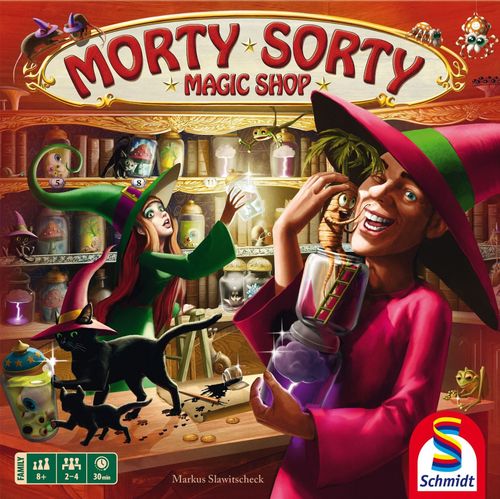
Morty Sorty Magic Shop
Morty Sorty Magic Shop Rulebook
Table of Contents
Table of Contents
Content
- 104 jar tiles
- 4 shelf boards (with sides A and B)
- 1 special jar bar
- 4 badges (printed on both sides)
- 8 scoring tokens (with 4 different animals)
- 1 large scoring scroll
- 4 small scoring scrolls (for the advanced game)
- 16 kittens
- 1 bag
- 1 score pad
Setup
- Choose an animal each and take the respective shelf board. Place your shelves in front of you, side A facing up. In further games, you may choose to all play with side B.
- Take 2 kittens each. Keep the rest of the kittens on the table as a supply.
- Assemble the special jar bar and place it off to the side. Leave some space below it for placing tiles.
- Place the large scoring scroll above the special jar bar. (The small scoring scrolls are only needed for the advanced game, see Scoring scrolls for the advanced game.)
- Select (by choice or at random) 2 badges and place them above the special jar bar. Take the 2 scoring tokens matching each of your animals.
- Note: For a simpler first game, you can play without badges and scoring tokens.
- Put all of the jar tiles in the bag and mix them thoroughly. Remove 4 random tiles from the bag and put them back in the box unseen. These tiles are not available during this game.
- At two players, you remove 23 tiles from play.
Whoever last petted a cat receives the bag and starts the game.
Gameplay
Each round, tiles are drawn from the bag and dropped on the table as a display. One after another, players choose one tile each from the display and place it on their own shelf according to certain rules. This continues until there are not enough tiles left in the bag to form a full display.
Playing a round
If you have the bag, you draw 5 tiles from it at random and drop them in the center of the table. This is the display for this round. The tiles are printed on both sides and must not be turned over. They remain as they fell.
- At two players, a full display consists of only 4 tiles.
Whenever you draw tiles with a blue lid, place them below the respective numbers on the special jar bar and keep drawing tiles until there is a display of 5 tiles (without blue lids).
You are now the first to take a tile from the display or pass. The other players do the same, taking turns clockwise until everybody has either taken a tile or passed. The leftover tiles are put back in the box and are no longer available during this game.
If you passed, take a kitten from the supply.
If you took a tile, place it on your shelf, adhering to the following placement rules:
- The tile must be placed on an empty space on your shelf.
- The tile may not be turned over, but must be placed the way it was lying in the display. (Exception: Kittens, see Kittens.)
- The numbers on the tiles within each shelf level must be ascending from left to right.
- Each number may only occur once within each shelf level (therefore one may not place equal numbers next to each other — exception: Kittens, see Kittens).
- The color of the lid determines which shelf levels a tile may be placed on:
- Golden Lid — on all 3 levels.
- Silver Lid — only on the middle and bottom level.
- Black Lid — only on the bottom level.
Sidebar note: The number on a tile depends on the color of the lid. Important: The back of a tile has a different ingredient (the lid and number are the same) — toadstool and cloud are always on a tile together, as are eyes and mandrake.
Special Jars
When you have placed three different ingredients in a column, you may take any tile with a blue lid from the special jar bar and put it on your shelf. Tiles with blue lids can be placed on any shelf level. You must still follow the other placement rules.
- Note: This can absolutely happen multiple times per turn. If you are unable or unwilling to take a special jar, you can take a kitten instead.
Kittens
Kittens are magical animals that can help you stock your shelf. When you return a kitten to the supply, you may tweak the placement rules for one tile you just took (from the display or the special jar bar) as follows:
- You may place the tile next to a jar tile with the same number (one space to the left or right of it).
- Or you may flip the tile to the other side (to get a different ingredient) before you place it on your shelf.
- Note: Toadstool and cloud as well as eyes and mandrake are always on a tile together.
Sidebar note: You can also return two kittens to the supply at the same time to take advantage of both effects. Tiles already on your shelf may no longer be flipped.
If, at the end of the game, you still have kittens left, they are worth 2 stars each.
Completing Shelf Levels
When you have entirely filled one of the levels of your shelf with jar tiles, you receive the bonus of that level: You get the kitten immediately and the stars at the end of the game.
Shelf Labels
Some spaces have labels below them. At the end of the game you receive stars for each tile that matches its shelf label.
- Important: You are also allowed to fill those spaces with tiles that do not match the shelf label.
Shelf board side A: At the end of the game, count the spaces that have a jar tile matching the number indicated on their shelf label. You receive stars as indicated in the table.
Shelf board side B: At the end of the game, you get 6 stars for each set of 2 spaces with matching shelf labels that both have a tile with the corresponding ingredient on them.
Badges
When playing with badges, you can impress Morty Sorty even more and earn extra stars!
As soon as you fulfill the conditions of one of the badges, put one of your scoring tokens on the next empty ribbon from the left. At the end of the game you get the number of stars indicated above the ribbon. Whoever is first to put their token on a specific badge also receives a kitten. You can claim each badge only once.
The badge conditions are:
- Place at least one tile with each ingredient (cloud, toadstool, mandrake, eyes) on the bottom shelf level. The order of ingredients does not matter.
- Form an ascending chain of 4 consecutive numbers on a shelf level. Example: 4 tiles numbered 5, 6, 7 and 8.
- Fulfill the requirements of at least 6 shelf labels.
- Place 3 tiles with the same number in a column.
- Place at least 3 tiles with golden lids on the top shelf level, at least 2 on the middle level, and at least 1 on the bottom level.
- Place at least 2 tiles with blue lids in a column.
- Form a group of at least 5 adjacent tiles with silver lids. (Vertically or horizontally adjacent, not diagonally.)
- Place 3 tiles with the same ingredient in a column.
Sidebar note: If multiple players fulfill the conditions of a badge in the same round, the scoring tokens are stacked on the same ribbon as an exception, and all involved players get the full reward. Once all its ribbons are occupied, a badge can no longer be claimed.
Preparing the Next Round
Once everyone has taken and placed a jar tile or passed, the leftover tiles in the display are put back in the box and are no longer available during this game. The bag is handed to the next player in clockwise direction and a new round begins. You play as many rounds as it takes to reach the end of the game.
End of the Game
Once you can no longer form a full display, the game ends immediately, and scoring follows.
Sidebar note: It is not permitted to count the remaining tiles in the bag (neither by feeling around inside, nor by looking). The tiles in the box may also not be examined or counted.
Use the score pad to sum up how many stars you earned in each category:
- completed shelf levels
- ingredients according to scoring scroll(s)
- shelf labels
- remaining kittens
- badges
In the base game, all ingredients are scored equally: For each ingredient, count the tiles on your shelf. You receive stars per ingredient according to the table on the large scoring scroll. (In the advanced game, you receive stars according to the small scoring scrolls, see Scoring scrolls for the advanced game.)
Whoever earned the most stars in total wins and is pronounced best apprentice. There is a bright future in (a) store for them: A permanent position at the Morty Sorty Magic Shop!
Ties are broken by the most stars earned with a single ingredient. In case of another tie, the victory is shared.
Scoring Scrolls for the Advanced Game
Once you are well acquainted with the base game, you can change up the scoring for each ingredient. To do so, replace the large scoring scroll with the small scoring scrolls. The scrolls have two sets (I and II) of balanced scoring criteria. You can also experiment with combining criteria from different sets. Lastly, you can choose to only use small scoring scrolls for some ingredients and score the rest according to the large scroll. Scoring might just not be entirely balanced in these cases.
Wormy Wondercap
Grey hair? Stooped? Bad teeth? No worries! A small dose of wondercap instantly makes you several years younger! The worms inside are how you know that the mushroom is especially fresh and potent.
- Set I: Each of your toadstool tiles is worth 3 stars. You get 10 additional stars for each shelf level with at least 3 toadstool tiles.
- Set II: Count only those of your toadstool tiles that are not adjacent to another toadstool tile. (Diagonal does not count as adjacent.) You receive stars as indicated in the table.
Surly Storm Cloud
Wizards and witches have been trying to control the weather since the dawn of time. Morty's aunt Gizela Grumble was the first to do it! She managed to conjure storm clouds, and even to catch lightning in jars. Sadly, she could not do the same with fair weather…
- Set I: Each of your cloud tiles is worth 4 stars. All players with the largest / second largest group of cloud tiles receive an additional 14 / 6 stars. Note: A group consists of at least 2 vertically or horizontally adjacent tiles. A player can have both the largest and second largest group.
- Set II: Each of your cloud tiles is worth 2 stars. All players with the most cloud tiles on the top / middle / bottom shelf level receive an additional 14 / 10 / 8 stars.
Slippery Eyeballs
From invisibility to mind erasure: Many dark and forbidden potions require slippery eyeballs. But they are agents of chaos… So proceed at your own risk and don't eyeball it! We do not assume liability for any side effects!
- Set I: Count the number of tiles with black lids on your shelf. Multiply that number with the number of eye tiles on your shelf. Note: You can have a maximum of 8 tiles with black lids. If you manage to do that, each of your eye tiles is thereby worth 8 stars.
- Set II: Count separately the numbers of tiles with golden and silver lids on your shelf. Multiply the lower of both counts with the number of eye tiles on your shelf.
Sleepy Mandrake
Be careful! Mandrake leaves are an especially important ingredient for many potions. But if they are forcibly roused from their slumber (which can last several weeks), they shriek a terrible shriek that causes glass to shatter and their leaves to wilt.
- Set I: Count the unique numbers on your mandrake tiles. You receive stars as indicated in the table. Note: If the same number occurs on multiple of your mandrake tiles, count it only once.
- Set II: Each of your mandrake tiles is worth 4 stars. You get an additional 4 / 12 / 32 stars for each set of 2 / 3 / 4 equal numbers on your mandrake tiles.