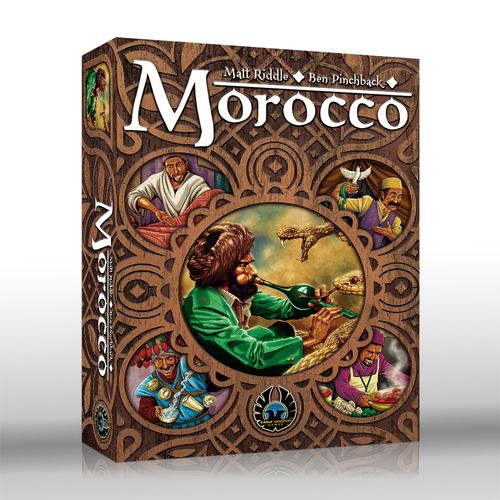
Morocco
Morocco Rulebook
Table of Contents
Table of Contents
Contents
- 60 Assistants (12 per player color)
- 10 Bodyguards (2 per player color)
- 10 Tourists (2 per player color)
- 10 Cousins Tokens (2 per player color)
- 5 Score Markers (1 per player color)
- 36 Juice Seller Tokens (in 3 denominations)
- 15 Gold Coins
- 100 Information Cubes (20 per color)
- 60 Market Tiles (12 per player color)
- 12 Empty Stall Tiles
- Market Die
- Start Player Rooftop Marker
- Pawn
Overview
In Morocco, players will send their workers out to try to claim the best stalls at the market. When enough workers of the same color have made it to a stall, that artisan claims that market stall and clears out any adjacent Juice Sellers.
Morocco is played over two separate phases: Scout Stalls and Assign Workers. In the Scout Stalls phase, players use the roof to scout the market and determine where the busiest stalls will be. In Assign Workers phase, players use the gained information to send workers to stalls across the market.
The player who generates the most victory points via Market Tiles, Juice Seller Tokens, and their Largest Market District will win the game!
Setup
(Setup shown for a 4-player game.)
- Position the game board in the center of the play area.
- Players take all pieces of their chosen color: 2 cousins tokens, 2 tourists, 2 bodyguards, 12 assistants, 12 market tiles, 1 score marker.
- Place all players' score markers on "0" on the score track.
- Place all players' bodyguards in the guards' quarters on the game board.
- Randomly draw and place juice seller tokens face up on each of the corresponding spaces in the market.
- Pile the information cubes and gold coins near the game board; this is the supply.
- Assign 5 information cubes (one of each color), at random, to the market rows (along the side).
- Assign 5 information cubes (one of each color), at random, to the market columns (along the bottom).
- Assign 5 information cubes (one of each color), at random, to the inner spaces on the rooftop on the game board.
- Place the pawn in the center space on the rooftop.
- Give the start player marker to the player who has most recently traveled to Morocco; that player will begin the game.
Gameplay
Morocco is played over a series of rounds. Each round has two separate phases:
- Phase 1: Scout Stalls
- Phase 2: Assign Workers
The final round is triggered when there are five or fewer open stalls remaining in the market.
Phase 1: Scout Stalls
In this phase, players will scout the market from the nearby rooftop and gain information that they'll use later on when they send their workers out into the market to claim stalls. Beginning with the first player and proceeding clockwise, each player takes one turn during this phase.
On your turn, move the pawn to any other space on the rooftop (i.e., you cannot choose to leave the pawn where it was). You gain two cubes: one for each cube on the spaces adjacent to the pawn.
Example A: The blue player moves the pawn to the space with the brown information cube. He gains one green cube and one orange cube.
Next, every other player gains one cube that matches the cube on the space where you placed the pawn.
Example B: After the blue player gains his green and orange cubes, every other player gains one brown cube.
Rolling the Market Die
The market die is only used in games with two or three players. If you are playing with four or five players, ignore this section.
- 3 players: At the start of the round, the first player rolls the market die once. Every player gains one cube of the color indicated on the die. If the "wild" face is rolled, every player gains a cube of their choice.
- 2 players: At the start of the round, both players roll the market die once. For each roll, both players gain one cube of the color indicated on the die. If the "wild" face is rolled, both players gain a cube of their choice.
Phase 2: Assign Workers
In this phase, players will use their information cubes to send workers out into the market to claim the best stalls. Beginning with the first player and proceeding clockwise, each player takes two turns (one at a time) during this phase.
You may play your worker in any open space in the chosen stall. All stalls have four spaces. All workers, including bodyguards, occupy one space each in a stall.
Which information cubes are required is determined by the cubes assigned to the market row and column that the specific stall is in as well as by the type of worker you wish to play.
- Assistant / Bodyguard (2 cubes): Play an assistant or bodyguard to a stall, spending one of each of the corresponding cubes in that stall's market row and column.
Example C: The green player wants to place an assistant in the indicated stall. She must spend one of each of the corresponding cubes in the stall's market row (green) and column (brown).
-
Tourist (3 cubes): Play a tourist to a stall, spending one of each of the corresponding cubes in that stall's market row and column, plus one additional cube of any color.
-
Cousins (3 cubes): Discard a cousins token to play an assistant to a stall, spending one of each of the corresponding cubes in that stall's market row and column, plus one additional cube of any color. Then, play another assistant in an adjacent space of a different stall from the first, at no additional cost.
Example D: The yellow player plays an assistant in the stall highlighted in white. He spends one of each of the corresponding cubes in the stall's market row (green) and column (orange), and any one additional cube. He then discards a cousins token and plays another assistant. The second assistant may go in either of the spaces highlighted in red (adjacent in a different stall).
Note: You MUST play a worker on your turn if able. If you don't have the required information cubes to play a worker, you must pass.
Each assistant or tourist counts ONE toward worker count; each bodyguard counts TWO toward worker count.
Scoring & Closing A Stall
After playing your worker, check to see if any stalls are now full. A stall is considered full when the worker count plus overflow from adjacent tiles equals four or more. If multiple stalls fill up on the same turn, close them in order in which they were filled.
Example E: The stall above is full. It contains four assistants.
Example F: The stall above is full. It contains three assistants and receives overflow from the adjacent tile to the left.
Example G: The stall above is full. It contains one bodyguard (green), one tourist (yellow), and one assistant (blue).
Scoring Stalls
When a stall is full, score the stall, giving players the appropriate rewards for their relative position in worker count for that stall. All victory points (VP) are tracked by moving score markers on the score track.
- 1st Place: 5 VP and place their market tile.
- Tied 1st: If there is a tie for 1st, all tied players receive 5 VP and the active player places an empty stall tile.
- 2nd Place: 2 VP + 1 gold coin + 1 bodyguard.
- Tied 2nd: If there is a tie for 2nd, all tied players receive 1 VP + either 1 gold coin or bodyguard.
- 3rd Place: 1 VP + either 1 gold coin or bodyguard.
Example H: After the stall above is scored, the white player takes the juice seller token adjacent to his bodyguard. The green player takes the two juice seller tokens adjacent to her assistants. The remaining juice seller token remains on the board.
Example I: After the stall above is scored, the blue and green players take the juice seller tokens adjacent to their assistants. There are no juice seller tokens for the white and yellow players to collect, as they were taken on a previous turn.
Example J: The stall has one blue assistant and one white assistant. The green player plays a bodyguard into an open space in the stall, bringing the total worker count to four (one per assistant, two for the bodyguard) and closing the stall.
The green player has the highest worker count and therefore receives 5 VP. The blue and white players are tied for second, and gain 1 VP and either 1 gold coin or bodyguard. Each player takes their adjacent juice seller tokens.
Then, the green player places one of his market tiles on the stall, orienting it so that the overflow arrow points toward an adjacent open stall.
Collect Juice Seller Tokens
After a stall has been scored, all players take any juice seller tokens adjacent to their own workers (if any) in that stall, placing them face down in their respective player areas.
Place Market Tile
All players remove their workers from the stall: assistants return to their respective players, bodyguards return to the guards' quarters, tourists move (see Moving Tourists).
The player who had the highest worker count places one of their market tiles on the stall; that stall is now closed. If there was a tie for highest worker count, the active player places an empty stall tile on the stall instead.
That player then selects an adjacent stall to overflow into by orienting their market tile so that the arrow points in that direction. The target stall cannot be an already closed stall, unless no open stalls are adjacent.
Moving Tourists
If there is a tourist in a stall when it closes, the tourist moves to any available space in the adjacent open stall indicated by the overflow arrow on the market tile. Then, the tourist is replaced with one of that player's assistants and then discarded from the game. If multiple tourists need to move from the same stall, resolve their moves in turn order clockwise from the active player.
Example K: The stall has two green assistants and overflow from one adjacent market tile. The blue player plays a tourist into the stall. It is now full (worker count = 3, overflow = 1) and scored immediately. Green has the highest worker count and gains 5 VP. Blue is second and gains 2 VP, a gold coin, and a bodyguard.
Example K (Continued): Then, the green player places a market tile, orienting it toward an adjacent open stall that already has one green assistant, one purple assistant, and overflow from one adjacent market tile. The tourist moves into the adjacent stall and is replaced by an assistant in an open space chosen by the blue player. That stall is now full (worker count = 3, overflow = 2) and is scored immediately: Green, blue, and purple are tied for highest worker count and gain 5 VP each. The active player, blue, places an empty stall tile on that stall.
Gold Coins
Gold coins may be spent at any time on your turn during the Assign Workers phase. There is no limit to the number of gold coins you may spend in a single turn.
Spending a gold coin allows you to swap the positions of any two information cubes assigned to the market rows or any two information cubes assigned to the market columns. You may not swap a cube from a row to a column or vice versa.
Example L: The yellow player spends one gold coin to swap the positions of the purple and green cubes in the market columns, then one additional gold coin to swap the positions of the brown and orange information cubes in the market rows.
Unused gold coins at game end are worth 1 VP each. A player may never have more than 3 gold coins at any one time.
Round End
After each player has had two turns in the Assign Workers phase, the round ends. Pass the start player marker clockwise. Return the pawn to the center space of the rooftop.
Each player may only store one information cube for use next round; all other cubes they have gained must be returned to the supply.
Game End
The final round is triggered when closing a stall leaves five or fewer open stalls in the market. When this occurs, finish the current round; then the game ends.
Note: If, after a stall is closed, no open stalls remain, the game ends immediately.
Final Scoring
When the game is over, each player scores their juice seller tokens, gold coins, and their largest market district.
- Gold Coins: Each gold coin is worth 1 VP.
- Juice Seller Tokens: Each juice seller token is worth 2, 3, or 4 VP (as indicated on the token).
- Largest Market District: Each market tile in your largest contiguous group of claimed stalls is worth 3 VP.
Example M: The green player earns 15 VP (3 x 5).
The player with the most total points is the winner! In case of a tie, the tied player who claimed the most stalls is the winner. If there is a further tie, the tied players enjoy their shared victory.