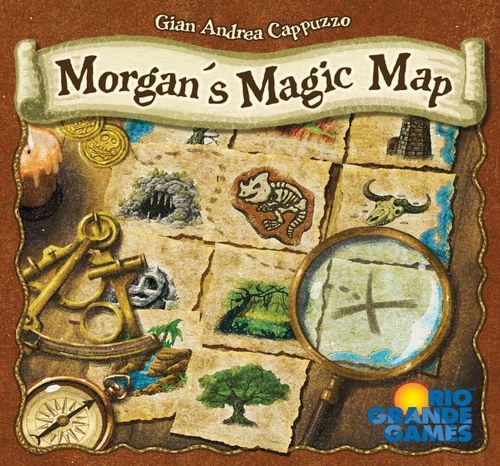
Morgan's Magic Map
Morgan's Magic Map Rulebook
Table of Contents
Table of Contents
The Goal of the Game
Morgan's Magic Map is played over a series of turns in which players use map cards to locate where Captain Morgan has hidden his treasures. Players can change the position of the tiles on the map to make the island conform more closely to the map cards they have in their hands. Each card that is played is an opportunity to dig deeper and find more valuable treasure. Once most of the hidden treasures have been found, the player with the most doubloons in cash and treasure is the winner.
Components
- 20 map tiles
- 72 map cards
- 29 treasure cards
- 1 treasure board
- 45 doubloons (20x1, 20x5, 5x10)
- 4 pirate pawns (one in each player color)
- 4 player aid cards (one in each player color)
Game Concepts
Map tiles – These are the lost fragments of Morgan's Magic Map. Most contain a reference point (e.g., "The Lighthouse") that will allow you to target your search. These tiles are connected to each other to form the island map, which is modified while playing the game. (Each tile shows a tile name, land edges and water edges.)
Map cards – These cards represent the clues that the players use to find the buried treasure on the island map. Each card has a reference point and a number that indicates the distance measured in "steps" from that specific reference point (e.g., "A treasure may be found 3 steps away from the Lighthouse"). The distance is always measured orthogonally and does not count the map tile where the pirate pawn is located. The process for playing cards is explained in detail on the Dig for Treasure section.
Each card also contains a symbol that may allow you to perform a special action during your turn. These are called map card bonus actions and are explained in detail in the Map Card Bonuses section.
Treasure cards – These cards represent the treasures you can find when performing a "dig" action. Each card contains a value in doubloons and a numerical rank. The rank is used to establish the order in which they are placed on the treasure board.
Each treasure card belongs to a set of treasures of the same type. These may be identified by the color of the card as well as the symbol located on the lower corners of each card. Players are awarded bonus doubloons if they hold the most treasure cards in a set at the end of the game.
The sets are:
| Type of Treasure | Color / Symbol Reference | Number in the Set |
|---|---|---|
| Gems | Pink | 8 |
| Silver | Cyan | 5 |
| Gold | Yellow | 5 |
| Pearl | White | 4 |
| Jewelry | Red | 4 |
| Jade | Green | 3 |
Setup
- Shuffle all 20 map tiles face down. Draw tiles one at a time to build the island map by randomly connecting all the map tiles in a starting rectangle 4 tiles wide and 5 tiles long. The map tiles must be placed so that land edges are next to other land edges and water edges are next to other water edges. The map tiles have no predefined orientation. They may be oriented in any direction to match the edges as needed. Players are free to move tiles around during the initial setup in order to allow the island map to conform to the rules.
- Shuffle the treasure cards and place them in a face-down stack next to the treasure board. Reveal the top 5 treasure cards from the deck, putting them face up on the treasure board from the lowest treasure rank value at the top to the highest treasure rank value at the bottom.
- The map cards are shuffled and placed in a face-down pile near the island map. Deal 4 cards to each player to form their initial hand.
- Each player takes the following items: a. A pirate pawn and player aid card in matching colors. b. 2 doubloons. c. A hand of 4 map cards (see step 3 above). These cards should be kept secret from the other players at all times.
- The players choose a starting player using any mutually agreed upon method.
- Starting with the player to the right of the starting player and going around the table counterclockwise, each player chooses one corner of the island map to place their pirate pawn. Players may choose an already occupied corner, but they must pay 1 doubloon to each player who has already put their pirate pawn there.
The treasure hunt is ready to begin!
Sequence of Play
- Change the island map
- Move the pirate
- Dig for treasure
- Draw map cards
The game is played in a series of player turns. Beginning with the start player and moving clockwise, players take turns until the treasure card deck is empty.
During their turn, a player may perform the following 4 actions in this order:
1) Change the Island Map
The player may choose to move 1 map tile from the island map and place it in any new legal spot on the island map. The tile may be reoriented as part of this process. When placing the tile, players must observe the following rules:
- The chosen tile must not be occupied by a pirate pawn. This includes the player whose turn it is as well as all other players.
- The chosen tile must have at least one edge that is not connected to another tile. A tile that is surrounded on all sides by other tiles may not be moved.
- The chosen tile must be placed so that at least one edge of the tile is connected to an existing tile on the island map.
- The chosen tile must be placed so that all sides match adjacent tiles: land edges must be placed next to land edges, and water edges must be placed next to water edges.
- The chosen tile may be placed so that it creates a hole in the island map. A tile may be placed so that it fills a hole in the map as long as it meets the other placement requirements.
- The chosen tile may be placed in such a way that it extends the island map outside of the starting 4 x 5 grid of tiles. There is no limit to the length or width of the island map.
- The island map may be broken into two more or separate parts momentarily while a tile is being moved. However, at the end of the action, all map tiles must be accessible from all other map tiles. Players must be able to trace an uninterrupted path from every map tile to every other map tile on the island map.
Examples (illustrated on the map diagram in the rulebook):
- A tile could be moved to the spot indicated by the green arrow if the tile is properly rotated to connect to the map so that water would connect to water and land to land.
- A tile could not be moved to the spot indicated by the red arrow because there is no way to orient the tile so that it follows the placement rules for matching edge types.
- A tile could be moved to the spot indicated by the green arrow even though this creates an empty space because it still results in a single connected island map.
- A tile could not be moved to the spot indicated by the red arrow. This would split the island into two parts because the tiles on the top right would have no available path to the other tiles, which is not permitted.
- A tile may not be moved because it is occupied by a pirate pawn.
- A tile may not be moved since it is surrounded on all sides by other tiles.
2) Move the Pirate
The player may choose to move their pirate pawn up to 2 steps. Moving the pawn from one map tile to an adjacent map tile counts as one step. The pirate moves orthogonally, either horizontally or vertically, from one tile to the next on the island map, regardless of whether there was land or sea terrain between the two tiles. (Pirates have boats so they can move freely across water!)
The pirate pawn may not move onto or through a gap in the island map where there is no tile.
If the player's pirate pawn passes through or stops on a map tile that is occupied by another player's pirate pawn, the player who is moving must pay a doubloon to the other player. If more than one player has their pirate pawn on the tile, all opposing players are paid a doubloon. If the player cannot pay the cost, they may not enter the map tile.
3) Dig for Treasure
a) Play map cards
If the player's pirate pawn is on a map tile on which one or more of the map cards in their hand indicate the presence of a treasure, the player may play any number of those cards from their hand to dig on that spot to recover the treasure.
Each map card has a number on it to indicate the distance from the reference point to the current location of the player's pirate pawn. The distance is always measured orthogonally and does not count the map tile where the pirate pawn is located. Cards with a tile distance of "0" on them indicate that the pirate pawn must be standing on the map tile with the reference point. Empty spaces in the map are counted as one space for each "missing" map tile (see the dig example below).
The player may play as many map cards that apply to the current position as they want. Each map card that the player wishes to play is placed in front of them face-up.
Map cards that have been played are kept face-up in front of players and may be discarded during the game in order to gain map card bonus actions (see Map Card Bonuses). The map cards are not discarded until the bonus action on the card has been used.
b) Take treasure card
The player then takes one treasure card from the treasure board. The treasure card they take depends on the number of map cards they played during the current turn. The total number of map cards played allows the option to take from the corresponding level or higher. For example, if three map cards were played this turn, a single treasure card may be chosen from any one of the first three positions on the treasure board. These positions are counted from the top of the treasure board down.
If a treasure card is chosen from a position showing doubloons, the player takes the number of doubloons from the supply as a bonus. Players should keep their treasure cards face-down in front of them.
The treasure board is immediately refilled by drawing the next treasure card from the deck. The treasure cards are immediately reorganized on the board according to their treasure ranks, if necessary. The lowest rank goes into the top spot on the treasure board.
4) Draw Map Cards
The player must now refill their hand back to 4 map cards by drawing from the map card deck.
Before drawing new map cards, players are permitted to discard one map card from their hand to the discard pile. If the map card deck is empty, the discards are shuffled to create a new draw deck.
After refilling their hand up to 4 map cards, play continues with the player on this player's left.
Dig Example
Anna is the red player. Before taking her turn, she examines the island map and notices that she is already in the correct position to use her "2 steps away from the Tomb" map card during her dig action later in the turn. She would be able to dig for a treasure card even without moving any map tiles on the island map or moving her pirate pawn.
Next, she notices that she can move the Oasis map tile to a spot 3 steps away from her pirate pawn to use the "3 steps away from the Oasis" map card during the dig action. In this case, the empty space in the map counts as 1 step. (This movement is shown in the rulebook with the blue arrow.)
As an alternative move, she could move the Anthill map tile to a spot next to her current position, then move her pirate pawn on it during the "move the pirate" action to use the other two map cards in her hand during the "dig" action. (This movement is shown with the red and yellow arrows.)
Anna decides to choose the second option. She uses two map cards during her "dig" action. Because she used two map cards, she can take a single treasure card from either of the first two positions on the treasure board. She decides to take the gem treasure card from the second spot. Taking a treasure card from this spot gives her a bonus of one doubloon. She places the two map cards she just played in front of her, face-up, and the treasure card face-down.
Map Card Bonuses
During their turn, players may discard map cards in their play area (even ones played on this turn) to provide benefits according to the bonus symbol on the card(s). Cards used in this manner are put in the discard pile. Each symbol is explained below:
- Map symbol: A player may discard map cards with the "map" symbol on them during the Change the Island Map action. This allows the player to change the position of one additional map tile for each map card they discard. For example, a player who discards two of these map cards could change the position of a total of 3 map tiles as a part of the action.
- Boots symbol: A player may discard map cards with the "boots" symbol on them during the Move the Pirate action. This allows the player to move their pirate pawn up to 2 additional steps for each map card they discard. If a player discards two "boots" map cards, they could move their pirate up to 6 total steps during that action.
- Shovel symbol: A player may discard map cards with the "shovel" symbol on them during the Dig action. This allows the player to choose a treasure card from the treasure board from a lower position (as if they had played another map card this turn). Each map card with a "shovel" symbol used in this way increases the available treasure cards by one position on the treasure board.
- 2 doubloons symbol: Each player may discard map cards with the "2 doubloons" symbol on them at any time during their turn to receive 2 doubloons for each card.
A player may also discard two map cards with the same symbol to use a bonus of their choice from those described above.
Example: Two cards with the "boots" symbols on them could be discarded from in front of the player in order to use a different map card bonus like "dig", "map", or "doubloons".
Dig Card Example
During step (a) of her digging phase, Anna uses two map cards. She places them face-up in front of her. Because she used two cards to locate the treasure, she can take a single treasure card from either of the first two positions on the treasure board as her action in step (b). However, she does not want either of the first two treasures. Instead, she wants the treasure card that is one level deeper. Therefore, she discards the map card with the shovel symbol to dig one level deeper and collect the Silver Teapot. She also takes 2 doubloons as a bonus for taking a card from the third layer below the surface.
End of Game
The game ends immediately when all cards from the treasure deck have been placed on the treasure board. The last five treasure cards on the treasure board will not be claimed.
Bonus doubloons are awarded at the end of the game for the players who hold the most of each type of treasure card. The number of items shown on the cards does not affect scoring.
Evaluate each type of treasure card as defined by the descriptions in the Game Concepts section. Determine which player(s) have the most of each card type. For each treasure card type, the player who holds the most of that type is given a bonus of 6 doubloons. If there is a tie for the most, the bonus is divided equally among all tied players; 3 doubloons each in case of a two-way tie, 2 doubloons each in case of a three-way tie. If 4 players tie, give each player 1 doubloon.
The final score is the sum of each player's doubloons that were collected during the game plus the doubloon value of the treasures they have at the end of the game.
In case of a tie, the player with the highest total doubloon value of treasure cards (not counting the bonuses) is declared the winner. If there is still a tie, the players involved in the tie must reluctantly accept the result.
Final Scoring Example
The game has ended, and it is time to calculate the final score. Each player has counted their remaining doubloons. Anna has 18 while Beth has 16, and Connor has 19. These are the first items that each player will score.
Next, they need to evaluate who has the most treasure cards in each category. The winner in each category receives 6 doubloons.
- Gems: Beth has 3 cards, Connor has 2 cards, and Anna has 1 card. Beth is awarded 6 doubloons.
- Silver: Each player has one card, so they split the 6 doubloons equally, getting 2 doubloons each.
- Gold: Anna and Connor both have 2 cards; Beth only has one. Anna and Connor each get 3 doubloons.
- Pearl: Beth has 2 cards; Anna and Connor have 1 card each. Beth is awarded 6 doubloons.
- Jewelry: Anna and Connor have 2 cards each; Beth has none. Anna and Connor each receive 3 doubloons.
- Jade: Beth and Anna have 1 card each; Connor has none. Anna and Beth split the 6 doubloons, so each receives 3.
Finally, they add up the doubloon values shown on all of their cards. Anna has 34, Beth has 30, and Connor has 32. Anna and Beth have tied at 63 doubloons each. Anna wins the tiebreaker, having 34 in treasure value compared to Beth's 30. Anna is the winner!
| Anna | Beth | Connor | |
|---|---|---|---|
| Doubloons | 18 | 16 | 19 |
| Gems bonus | - | 6 | - |
| Silver bonus | 2 | 2 | 2 |
| Gold bonus | 3 | - | 3 |
| Pearl bonus | - | 6 | - |
| Jewelry bonus | 3 | - | 3 |
| Jade bonus | 3 |
Complete Turn Examples
Anna's turn
It is Anna's (red player) turn. First, she decides to move the "The Oasis" tile from the upper right corner of the map to a position in the lower left next to "The Swamp" using the "change the island map" action.
Now, it is time for the "move the pirate" action. Anna decides that she wants to move her pirate pawn to the "The Tomb" tile. It is two steps away, and that is the movement limit for the pirate pawn using this action.
She is now ready to perform the "dig" action. Her pirate pawn is now in position for her to use three of her map cards, which she plays face-up in front of her. These three cards meet the conditions shown on the current island map relative to the position of her pirate pawn:
- Her pirate pawn is 1 step away from the Anthill.
- Her pirate pawn is standing on the Tomb.
- Her pirate pawn is 3 steps away from the Oasis.
Anna places the 3 cards she just used in front of her (not in the discard pile.) This gives her the option to claim one of the first three treasure cards on the treasure board. However, she really wants the treasure in the fourth position from the top. She decides to discard "The Tomb" map card that she played on this turn immediately. (It is legal to use the map card bonus action of the card on the same turn it is played.) This card has a shovel icon on it so that she can dig one level deeper than normal. She can take the "Diadem" treasure card plus the 3 doubloons as a bonus for claiming the treasure from that depth. The treasure board is refilled and reorganized according to the numerical rank of treasures that are now shown.
As the final step of her turn (i.e., "draw map cards" action), Anna then draws three new map cards from the deck and passes the turn.
Luke's turn
Now, it is Luke's (green player) turn. He uses the "change the island map" action to move "The Biting Cave" tile to a new position. Next, he uses the "move the pirate" action to move his pirate pawn to the "The Biting Cave" tile that he just moved.
He can now use three of his map cards during his "dig" action. He plays them face-up in front of him, not to the discard pile.
- His pirate pawn is 2 steps away from the Green Tree.
- His pirate pawn is standing on the Biting Cave.
- His pirate pawn is 2 steps away from the Oasis. (Note that the single empty space to the left of the Biting Cave counts as one step.)
Luke could choose a treasure from the top three on the treasure board, but he decides to discard his card with the "shovel" symbol and the two cards with the "doubloons" symbol to turn them into another "shovel": in this way, he can reach the maximum depth on the treasure board and recover the "Jade Dragon" plus the 4 doubloons as a bonus. Again, the treasure board is refilled and reorganized. Before refilling his hand, Luke decides to discard the last map card he had left in his hand, then draws 4 cards from the deck and passes his turn.
(Please note Luke could not have discarded "The Skull" map card to dig deeper because this card was in his hand. Only map cards already played to a player's play area can be used for their bonus actions.)
Easily Forgotten Rules
- During setup, the initial placement of the map tiles may be adjusted in order to create a map that conforms to the rules (see Setup).
- The map cards that are played as part of your turn are not discarded. Instead, they remain face-up in front of you until you use them for their map card bonus (see Map Card Bonuses).
- You may use the map card bonuses on cards immediately, even on the turn during which the card was played. The example turn (Anna's turn) shows how this is done.
- Map card bonuses may only be used from cards played in front of you, not from your hand.
- Two map cards with the same symbol may be discarded from in front of you to activate a map card bonus of your choice (see Map Card Bonuses and Luke's turn).
- The only way to claim the treasure card on the lowest level (Level V) on the treasure board is to use at least one "shovel" map card bonus as part of your "dig" action.
- When refilling the treasure cards on the treasure board, the cards are reorganized according to their treasure ranks, if necessary. The lowest number goes into the top spot on the treasure board (Level I), followed by the remaining cards in ascending order (see Dig for Treasure).
- The terrain features shown on the map tiles do not affect the movement of the pirates. The terrain on the edges of the map tiles only affects how they are placed on the island map (see Change the Island Map).