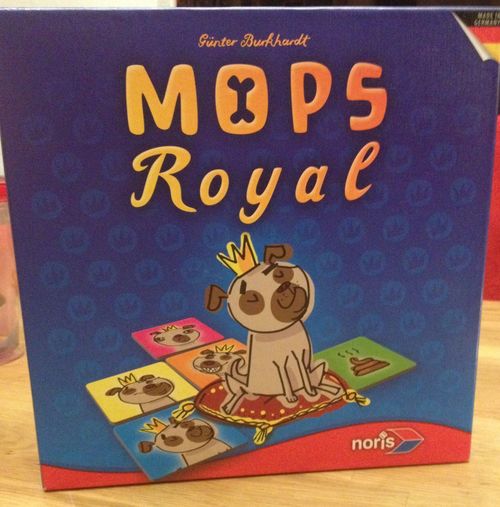
Mops Royal
Mops Royal Rulebook
Table of Contents
Table of Contents
Contents
- 4 sets of placement tiles (Legeplättchen), 36 tiles per set
- 4 game pieces (Spielfiguren)
- 1 game board (Spielplan)
Goal of the Game
Our royal pug has once again caused a great chaos and now seeks out whoever brings the most order to his things.
To do so, all players receive an identical set of tiles, which show different objects and colours.
The players lay out the tiles to form combinations. When a combination is scored, it earns points: the more tiles belong to a combination, the higher the point yield.
Each player decides for himself when to trigger a scoring, because the more tiles that belong to a combination, the more points it is worth.
But beware! Each player may make only one scoring per round. Make sure that no tile combinations remain unscored when the game ends.
Setup
Before the first game, carefully punch the tiles out of their cardboard frames.
Place the game board, with its score track, in the middle of the table.
Each player takes a set of tiles in the colour of his choice, together with the matching game piece, which he places on the first space of the score track on the game board.
Then each player draws one tile face down from his set and lays it face up in front of him. This tile is the start of his layout (Auslage). It must not show a "crown" symbol. If it does, the player draws another tile in its place, repeating as often as necessary until he has a tile without the symbol.
The remaining 35 tiles form the player's stock (Vorrat).
One player places the tiles of his stock face down on the table in front of him. All other players lay their tiles face up in front of them as their own stock.
Example (from the rulebook's illustration): a yellow tile showing the pug has been revealed. All other players now lay out the same tile.
Gameplay
Revealing a Tile
The player with the stock of face-down tiles turns one of them face up and shows it to all other players.
The others search their own stock for exactly the same tile.
Note: if a player already has the sought tile lying in his layout, he does not take a tile from his stock; instead he skips this round.
Placing Tiles
Then each player places his tile in his layout. The following applies:
- Each tile must border another tile horizontally or vertically. Touching only at a corner ("diagonally") is not enough.
- No more than 5 tiles may lie in a row, horizontally or vertically, in total.
In the end a square forms, 5 x 5 tiles in size, that is 25 tiles. This also means that not all tiles in a game get laid out.
Example (from the rulebook's illustration): in the marked places no further tile may be placed.
Scoring
Possible Combinations
After placing his tile, each player may score one combination in his layout.
- Only combinations of 3, 4 or 5 tiles are scored.
- A combination may consist only of tiles of the same colour or of tiles with the same object.
- It must be formed on the game board as shown on the board. It does not matter whether the depicted combination is rotated or even mirrored.
Points for Combinations
Combinations score the following points:
-
3-tile combination: 2 points
-
4-tile combination: 4 points
-
5-tile combination: 7 points
-
If a tile of the scored combination shows the bonus crown, there is one extra point.
The player then moves his game piece forward the corresponding number of spaces on the score track.
Turning a Tile Over
After scoring, the player must turn over one tile of the combination.
Which tile is meant is shown by the marking of the corresponding combination on the game board. If a combination shows 2 marked tiles, the player may decide for himself which one to turn over.
A turned-over tile may no longer be part of any future combination of that player.
Note: as long as a tile has not yet been turned over, it can be part of another combination.
End of the Game
The game ends when all players have laid out 25 tiles, that is, when their 5 x 5 tile square is complete.
The player who is furthest advanced on the score track has won. In the event of a tie, the winner is the one who has fewer face-down tiles in his layout.
Variants
Variant "Replacement Tiles" (Ersatzplättchen)
In this variant the players have the option to reject tiles that are about to be laid out.
To do so, the player takes the corresponding tile and places it face down on an already turned-over tile in his layout.
Note: this of course presupposes that the player has already made a scoring.
For the first tile he rejects, the player loses 2 points. For the next tile he rejects, he loses 3 points. For each further rejected tile, the deduction is one point more than for the previous one.
Variant "Scoring" (Wertung)
In this variant there are no scorings during the course of the game. Only after all 25 tiles of the layout have been laid out are the scorings carried out.
Each player scores any combination in his layout. Then the next player clockwise takes his turn.
Each scoring is carried out as already described in the rules.
Scoring continues for as long as the players can still make scorings in their layouts.
Note: since here too a tile must be turned over with each scoring, and that tile is then no longer available, it is worth considering which order of scorings is optimal.
This variant lengthens the game.
Have fun with Mops Royal!