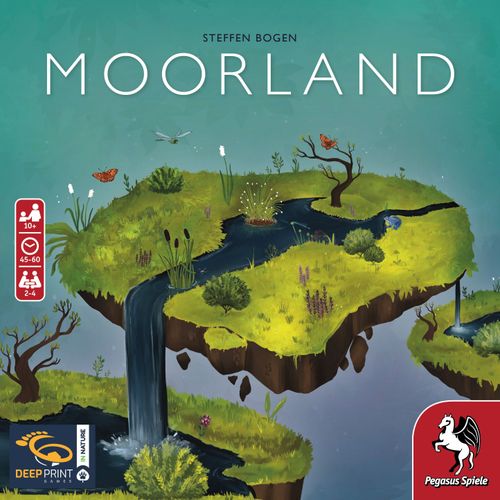
Moorland
Moorland Rulebook
Table of Contents
Table of Contents
Components
- 4 storage boards (1 for each player)
- 16 moor plans (4 for each player)
- 1 scoring pad
- 60 moor cards
- 14 plant cards
- 4 water cards
- 88 plant markers (22 per plant type): cotton grass, rushes, peat moss, heather
- 12 water markers
- 1 mushroom marker
Setup
-
Shuffle the 4 water cards and place them next to each other in the center of the table, forming the moor structure. For your first game, we recommend laying the cards out in a random 2x2 grid with the white letters facing up. At the end of this rule book, you will find some variations.
-
Place one of the 12 water markers onto each drop symbol in the moor structure.
-
Take the 60 moor cards. With two or three players, remove the 12 cards with the plant symbol and put them back in the box unused. Shuffle the remaining moor cards and place them face down as the moor deck next to the moor structure. Leave space for a display of 3 to 5 cards and a moor discard pile.
-
Shuffle the 14 plant cards and place the top 12 face down as the plant deck next to the starting moor. Leave room for a plant discard pile. Return the remaining 2 plant cards to the box unseen.
-
Form a supply for the 4 types of plant markers: cotton grass (white), rushes (green), peat moss (red) and heather (purple).
-
Each player takes the 4 moor plans of one color and creates their own moor by reproducing the moor structure from step 1. All the moor plans must match the layout and orientation of the moor structure, which is easiest to do by matching the letters and root sections in the outer corners.
The moor plans show 4 sections of existing moor (root sections) as well as 12 colored ground sections into which your moor can expand.
-
Each player takes a storage board and places it next to their own moor. Make sure that there is room under your storage board for moor cards.
-
Choose a starting player, who receives the mushroom marker.
How to Play
Moorland is played over 12 rounds. Each round consists of the following 3 phases:
- Reveal Phase — see below
- Action Phase — see below
- Clean-up Phase — see below
At the end of the 12th round, the game ends and the scores are worked out.
1) Reveal Phase
Take the top card from the plant deck and place it face up onto the plant discard pile. This is the current plant card. (Most plant cards show two types of plant, while two cards show all four).
Next, form the display by revealing moor cards from the moor draw deck:
- With two players, 3 moor cards are revealed each round.
- With three players, 4 moor cards are revealed each round.
- With four players, 5 moor cards are revealed each round.
2) Action Phase
The player with the mushroom marker starts the Action Phase with their turn, then play continues clockwise until all players have taken one turn.
On your turn, perform the following three actions in this order:
- A) Take a moor card from the display (mandatory) — see below
- B) Place plant markers in your moor (optional) — see below
- C) Play moor cards into your moor (usually optional) — see below
Once everyone has taken one turn, the Action Phase ends and you move on to the Clean-up Phase.
A) Take a moor card from the display
Choose one moor card from the face-up display and place it below your storage board. You must take a card each turn.
Tip: Planning is easier if you rotate your cards to line up with your moor.
Example - Taking a card from the display: On his turn, Peter chooses the middle moor card from the display and places it below his storage board.
As the game progresses, you will have to place each moor card you choose in Action A onto a ground section in your moor. Action C explains how to do this in detail. However, it's important to understand the elements shown on the cards, which are explained here:
Elements on the moor cards
-
Plants: Each moor card has 1 to 4 plant symbols that show which plant markers need to be on a ground section before the card can be played onto it. Some of these symbols may contain an additional symbol indicating what will happen to the plant marker after the card is played:
- Withered (the marker is returned to the supply)
- Take root (the marker is permanently placed on this symbol)
If the plant symbol has no inner symbol, its plant marker will later drift through the moor (see the Playing Moor Cards section for details).
-
Waterways: The moor cards show variously shaped waterways that can be connected together. It is to your benefit to play your moor cards so that they form an extended network of waterways. This will help you to drift plant markers to the right places. You'll also score points at the end of the game for your longest connected waterway.
-
Animal species: Some moor cards show an animal species symbol. There are 6 animal species altogether. The more species you have in your moor at the end of the game, the more points you'll get. Each pair of the same animal species is also worth points. You'll find the following number of each species in the game: 8 x beetles, 4 x birds, 4 x snakes, 4 x dragonflies, 4 x butterflies and 4 x frogs.
Note: We use the term "species" here to distinguish the types of animal symbols, not in its scientifically correct sense.
-
Water striders: Some moor cards show water striders on their waterways. These do not count as animal species. Instead, at the end of the game, they give points to the players who have the most of them in their moors.
B) Place plant markers in your moor
After you take a moor card, you may choose one of your ground sections and place plant markers of one type from the supply onto it. The type and number of these plant markers depend on the growth symbol printed in the corners of that section:
- If the section has a dotted growth symbol, choose one of the plant types shown on the current plant card in the middle of the table. Take as many markers as the growth symbol indicates (1, 2 or 3 dots) from the supply of the chosen plant and place them onto the section.
- Take 1 plant marker of a type shown on the current plant card and place it onto the ground section.
- Take 2 plant markers of one type shown on the current plant card and place them onto the ground section.
- Take 3 plant markers of one type shown on the current plant card and place them onto the ground section.
- If the section has the special growth symbol, take 1 plant marker of any type from the supply and place it onto the section.
Note that each ground section has 6 spaces and each space can hold only one plant marker. If taking this action would cause you to overfill your chosen ground section, place as many as you can and put the excess in the bottom right of your storage board. These excess markers will subtract from your final score.
Plant marker supply: The plant marker supply is unlimited. If there are not enough plant markers in the supply, use something else as a substitute.
Example 1 - Placing plant markers in the moor: Annika wants to place plant markers onto her ground section F, which shows the 2-dotted growth symbol. She chooses heather (purple) on the current plant card and places 2 purple plant markers from the supply onto 2 free spaces of section F.
Example 2 - Placing plant markers in the moor: Peter wants to place cotton grass (white) in his moor, but the current plant card does not show it. However, he may place 1 white plant marker from the supply onto the ground section H, since this section shows the special growth symbol.
Example 3 - Placing plant markers in the moor: Rebi wants to place peat moss (red) onto her ground section C, which shows the 3-dotted growth symbol. However, she must place 1 of the 3 red plant markers she takes in the bottom right of her storage board since there are only 2 free spaces on section C.
C) Play moor cards into your moor
With this action, you may play one or more of the moor cards beneath your storage board onto ground sections of your moor.
To play a card onto a ground section, all plant markers shown on the card must be present on that section (it does not matter if there are any additional plant markers on the section). If this requirement is met, carry out the following steps:
- Remove all the plant markers from the chosen ground section and place them in front of you as a temporary stock.
- Place the moor card onto the ground section. You can orient it as you like (0 or 180 degrees). Your waterways do not have to connect to any of the neighboring waterways, but it's usually better if they do.
- Check if any of the plant symbols on the moor card have the "take root" symbol. If so, place onto each such symbol one plant marker of the matching type from your temporary stock. These placed markers count as rooted plants and remain on their symbols until the end of the game.
- Check if any plant symbols on the moor card have the "withered" symbol. For each such symbol, return one plant marker of the matching type from your temporary stock to the supply.
- Finally, place all plant markers remaining in your temporary stock onto the moor card's waterway. These plant markers now drift.
Drifting means moving the plant markers you just placed onto the waterway along the resulting network to ground sections connected to it. Which of the markers you move to which connected ground section is up to you, as long as there is a free space on it to hold the plant marker.
Alternatively, plant markers can be drifted onto connected free root spaces. There are four of these in your moor: one on each of your root sections. Each root space can hold one plant marker. Once you drift a marker onto one, it remains there for the rest of the game.
Example - Drifting: Annika places a moor card onto section F after having removed the two purple plant markers from the section. Now, she returns those two purple markers to the card's waterway and must drift them along the network onto any free spaces on sections D and/or B. Alternatively, she can choose to drift one of the markers onto the free root space. Section I and the second root space cannot be reached through the network of waterways, and there are no free spaces on section E for Annika to place markers onto.
Notes on drifting:
- Some moor cards and root sections interrupt the waterway. Plant markers cannot be moved through these sections. However, when you place such a moor card on a ground section, its plant markers (those that are neither rooted nor withered) can be drifted in any of the 4 directions.
- If you have to move plant markers, but there are no spaces that you can move them to, you must place them in the bottom right of your storage board instead.
- The growth symbols on the ground sections do not affect drifting. Any number of plant markers can be moved to the same ground section, as long as there are enough free spaces.
The backs of the moor cards
Each moor card shows a waterway intersection on its back. When playing a moor card, you can always choose to play it face down onto any ground section that has at least one plant marker of any type on it. To do this, carry out the following steps:
- As usual, take all the plant markers from the selected ground section and place them in front of you as a temporary stock.
- Place the card face down onto the section.
- Place one plant marker from your temporary stock in the bottom right of your storage board. (The swirl symbol on the card backs is to remind you of this). Then place the remaining markers from your temporary stock onto the waterway of the card you placed, and drift them along those waterways as usual.
When do you have to play moor cards?
Usually, you can refrain from playing any moor cards during this action, unless there are already 3 of them beneath your storage board. In this case, you must play at least one of them, either face up or face down. The bottom of your storage board has space for 2 unplayed cards, which you can keep there for the next round. Also, in the 12th round, you must complete your moor by playing all cards you have left beneath your storage board.
Special case: If you ever have to play a moor card for one of the reasons just described, but you don't have any plant markers left on any of your ground sections, play the card face down onto one of your ground sections. Then take any plant marker from the supply and place it in the bottom right corner of your storage board.
Getting water markers
At the end of your turn, after you have finished playing moor cards, check whether during this turn you covered any ground sections that no other player has covered yet. (Due to the structure of the moor, the positions of the ground sections in your moor are the same as those of your opponents and are marked with the same letters).
For each such section (whether you covered it with a face-up or face-down card), you receive the water marker from the part of the moor structure with the same letter as the covered section, and place it in the top right corner of your storage board.
At the end of the game, each water marker on your storage board is worth 1 victory point.
Spending water markers
You may spend water markers from your storage board at any time during your turn to move plant markers within your moor. For each water marker you spend, you may take one plant marker from any of your ground sections and place it onto a free space on any other of your ground sections. The two sections do not have to be connected by waterways.
Spent water markers are returned to the box and cannot be obtained again.
Example - Playing moor cards into the moor: Peter has 2 moor cards beneath his storage board and would like to play both into his moor this round. First, he places moor card 1 onto ground section F. To do this, he takes all plant markers from the ground section and places them as his temporary stock in front of him. Then he places the card. Since it shows two "take root" symbols, Peter takes the matching plant markers (white and green) from his temporary stock and places them onto those symbols on the card. The card also shows two "withered" symbols, so Peter returns the matching plant markers (white and purple) from his temporary stock to the supply. Now one white plant marker remains, which he puts on the card's waterway and drifts to ground section D.
Peter then chooses to play his second moor card face down onto ground section D. As a result, he must place one of the section's two plant markers (red or white) in the bottom right corner of his storage board. He chooses the red one and drifts the white one to ground section I.
After he has completed all actions, Peter checks the moor structure in the center of the table to see if he was the first to cover any of the previously uncovered ground sections. Since he was the first to cover section D, he takes the water marker from the matching part of the moor structure and places it in the top right corner of his storage board.
3) Clean-up Phase
Once everyone has taken one turn, the Action Phase ends. Now clean up the display by putting its last moor card face up onto the moor discard pile.
The player with the mushroom marker passes it to the player to their left. Then start the next round with the Reveal Phase.
End of the Game
The game ends after 12 rounds (at the end of the round in which the plant deck runs out). Now work out the scores. Go through the 7 scoring categories on the scoring pad, recording how many victory points (VP) each player gets in each category.
-
Rooted plants: 1 VP for each plant marker in your moor.
-
Biodiversity: Victory points for the number of species in your moor:
- 6 species: 12 VP
- 5 species: 8 VP
- 4 species: 5 VP
- 3 species: 3 VP
- 2 species: 2 VP
- 1 species: 1 VP
-
Species pairs: 2 VP per two animals of the same species in your moor. Example: For 4 beetles, Annika gets 4 VP. For 3 dragonflies, Peter gets 2 VP.
-
Water striders: VP for the number of water striders compared to your opponents:
- 1st place: 7 VP
- 2nd place: 3 VP
- 3rd place: 1 VP
- There is no 3rd place in a game with two players.
- You must have at least 1 water strider in your moor to be able to score VP in this category.
- In the case of a tie, add up the victory points for the relevant places and split those VP evenly (round down if necessary). Example: Annika and Peter both have 6 water striders. Rebi has 4 water striders. Annika and Peter add up the victory points for 1st and 2nd place (7+3=10) and split them evenly, scoring 5 VP each. Rebi scores 1 VP for the 3rd place.
For each player, add up the VP that player scored in each category. The player with the most points in total wins. If tied, the victory is shared.
In the Deep Print Games app, you can find virtual scoring pads for all Deep Print Games titles. Get it for free on the App Store and on Google Play.
Global Nature Fund
No moor, no go: Why we must preserve moors worldwide at all costs
Moorland takes a playful approach to a habitat whose importance for our planet still receives too little attention: Everyone has probably heard that tropical rainforests and coral reefs are threatened and deserve our protection – but few know that peatlands are incredibly important natural areas, especially in the fight against climate change.
The destruction of natural peatlands releases large amounts of greenhouse gases, fueling global warming. Peatlands cover about three percent of the global land area, but they store about one-third of the carbon stored in the soil – so their destruction causes three percent of global CO2 emissions. Worldwide, more than 12,000 animal and plant species live in moors, many of which are endemic, meaning they occur exclusively in these ecosystems. They are often adapted to the special conditions found in peatlands. The destruction of moor landscapes through drainage, peat cutting and agricultural use threatens their survival. But what can we do to protect the climate and preserve highly specialized moor creatures such as the pudu in Central and South America or the moor frog in Europe and Asia?
Drawing attention to the importance of our threatened peatlands is an important step. That's what Moorland does, too: Here you can playfully supply moors with water and ensure an intact network of life. In fact, so-called rewetting is a successful strategy to renaturalize peatlands worldwide while allowing some use. For example, as part of a wetlands management technique called paludiculture, water buffalo graze on peatlands and harvested reeds provide the raw material for packaging or substrates for horticulture.
Moorland, Deep Print Games and the international conservation foundation Global Nature Fund (GNF) are doing something together – and you are part of it: By buying the board game Moorland, you support environmental protection projects. Together with the international network Living Lakes, the GNF supports the preservation and rewetting of peatlands around the globe. It is also working on the certification of peat substitutes such as bark mulch, compost and coconut fibers: In their use lies a great opportunity for the conservation of moors and their unique creatures.
Setup Variants
Once you're familiar with the game and ready for a new challenge, you can vary the layout of the moor structure in step 1 of the setup:
Each water card has an easy side and a hard side. The white-letter sides are easier to build water networks with, the black-letter sides harder. You can combine white and black letter sides as you like to control the game's difficulty.
You can arrange the moor structure as you like, not just in a 2 x 2 grid. However, the long edges of the water cards must all be placed parallel to each other and at least one section of each card must fully touch at least one section of another card.