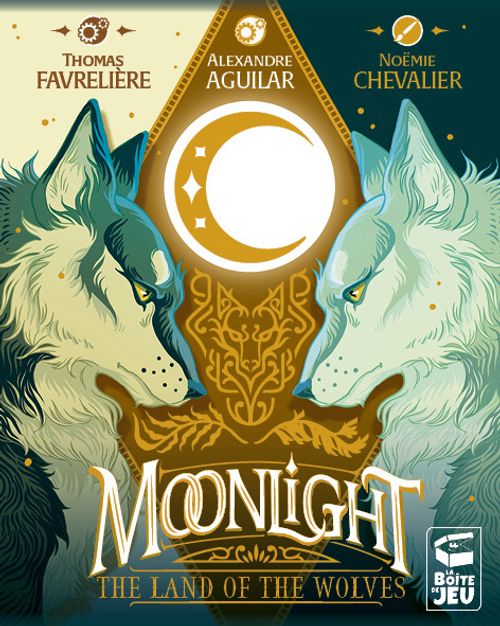
Moonlight: The Land of the Wolves
Moonlight: The Land of the Wolves Rulebook
Table of Contents
Table of Contents
Contents
- 1 deck of Wolf cards per player, each containing:
- 11 Wolf cards
- 4 Lone Wolf cards
- 8 Alpha Power cards
- 3 Mountain tokens to assemble
- 1 player aid card
- 1 rulesheet
Set-up
- Each player chooses one deck of color and takes the associated player aid card. Separate the Lone Wolf cards from the Wolf cards.
- Randomly draw 4 Alpha Power cards and place them close to the game area.
Those cards, as well as the Lone Wolf cards, will be used at the start of the second game round.
- Shuffle and create a face-down pile with your Wolf cards. Draw 3 of them to create your hand.
At the beginning of each round shuffle your pile again.
- Keep enough space between the players to play the cards.
The last player who has seen a wolf starts playing.
Card Description
Each Wolf card shows:
- Value — a number in the top corner of the card.
- Potential Moon space — a marked space in another corner of the card, which can hold a Moon token.
- Potential effect space (see details in the Cards Effects section) — a marked space on the card.
- A second Value, in the opposite corner from the first.
Goal of the Game
Moonlight is an area control game. Place your cards wisely and anticipate your opponent's moves in order to win. The game ends when one player wins their second round and finishes their Mountain.
How to Play
Players take turns one after the other. A game turn is divided into two steps:
- Placing a Wolf: The active player chooses and places one of their wolves in the playing area, following the placing rules.
- Drawing: The active player adds one card from their pile to their hand.
Placing Rule
1. Playing Area
The Wolf cards will be placed one after the other in the playing area between the players. The final shape of all the cards has to be a rectangle. Either formed by 4 by 3 cards or formed by 3 by 4 cards.
Once a 4th card is placed in a row or a column, the final shape is known for the rest of the round.
2. How to Place a Card
A player gets 2 options when placing a card (except for the first one played in the round):
- Placing it adjacent to one already placed (orthogonaly, no diagonals authorised). This card has to fit in the formed rectangle. The Wolf is placed in an empty space of the rectangle.
- Placing it on top of an opponent's card, only if the value is exactly one above the value of the covered card (a 3 cannot cover a 1, for example). The card with a value of 2 is placed on the opponent's Wolf card of value 1.
Important: If it's your opponent's last or only visible Wolf, you can't cover it.
Pay attention of the cards played by your oponent, you know their distribution. (You'll find a reminder on the player aid card.)
End of a Round
A round can end in 2 ways:
- When placing a card, if the rectangle of the playing area is complete, the round ends immediately.
- Once a player place their last card. Players finish the current turn, then the round ends.
After that, the round's points are calculated.
Scoring Points
To determine your score of the round, follow these steps:
1. Moons Majority
The player who has the most visible Moons gains a bonus of 2 points for the round. If there is a tie, no one gets the bonus.
2. Rows Majority
For each row of cards (in the players' perspective) each player sums up all the values of their visible cards. The player with the highest sum wins the row.
In case of a tie, the row is lost for both players.
Next, the player who has just won the row takes each card of their color that is visible in this row. Those cards will count as points for this round. The rest of the cards of the row is discarded.
3. Round Points
Once the row majorities have been calculated for the 3 or 4 rows (depending on how the rectangle was made) each player counts how many points they made in this round.
Each card gives 1 point to the player. Cards with a value of 3 give 1 bonus point (see effects below). The player with the Moons majority adds 2 points.
Important: Do not confuse the value of the card used to win a row with the points earned by that card at the end of the round!
Continuation of the Game
The player with the most points wins the round and takes a part of their Mountain. If there is a tie, the player with the most cards in front on them wins the round. If there is still a tie, no one wins and the round must be played again (without taking a bonus card, see after).
If it's the first round won by a player, they take the base of their Mountain (with their color). If it's the second they take the top and complete their Mountain.
The first player to win their second round wins the game.
If the victory is not determined at the end of a round, a new one is played:
- The winner chooses one of their Lone Wolf card (red) and adds it to their deck. It has to be known by their opponent.
- Then, the looser chooses one of the available Alpha Power cards and places it, face up, in front of them. They can use the power of the card for the rest of the game.
Those cards are kept from one round to another, in case of a 3rd round.
The winner of the last round starts playing the next. If you're facing an unbroken tie at this point, the player that did not start the previous round starts this time.
Cards Details
Cards Effects
The 2 players start with the exact same 11 Wolf cards, the only difference is their color.
Some cards have effects that are applied at the end of a round. If the card is covered by another, the effect does not count anymore. The effects are applied even if the rectangle is not completed at the end of a round.
Value 1 cards: If at the end of the round those cards are placed on one of the 4 corners of the formed rectangle, their value is multiplied by 3 (meaning they have 3 in value) for the row majority.
Even though their value is 3 while on a corner, they must still be covered by a card with a value of 2 (never a value of 4!).
Value 3 cards: If you win a row with one or more cards with a value of 3, they give you 1 bonus point each (so 2 points total).
Lone Wolf Cards
A Lone Wolf card is added to your deck when you win a round. They follow the same rules as the other Wolf cards, and show the same back color as yours. If you play a 3rd round, you can choose the same Lone Wolf card as your opponent.
- 1 card with a value of 1, identical to the 2 you already have in your deck, except this one shows 2 Moons.
- 1 card with a value of 2 having the same effect as the 1 value card. Meaning, if they end up in one of the angles they count 3x their value for the row majority, (so 6 of value). They must still be covered by a 3 value card.
- 1 card with a value of 4 and 1 card with a value of 6 (this last card is only found in the Lone Wolf cards).
Alpha Powers
The effects of the Alpha Power cards are explained on them. When choosing one, place it side up in front of you. In case of a 3rd round, keep the Alpha Power you already aquired.
Powers must be used in accordance with the placing rules.
There are 2 types of Power cards:
'Ambush', 1 time effect — It must be turned face down when used. The effect can only be used once per round. In case of a 3rd round, turn it back up to use it during this new round.
'Stamina', permanent effect — This power is always active.