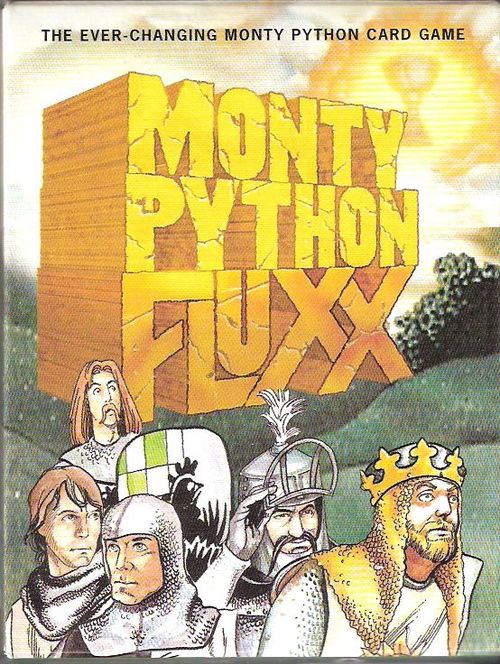
Monty Python Fluxx
Monty Python Fluxx Rulebook
Table of Contents
Table of Contents
Exec Summary
- Fluxx is a game about constant change.
- Begin by following the Basic Rules.
- Each player starts with a hand of 3 cards.
- On your turn, draw 1 card, play 1 card.
- New Rules take effect as soon as you play them.
- Collect Keepers to match the Goal and you win!
Overview
Fluxx games are all about change. The game begins with just a couple of simple rules, then becomes more complex little by little as additional rule cards are played. At first there will be no way to win – that's what Goal cards are for. Each Goal has a different victory condition, but they all require you to collect special cards called Keepers. As soon as someone's collection of Keepers matches the current Goal, they win!
Setup
Place the Basic Rules card in the center of the table.
Shuffle the deck and deal three cards to each player.
Establish the draw pile by placing the remainder of the deck face down where everyone can reach it.
Going First
The dealer goes first. Or choose a player at random.
Play proceeds clockwise.
Types of Cards
Each turn, you will Draw at least one card, add it to your hand, and Play at least one card. Here's how each type of card is used in the game:
New Rule
New Rules change the way the game works. When a New Rule is played, you must adapt to it right away. To play one, place it face up in the center of the table.
When a New Rule contradicts a card already in play, the old rule is discarded.
New Rules that override the Basic Rules are placed overlapping the part they supersede. Other New Rules are placed in the center.
Keeper
To play a Keeper, place it face up on the table in front of you.
Keepers are what you need in order to win. Keep them in front of you after playing. Keepers are placed in front of their owners.
Goal
Goals indicate which Keepers you currently need in order to win.
Goals are played face up in the center of the table. Discard the previous Goal, if any.
Goals also go in the middle. They are shared by all players.
Action
To play an Action card, do whatever it says, then place it on the discard pile.
Actions are single-use cards. Follow the instructions on the card, then discard it. After following an Action card's instructions, place it onto the discard pile.
The Basic Rules Card
The Basic Rules card stays in the middle for the entire game. It reads:
- Start with 3 cards.
- Draw 1.
- Play 1.
Turn Sequence
- Draw the number of cards currently required.
- Play the number of cards currently required.
- Discard to comply with any Limit rules in play.
Optional actions allowed by New Rules, Keepers, etc., may be performed at any point during this sequence.
All cards are always playable, even if they have no effect. If you aren't sure how a card works, try reading the full text aloud as you play it.
Limits
At first there will be no limitations on the number of cards you can hold in your hand or Keepers you have in play. But Hand and Keeper Limit cards will create such restrictions. These rules only affect you when it's NOT your turn, so you can ignore them until your turn ends. When someone plays a new Limit rule, the other players must immediately comply with the new restriction, discarding cards of their choice as needed.
How to Win
The game continues until someone meets the conditions of the current Goal. That player wins instantly, no matter whose turn it is! (If a tie, the game continues until one winner emerges.)
Other Types of Cards
Creeper
When you draw this, you must immediately place it in front of you, and draw another card.
Creepers: These are like Keepers you do not want. Usually Creepers prevent you from winning, but sometimes you actually need them to win. Creepers are kept on the table in front of you in the same area as your Keepers.
Creepers cannot be held in your hand. Instead, they automatically go into play. As soon as you draw a Creeper, you must place it face up in front of you and draw another card. This does NOT count as a "play."
You might have to accept several Creepers at once as you draw cards, until you've drawn the required number of non-Creepers and added them to your hand. Note that this is true any time you draw a card, such as during an Action.
Other Notes
First Round Creepers: At the start of the game, any player whose initial hand of cards contains a Creeper must immediately play all of the Creepers they have, and draw again, as needed, until they have three non-Creeper cards in hand.
Regarding Discarding: You cannot simply discard unwanted cards. You can only discard if compelled to by a Hand Limit or similar compulsion. (Yes, this means you could end up being forced to play a card that makes someone else win.)
Reshuffling: If the Draw pile runs out, shuffle the Discard pile, turn it over to make a new Draw pile, and keep playing.
Cards In Play: Whenever something mentions a card "in play," this refers to a card that is face up on the table, but not in the discard pile. Keepers must be in play for you to meet a Goal that requires them. If a Keeper has a special power, you must have it in play in order to make use of its bonus ability.
Free Actions: Some cards allow for bonus actions which can be taken at any time during your turn. Since they don't count as plays, they are called Free Actions.
Jumping In: New players may join at any time by being dealt a hand of three cards.
Dropping Out: Players can exit the game at any time. Just discard your hand and all of the cards you have in play.
Knights of the Round Table: This icon is used to indicate that a Keeper counts as a Knight of the Round Table.
Examples
Here are a few examples to show how various cards interact:
-
After drawing one card, you play the Draw 3 New Rule. Now the rules require you to draw three cards on each turn, but since you only took one card before, you must immediately draw two more cards. The next player draws three cards for their turn. They play Draw 2 which changes the rules again, but they draw no more cards, having already gotten (at least) two cards this turn. Since Draw 2 contradicts Draw 3, the Draw 3 rule is discarded.
-
If you play the Action called Draw 2 and Use 'Em, you will immediately draw two cards and play them both. If one of those cards is Draw 3, Play 2 of Them you would keep going, drawing three more cards, playing two cards, and discarding the third. All of this activity would be considered the playing of just one card when counting the number of plays on your turn.
-
Suppose you play Draw 3, Play 2 of Them. You will start by drawing three cards. If any of those cards are Creepers, you would place them in front of you and redraw immediately until you have three non-Creeper cards, then you would choose which two of those cards to play.
Questions?
When playing Fluxx, there are many interesting situations that can arise. If you get stuck on how a particular card works and need an official answer, the fastest solution is to check the extensive online database of Frequently Asked Questions at faq.looneylabs.com/.
If you can't find the answer you need there, please email Looney Labs and they'll get back to you with a ruling as soon as they can.
Another great way to learn is with the many tutorial videos at looneylabs.com/Video-Fluxx.
Here are a few FAQs that relate specifically to Monty Python:
Q: If the Animator counts as the Finger of God, can it count as both at the same time in order to fulfill the Goal the Meaning of Life? A: No. While God Himself may be omnipresent, nothing else can be in two places at once. Since the card shows two things being required, you need to have both slots filled. While the Animator can take the place of the Finger on other Goals, you need him to be himself when the Goal is the Meaning of Life, and he can't do that if he's off being the Finger of God.
Q: Does the Animator count as the Finger of God for smiting purposes as well as Goals? A: Yes, the Animator can smite Creepers if the Finger of God is not on the table, since that's something the Finger of God can do. If something "counts as" another card then it has all the same properties as that other card, without having to spell out all of those properties as written on the other card.
Q: Can you combine this game with other versions of Fluxx? A: Yes, but it will be extremely perilous. Even though the cardbacks are the same for each version, some cards in other Fluxx games won't interact well with this one. For example, the 1, 2, 5 rule from Monty Python Fluxx contradicts the Inflation rule in original Fluxx, but it doesn't say so on either card. So proceed with caution. If you aren't careful, the Penguin on top of your television set will explode!
Q: Why aren't the Black Knight and Tim the Enchanter in the game? What about the French Persons? Most of all, where is the aptly-named Sir Not Appearing In This Game? A: We tried to squeeze as much fun into this box as we could, but there just wasn't room for everything. However, if you seek out the expansion packs and promo cards Looney Labs has published since this game was originally released, you will find all of those wonderful things and more. Just ask your friendly local game supplier!