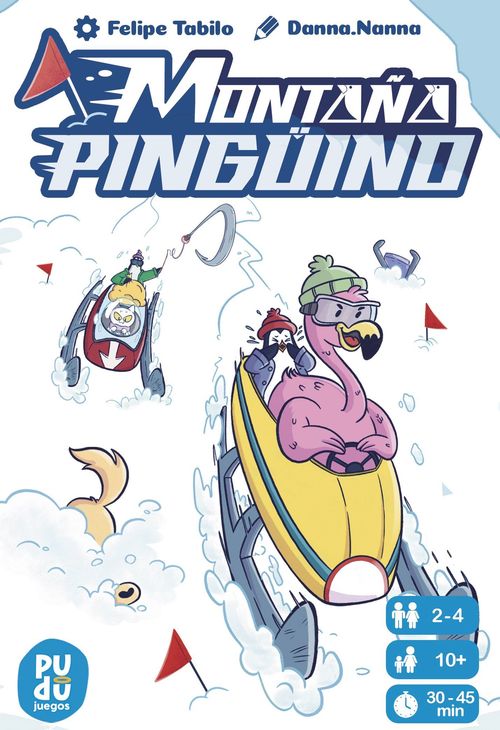
Montaña Pingüino
Montaña Pingüino Rulebook
Table of Contents
Table of Contents
Components
- 1 rulebook
- 4 character cards
- 44 action cards
- 1 start card
- 1 finish card
- 24 track cards
- 4 sleds
- 42 item cards
- 4 summary cards
- 8 cubes
- 6 effect tokens
- 1 first-player token
Objective of the Game
In MONTAÑA PINGÜINO, the runners (players) compete to reach the finish line first, gaining a great deal of speed as they descend. Knowing how to use items and play them at the perfect moment is the key to winning this fascinating race!
Setup
Runners
Each runner:
- Chooses a sled and 2 cubes of the same color.
- Takes 1 character card and the 11 action cards belonging to their runner (their deck). Shuffles the action deck of their character and takes the first 5 cards to form their hand. The remaining cards are placed to one side of their character card.
- Places:
- The character card in front of them.
- One cube at the start of the speedometer.
- The other cube on the highest number of the health meter.
- The action deck to one side of the character card.
Track Setup
Note: For the first games it is recommended to use the 7 track cards marked with the [icon] symbol.
- Separate the start card and the finish card from the track cards. Place the start card face up on the table so that it is visible and within reach of all players.
- Shuffle the remaining track cards, take 7 cards, and return the rest of the track cards to the box; they will not be used in this game. Place the selected cards one at a time following the direction of the track, then place the last card to close the track with the finish card. Players may use more track cards if they wish.
- Shuffle the item deck and place it face down to one side of the track.
- Each runner places their character card around the track.
- Each runner places their sled before the starting line on the start card.
- Each runner is dealt one summary card. The runner whose summary card bears the [flag symbol] is the main runner and takes the first-player token.
Translator's note: the printed manual shows the summary-card symbol pictorially in step 6; the symbol is described here as the flag symbol shown beside that step.
Note: For advanced runners, the character cards may be used on their alternative side.
- Heavy character [icon]: this type of character has one more health, but takes longer to reach high speeds.
- Light character [icon]: this type of character has one less health, but reaches high speeds more quickly.
Heavy characters are shown in the manual as Jimy and Doffy. Light characters are shown as Pudú and Kay.
Card Types
Character
- Speedometer: made up of 4 speed levels.
- Speed: defines how far the sled will move.
- Acceleration: represents the change in speed. It can be increased or decreased by action and item cards, and even by the track.
- Health of the sled: the health meter across the top of the card.
- Runner identifier: the symbol identifying the corresponding runner.
Action
- Speed at which the card's ability activates: the speed range in which the card's ability is active.
- Ability or effect: these allow you to increase or decrease your speed, recover cards from the discard pile, strike other runners, and increase your conduction.
- Runner identifier: the symbol of the runner who owns the card.
Item
- Item identifier: the symbol identifying an item card.
- Item name: the name of the item card.
- Ability or effect: these are similar to action cards, but in addition they allow you to apply effects to the track by means of tokens, and to affect the runner themselves or other runners.
Track
Each track card is made up of two sections. The zone in the middle separates each section. Runners move their sleds between sections.
- Track acceleration of the track section.
- Speed limit of the curve.
- Tree symbol (obstacle).
Round of Play
The game is played over several rounds. Rounds proceed to the left, beginning with the main runner.
Each round is divided into 2 phases:
- Support Phase.
- Impulse Phase.
1) Support Phase
In the support phase the runners prepare their moves to go as fast and as recklessly as possible. This phase is carried out as follows:
1.1) Each runner, in turn order, draws one card from the item deck. The runner or runners in last place draw 3 cards and choose one of them, discarding the others. A runner may not hold more than two item cards in hand. If the limit is exceeded at any point, the runner must discard the card(s) they cannot keep.
Note: No item cards are drawn during the first round.
1.2) All runners must play one action or item card, placing it face down to the left of their character card. Optionally, they may play a second card to the right of their character card. The left card is activated first, then the right. With these cards a runner may accelerate, use conduction, and/or strike (see the ABILITIES section, page 10).
Note: Cards marked with the [immediate-effect icon] may be played at any time and are not counted toward the limit of played cards, since they are immediate effects.
Note: Some action cards are double cards. The ability that is activated is the one in the upper section; make sure the card is placed correctly.
Example: Doffy is at orange speed according to the character card, so the upper effect of the card cannot be used, since Doffy's speed is higher. If Doffy had played the card in the other orientation, they could have used the lower effect of the card, whose speed range is orange, but unfortunately the card was played upside down.
Note: Action cards only activate if the runner's speed is within the speed range defined by the card.
1.3) Once all runners have placed their cards, starting with the main runner and continuing to the left, the runners activate their cards from left to right. When all runners have applied the effects of their cards, the Impulse Phase follows.
2) Impulse Phase
In this phase the runners use the accumulated speed to advance along the track, gaining even more acceleration as they pass from section to section. The impulse phase has 3 sub-phases:
- 2.1 Advance.
- 2.2 Speed check.
- 2.3 Track acceleration.
2.1) Advance
Starting with the first runner, each runner moves their sled forward as many sections on the track cards as the speed level shown on their speedometer:
- Green / square: 1 section.
- Yellow / hexagon: 2 sections.
- Orange / circle: 3 sections.
- Red / star: 4 sections.
Example: Doffy plays two actions that give +3 (1+2) of acceleration, so Doffy must move their speed marker three boxes. Doffy is at green speed, so they move their sled only one section.
2.2) Speed check
When entering one or more curves or passing one or more trees, the speed level of the sled must be checked and compared with the speed limit of the track card. This limit may be increased by using conduction. If the limit is exceeded, the sled takes damage (see the DAMAGE section, page 11).
Example: Doffy is at orange speed and the limit at the curve is yellow, but Doffy increased their conduction by 1 thanks to an action card, so they can enter the curve without taking damage.
2.3) Track acceleration
Once the movement has been made and the sled is still standing, the runners must add or subtract from their speedometer the acceleration indicated in each track section the sled has entered. This may increase or decrease the acceleration on the character card.
Example: Pudú must advance 2 sections. Upon passing the first track section, they add 1 to their speedometer, and then add 1 more upon passing the second. Pudú must therefore adjust their speedometer, since the track acceleration was 2 in total.
End of Round
At the end of each round, check whether:
- A sled has passed the finish line: the game ends (see the FINAL OF THE GAME section).
- No sled has passed the finish line: each runner discards the cards they played and the tokens on the track are removed. Runners draw cards from their action deck until they have 5 cards in hand. If the action deck does not contain 5 cards, they may draw only the cards that remain. The action deck can only be recovered with action cards. Item cards do not count toward the hand limit. Runners whose sleds were destroyed in this round may not draw cards. The runner holding the first-player token passes it to the left, and a new round begins.
End of the Game
The game ends at the end of the round in which one or more sleds cross the finish line.
The sled that reaches the finish line with the most speed is the winner. If more than one sled reaches the same speed, the tie is broken by the runner who achieves greater acceleration. If the tie persists, the runner with more health wins. If the tie still persists, the runners share the victory as a photo finish.
Note: If a sled crosses the finish line by means of an item card during the Support Phase, that sled is the winner, regardless of whether it ends the round destroyed. If more than one sled crosses the finish line during this phase, play continues until the end of the round, and the winning runner is determined at that point.
Abilities
Both action cards and item cards have abilities that may affect the same runner or other runners. They must be carried out in full. If this is not possible, the card is simply discarded at the end of the round and cannot be used.
Applying Abilities
The ability box may contain abilities with a white background or abilities with a red background. They are read from left to right.
- White background: these affect the same runner. They consist of an ability icon and a number, and allow you to modify acceleration, conduction, movement, among others.
- Red background: these affect other runners. First they indicate the target or targets, then the range of the effect, and then the effect itself.
Note: If an action or item card contains both white and red background abilities, the white background section is carried out first and then the red background section.
Example: Kay plays an action card and the item card BOMBA DE NIEVE (Snowball Bomb). First the action card is carried out. It reduces Kay's acceleration and may shuffle Kay's discard pile into Kay's action deck; since it has a white background, it affects only Kay. Then BOMBA DE NIEVE is carried out, which affects all runners within a range of 1 or 2 sections, removing 1 health and 3 acceleration from each of them.
Damage
In the Support Phase
When a sled receives damage from action or item cards, health must be subtracted on the health meter by as many spaces as the damage received. Once all damage has been assigned, the state of the sled is checked:
- If the health counter is greater than 0, nothing happens and the sled remains standing.
- If the health counter reaches 0, the sled is destroyed (see the SLED DESTRUCTION section).
In the Impulse Phase
During the Impulse Phase a sled may receive damage in the following ways:
-
Exceeding the speed limit when passing a curve. The restrictions on speed may be green or yellow depending on the curve:
- Slow curve: its speed limit is green.
- Fast curve: its speed limit is yellow.
The runner moves the health marker back by as many spaces as the difference between the speed limit of the curve and the speed range the sled is at. Damage is received each time the speed limit is exceeded in curves.
Example: Doffy passes the curve on the track, which has a yellow speed limit, and receives 1 damage, because they are passing at orange speed. Had Doffy passed at red speed, they would have received 2 damage.
-
Passing over a tree. Only one damage is received when passing a tree at a speed above yellow.
Example: Doffy passes over a tree and receives 1 damage, since their speed is red. Had Doffy passed at orange speed, they would also have received 1 damage.
Sled Destruction
When, by any card or track element, a sled reaches a health level of 0, the sled is destroyed. The runner must immediately place their speed marker on the first acceleration box and return the health counter to its highest number. The runner may play only one card during their next turn and may not draw cards from their action deck.
Note: Immediate cards are not affected by this restriction.
During the Support Phase
If the destruction occurred during this phase, once the consequences of the sled's destruction have been applied, the runner may play the cards they have not yet been able to activate, adding acceleration or effects to their sled. The Impulse Phase is then carried out normally.
During the Impulse Phase
In the case of destruction during the Impulse Phase, the runner must carry out the advance sub-phase and then apply the destruction effect indicated above. The runner may not apply the track acceleration to their speedometer.
Effect Tokens
- Ice token: in the section where the ice token is located, a yellow speed limit applies. If the section already has a yellow limit, it is treated as a green limit. The token is removed at the end of the round.
- Spike token: causes 1 damage to any runner who is in or enters that section, including the runner who placed it. This effect is not cumulative with other spike tokens in the same track section. The token remains only until the end of the round.
Variants
Purist Mode
Remove the item deck. Play with action cards only.
Championship Mode
The runners race 3 races. Each race is played in the same way as a normal race. The game ends once all runners have reached the finish line. Depending on the position in which they finish and their speed, runners score points as shown in the following tables:
2 runners
| Place | Points |
|---|---|
| 1st | 7 |
| 2nd | 3 |
3 runners
| Place | Points |
|---|---|
| 1st | 7 |
| 2nd | 5 |
| 3rd | 3 |
4 runners
| Place | Points |
|---|---|
| 1st | 7 |
| 2nd | 5 |
| 3rd | 3 |
| 4th | 1 |
The runner with the most points at the end of the championship is the winner. In case of a tie, the runner who has finished in first place the most times is the winner. If the tie persists, the victory is shared.
Card Explanations
Action Cards
The icons on action cards mean:
- Heart with −1: lose 1 health.
- Sled with +1: +1 to acceleration.
- Steering wheel with +1: +1 to conduction.
- Sled with −X and discard-pile icon: −X to acceleration, minimum 1. The runner who activated the card chooses how much their acceleration is reduced, and at the end of the turn must shuffle the discard pile into the runner's action deck.
- Sled with −X and "+1" card icon: −X to acceleration, minimum 1. The runner who activated the card chooses how much their acceleration is reduced, and recovers 1 card of their choice from the action discard pile directly to their hand.
- Sled with −X and "+2" card icon: −X to acceleration, minimum 1. The runner who activated the card chooses how much their acceleration is reduced, and recovers 2 cards of their choice from the action discard pile directly to their hand.
- Target icon with heart −1 (red): an opposing runner in your same position loses 1 health.
- Target icon with 1/0 range and heart −1 (red): an opposing runner in your same position, or 1 section away, loses 1 health.
Item Cards
- Aletón: the driver gains +1 conduction.
- Ardilla: recover 1 item card of your choice from the item discard pile.
- Bomba de Nieve (Snowball Bomb): all runners within a distance of 1 or 2 sections lose 1 health and 3 acceleration.
- Caña Mágica (Magic Rod): move your sled 1 section forward and move the opposing sled that is in first place back 1 section. The track's curve limits and track accelerations apply.
- Carnero (Ram): move your sled 1 section forward. All opposing runners who are in the finish section lose 1 health. The track's curve limits and track accelerations apply.
- Erizo (Hedgehog): at a distance of 0 or 1 section, place a spike token.
- Escuadrón Canino (Canine Squad): add 3 to the runner's acceleration.
- Hielo (Ice): at a distance of 0 or 1 section, place an ice token.
- Iglú (Igloo): blocks the damage received from an action or item card.
- Misil Orca (Orca Missile): all runners within a distance of 1 to 5 sections lose 1 health.
- Pez Espada (Swordfish): one targeted opposing runner loses 1 health and 3 acceleration.
- Reparar (Repair): the runner recovers 1 health.
Translator's note: the item names above are the Spanish card titles from the manual, with an English rendering in brackets. The manual prints no English titles.