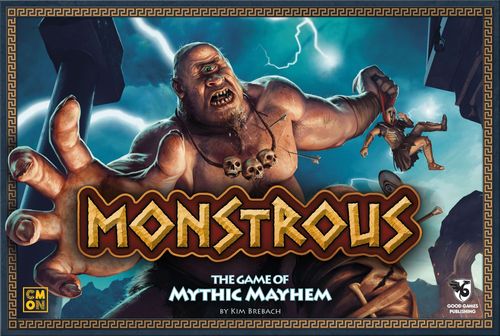
Monstrous
Monstrous Rulebook
Table of Contents
Table of Contents
Game Overview
Ages 10+. 2 - 5 players, or 4 / 6 / 8 / 10 players in the team play variant. 15 - 45 minutes.
Use the Lightning Start Rules in the box to start playing Monstrous fast. Use these rules for more detailed explanations and examples of play.
Components
- 56 Faith tokens
- 5 God Boards
- 5 player aids / turn sequence cards
- 60 Monster cards (12 mythical Monsters in each of 5 decks with different colored frames)
- 11 large Location cards
- Lightning Start Rules
- This rule book
Faith
Faith is the measure of victory gained by gods from a common Faith pool during the game. It comes in 1, 3, 10 & 30 Faith tokens.
God Boards
Each god's double sided God Board lists Location details on one side and Monster details on the other. Reference these if key text is covered by game pieces throughout the game. They also show you where to put your Monster Deck (in landscape orientation to the left of the board), and your Underworld - your discarded cards (in portrait orientation on the right of the board).
Player aid
Each player aid summarizes a turn sequence in 7 Throw Steps.
Monsters
Monster cards have 2 sides; a unique power side and a common power side. Gods can choose to throw either side face up.
Unique powers. Red or bronze name plates indicate the unique power side of each Monster card and its name.
- Monsters with red name plates are Trap Monsters. When in play, Trap Monsters use their powers when they are hit by a Monster that has just been thrown, before that Monster can use its own power (page 12).
- Monsters with bronze name plates use their power if they hit something (page 11), but after any Trap Monsters powers are used (page 12).
- Colored frames - each god controls all 12 Monster cards of one frame color (green, blue, purple, orange, white) & pattern matching their God Board.
- Unique Monster power - certain conditions must be met in order for each Monster's unique power to be used. These powers are used following a throw and are compulsory (page 11).
Common powers. All Monsters share a common power on their reverse sides. Common Monster powers are signalled by iron name plates.
Locations
Gods throw their Monsters at large Location cards that are laid out on the table.
- Location name
- Location power - a god must use this power if they hit this Location with a Monster.
- Faith - the number of Faith a god gains if they hit this Location with a Monster.
Game Setup
- Remove the chairs. You stand up and move around the table to play.
- For your first game place the Locations Naxos, Athens, Corinth, Sparta and Troy in the centre of the play area, with each Location at least 1 Monster card's length from each other Location. Otherwise select a scenario to play (see back cover) and set it up in a similar layout.
- Each god takes a God Board with its matching player aid card and Monster Deck of 12 colored/patterned Monster cards.
- Put your God Board near you on the table edge, Location side face up, with the matching player aid on top of it.
- The youngest god shuffles their Monster Deck and randomly removes Monsters from their deck equal to the number of gods playing. Remove those same Monsters from all decks, and in the same order, tuck them beneath the Underworld side of their God Board, vertically oriented. (See Table 1)
- Shuffle your remaining Monster cards into your own Monster Deck, with the bronze or red name plate side of the cards face up, then cut the deck and place it horizontally to the left of your God Board.
- Put the Faith tokens in a Faith Pool within reach of all players. The play area should now look something like the diagram in the rulebook.
- Draw 3 cards from your Monster Deck.
- In your first game, practice throwing those 3 Monsters at Locations at least 10 times, then gather your cards. You are ready to play MONSTROUS.
Table 1 - Starting Monster cards in deck or underworld by player numbers.
| Number of gods playing | 2 | 3 | 4 | 5 |
|---|---|---|---|---|
| Cards in god's Monster Deck (random order) | 10 | 9 | 8 | 7 |
| Cards in god's Underworld (same order for all players) | 2 | 3 | 4 | 5 |
Playing Monstrous
The youngest god goes first. Play proceeds clockwise with each god taking a turn until the end of the game (page 18).
Turn overview
In your turn you throw one Monster card from your hand onto the table, trying to 'hit' Locations and perhaps other Monsters there. The main aim is to gain as much Faith from Locations as possible, but various Monster and Location powers may allow you to do additional things in a turn, including gaining additional Faith, cards or throws. You may throw either the unique or common power side of your Monster face up. The power that is face up when it has finished moving must be used if possible, even on your own Monsters.
Throw steps
Take your turn by following these 7 Throw Steps:
- THROW a Monster from your hand of Monster cards onto the play area (page 9), and when it has stopped moving check the following Throw Steps:
- TRAP MONSTER POWERS: Check for 'hits' by that monster on Trap Monsters (Gorgon / Siren / Phoenix) already on the table. The Trap Monster's owner uses that Monster's WHEN HIT: power (see page 12).
- MONSTER POWERS: Check for 'hits' by your Monster on other cards (page 10). Use your Monster's face up power if its activation condition has been met (see HIT MONSTERS and/or HIT LOCATION, page 11).
- LOCATION POWERS: Check for 'hits' by your Monster on Locations. Use the 'WHEN HIT:' power of one Location hit by your Monster (page 11).
- GAIN FAITH from one Location your Monster hits. Collect the number of Faith indicated in the Location's corners from the Faith pool and place them on your God Board.
- EXTRA THROW? Keep track of 'throws' you have gained this turn. If you have gained any throws, start at Throw Step 1 again until you have no further throws or cards left.
- END TURN: Once you have used all your throws this turn, or have run out of cards in hand to throw; a. Draw 1 card from your Monster Deck if possible. b. Pass your turn to the god on your left.
Example in the rulebook: the Harpy has just been thrown by the orange player and has 'hit' the Siren, the Dragon and Naxos. See pages 15 - 17 for detailed examples.
Throwing cards
When throwing a Monster, you may move around and throw from any side of the table. You must throw from outside the table edge or agreed play area. Your hand should not cross the table or play area's edge while you throw. If it does, and the other gods call you out, you will be struck by lightning - put your Monster into your Underworld at the end of Throw Step 1.
Be sure to throw the side of the Monster you want face up. Generally this will be its more tactical unique power, but sometimes you might want to throw your Monster's common power side face up.
If a card lands off the table, put it straight into its god's Underworld. Once you have thrown a card, check to see what it 'hits' in Throw Steps 2 - 5.
Hit cards / Hitting
The aim of the game is to gain the most Faith by 'hitting' Locations, and perhaps other Monsters, with the Monsters you throw.
Once all cards on the table have stopped moving after a throw in Throw Step 1, check for hits by the Monster just thrown once in each of Throw Steps 2 - 5, and use powers (see page 11) resulting from hits within each of those steps. Start by checking for hits on Trap Monsters in Throw Step 2, use Trap Monster powers, and then proceed to check hits and use powers through Throw Steps 3, 4 & 5. It is possible for a card to have multiple hit effects, and trigger multiple powers across the different throw steps (see examples pages 13 - 15).
A card just thrown 'hits' any card where its own edge is visibly over or underlying some part of another card directly. They do not have to be directly touching. If a card cannot be seen to be overlying or underlying a card directly due to the placement of cards in between them, it is not counted as hitting, even if those cards might be touching if the intervening cards were removed.
Think of this as a scrum of Monsters where they cannot all quite get to each other or the mortals underneath. However, some Monsters have powers that discard Monsters they hit (to the top of their owner's Underworld), or move them elsewhere, so be careful to check the sequence of hits carefully across Throw Steps 2 - 5 within each throw (see page 8).
Using card powers
The key to winning Monstrous is in how you use your Monsters' powers and the power of Locations you hit to gain a tactical edge and/or extra Faith throughout the game.
Most cards have powers that are used when they meet certain "HIT" conditions such as "HIT MONSTERS", "HIT LOCATION", "MISS LOCATION", or "WHEN HIT" by other Monsters (see below). Only face up card powers are used, and if their conditions are met, they must be used, even on your own Monsters. After a throw's hits are checked, resolve different types of card powers as follows.
Monster powers: Use "WHEN HIT" powers of Trap Monsters already in play first in Throw Step 2 - Trap Monster powers. Trap Monsters cannot resolve their WHEN HIT powers in any other way.
- WHEN HIT: means 'When this card is hit by a Monster.'
Use "HIT MONSTERS" / "HIT LOCATION" / "MISS LOCATION" Monster powers in Throw Step 3 - Monster powers.
- HIT MONSTERS: means 'When this Monster hits any number of other Monsters.'
- HIT LOCATION: means 'When this Monster hits a Location.'
- MISS LOCATION: means 'When this Monster misses a Location.'
Location powers: Use "WHEN HIT" powers of Locations in Throw Step 4 - Location powers.
- WHEN HIT: means 'When this card is hit by a Monster.'
Example hits
- The Phoenix is hitting the Cyclops but is just missing Delphi.
- The Harpy is hitting both the Manticore and the Siren but is not hitting Delphi because you cannot see an edge of the Harpy card directly overlay a part of the Delphi card, even though you suspect it is sitting on top of its top right corner.
- If the Manticore somehow landed between the Harpy and the Siren, it would count as hitting both of them, and Delphi, because you can see its edge overlaying or underlaying each of them.
Trap Monsters
Be careful which Trap Monsters you hit when throwing Monsters onto the table. Lookout for their red nameplates before you throw. These Trap Monsters have special powers that work after they are hit, during Throw Step 2, before thrown Monsters use their powers in Throw Step 3.
- The Gorgon petrifies and discards any other Monster that hits it, before that Monster can use its powers.
- The Siren earns its god 1 Faith when it is hit by any other Monster.
- The Phoenix is returned to the top of its owner's deck when it is hit by any other Monster, before other Monster powers can be used. It also has a HIT MONSTERS' power that can be used in Throw Step 3 if it hits any Monsters.
If your Monster hits multiple Trap Monsters in the same throw, the gods who own those Monsters use their powers in turn order, starting with the god currently having a turn and proceeding clockwise. If one god owns several trap Monsters that are hit by a Monster, that god may choose the order in which their powers are used.
More about card powers
You must use card powers if their conditions are met, but sometimes you have a choice in how to resolve them. Card wordings are specific.
Some Monster powers affect just one Monster eg "HARPY - HIT MONSTERS: Take 2 Faith from one hit Monster's god." allows the Harpy's owner to choose on which god to use the power. In the rulebook's example, the Harpy's god can choose to take 2 Faith from the white god or the orange god.
Other Monsters use their powers on each Monster they hit eg "DRAGON - HIT MONSTERS: Discard hit Monsters." In the rulebook's example both the Giant and the player's own Siren would be discarded because use of Monster powers is compulsory.
If a power involves multipliers, it will say so.
- "HIT MONSTERS: Gain 1 Faith." means if you hit 1 Monster or 5 Monsters you just gain 1 Faith. In the rulebook's example the Pegasus would gain just 1 Faith from its power.
- "HIT MONSTERS: Gain 1 Faith for each hit Monster" means you get 3 Faith if you hit 3 Monsters. In the rulebook's example the Manticore would gain 3 Faith from its power.
Faith
Gods gain Faith from Locations they have hit in Throw Step 5. Some Locations can earn a god Faith as part of their powers in Throw Step 4. Monster powers can also earn a god Faith or even allow Faith to be taken from other gods in Throw Step 2 or 3.
When you gain Faith, collect the number of Faith points matching the Location you hit, or as per Monster or Location powers, from the Faith Pool, and put them on your God Board.
When you take Faith from another god, take the correct amount of Faith from them and put it on your God Board.
Gods should convert smaller Faith tokens into larger ones throughout the game to help other gods see their total Faith scores.
Example turns
Turn example 1:
- Throw Step 1 - Throw a Monster: Player 1 (blue) throws their Dragon.
- Throw Step 2 - Trap Monster powers: The Siren (a Trap Monster) is hit, and used now. Its god gains 1 Faith from the Faith pool.
- Throw Step 3 - Monster Powers: Hits by the Dragon are checked. It hits and discards the Siren and Gryphon to their god's Underworlds. However, it does not hit the Hellhound because no card edge of the Dragon can be seen directly overlaying the Hellhound at the beginning of this step, when the "check" is made.
- Throw Step 4 - Location Power: Having blasted through, the Dragon is now hitting the Location and can use the Location's power. The Dragon's god takes 1 Faith from the Hellhound's god. Note: the Dragon's HIT MONSTERS power is not used in this step, so the Hellhound survives.
- Throw Step 5 - Location Faith: The Dragon's god gains 4 Faith because the Dragon is hitting Naxos.
- Throw Step 6 - Extra throw?: No extra throws have been gained.
- Throw Step 7 - Draw 1 card and pass: Player 1 draws a card from their Monster Deck and passes play to player 2.
Turn example 2a:
- Throw Step 1 - Throw a Monster: Player 2 (orange) throws their Phoenix at Athens.
- Throw Step 2 - Trap Monster powers: Player 1's Siren (a Trap Monster) is hit by the Phoenix and Player 1 gains 1 Faith.
- Throw Step 3 - Monster Powers: Now the Phoenix is hitting both the Dragon and the Siren. Player 2 gains 1 throw for hitting any number of Monsters with the Phoenix.
- Throw Step 4 - Location Power: The Phoenix is hitting Athens and its god can now choose to gain 1 Faith or draw 1 card. They choose to draw 1 card from their deck (the Cyclops).
- Throw Step 5 - Location Faith: Player 2 gains 3 Faith because its Phoenix is hitting Athens.
- Throw Step 6 - Extra throw?: Player 2 has gained an extra throw from the Phoenix (during Throw Step 3) so bypasses Throw Step 7 and chooses another Monster to throw in a new Throw Step 1.
Turn example 2b:
- Throw Step 1 - Throw a Monster: Player 2 throws their Cyclops at Athens.
- Throw Step 2 - Trap Monster powers: Player 2's Phoenix (a Trap Monster) is hit by the Cyclops. The Phoenix is returned to the top of player 2's Monster Deck due to its WHEN HIT power.
- Throw Step 3 - Monster Powers: With the Phoenix gone, the Cyclops is hitting both the Dragon and the Siren. The Siren's god does NOT gain 1 Faith because it wasn't 'hit' when checked at the beginning of Throw Step 2 - Trap Monster powers. The cyclops chooses to pick up and throw the Siren at the same Location to attempt to gain more Faith. However, before throwing, the Cyclops' god flips the Siren card over and throws its common side face up so its god won't gain its trap power for the rest of the game. The Siren hits Athens and player 2 scores just 3 Faith from it as part of the Cyclops's throw.
- Throw Step 4 - Location Power: The Cyclops is now hitting Athens and its god can now choose to gain 1 Faith or draw 1 card. They choose to draw 1 card from their deck (the Phoenix that was returned there in Throw Step 2).
- Throw Step 5 - Location Faith: The Cyclops is hitting Athens so player 2 gains 3 Faith from Athens.
- Throw Step 6 - Extra throw?: Player 2 has no more throws.
- Throw Step 7 - Draw 1 card and pass: Player 2 draws a card and play passes to the next player on the left.
End of the Game & Scoring
Take turns until one god has no cards left in their hand or deck when they finish their turn and pass. Then each other god completes 1 final turn. When all gods have finished their final turn, they present their achievements to mighty Zeus who crowns the winner as the "MOST MONSTROUS GOD".
Deciding the winner
Each god counts their Faith and then subtracts 1 Faith per Monster left in their hand, Monster Deck and Underworld.
- The god with the most Faith wins.
- If there is a tie, the god with the most Monsters hitting Locations wins.
- If there is still a tie, the god with the most Monsters in play wins.
- If there is still a tie, Zeus calls on you to get MONSTROUS again until there is a clear winner.
Monstrous Variants
Use the Scenarios on the back page and the following variants to play Monstrous in many different ways.
Young gods Monstrous
Zeus recognises that young gods may need a helping hand. So here are some special rules you can use as you like.
- Young gods each start with 3 Faith.
- Once per god's turn, a young god can spend 1 Faith to pick up a monster they threw that hit nothing, or lands off the table, and throw it again.
WARNING: Zeus says it's not cool to throw Monsters directly at another god because Monsters have sharp bits and a god could lose an eye. His god-friend Odin lost an eye just this way, so he should know.
Epic Monstrous
Play with all 12 Monsters in the Monstrous deck for a longer & crazier game.
Monstrous Wars
Play 3 games in a row, with these additional rules:
- Select Location scenarios in increasing complexity each round.
- During setup, the winner of the previous game may swap 1 Location of their choice with another Location from outside the scenario.
- During setup, the winner of the previous game can swap a Monster in their deck with a Monster from their Underworld, and a Monster from each other god's deck with a Monster in that god's Underworld.
- Note the Faith gained by each god in each game and total the Faith after the agreed number of games. The God with the most Faith after the final game is the "MOST MONSTROUS GOD OF WAR".
Team Monstrous
Play with 2 - 5 teams of 2 gods per team. Setup the game as usual but with the following changes.
Each team takes 1 God Board and shuffles and divides its matching Monster deck in 2, giving 1 deck of 6 Monsters to each god in the team. Each team puts their decks to the left and right of their God Board.
Teamed gods:
- Draw only from their own Monster decks
- Share a common Underworld, placed in the middle of their God Board
- Throw their cards together & choose which order to fully resolve their throws during each Throw Step
- Share 1 common Faith pool
- Share extra throws gained or cards drawn between each other as they like.
The youngest god's Team goes first. Each god on that team draws 2 Monsters from their deck. Then other team's gods draw 3 Monsters from their decks.
The first team to have no cards in either god's hand and decks ends the game. Other god teams do not get an extra turn like they do in the regular game. Calculate end game scores as usual but with team totals. The team with the most Faith at the end of the game wins.
Monstrous Team Wars
Play with both Monstrous Team and Monstrous Wars rules, but without rule 3 from Monstrous Wars.
Frequently Asked Questions
Do Monster cards stay on the table after I throw them? Yes. Unless they hit a Gorgon in which case they are discarded by its power.
What happens when a card is thrown off the table or knocks another card off the table? Move the Monster to its god's Underworld / discard pile. Even if it was a Pegasus.
What happens when a thrown Monster knocks a Location from its position? Leave the knocked Location where it is, even if it's close to or touching another Location. Now gods have a chance to hit 2 Locations with one Monster. If they do, they can use the power of one hit Location they choose in Throw Step 4 and gain Faith from either Location in Throw Step 5.
If a Monster already on the table is knocked onto another Monster, does that count as a hit? No. Only the Monster that was just thrown is considered for the purposes of hitting.
If my Monster flips over to its other side when I throw it, can I use the power I threw face up? No. You must use the face up power displayed when your Monster has stopped moving.
When I throw another god's Monster who uses its power? The god that throws a Monster can use its power during the resolution of the 7 Throw Steps, as if it were their own. Control of that Monster reverts to its god from the end of that throw.
Are extra throws gained compulsory? Do I have to use them in my turn? Yes and yes, assuming you have cards left to throw.
Is there a limit to how many extra throws I can gain in a turn? No, but when you run out of cards you cannot use any extra throws you may have gained this turn. So the number of cards in your hand is the only limit to the number of extra throws you may use. However, you may find ways to gain more cards with your extra throws.
If a Monster ability can affect multiple hit Monsters, and by removing one such Monster (discarding or returning it to its god's hand), another Monster is revealed so that it looks like it is being hit now too, can the just thrown Monster use its power on the just revealed Monster too? No. Hits on Monsters are determined all at once in each of Throw Steps 2 and 3.
Do my own Monsters affect each other with their powers, even if I don't want them to? Yes. They are Monsters, not soldiers. Throw them carefully, or throw their common power side face up.
What's with the Phoenix, can anything kill it? The undying Phoenix is hard, but not impossible to kill.
- When a Phoenix is 'hit' by something in Throw Step 2, you carefully pick it up and return it to the top of its god's Monster Deck before the other god's Monster power has a chance to happen in Throw Step 3.
- When Phoenix is already on the table the only way to send it to the Underworld is if someone discards it using Sparta's power.
- If, when thrown, the Phoenix lands on the Gorgon, it is immediately petrified and discarded to its god's Underworld.
Can I use the Cyclops to throw another god's Monster off the table? And if I do, where does it go? Sure, but Greek gods are vengeful beings, and why don't you want to try scoring Faith with that throw this turn? That would please Zeus far more. All Monsters thrown off the table go to their god's Underworld pile, no matter who throws it.
If my Hellhound is touching Troy at the end of the game and I have the most Monsters touching Troy, how many Faith do I gain from Troy's power? Just 3. Hellhound's power only works in Throw Step 3, after it has been thrown.
What happens if my Gorgon hits a Gorgon already in play? Your Gorgon is discarded.
What is the difference between the Underworld Location and each god's Underworld / discard pile? Each god has their own discard pile known as their Underworld. The Underworld, Delphi and Olympus locations each allow gods access to your own or other god's Underworld / discard piles to retrieve discarded cards in various ways.
More FAQs at www.monstrousgame.com
Glossary of Key Terms
- Gods - The players are Greek gods in Monstrous.
- Monster (4) - Greek mythological Monster cards gods throw at Locations.
- Trap Monster (4 & 12) - A Monster with a trap power (indicated by a red nameplate).
- Location (5) - Large Location cards placed on the table gods throw Monsters at.
- God Board (3) - Each player's board they use to organise their Monster Deck and Underworld with, and store their Faith on.
- Monster Deck (5 & 7) - The Monster cards placed horizontally to the left of your God Board, sometimes called your deck.
- Underworld (5) - Discarded Monster cards tucked vertically under the right side of your God Board. These are sometimes accessible through Location powers.
- Throw Steps (8) - The 7 steps in a player's turn.
- Throw (9) - take a card and throw it at other cards in the play area without your hand crossing the edge of the play area.
- Hit/Hitting (10 & 11) - a thrown card is seen to be directly overlying or underlying a card when it has stopped moving. A card landing under a card is considered hitting the card above it.
- Discard (10) - Remove a card from the table and put it on top of its god's Underworld.
Monstrous Scenarios
Zeus likes to spice things up sometimes. Choose from the following Location scenarios during step 2 of Game Setup. These scenarios create games of varying complexity and length. Or create your own!
Each scenario lists its five Locations in order.
Basic / Quick
- Scenario 1: Troy, Corinth, Olympia (Centre), Argos, Athens
- Scenario 2: Troy, Corinth, Olympia (Centre), Sparta, Athens
- Scenario 3: Sparta, Corinth, Naxos (Centre), Argos, Athens
Intermediate / Medium
- Scenario 1: Naxos, Corinth, Underworld (Centre), Sparta, Argos
- Scenario 2: Troy, Athens, Underworld (Centre), Sparta, Thebes
- Scenario 3: Naxos, Corinth, Delphi (Centre), Thebes, Athens
- Scenario 4: Troy, Corinth, Delphi (Centre), Sparta, Athens
- Scenario 5: Naxos, Corinth, Mt Olympus (Centre), Argos, Thebes
- Scenario 6: Troy, Thebes, Mt Olympus (Centre), Sparta, Corinth
Advanced / Long
- Scenario 1: Delphi, Corinth, Naxos (Centre), Thebes, Underworld
- Scenario 2: Underworld, Thebes, Argos (Centre), Athens, Sparta
- Scenario 3: Argos, Corinth, Mt Olympus (Centre), Underworld, Thebes