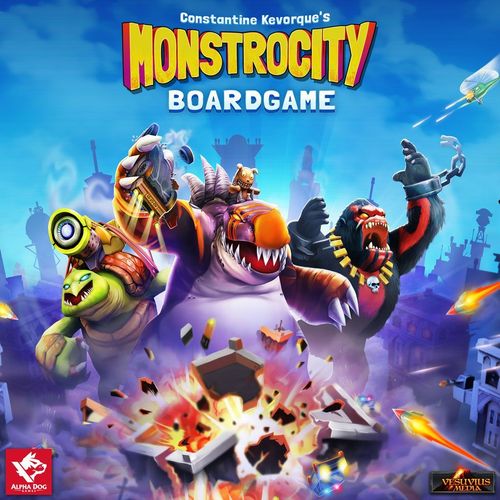
MonstroCity
MonstroCity Rulebook
Table of Contents
Table of Contents
Components
- 4 Monsters
- 1 City Board
- 1 Game Board
- 1 Police Board
- 12 Police Cars
- 16 Custom Dice
- 4 Two-sided Player Boards
- 6 Mystery Cards
- 7 Reinforcement Cards
- 4 Event Cards
- 10 Retaliation Cards
- 60 Damage Counters
- 4 Rage Markers
- 4 Health Markers
- 1 Threat Level Marker
- 24 Building Bodies
- 24 Building Rooftops
- 24 Building Bases
- 16 Blocking Items
- 16 Turret Tops
- 1 Round Counter
Assembly Instructions
The first time you open the box and before you begin setting up your game, you will need to assemble the various buildings.
To do so, get all the boards with buildings out of the box and punch them. There are 3 different building types: Common, Turrets and Special. Each type has a different color rooftop which matches the cardboard's back. You should use grey rooftops for the Common buildings, red rooftops for the Turrets and purple rooftops for the Special buildings.
To assemble each building, simply attach the base and the rooftop to the body of the building. The building's back color should match the roof's and base's color. If the building is a turret, you need to attach its top on the roof. Check page 16 to find their match.
You should end up with 12 Common buildings with grey rooftops, 8 Turrets with red rooftops and 4 Special buildings with purple rooftops.
Timer App
To play MonstroCity you will need to be able to track the time for each round. To do that there is a mobile Timer App (App Store for iPhone/iPad, Google Play for Android) to enhance your gameplay.
Introduction
MonstroCity is a co-op, soloable, action, real-time game. Players assume the roles of monsters forming a squad sent to level a city that is a front for Dr. Spotnik's secret laboratory and foil his plans to conquer the world! The game supports various modes of play including: turn-based mode where the game becomes a puzzle game and more challenging, and competition mode where players can be divided in teams and compete against each other.
Overview
City Board
- City Threat Track
- Turret Damage
- Threat Level Marker
- Round Track
- Threat Icon
Player Board
- Monster Name
- Speed
- Health Track
- Rage Track
- Rage Ability
Game Setup
-
Place the game board in the middle of the table. The board depicts the various city blocks of the town that you will be attacking. The town is divided with a 10x10 grid of spaces marked with dashed lines. In the town there are 9 city blocks. Each city block consists of 4 spaces (building spots) where buildings can be placed to form the city. (Diagram labels: City Block, Space (Building Spot), Space (Road).)
-
Place the city board adjacent to the game board. On it, place the threat level marker on the first position of the city's threat track, and the round marker on the first position of the round track.
-
Place the police board adjacent to the game board. On it, place the twelve police cars, one on each slot on the board.
-
Shuffle the Reinforcements cards and place them in a pile face down on the table.
-
Shuffle the Retaliation cards and place them in a pile face down on the table.
-
Shuffle the Event cards and place them in a pile face down on the table.
-
Each player, starting with the youngest one and proceeding clockwise, chooses a monster to play. Then they get the monster's player board, the monster's miniature, a health marker, a rage marker, 4 custom dice and 15 damage tokens of their chosen color. Place the Player Board face up with the Standard mode of the monster (not the side that has the "Enhanced" icon at the top left corner), then place the health marker at the maximum number of your monster's health, and your rage marker at the maximum number of your monster's rage track. Place the damage tokens beside your player board.
-
You will need a digital clock that can keep track of the time passing. We recommend you download on your phone our app (available for both iOS and Android) that will help you track the time.
-
Find the Townhall building and place it in one of the four building spots at the middle city block.
a) When placing any type of building (Turret, Common, Special) in a city block, you choose a random building spot.
Gameplay
MonstroCity is a co-op game played in a series of 5 rounds. You all work together trying to level the city before the clock runs out. Each round is divided into 5 phases: Spawn Phase, Police Phase, Retaliation Phase, Rampage Phase and Clean-up Phase.
Spawn Phase
During this phase, if your monster is not on the board, you need to place it in one of the spawning positions on the board marked with the spawn symbol.
Starting with the youngest player and moving clockwise, each player places their monster on the board.
If your monster was killed in the previous round, before spawning it, reset its health and rage tracks to full.
Police Phase
During this phase you spawn X number of police cars. X equals the number of players for this game. When you spawn a police car, you first pick the rightmost car up from the police board. If there are two cars that are tied for the rightmost position, pick up the bottom one.
On the game board there are 16 crossroads spaces marked with the police spawning spot symbol and a number beside it. The numbers go from 1 to 16. Starting always from number 1 and going up one number at a time, find the spot that has no police car in it.
For example if spots 1, 2, 3 and 5 are occupied with a police car, but 4 is free, the spot you are looking for is number 4. Place in that free spot the police car you just picked up.
This process applies any time you need to spawn a police car during the game. For example an event might request you to do so.
Police Threat Level: As you remove police cars from the police board, numbers are revealed beneath them. The highest revealed number defines the current Police Threat Level.
If at any time a police car is removed from the board (because a monster destroyed it or an event said so), you always place the police car at the leftmost free spot on the police board.
Retaliation Phase
The city's Threat Level (marked by the Threat Level Marker on the City Board) corresponds to a Turret Damage. The higher the city's Threat Level gets the higher the Turret Damage of the city. To find the Turret Damage of the city, you check the number that corresponds to the same row as the row of the current city's Threat Level. For example a Threat Level of 7 has a Turret Damage of 2, a Threat Level of 13 has a Turret Damage of 3, while a Threat Level of 33 has a Turret Damage of 4.
During the Retaliation phase, resolve a number of cards from the top of the retaliation deck equal to the number shown based on the City's Threat Level. For example if the threat level is 13 you need to resolve 1 Retaliation card. If you need to draw more than one retaliation cards, you must resolve one card at a time, drawing the next one only after you have finished with the previous one.
Retaliation card: 1. Name, 2. Effect (example: REPEL BEAM - MOVE ALL MONSTERS 3 SPOTS AWAY FROM BUILDINGS).
To resolve a retaliation card you need to simply follow the instructions on its effect. If the effect mentions that you need to do something "X" times, then "X" equals the number of players. For example if it says "Spawn X+2 tokens" then in a 3-player game you spawn 5 tokens.
Once you resolve a retaliation card discard it face up next to its deck. If at any time the retaliation deck is empty and you need to resolve a new one, get all the retaliation cards from the discard pile, shuffle them and place them face down forming a new deck to draw from.
Rampage Phase
The time has come to use your monsters and attack the city! This phase (unless otherwise stated) lasts exactly 2 minutes. Use a timer or download the MonstroCity Timer App to keep track of the time passing. During the course of the two minutes, all players play simultaneously, rolling their 4 dice and resolving them, roll after roll, as fast as they can, until the time is up.
Dice
Each die has 5 different outcomes:
- City: If your monster is in range of a turret, then you lose health equal to the city's Turret Damage. A turret is in range if it is located in an adjacent city block. If your monster is on a crossroad then it can be adjacent to up to 4 city blocks, and have up to 4 turrets targeting you. If there is no turret in range, your monster takes 1 point of damage.
- Police Light: You lose that much health as the current Police Threat Level.
- Rage: You gain 1 Rage.
- Combat: You may inflict 1 point of damage to a target that is adjacent to your monster. Take one of your damage counters and place them on the target. If the target is a building you place the damage counters on the rooftop. If you inflict enough damage to completely destroy the target, then immediately remove the said target from the board and place it next to your player board.
- Energy: You can either gain 1 Health, or gain 1 Rage or Deal 1 Damage to a target or move your monster on the board. When moving your monster you always move a number of spaces on the board equal to your monster's speed. Unless otherwise stated, your monster does not move diagonally, can not go on top of buildings and can not enter or pass through spaces that are occupied by another monster or a blocking item.
Monster Special Ability: At any time during the Rampage Phase, if your monster's rage is at its maximum, then you can immediately (even between resolving dice) move the rage counter to zero and activate your monster's special ability.
General Rules
The following rules apply:
- Police Cars have 1 Health.
- Blocking Items have 6 Health in a 1 or 2-Player game, 10 in a 3-Player game and 12 in a 4-player game.
- If your monster dies during the Rampage round, immediately choose a spawn location to re-spawn with max health and zero rage.
- You always resolve ALL the dice starting with the "City" and "Police Light" first. If you have multiple of them you choose the order you resolve them. If your monster dies in between, you first re-spawn and then continue resolving the rest of the dice.
- Once you roll your 4 dice, and BEFORE you start resolving any of them, unless otherwise stated, you are allowed to move your monster for free by one space. This rule does not apply in the Enhanced gameplay mode.
Building Health: Depending on the number of players, the buildings have a different amount of Health:
| Players | Turret | Special | Common |
|---|---|---|---|
| 1-2 | 8 | 7 | 6 |
| 3 | 10 | 9 | 8 |
| 4 | 12 | 11 | 10 |
Adjacent, Area Damage and Turret Range
Adjacent: An adjacent space is a space that your monster can reach by moving 1 space. Since monsters do not move diagonally, at any given moment your monster can be adjacent to a maximum of 4 spaces. When you deal damage to an adjacent target, this refers to a target that is located in an adjacent space.
Area Damage: If your monster has an ability with an effect that is described as "area" (e.g. Furious George's or Torty Shell's special ability), then they apply damage to all adjacent spaces and to the ones that are diagonally around the monster's location.
Turret Range: A turret placed in a city block is in range to any monster that is located in any space within or around that city block, including the intersections.
CAUTION: It is possible to be within range of up to 4 turrets, if you are standing at an intersection with 4 city blocks that have a turret in them!
Dice Roll Examples
Example 1. John first moves his Torty Shell for free one space to assume a better position. Then takes 3 damage because of the current city's turret damage, and resolves the first rage die to max out rage. Then he activates the special ability dealing 2 damage to all adjacent buildings. He places cubes to all buildings and moves the rage marker to zero. Now by resolving the second rage die he increases Torty's rage to 1. Finally he resolves the Energy roll to heal the monster by 1. (Health -3, Rage +1, Rage +1, Health +1.)
Example 2. Jack must first resolve the City roll and take 3 damage because Furious George is in range of one Tower. Then he decides to resolve the Rage to max it and activate the special ability. Furious George jumps and lands between the buildings and the police car. The police car is destroyed (it has only 1 Health), all adjacent buildings take 2 damage. Unfortunately, the position that Furious George finds himself in is in range of 2 turrets! So, Jack decides to resolve one Energy to move Furious George one space back and the last Energy to heal him by 1 point. (Health -3, Rage +1, then +1 and +1 from the Energy dice.)
Example 3. Silvia needs to first resolve City and Police rolls. Because Max's health is at 1, she decides to first resolve City taking 3 damage. Max dies and respawns at full health and zero rage. Now Sylvia resolves the Police roll and Max gets 1 damage. Finally she resolves the Rage to increase it by 1 and the Energy to move by 2 spaces and get back into the battle. (Health -3, monster dies, Health -1, Rage +1, move +1 Energy.)
Clean-up Phase
During the clean up phase you perform each of the following actions in their specified order.
1. Adjust City Threat Level
Based on their type, each building has a threat level modifier shown in the table below. For example Turrets have a city threat level modifier of 2. For each building that you destroyed during the Rampage phase, remove it from play by placing it back to the box and at the same time increase the city's Threat Level by the modifier's amount. Players that have damage counters on the building get them back.
| Type | Threat Level |
|---|---|
| Common | 1 |
| Special | 2 |
| Turret | 2 |
While you are moving the Threat Level Marker, if you enter a square with Dr. Spotnik you need to draw and resolve a Retaliation card. If you enter a square with Maddie Newton you need to draw and resolve a Reinforcement card.
Example Retaliation card: DEMOLITION SQUAD - FOR EVERY 3 BUILDINGS THAT HAVE BEEN DESTROYED (ROUND UP) THE THREAT LEVEL INCREASES BY 2.
The Retaliation cards are resolved immediately. The Reinforcement cards are given to a player who can resolve them based on their type. Each player may have any number of cards at any given time. If there is a disagreement on who should get a card, the youngest player decides.
If the effect requires you to spawn an item on the board then you need to place the precise number of tokens mentioned by the card, on the Police Spawning Spots indicated (going from left to right).
If the effect mentions that you need to apply X damage, or spawn X items etc, then X is equal to the number of players.
There are three types of Reinforcement cards:
- Instant: These can be resolved at any time during play. Even during Rampage phase. After you resolve them, discard them.
- Ongoing: These are activated any time during a round and their effect lasts until the end of the round, when they get discarded.
- Spawn: These can only be resolved during the Spawn Phase. After you resolve them, discard them.
There are various items you might have on the board, and they are placed there by Reinforcements, Events or Retaliation cards. You can not pass through a blocking item unless you first inflict enough damage to destroy and remove it from the board. Some items have an ongoing ability that is active as long as they are on the board, which is described on the card that spawns them. Police Cars are also considered to be blocking items.
2. Spawn Events
If this round has the Threat Icon on its spot then you need to draw and put in play the top card of the Events deck. These events will spawn a number of blocking items that you will need to place on the game board. At the same time and for as long as these items are in play, certain effects may apply. To remember these effects, keep the event card face up near the board.
Event card: 1. Name, 2. Effect, 3. Spawning Position.
All items spawned by events are blocking. If you need to spawn an item in a space that is not completely empty, then the item spawns to the next adjacent road space that is empty and closer to the center of the town. When in doubt, the youngest player decides.
It is possible that you end up with more than one such event active (if for example the previous event is still in play because of blocking items that still exist on the board, and you need to spawn a new one).
3. Check Win/Lose Conditions
If this was the 5th round or you have managed to destroy all the buildings of the city then you move to the Game End phase.
4. Move to the next round
Move the Round Counter to the next spot and start a new round.
Game End
Depending on how well you performed you unlock Victory Stars. To achieve a complete victory you need 3 Stars. Stars are earned based on specific milestones that you may have reached during the game. These are the following:
- You gain 1 Victory Star if you destroyed the Town Hall
- You gain 1 Victory Star if you destroyed all buildings on the board
- You gain 1 Victory Star if you managed to finish the game before the end of Round 4
Calculate your Victory Stars to see what your final outcome is.
Multiple Game Modes
MonstroCity supports different game modes depending on the level of challenge and your game group. The rules described so far explained the Standard Mode. Below you can read rules to play the game in a different mode.
Turn-Based Mode
If you would like to remove the time tracking/real-time element of the game, and make it a strategy/puzzle solving type of game instead, then apply the following changes to the rules:
a) During the Rampage Phase, do not use the Timer App. Instead you get 6 dice rolls before the Phase is considered finished. You can roll the dice at your own pace, make your decisions and execute your actions, before proceeding to the next roll. Once you have resolved the 6th roll, that round is finished.
b) You can play in Turn-based mode with more than one player. In this case, you should be rolling at the same time and resolving at the same time. Once all players have finished resolving their action, you should move to the next roll.
c) You can use a six-sided die (not included in this box) to keep track of the rolls that you have resolved so far.
TUTORIAL TIP: The best way to teach the game is to play the first round using Turn-based mode and then the rest of the rounds using the regular timed mode.
Team Competition Mode
MonstroCity can be played in a team Competition mode. In this case contestants form two teams of equal number of players. Then each team plays one game trying to defeat the city that the other team sets up and controls.
Randomly decide which team goes first. Then that team chooses the monster they are going to be using, while the other team sets up the board. The rules of the game remain the same, with the following exceptions:
a) When spawning police cars, you may place them anywhere on the board, but they have to be at a distance of at least 2 spaces from other police cars.
b) When you are spawning blocking items, you may place them anywhere on the board, but they have to be at a distance of at least 2 spaces from any other blocking item (same or different ones) on the board and any monster.
While one team is going through the Rampage phase, the other team players should make sure that everything is run smoothly and everyone follows the rules of the game.
At the end of the game, you should:
- record the number of Victory Stars the team achieved
- add all Threat Modifiers from all the buildings that were destroyed
- record the number of blocking items that have been destroyed
After the end of the first game, the teams change roles. The first team now sets up the game and the second team chooses monsters and prepares for battle.
The winner of the two teams is the one that manages to gather the most Victory Stars, in case of a tie the one that had the highest Threat Modifier total and in case of a tie the one that destroyed the most blocking items.
Enhanced Mode
To play the game in the Enhanced Mode you need to start by flipping the Player Boards for all monsters to their Enhanced side. This side is clearly marked with a special icon at the top left corner with the word 'ENHANCED' in it. When you use this side of the player board, you need to pay attention to the following changes:
-
Speed: The speed of each monster is two numbers separated by a slash "/". The left number indicates how much your monster moves whenever you resolve an Energy outcome on a die. The right number indicates how much your monster moves for free before you resolve any dice after you just rolled all of them.
-
Damage: This number indicates the amount of damage your monster inflicts every time you roll a Combat. This does not apply when you decide to resolve an Energy outcome to inflict damage, in that case you always inflict 1 point of damage (unless otherwise stated by any rule or effect).
-
Attribute: Each Monster has a special attribute that gives them a special advantage or a disadvantage in the field. Look at the table below for each attribute's effects.
| Attribute | Attribute Ability |
|---|---|
| Trumble | When you move in a space occupied by police, you destroy it |
| Heavy | Immune to Pushback Attacks |
| Fast | Immune to Freeze Attacks |
| Flying | You can move over buildings and pass through blocking items |
| Kamikazee | When you die deal 4 area damage |
| Balistic | You may deal damage at a distance of 2 spaces |
| Regenerate | You heal 1 point every time you roll all 4 of your dice |
In addition to the monsters, the turrets also have special effects that affect certain monsters:
- Freeze Ray - Freeze: All monsters in range of this turret use 1 less die during the Rampage phase.
- Mortar - Heavy Duty: All Heavy monsters in range take +2 damage whenever they resolve a City result on a die during Rampage phase.
- Plasma Cannon - Pushback: All monsters in range get push backed by 1 space every time they resolve a City result on a die during Rampage phase.
- Rocket Launcher - Anti-air: All Flying monsters in range take +2 damage whenever they resolve a City result on a die during Rampage phase.
Last, but not least, you need to bring into play the Mystery Deck. Gather all Mystery Cards, remove the cards with the Mission Icon, shuffle the rest and put them face down beside the board. Whenever a player destroys a Special building, reveal the top card from this deck and resolve it.
Monster Index
Furious George
Furious George is the ideal all-rounder in the monster lineup. He has a strong balance between attack and defense, able to both do reasonable damage as well as take a few hits before going down. He has decent utility with his highly mobile Jump Smash ability, allowing him to do damage quickly and efficiently, though it can put him in danger's way.
Special Ability: Jump Smash. George's Jump Smash allows him to jump over obstacles and buildings that might be in his way, and does decent damage in a small area when he lands. He jumps in a straight line (not diagonally), up to a distance of 3 spaces, and must land on a space either occupied by a Police Car or empty (no building, monster etc present).
Enhanced Mode Attribute: Trumble. When using the Jump Smash ability, George may land on a space occupied by a Police car, smashing it and destroying it completely.
Torty Shell
Torty Shell is the quintessential Tank monster. His damage output is much lower than other monsters, but he can take more damage than any other thanks to his hardened carapace. He moves slowly and awkwardly, but his back-mounted flame thrower does damage in an arc in front of him to all nearby buildings.
Special Ability: Turtle Power. Torty rolls up to 2 spaces from his current location, hides inside his carapace, activates his flame thrower and starts spinning like crazy dealing 2 damage to all adjacent spaces. While rolling, Torty may enter a space occupied by a Police Car, destroying it and removing it from play.
Enhanced Mode Attribute: Resistant. Torty is immune to the Freeze ability of Turrets. So, he always rolls all 4 dice even if in range of a Turret with this ability.
Max Horn
Max Horn is a compact bruiser that smashes any problems in his way and punches them into rubble. No building can stand against him for long, but he can be distracted from turrets if a large building offends him with its size. Max's Monstrous Charge ability smashes through obstacles at supersonic speed, until he slams into something too big for him to handle.
Special Ability: Run in a straight line (not diagonally). Anything in Max's path with 2 or less health is destroyed without stopping him. If he reaches a building or a blocking item that has 3 or more health, then he stops immediately inflicting 4 damage to it.
Enhanced Mode Attribute: Fast. Max is super fast so whenever he moves (resolve one Energy die for movement) he moves. He is also immune to the Freeze effect of the turrets.
Bobzilla
Bobzilla is a beefy behemoth, a monarch of mayhem who can eradicate entire cities by himself (with Teddy's help). He will attack anything, nothing will stand between him and his title of King of the Monsters!
Special Ability: Roaring Blaze. Bobzilla targets up to 2 spaces in a straight line and deals 3 damage to everything inside them.
Enhanced Mode Attribute: Heavy. Due to his size, Bobzilla is immune to the Pushback attack of turrets, but at the same time he takes more damage from turrets like the Mortar.
FAQ
Q1: Does the Riots event affect the minimum damage you get even if there are no turrets in range.
A1: Yes it does. So if there are roadblocks in play, you always get a minimum of 2 damage even when there are (sentence ends here in the source as printed)
Q2: If the timer ends, and I haven't finished resolving all dice from my last roll, can I finish them?
A2: Yes, but remember to follow all the rules of dice resolving. If in the process your monster dies, you can not re-spawn.
Q3: Can I use the special ability before I resolve any dice?
A3: No, you must first roll your dice, resolve any Turrets or Police, and then you may activate your monster's ability at any time before/between or after resolving the rest of the dice.
Q4: If a blocking item or a building has 1 Hit Point left, can I use Max Horn's Special ability to pass through it and destroy it without stopping.
A4: Yes you can. Max Horn's Ability and the "Trumble" attribute allows you to move through targets with 1 Hit Point destroying them in the process. Although you can never go through other monsters.