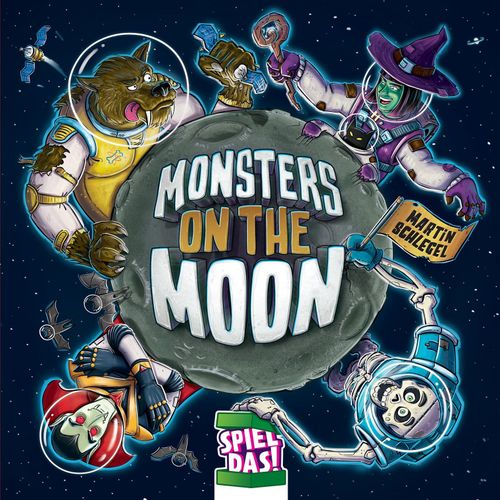
Monsters on the Moon
Monsters on the Moon Rulebook
Table of Contents
Table of Contents
Contents
59 cards:
- 20 monster-cards (2 or 3 players)
- 26 monster-cards (4 players)
- 2 "lunar surface" cards
- 1 "Armstrong" card
- 8 "Mission" cards
- 2 "Overview" cards
8 spaceships (2 per player)
8 monster tiles (2 per player)
4 score counters for "Crystal scoring"
36 moon-walls (12 long ones and 24 short ones)
1 "Crystal scoring" board
1 scoring pad
Standard Mode (without moon-walls)
Setup
Choose your monster: Firstly, choose a monster that you want to conquer the moon with during the game. When playing with 2 or 3 players, the skeleton is not available. Take the two spaceships corresponding to the color of your monster.
Werewolf, Witch, Vampire, Skeleton.
Scoring board: Place the "Crystal scoring" board on the table so it shows the side with the number of participating players (upper right-hand corner). Place your score counters on the space labeled "0" on the board. Each number on the board corresponds to victory points that you receive during final scoring.
Place one of each monster tile (only participating monsters!) on each of the spaceships shown.
Scoring pad and pen: Take a sheet from the scoring pad and grab a pen for the in-game scoring and the final scoring and place them nearby. The remaining game material is not needed; put it back in the box.
Monster-cards: Depending on the number of players, use the appropriate deck of cards. Set aside the three cards "lunar surface" and "Armstrong" for now.
| Players | Cards | Symbol |
|---|---|---|
| 2-3 | 20 | none |
| 4 | 26 | monster-head icon = 4 |
Each playing card has a 3×2 grid with a total of 6 squares. Find two cards from the deck which depict two of your monster's heads in a single square.
Give one of these cards to the player on your right-hand side. Once everyone has done so, you now have two cards in your hand again.
Shuffle the remaining deck of cards and place them face-down to form your draw pile.
- When playing with 2 players, each player draws three additional cards from the deck. You start the game with these 5 cards in your hand.
- When playing with 3 or 4 players, each player draws one additional card from the deck. You start the game with these 3 cards in your hand.
Make sure the other pesky monsters don't peek into your cards!
Starting formation: Draw the top two cards from the draw pile and also take the two "lunar surface" cards and the "Armstrong" card. Now place these five cards on the table, side by side and face-up. The following rules apply:
- The cards can be rotated as desired; however, they must be arranged so that the squares are properly aligned in the grid.
- The use of the "lunar surface" and "Armstrong" cards is optional; however, the two monster cards from the draw pile must be used.
Here are some suggestions for starting formations, which you can modify as you wish. The monster cards shown serve only as examples.
- Houston, the eagle has landed! (We recommend this starting formation for your first game.)
- Naughty neighbours.
- Escalating conflict.
- A settlement needs your help!
- Long-distance relationship.
Objective
Whoever has the most victory points wins! And this is how you get them:
- Get as many of your own monsters to the moon as you can. If these are next to each other, you get double the victory points.
- Form as large a group as possible, in which many of your monsters are edge to edge are adjacent to each other.
- Collect moon crystals.
- Place moon crystals on an empty moonscape.
How to Play
Randomly choose who starts the game.
During your turn you place exactly one card from your hand onto the table and immediately draw a new one from the draw pile. Play continues in clockwise order.
Place a card: When placing a card, it may be rotated freely. There are two possible actions when placing cards:
-
You can place your card next to other cards.
- The squares in the 3×2 grid must be aligned properly with other cards.
- It does not matter how many squares on other cards your card touches.
Example 1: The new card is placed next to another card. Example 2: The new card is adjacent to one square of Card 1 and with two squares on Card 2. Example 3: The new card has been rotated and is adjacent to two squares on Card 1.
-
You can place your card on top of other cards.
- You always place a square on top of another square; squares must be completely covered.
- The card you place may cover squares on one or more cards. But no more than 2 squares per card!
- You may also cover cards that cover other cards - but only ever 2 squares per visible card! There is no limit to how many cards may lie on top of each other.
Example 1: The new card covers one square on another card. Example 2: The new card covers two squares on Card 1, two squares on Card 2 and one square on Card 3.
Collecting and scoring moon crystals: If you cover one or more moon crystals when placing a card - regardless of the monster covering it - then you may immediately advance your score marker one space per crystal on the "Crystal scoring" board. The further you advance, the more victory points you receive during final scoring.
If your score marker reaches or passes over the red-bordered scoring space (where the monster tiles are placed), then take the tile with your monster's head on it. Immediately place that tile on an opponent's monster on the card that you have just placed. Congratulations, you just transformed their monster into one of yours! However, that monster tile could later be covered again ...
Placing spaceship: Anytime during your turn, you may place one of your spaceships in addition to placing a card (before or after placing the card).
You may place the spaceship on any visible moon crystal (no matter on which card) and immediately advance one space on the "Crystal scoring" board. The square on which the spaceship was placed may never be covered by a card.
Placing moon crystals / rules for lunar surfaces: If the empty "lunar surface" cards and/or the "Armstrong" card are in play, you may also cover a maximum of two squares per card; only Armstrong and his base camp may never be covered.
If you place monster heads on an empty lunar surface square, nothing happens. If you place one or more moon crystals here, then you will immediately advance one space on the "Crystal scoring" board for each crystal placed.
In-Game Scoring
As soon as the last card is drawn from the draw pile, the in-game scoring takes place. Victory points are now awarded depending on how many of your monsters are visible on the moon. These points are written into the white spaces on the scoring sheet. (The gray spaces are only used for the other game variants).
- 1 victory point is awarded for each of your visible monsters that is not part of a group.
- 2 victory points are awarded for each of your monsters that is part of a group, i.e. adjacent to at least one of the same monster-type. Groups can extend over several cards. The squares in which two of your monster's heads are depicted always count as a group (even if they are not adjacent to another one of your monsters) - therefore they always award 2 victory points per head.
NOTE: Scoring crystals is not part of the in-game scoring process.
In-game scoring example for the Werewolf: 1 — 3 single heads = 3 victory points; 2 — 4 heads forming a group = 8 victory points; total = 11 victory points.
After the in-game scoring is completed, put the scoring sheet aside for now and continue playing as before.
Whoever has the fewest victory points on the scoring sheet decides who gets to place their next card first. In case of a tie, the person who is farthest behind on the "Crystal scoring" board gets to decide.
From now on, no more cards can be drawn after placing a card (since the draw pile is empty).
Play continues clockwise until all players have placed their remaining cards from their hands. Then the game ends and you proceed to final scoring.
Final Scoring
Time to grab a pen and the scoring sheet! You will now receive additional victory points and add them to the ones you already earned during in-game scoring. Again, ignore the gray spaces. Unused spaceships do not score any victory points, so make sure you place them beforehand.
- Number of monsters: Count your single monsters (1 victory point per monster) and your monsters in groups (2 victory points per monster) again.
- Largest monster group: Look for your largest monster group (each monster needs to be adjacent to at least one of your other monsters). You will score 2 extra victory points for each monster in this group. This scoring option is ignored in the "Advanced mode".
- Crystal scoring: You will earn victory points according to the position of your score counter on the "Crystal scoring" board.
Add up all the victory points from the in-game scoring and final scoring. Whoever has the most victory points wins. In case of a tie, the player with the most victory points on the "Crystal scoring" board wins. Still tied? Play another round!
Advanced Mode (with moon-walls)
Moon-walls protect your territories and double your victory points! The rules are identical to "Standard mode" - with the following exceptions and additional rules.
Setup
Before starting the game, distribute the moon-walls.
- When playing with 2 players, each player gets 3 long and 9 short moon-walls.
- When playing with 3 players, each player gets 3 long and 7 short moon-walls.
- When playing with 4 players, each player gets 3 long and 6 short moon-walls.
Put any remaining moon-walls back in the box.
How to Play
On your turn, you must choose between the following two actions:
- Place a card (as usual) and no moon-walls.
- Place exactly 3, 4 or 5 of your moon-walls and no card.
In both cases, you draw a card from the draw pile.
Effect of moon-walls: Moon-walls protect your territory and can never be covered - but you may place a card to the right and left of a wall. Until an area is completely surrounded by walls, all players may place cards here. As soon as an area is completely surrounded by moon-walls, only players who have at least 1 monster in that area may place cards in it. Walls may no longer be placed inside a surrounded area. The outer edges of the playing area do not count as walls.
Placing moon-walls: You may place your moon-walls on any card(s) - remember to place them on a border of the respective square(s). All moon-walls that you place during your turn must be in contact with each other, i.e. touch each other. Contact to walls that have already been placed in earlier turns is not necessary, but possible. Walls may not be placed on top of each other.
NOTE: Moon-walls will divide groups! If you place a wall between two adjacent monsters, a group of 2 monsters (= 4 victory points) is divided and turned into two single monsters (= 2 victory points).
Scoring
The game ends as soon as no player can place any more cards or moon-walls. If this happens to one player earlier than the others, that player is simply skipped. Tough luck!
The following changes apply to scoring:
- During in-game scoring and final scoring, all monsters within an area completely surrounded by moon-walls are doubled in value: For every single monster you receive 2 victory points (instead of 1), and you receive 4 victory points (instead of 2) for each monster in a group. Enter these points in the corresponding gray spaces on the scoring sheet.
- You will receive no victory points for your largest monster group during final scoring. This scoring option is simply ignored.
Example: The werewolf scores 16 victory points (3× adjacent, 2× single). The witch scores 14 victory points (3× adjacent, 1× single).
Missions (with or without moon-walls)
Objective
This game variant can be combined with "Standard mode" or "Advanced mode". The rules remain the same. In addition to the known ways of collecting victory points, there are now also random missions you can complete. If you complete exactly one of these, you will receive bonus victory points during final scoring.
Setup
Variant 1: Secret Mission Before starting the game, shuffle all 8 "Mission" cards and deal two face-down cards to each player. Keep your missions secret from the other players! During final scoring you have to choose one of the two missions; only the chosen one is scored.
Variant 2: Bulletin Board Before starting the game, shuffle the "Mission" cards with numbers 1 to 6 and randomly place three of them face-up on the table. During final scoring, you must choose one of these three missions; only the chosen one is scored. Of course, players may choose and score the same mission.
Solo Mode
"The Man In The Moon" has spoken! The vampire is his favourite monster and may live on the moon happily ever after. But that means that all other monsters need to leave! And yes please, we want to keep the moon crystals as well.
Setup
Shuffle the 20 monster cards that you would use when playing with 2 or 3 players. Form a face-down draw pile and place the top card face-up on the table. You will just need these cards; please return all remaining game contents to the box.
Now draw one card at a time and place it according to the rules you are already familiar with (we hope ...). The game ends when the draw pile is empty.
Final Scoring
In this variant, you only receive victory points for vampires and moon crystals - according to these rules:
- The vampires and moon crystals are visible and not covered by other cards.
- A vampire is adjacent to at least another vampire, and a moon crystal is adjacent to at least another moon crystal.
Add up your points at the end of the game as follows:
- You receive 1 victory point for each vampire and 1 victory point for each moon crystal that meet the requirements mentioned above.
- If a vampire or moon crystal is not part of a group, they score 0 points.
- You lose 1 point for each visible witch and each visible werewolf; even if they are not part of a group.
This scoring table shows how you did:
- 13 points or less: The witch and the werewolf are partying hard! Poor little vampire ...
- 14 - 19 points: Maybe get some more training at the SPIEL DAS! Space Academy.
- 20 - 24 points: Almost there, my fanged friend - there's just a little more room for improvement.
- 25 - 28 points: You're an absolute space ace! Or maybe you just got really lucky ...
- 29 points or more: "The Man In The Moon" has finally found his champion!