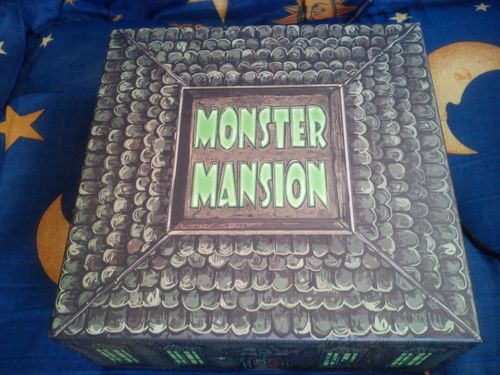
Monster Mansion (2014)
Monster Mansion (2014) Rulebook
Table of Contents
Table of Contents
Components
- Character Cards: Choose between 8 characters, each with unique strengths and weaknesses.
- Agenda Cards: 8 agenda cards add subterfuge and deduction between the players.
- Avatars: Each character gets an Avatar to track their location.
- Room-tiles: 24 dynamic room tiles allow you to construct a fresh map to explore each game.
- Encounter Cards: Over 100 encounter cards containing over 40 awesome monsters for you to fight.
- Gold Coins: More than 20 gold coins can be found in the dungeon by exploring or defeating monsters along the way.
- Item Deck: More than 50 items can be bought from the Monster Mansion's very own "Item Merchant".
- HP trackers: HP trackers can be used for both players and monsters to keep track of their health.
- Rule Cards: Rule cards are perfect for helping new players learn the game.
- Timer: Monster Mansion happens in real-time, and a time will be provided to keep track of the time limit!
- The Turn Die: The "Turn Die" follows the active player, and will be used whenever a roll is required.
Objective
Overview: The objective of the game is for all the players to "Escape" as a team before the time runs out. Even if a single player is left behind, the whole team will lose.
Escape: To "Escape", you must first reach the "Exit Room" (See Figure). Then, use your turn to roll the "Turn Die" (See Rooms → Effects → Crossing). You must roll a 5+ to succeed, and once you do, you are out of the game immediately. You may not trade or come back after you have escaped.
Agendas: Hidden agendas are included in the game depending upon the group size. Games with 2-3 players are fully cooperative, while games with 4+ players throw a traitor into the mix!
- Civilian: "Civilians" on the team must work together to escape.
- VIP: The "VIP" is also on the team, but is very vulnerable because if he dies, the game ends immediately and the entire team loses.
- Assassin: The "Assassin" is a traitor and not a member of the team! He becomes the winner only if the "VIP" dies. Escaping is NOT part of his objective.
Agendas vs. Group Size (number of each agenda role by player count):
| 2 player | 3 player | 4 player | 5 player | 6 player | 7 player | 8 player | |
|---|---|---|---|---|---|---|---|
| # of Civilians | 2 | 3 | 2 | 3 | 4 | 4 | 5 |
| # of VIPs | 0 | 0 | 1 | 1 | 1 | 1 | 1 |
| # of Assassins | 0 | 0 | 1 | 1 | 1 | 2 | 2 |
The End: The game has 3 possible outcomes: Ideally, the game ends when all "Civilians" and the "VIP" make the Escape (team win). If the timer ends and not all players have escaped, everyone loses (even the "Assassin"). Finally, if the game ends by the "VIP" dying, the team will lose but the "Assassin(s)" will win the game (Only possible with 4+ players)!
HINT: Games of 2-3 players are full co-op and a lot of fun, but if you like bluffing and deception, try games with 4+ players!
Setup
- Adventure Map: (See Figure) Construct a randomized Adventure Map exactly as depicted in the figure.
- Starting room: Place the "Starting Room" on the table, like shown (this is where you start).
- Dungeon Lvl: Shuffle and place 3 Dungeon room-tiles facedown on the table, like shown, connecting them with the "Starting Room".
- Secret Stairs: Place the "Secret Stairs" on the table, like shown, connecting it with the last dungeon room.
- Mansion Lvl: Shuffle and place 3 Mansion room-tiles facedown on the table, like shown, connecting them with the "Secret Stairs".
- The Exit: Place the the "Exit Room" on the table, like shown (this is where you must reach in order to "Escape").
- Character: Each player gets a character card. First, spread the character cards on the table. Then, all the players may select their favorite character at once. Whoever calls out their favorite character's name first, gets first dib.
- Starting Gold: Each player gets 2 gold coins at the start of the game.
- Avatar: Each player gets an avatar to match their character. All avatars are then placed in the "Starting Room".
- HP tracker: Place an HP tracker underneath your character card to keep track of your health (Players start with full HP).
- Secret Agenda: Refer to the "Agendas vs Group Size" figure to determine which agendas should be played. Then, shuffle the chosen agenda cards into a single pile, and allow each player to draw one agenda card. Do NOT show your agenda card to other players.
Turns & Actions
Overview: Turns proceed in clockwise fashion, and whoever has the "Turn Die" is the active player. Since the countdown never stops ticking away, players must act fast in order to "Escape" on time. To speed things up, many actions (such as buying items) can be performed at anytime, even when it is not your turn.
HINT: (See Figure) Grab a rule card and turn to the "Turn Guide" for reference.
Anytime: The following "Free Actions" can be performed at anytime (on/off the turn).
- Buy Item: Items from the shop may be bought at anytime (if you can afford it). Name the item, pay the cost, and grab the card from item shop (always remember to refill the shop by drawing a new item card after you are done).
- Sell Item: Items in your possession may be sold at anytime. Discard the item to get its value back in gold.
- Trade: Items and gold coins may be traded with players in your room at anytime.
- Use Item: Items with a Single-Use icon may be used at anytime (conditions may apply).
Your Turn: Players will take turns clockwise. Follow the procedure:
- Grab The Die: Begin your turn by grabbing the "Turn Die".
- Draw Encounter: Draw an encounter card from the deck.
- Monsters: If you draw a monster card, place it in your "Monster Zone" (See Character → Personal Zones → Monsters).
- Discards: Any card which is discarded goes into your "Discard Zone" (See Character → Personal Zones → Discards).
- Turn Action: Players may choose to perform one of the following "Turn Actions" (or choose to pass).
- Move: You may advance through any door in your room to enter into a connected room. However, if the room is booby-trapped, you may have to roll the "Turn Die" before moving (See Rooms → Effects → Crossing).
- Attack: You may attack any monster or player in your room (See Monsters → Location). Each Fist attribute you possess deals 1 damage to the target.
- Heal: You may heal yourself or any other player in your room. Each Cross attribute you possess removes 1 damage from the target.
- Monster Attack: All monster(s) engaged with you which have a Monster Attack icon will attack you now, at the end of your turn.
HINT: Don't forget to pass the "Turn Die" to the next player!
Monsters
Overview: Roughly 40% of the "Encounter Deck" will be monsters! When a monster card is drawn, it becomes engaged with you immediately.
Engagement: Engaged monsters are placed in your "Monster Zone", and remain until they are killed. Players are still to free to move around, but engaged monster(s) will stay with them.
Location: Monsters are always considered to be in the same room as the engaged player.
Hitpoints: HP trackers are placed beneath each monster card. Monsters die when their HP drops to 0.
Rewards: After a monster dies, a reward goes to the engaged player! The type (Gold or Item) and quantity is indicated on the upper-left corner of the card (item rewards are drawn from the deck).
Monster Abilities: Each monster has a unique ability (star icon) which activates immediately, or an attack (Monster Attack icon) which occurs at the end of your turn. Some abilities may seem harmless by themselves, but combinations will prove deadly.
Items
Overview: A magical merchant has set up shop in the Monster Mansion! Although his selection is always limited to 4 items, through his powerful magic, his items may be bought at anytime, from anywhere!
HINT: To save time, always remember that buying/selling/trading items can be done at anytime.
Buying Items: The cost of each item is written on the upper-left corner of the card (Gold). (Figure caption: "The Crowbar costs 2 gold".)
Replacement: After buying an item, always remember to replace it by drawing a new item card from the deck.
Permanent: Items with the Permanent icon (star) remain in effect for as long as it is in a player's hand (to prevent abuse, permanent effect items may not be traded if they were used by the player during their preveious round).
Single-Use: Items with the Single-Use icon (gear) may be used at anytime (additional conditions may apply).
Characters
Overview: Each character has strengths and weaknesses, and survival in the Monster Mansion is all about teamwork!
Hitpoints: Your health is measured in hitpoints (HP), which determines how much damage you can take before dying (See Character → Death).
Hand Attribute: Whenever you roll the "Turn Die", each Hand attribute increases your roll by 1. This will help you avoid all manner of traps and effects, as well as rolling for the "Escape". However, rolling a 1 is always a failure (See Rooms → Die Rolling).
Cross Attribute: Your Cross attribute determines how much HP you can heal with your "Heal" action (See Turns & Actions → Heal).
Fist Attribute: Your Fist attribute determines how much damage you can deal with your "attack" action (See Turns & Actions → Attack).
Special Ability: Each character has a unique special ability. Read it carefully before starting the game ;-)
Personal Zones: (See Figure) Your personal space is divided into 3 "Zones":
- Possessions: All of your personal possessions (secret agenda, gold coins, items, etc..) must be placed below your character card in your "Possession Zone".
- Discards: All of your discarded cards (items, encounters, dead monsters etc...) must be placed in a single pile (faceup) in your personal "Discard Zone".
- Monsters: Any monsters engaged with you must be placed in your "Monster Zone". Multiple monsters are placed side-by-side in a line. HINT: always leave 1-2 HP Trackers in your "Monster Zone" for convenience.
HP Trackers: (See Figure) Place HP Trackers underneath character and monster cards to indicate their HP.
Death: Unless you are the "VIP", if you die during the game, you will respawn at the most recent checkpoint you were in ("Starting Room" or "Secret Stairs"). If you died on your turn, the turn ends immediately.
Losses: Keep 2 gold coins or a single item, discard the rest. Respawn with 2 gold if you have nothing.
Monsters: Any engaged monster(s) go back to the top of the encounter deck, in any order you choose.
HP: When you respawn, you are healed back to maximum HP.
Rooms
Overview: Most of the rooms are booby-trapped so you better watch out when you move around the Adventure Map! (See Turns & Actions → Move).
New Rooms: Room-tiles which are face down become revealed when players move into them. First, turn the room-tile over and make sure all the doors in the new room are properly aligned before placing it down in its original location. Then, you may move your avatar into the new room.
Effects: Each room has an effect which is triggered by:
- Crossing: These effects are only triggered when you try to move out of the room in any direction other than back into the room you came from (See Figure). If the effect requires you to roll the "Turn Die", you must do so before you complete your move. Suffer the effect if your roll fails, then move into the new room.
- Turn Start: These effects trigger at the start of your turn.
- Turn Action: These effects only trigger if you choose to activate it with a "Turn Action" (See Turns & Actions).
- 1st To Enter: These effects trigger only once for the first player who enters into the room.
Die Rolling: Many room effects require you to roll the "Turn Die", the higher the better!
Bonuses: Each Hand attribute you possess gives you +1 to your roll (See Character → Explore).
Rolling a 1: Rolling a 1 is always considered a failure, regardless of any bonuses you might have!
FAQ
Overview: In conclusion, "Monster Mansion" is a fast paced game, with simple rules, but lots of depth and replay value (especially with groups of 4+ players)!
Q: Can Monster Mansion be played solo?
A: Yes! Setup the game normally, only without secret agendas. Use 2-3 characters instead of just 1, and alternate turns to try and help every character "Escape"
Q: What is the ideal group size for Monster Mansion?
A: The more the merrier! Small groups (2-3) are fun, but nothing beats a large game with multiple "Assassins" on the loose!
Q: How do I get more replay value out of this game?
A: You can try the "Hunger Game" rules: where only the first "Civilian" or "VIP" who escapes can win the game! (No change to the "Assassin"). You can also reduce the time to 5-9 minutes per player, or make the dungeon longer by adding dungeon and mansion room-tiles.
Q: Can I make my own adventure map?
A: Of course you can. Extra room-tiles will be included in the final game, and players can go crazy with their map designs. (Just do it!)
Q: Can I make my own rules?
A: Of course you can! We do it all the time. Silly rules, drinking rules, party rules... Make the game your own...
The Championship Challenge
The Challenge: Are you ready to turn your character into the ultimate champion? The character who fills up their column first becomes the Champion!
Note: the printed sheet is a tracking grid with one column per character (8 columns, each headed by its character figure) and rows for "1 win" through "6 win" plus "Champion". The grid's shading is a layout element and is not transcribed.