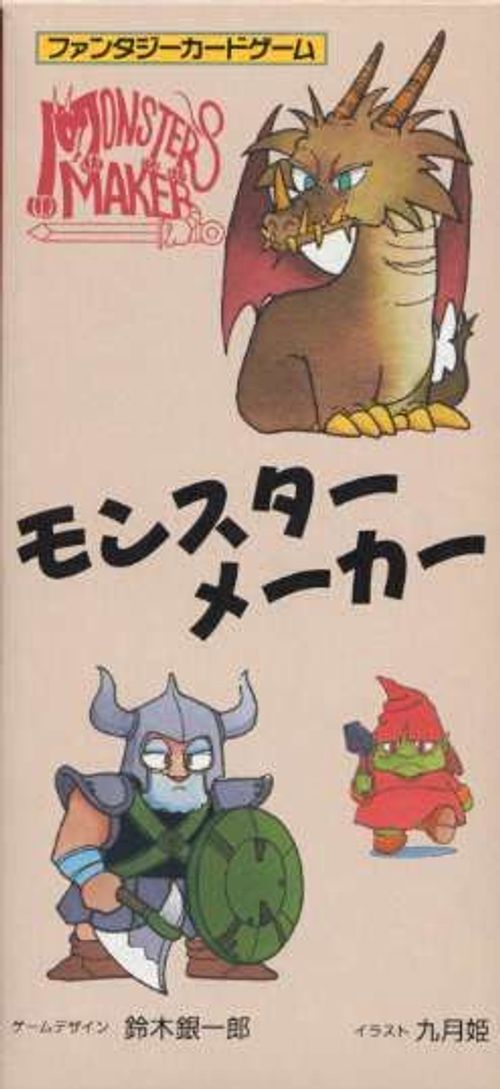
Monster Maker
Monster Maker Rulebook
Table of Contents
Table of Contents
1. What Kind of Game Is It?
Players advance through the dungeon (the underground labyrinth) using Corridor cards, and collect the treasure from Treasure cards. Opponents can hinder your progress with Monster cards. When a Monster card is played against you, you must fight it with Character cards and defeat it.
If a player gets back safely from the dungeon, the gold (prize money) printed on their treasure is theirs. The player who returns first may also draw one Prize card and take its gold.
Play continues until the Treasure cards or the Prize cards run out. The player who has collected the most gold wins.
2. Number of Players
2 to 6 players can play, but 3 or 4 players is the most suitable number.
3. How to Play
Setup
Shuffle the Monster Maker cards (hereafter simply "cards") well, face down, and deal 7 face down to each player. If a Trap card is among the first 7, exchange it for a card from the remaining cards. Place the remaining cards face down, shuffled, in a stack as the draw pile.
Shuffle the Treasure cards and the Prize cards separately, face down, and place each in its own stack.
Turn Order
Decide who plays first by dice or by rock-paper-scissors (janken). Turns then pass clockwise (to the right).
Turn
On your turn, draw 1 card from the draw pile and then do one of the following:
-
Advance. Place 1 Corridor card in front of yourself and move through the dungeon. If you played Corridor cards on earlier turns, place each new card so that the earlier numbers remain visible, overlapping them as a stack. Your total distance is the sum of the numbers. (The unit is the perch, which varies by era but is about 20 metres.) While a Monster card is placed against you, you may not play Corridor cards.
-
Hinder an opponent. Place 1 Monster card at the front of an opponent's Corridor cards, to hinder their progress. You may not place a Monster card on an opponent who already has one.
-
Fight. If an opponent has placed a Monster card against you, you may play one or more Character cards to fight that monster. The Character cards you used are discarded. If you win, the Monster card is discarded too, and on your next turn you may advance again. If you lose, the Monster card stays at the front of your Corridor cards, and you must fight it again on a later turn.
-
Discard. If you have 8 cards in hand and cannot do 1 to 3, or do not wish to, choose 1 card and discard it. You may not end your turn holding 8 or more cards.
-
Pass. If you have 7 or fewer cards in hand, you may instead say "pass" (pasu) and hand the turn to the next player.
Combat
The red number on a Monster card is that monster's strength. To win, the total strength of your Character cards must equal or exceed it.
A Character card's number with a "D" shows how many dice to roll. For example, "2D+3" means roll 2 dice and add 3; the result is that Character's strength.
If you play 2 or more Character cards, add their strengths together and compare the total with the monster's strength.
Cleric
A Cleric card has no strength, but it has two uses:
- It can drive away an Undead monster. Both the Cleric card and the monster are discarded.
- It can be exchanged for a Character card that you have just discarded. When you do this, declare "Heal" (chiryō).
Spells
A Spell card cannot be played alone. Play it together with a Character card, and you gain the effect written on the Spell card.
Sleep and Charm affect only human-type monsters.
Charm: Special Use
If a Magic User or an Elf uses the Charm spell and defeats a human-type monster with it, that monster may be placed at the front of another player's Corridor cards.
Detour
When a Monster card is placed against you, you may play a Detour card instead. You are considered to have taken a detour around that stretch of corridor. Both the Monster card and the Detour card are then discarded.
Trap
When you draw a Trap card, you must turn it face up and show it. If you hold a Thief card at that moment, you can escape the trap. If you discard the Thief, the trap is also discarded.
If you have no Thief, you fall into the trap. You must choose 3 cards from your hand and discard them, along with the Trap card.
Treasure Cards
Once you have advanced 100 p or more along the Corridor cards (you may declare it at any time after that), you have reached the dungeon's Treasure Room. Declare "Treasure Room" and draw 1 card from the Treasure card stack.
A player receives the gold written on a Treasure card only after returning from the dungeon.
A card marked with a "D" is treated like a Character card: you roll dice to determine its value. This is done at the end of the game.
If the card you draw is marked Open, turn it face up, show it to everyone, and follow its instructions.
Weapon cards may be used on the return journey. Treasure cards used in combat do not need to be discarded.
If you draw a Hidden Door card, you may discard a Thief or Dwarf card from your hand (if you have one) and then draw 2 more Treasure cards. If you have neither a Thief nor a Dwarf, you may wait in the Treasure Room until you draw one, or you may head back toward the exit aiming for a Prize card. Either is allowed.
Return Journey
Advance again by playing Corridor cards. The return distance must be exactly the same as the outward distance. Suppose you declared "Treasure Room" when you had advanced 105 p; then you have returned from the dungeon once your return total reaches exactly 105 p.
If your total does not come to exactly 105 p, you have taken a wrong turn and cannot get out.
Prize Cards
The first player to return from the dungeon may draw 1 card from the Prize card stack. The gold written on that card is added to their total.
End of the Game
When the draw pile runs out, no more cards may be drawn. Likewise, once any one player has returned from the dungeon, no more cards may be drawn.
From then on, players can only get out of the dungeon using the cards already in hand. When a player's hand runs out, the round is over.
A player who cannot get out of the dungeon has died in there.
Treasure cards held by players who could not get out are returned to their stack. However, the Hidden Door and the Goddess Statue may be used only once in a game.
Shuffle all the cards again, and begin the next round.
4. Special Rules for Multiplayer Games
- With 5 players, the distance required to reach the Treasure Room is 80 p or more.
- With 6 players, the distance required to reach the Treasure Room is 70 p or more.
5. How the Winner Is Decided
The game ends when the Treasure card stack or the Prize card stack runs out.
Compare each player's gold. The player with the most gold wins.
The number of rounds may also be decided in advance, if the players prefer.
Card Reference
The box states "150 cards" (カード150枚). The scan shows 89 different card faces, one per page, and the rulebook does not print how many copies of each card there are. The card backs in the scan are labelled Monster Maker, Prize and Treasure. The card faces themselves do not say which deck each one belongs to, so this list is grouped by card type only. Japanese names are given in brackets, with the English gloss first. Names of people are romanized from the katakana as printed.
Corridor and Detour
| Card | Notes |
|---|---|
| Corridor 5, 10, 15, 20, 25, 30, 40 | 7 cards. The number is the distance in perch (kairō). |
| Detour [回り道] | Used against a Monster card. See Detour. |
Cleric
| Card | Notes |
|---|---|
| Cleric [聖職者] | No strength. See Cleric. |
Magic Users
| Card | Strength |
|---|---|
| Vishnas [ヴィシュナス] | 3D+4 |
| Gandaulf [ガンダウルフ] | 6D+4 |
| Lufiera [ルフィーア] | 5D+4 |
| Ballgard [ボールガード] | 4D+4 |
| Zarsai [ザルサイ] | 2D+4 |
Dwarves
| Card | Strength |
|---|---|
| Golboa [ゴルボワ] | 4D+1 |
| Miku [ミク] | 2D+1 |
| Nimuremu [ニムレム] | 5D+1 |
| Rokkumokku [ロックモック] | 3D+1 |
Elves
| Card | Strength |
|---|---|
| Aruru [アルル] | 3D |
| Erusaisu [エルサイス] | 5D |
| Rorien [ロリエーン] | 4D |
| Shigurudo [シグールド] | 2D |
Fighters
| Card | Strength |
|---|---|
| Arusharuku [アルシャルク] | 6D+3 |
| Chichina [チチーナ] | 6D |
| Dianne [ディアーネ] | 6D+2 |
| Irene [イレーヌ] | 3D+2 |
| Joan [ジョアン] | 2D+2 |
| Kanan [カナーン] | 5D+3 |
| Lakuna [ラクーナ] | 4D+2 |
| Mirienne [ミリエーヌ] | 5D+2 |
| Lorand [ローランド] | 4D+3 |
| Tamuron [タムローン] | 6D+1 |
| Tarutas [タルタス] | 2D+3 |
| Zeltran [ゼルトラン] | 3D+3 |
Thieves
| Card | Strength |
|---|---|
| Haan [ハーン] | 1D+4 |
| Hattatas [ハッタタス] | 1D+1 |
| Beltanius [ベルタニウス] | 1D+2 |
| Regiek [レジーク] | 1D+3 |
| Shing [シング] | 1D |
Monsters
Each monster's strength is the red number on its card. Monsters marked "human type" can be affected by Sleep and Charm. Monsters marked "undead" can be driven away by a Cleric or by the Holy Ark or Holy Grail treasures.
| Card | Strength | Tag on card |
|---|---|---|
| Bandit [山賊] | 10 | Human type |
| Berserker [狂戦士] | 19 | Human type |
| Black Magician [黒魔道士] | 24 | none |
| Cave Bear [洞くつ熊] | 23 | none |
| Cobra [コブラ] | 14 | none |
| Dragon [ドラゴン] | 25 | none |
| Ghoul [グール] | 18 | Undead |
| Giant Ant [巨大アリ] | 11 | none |
| Giant Centipede [巨大ムカデ] |
Spells
A Spell card is played only together with a Character card. A number in brackets is the effect value as printed on the card.
| Card | Printed value | Notes on card |
|---|---|---|
| Charm [チャーム] | (4D) | Effective only against human-type monsters |
| Fireball [ファイヤーボール] | (3D+5) | none |
| Lightning Bolt [ライトニングボルト] | (2D+7) | none |
| Magic Missile [マジックミサイル] | (10) | none |
| Sleep [スリープ] | (2D) | Effective only against human-type monsters |
Trap
| Card | Notes on card |
|---|---|
| Trap [わな] | Open. If you have no Thief, discard 3 cards. |
Treasure and Prize Cards
Gold is printed on each card. Cards marked "D" are rolled at the end of the game, as described under Treasure Cards.
| Gold | Card | Notes on card |
|---|---|---|
| 200 | Prize money [賞金] | none |
| 250 | Prize money [賞金] | none |
| 300 | Prize money [賞金] | none |
| 350 | Holy Ark [聖櫃] | Open. Return distance +15. Drives away undead. |
| 200 | Magic Armour [魔法の鎧] | Weapon. Warrior or Dwarf +1. |
| 300 | Holy Grail [聖杯] | Drives away undead. |
| 200 | Magic Crossbow [魔法の石弓] | Weapon. Elf +2. |
| 300 | Lost Crown [失われた王冠] | none |