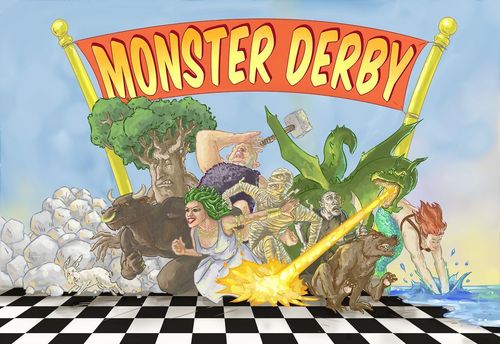
Monster Derby
Monster Derby Rulebook
Table of Contents
Table of Contents
Components
- This rulebook
- 8 map boards
- 25 Monster cards
- 25 Agenda cards
- 1 color blind assistance card
- 1 Starting Player Marker card
- 9 plastic stands
- 10 black clips (to mark hit points)
- 10 colored clips (for rage, poison, webs, etc.)
- 5 attack dice (3 "1" faces and 3 "0" faces)
- 1 movement die (standard faces)
- 1 wacky die (marked with a sword symbol, a shield symbol and both)
Setup
Place the board with numbered starting blocks at the edge of your play area. Line up four more boards (chosen at random or on purpose) in a row, leading away from the starting board to the right. For a short game use fewer boards. For a longer game use more boards.
Place the starting player card in the white stand. Shuffle the monster deck and turn up 8 monster cards. Mount the monster cards in the colored stands and place clips at the highest hit point number on each card. Place the monsters on the 8 starting spaces oriented so the cards are all parallel to the flow of the board.
Shuffle the Agenda card deck and deal 3 to each player. Each player selects one agenda card to keep and discards the rest.
Randomly determine the starting player for the first round and give this player the Starting Player Marker.
Starting Play
The starting player puts the Starting Player Marker out next to the board (it is now available) and takes a turn. Play proceeds clockwise in turns until all monsters have had a turn and the starting player marker has been claimed. Then begin a new round.
On Your Turn
Roll the movement die. Then either take the Starting Player Marker (if it is still unclaimed this turn) or control a monster. Taking the Starting Player Marker skips your chance to control a monster but ensures you go first on the next round.
Control a Monster
Select a monster that has not been controlled yet this round. If the monster's hit points are below 5, the monster must take the "Recover" action this round instead of attacking. If the monster's hit point clip is still on a red number after Recovering, it does not move or get to use its special ability. If the monster has 5 or more hit points, it gets as many movement points as the result on the movement die.
A monster must spend all of its movement points going forward. The player controlling the monster makes all movement decisions for the monster.
Each space of the monster's movement must be into one of the three adjacent spaces ahead of it. Thus, you can zigzag your movement to waste moves for a monster you want to slow down but you cannot go backwards.
It costs one point of movement to walk into an empty (tan) path space or the monster's native terrain. It costs two points of movement to walk into a space with terrain for which the monster is not native. If a monster has insufficient movement points to move, it doesn't move.
A space with another monster in it is impassable. Impassable is also a terrain type. An impassable space can only be entered by flying monsters with sufficient movement to fly over it and enter the space after it.
Flying monsters spend only one point per space they fly over but must pay walking costs for the spaces they land in. They must attack and end their turn landed.
Terrain Effects
A monster that is native to a given terrain pays no penalty to move into that terrain. (i.e., Giants walk into rock spaces as if they were empty path terrain.)
If the defender is in its native terrain, the attacker rolls one attack die less. (i.e., Anybody attacking the Giant in the rocks rolls one fewer attack dice.)
A monster in non-native terrain rolls one fewer attack dice. (If the Giant is standing in the Brush, Water or Desert while he is attacking he only rolls 5 dice.)
Monster Actions
Each monster may either recover or attack at any point during its turn (before, after, or on any space along its movement). Monsters with special abilities can apply them at any point in their turn unless their hit points clip marks a red number.
Recover - Move the monster's hit point marker up one number on the track (unless it is at the top already). If the monster does not attack, it must take this action.
Attack - Select a monster that is in front of the attacking monster, then roll the Wacky die with a number of dice equal to the attacker's Attack value.
- If the wacky die comes up with a sword symbol, the wacky attack happens.
- If the wacky die comes up with a shield symbol, the wacky defense happens.
- If the wacky die comes up with both symbols, both happen. Resolve the wacky attack first (exception: dodge).
Each attack die showing a "1" symbol scores one point of damage on the target monster.
Total the hits, then modify the number based on the attacker's abilities or effects such as "Rage" and then modify it based on the defender's special abilities or wacky defense.
Damage
Slide the clip on the monster's hit point track to indicate damage.
If a monster's hit points go to zero, it dies. Remove it from the board, leaving its stand as a grave marker. It may be needed for scoring later.
If a monster's hit points go to 4 or less that monster may only take "recover" actions. If, even after recovering, a monster is still in the red zone, it is unconscious and doesn't get to move or use its special ability.
End Monster Turn
After the monster resolves its action and full movement, rotate it 90 degrees to show that it took its turn for this round.
Note that monsters who are blocked and don't fly can't move but may still attack. A monster that is deeply in the red will simply recover one point of its wounds and then rotate to show that it has taken its turn for the round.
Repeat turns in clockwise order until all monsters have been controlled and the Starting Player Marker has been claimed. This ends the round.
Rotate all monsters 90 degrees to be ready to start the next round.
Repeat rounds until 3 monsters have crossed the finish line by exiting the last map. Note that the partial spaces are considered off the map.
Game End
The game ends immediately when the third monster crosses the finish line.
Each player scores points indicated on their agendas for the three finishing monsters. If two players are tied for points, the one whose first place monster finished first or is closest to the finish line wins. If their first place monsters are the same distance along, compare their second place monsters. If they have the same second place monster, you have a defective copy of the game.
Megacarnage
In the unlikely event that less than 3 monsters finish the race, score points for only those monsters that finished. The gravestones marking the dead might be useful for tiebreakers.
Example
In this example, the player has rolled a 3 on the movement die.
- The Gargoyle (red) can fly to any one of the red spots. He could land in the space diagonally behind the Golem (green) to attack it along the way, but might get stunned by the Golem's wacky defense ability and lose the rest of his turn. The Gargoyle must fly. He cannot choose to walk so as to end in the space behind the Golem. If he elects not to attack, he won't recover a hit point because he is at maximum now.
- The Cyclops (yellow) has to go to the 3, 4, or 6 spots. He's native to all terrains, so the brush just one space to the yellow spot and be blocked because he doesn't fly. He could attack the Golem either before or after he moves. If he attacks first, then he might get stunned by the Golem's wacky defense and lose the rest of his turn. If he kills the Golem, he would be able to move further. If he doesn't attack at all, he recovers a hit point up to 8.
- The Griffin (blue) could fly off or zigzag and land in 1 or 2 if she's not excited about finishing yet. Note that landing in non-native terrain on her last move is a good way to legally squander a move point. Everybody else is behind her so she's not going to get to make an attack this turn; she'll recover a hit point up to 7.
- The Golem (green) can walk to any of the green spots. Note that he could zigzag to the 2, 4 or 5 spots, or go as fast as he can to the 1, 3, 6, or 7 spots. He can attack the Griffin from where he lands.
Monster Card Anatomy
- Attack Dice: Number of dice you throw when this monster attacks.
- Hit Point Track: Place where the clip slides up and down to show current Hit Points to track monster's wounds. Hit Points start at the top. If they are below 5, monster can only recover as its action. If they are still red after Recovery, the monster doesn't move at all this turn. If they are below 1, the monster dies and is removed from the board. Leave the stand behind as a gravestone.
- Special Ability: Special thing this monster always gets unless its hit point clip marks a red number. "Flies" means it can fly.
- Wacky Attack Effect: Special thing that happens when this monster attacks and the sword symbol appears.
- Wacky Defense Effect: Special thing that happens when this monster is attacked and the shield symbol appears.
- Terrain Nativity: Where it gets a defensive bonus (attackers get one fewer die) and doesn't have to spend extra move points to enter. Monsters attacking from a non-native square get one fewer die.
Ability Summary
- -1 Damage: Suffers one less damage from this attack.
- +1 Damage: Adds one to the amount of damage dealt.
- 1/2 Damage: Half damage from this attack (round up).
- 2x move: The Hare counts its movement die twice.
- 360 Attack: Can attack any adjacent monster (even those behind it).
- Attack Again: The monster may attack again on any target.
- Attack Dice = Hit Points: Attack dice are equal to its current hit points.
- Blast: Apply this attack (including wackiness if any) to each monster adjacent to the attacker including those behind it.
- Brushwalker: It costs zero movement points for Brush spaces.
- Call: Select any monster up to 3 spaces away (ahead or behind) and place it in any empty space next to Siren.
- Charge: Add the number on the movement die to the number of attack dice this attacker throws.
- Counter-Strike: If it is conscious and unstunned after this attack, it gets a free attack on the monster that attacked it, if adjacent.
- Move the cursed monster backwards 3 spaces using otherwise normal movement rules.