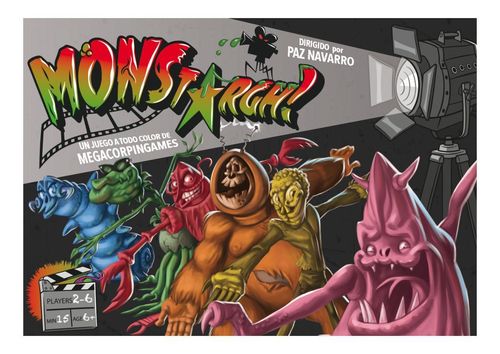
MONSTArgh!
MONSTArgh! Rulebook
Table of Contents
Table of Contents
Components
- 36 Monster Cards of 6 different species. Every species is made up of 6 monsters, and each one of these is marked with a value that ranges from 1 to 6.
- 6 Species Tokens.
- 12 Focus Cards: 6 of value ±1 and 6 of value ±2.
- 18 Close-Up Shot tokens: 12 of value 1 and 6 of value 3.
Game Objective
To win the game your monsters must receive the most Close-Up Shots in the scenes of MONSTArgh!
Game Setup
Firstly, take as many Species Tokens as indicated in the following chart according to the number of players in the game:
| # of players | 2 | 3 | 4 | 5 | 6 |
|---|---|---|---|---|---|
| # of tokens | 4 | 4 | 5 | 6 | 6 |
Secondly, take all the Monster Cards of the selected species and create the Game Deck with them.
Then set aside 2 Focus Cards for each player: a ±1 card and a ±2 card.
Finally, create a pool with the Close-Up Shot tokens. Leave the rest of the contents in the box, you will not need them.
Necessary game components for a 2 player game. You may choose what species to include in the game.
Playing the Game
A game of MONSTArgh! occurs over several movie scenes. At the beginning of a scene, each player receives 1 random Species Token. If there are any remaining tokens, set them aside without revealing them. Players then check the species they must represent during the scene and hide it from the rest. Remember that everyone's objective is to have the monsters they represent appear in the most Close-Up Shots at the end of each scene.
Shuffle the Game Deck and deal 3 cards to each player. Then deal 2 Focus Cards, one of each type, to each player.
Each player will start the game with a hand of 5 cards: 3 Monster Cards and 2 Focus Cards.
Note: If you wish, in order to get a step by step grasp of the game, you can play your first games without Focus Cards.
In the first scene of the game, the Starting Player will be the most photogenic among the participants. In any other scene, the Starting Player will be the player with the least total Close-Up Shots. In case of a tie, the most photogenic among those tied will start.
Starting with the Starting Player and in a clockwise manner, the turns take place following 3 phases:
- LIGHTS, CAMERA...!
- ...ACTION!
- CUT!
1. LIGHTS, CAMERA...!
The Active Player chooses a card to play from their hand.
-
If it is a Monster Card, they must place it in an empty space adjacent to a card already on the table. The Active Player can place a Monster Card on any of the spaces shown.
Note: the Starting Player of each scene will simply place a Monster Card anywhere on the table.
-
If it is a Focus Card, the player must choose one of the monsters already on the table to increase or decrease its value. During the ...Action! Phase, the monster will act with its modified value (its printed value plus or minus the applied modifier).
Example: The Active Player has decided to use a Focus Card on Pink 5, decreasing its value by 1. During the ...Action! Phase, this monster will act as if its value were 4.
The monster that has come into play or whose value has been modified is known as the Protagonist Monster.
2. ...ACTION!
All Protagonist Monster interactions are resolved.
Who does the Protagonist Monster interact with?
The Protagonist Monster ALWAYS interacts with orthogonally (not diagonally) adjacent monsters with values of EXACTLY 1 POINT LESS.
Stated differently, a Protagonist Monster whose value is 6 can only interact with adjacent monsters of value 5. If its value were 5, it would only interact with adjacent monsters of value 4. And so on.
How does the Protagonist Monster interact?
The Protagonist Monster interacts in the following way:
-
With a monster of a DIFFERENT SPECIES, the Protagonist Monster moves in front of it (place card on top), stealing the Close-Up Shot.
Example: the Active Player has placed Green 5 in the position shown. Green 5 is now the Protagonist Monster. Since it is adjacent to a monster of value 4, it interacts with it. Since they belong to different species, Green 5 moves in front of Blue 4. Green 5 made a stellar performance and stole its competitor's shot.
-
With a monster of the SAME SPECIES, the other monster is eclipsed by the impeccable performance of the Protagonist Monster and moves behind it (place card/s under it) dragging with it any cards it may have under.
Example: the Active Player has placed Blue 5 in the position shown. Blue 5 is now the Protagonist Monster and since it is adjacent to a monster of value 4, it interacts with it. Since they belong to the same species, Blue 4 moves behind Blue 5 dragging with it any cards it may have under. The Protagonist Monster's performance has eclipsed its colleague's.
As long as the Protagonist Monster is adjacent to a monster it can interact with, it will continue doing so as described earlier.
If the Protagonist Monster is adjacent to various monsters it can interact with of ITS OWN SPECIES and of DIFFERENT SPECIES, it will first interact with those of both ITS OWN SPECIES and then with the rest.
Example: Yellow 3 is the Protagonist Monster and is adjacent to 2 monsters of value 2. One belongs to its same species and the other belongs to a different species. The Protagonist Monster first interacts with the monster of ITS OWN SPECIES and therefore eclipses Yellow 2 with its performance. It then interacts with the rest and steals Red 2's Close-Up Shot.
If the Protagonist Monster is adjacent to various monsters it can interact with of DIFFERENT SPECIES, the active player will decide which ones to interact with.
Example: Yellow 3 is the Protagonist Monster and is adjacent to 2 monsters of value 2 of different species to its own. In this case, the player can decide what monster to interact with. The player chooses to steal Pink 2's Close-Up Shot. After doing so, it is once again adjacent to a different monster of value 2: Orange 2. So it steals yet another Close-Up Shot. Great performance Yellow 3!
Example: the Active Player chose to use a Focus Card to increase the value of Red 5 by 2. For this reason, it becomes the Protagonist Monster and in the ...Action! Phase will act as if its value were 7. First, the monster of its own species, Red 6, is eclipsed by its performance. It then continues to steal Yellow 6's Close-Up Shot. There is NO interaction with Yellow 4 because its value is not exactly 1 point less than the Protagonist Monster's value, which is currently 7.
The ...Action! Phase ends when the Protagonist Monster is no longer adjacent to any monsters it can interact with.
Any Focus Cards left on the table at the end of the phase are removed from the scene and the Protagonist Monster resumes its printed value.
3. CUT!
The Active Player draws a card from the Game Deck and the turn passes on to the player on their left. If the Game Deck runs out, no cards are drawn and the turn simply passes on to the player on their left.
The scene continues until all players have played all the cards in their hands.
Remember: no monster stays behind curtains!
Print It! / Scene End
When the scene ends, all players reveal the species they had been randomly assigned and count their Close-Up Shots. Regardless of the card value, each player receives 1 Close-Up Shot per visible Monster Card of their species on the table.
Example: Imagine this scenario at the end of a scene: Mark had Red, so he gets a Close-Up Shot per visible Red card. Chris had Pink, so she gets one per visible Pink card. Sam had Green, so he gets one per visible Green card. The Yellow species was not assigned to any players during this scene so no one scores any points for the 2 Close-Up Shots earned by the Yellow monsters.
Game End
The game ends when a player reaches 5 or more Close-Up Shots.
If this condition is not fulfilled when the scene ends, roll another scene to earn more Close-Up Shots.
When the game ends, the player with the most Close-Up Shots wins.
In case of a tie, if you do not want to share the honors, roll another scene.
If you find the film too short, roll another scene. If you want more, roll another scene. If you didn't find the ending quite convincing, roll another scene. If you think you could do better, roll another scene...