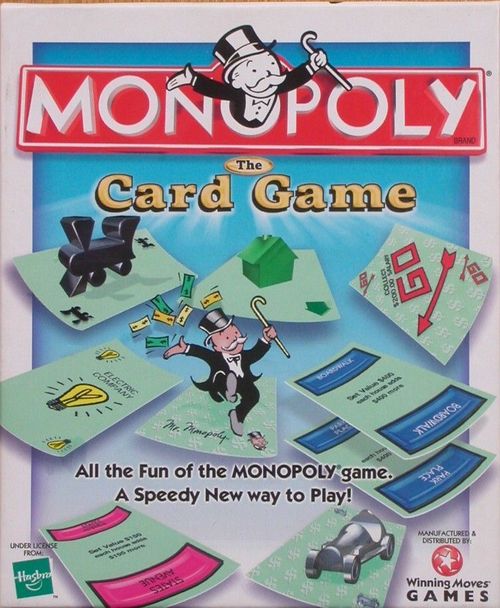
Monopoly: The Card Game
Monopoly: The Card Game Rulebook
Table of Contents
Table of Contents
Contents
Deck of 60 Playing Cards including:
- 28 Property Cards (green background), one for each property space on the MONOPOLY gameboard.
- 17 Improvement Cards (yellow background), including 9 House, 2 Hotel and 6 Token cards.
- 15 Bonus Cards (purple background) including 2 Wild (Mr. Monopoly), 6 GO, 5 Free Parking, 1 Go To Jail and 1 Get Out Of Jail Free card.
- 1 Bank (large card used to locate the draw pile and pad of money)
- Pad of Monopoly Money. Money is only used to keep score (there is no buying or selling in this game).
- Illustrated Instructions
Object of the Game
On each hand, be the first player to draw and trade until you hold a "complete" hand of 10 cards, which you then lay down and shout "Monopoly"! The player with the most money at the end of four hands wins the game.
Set Up
- Select a Banker, who puts the Bank in the center of the table, placing upon it the supply of money (from which the Banker will pay each player his winnings at hand's end.) The Banker now places a $500 bill, from this supply, under the marked corner of the Bank. This becomes the Free Parking "Jackpot."
- Select the first Dealer. He shuffles the deck and deals ten cards, face down, to each player. These are held in (each player's) hand. The Dealer next deals two cards face up on the table in front of each player. These become the player's initial trading cards. The Dealer places the remainder of the deck face down on the Bank, forming the Draw pile.
Property Cards
A complete Monopoly color-group includes all the Property cards of that color-group. For example, Boardwalk and Park Place complete the dark blue color-group. Note: a Railroad group can be 2, 3 or all 4 Railroad cards. Both Utilities are needed to complete its group.
Improvement & Bonus Cards
House, Hotel and token cards are used to increase a property's value. Go cards, Free Parking cards, Wild (Mr. Monopoly) Go To Jail and Get Out of Jail Free cards all have special impact on the value of your hand. See following images of each card for details.
How to Play
You begin your turn by either drawing a card from the deck or trading with one other player. Should you have a complete hand after doing so, you may go out.
Drawing
Take the top card from the Draw pile, add it to your hand, and then discard one card from your hand face up on top of your Trade pile.
Trading
If you decide to trade, announce which opponent you are trading with. Give one or two cards from the top of your Trade pile to your opponent who must place these cards in his hand. Take a like number of cards from the top of the opponent's trade pile and add these to your hand. Note: Your opponent will, temporarily, have more than ten cards in hand. He must wait until the end of his next turn to discard the excess cards.
Discarding
You may not hold more than 10 cards in your hand when you end your turn. After you Draw or Trade, end your turn by discarding the excess cards of your choice, onto your Trade pile. Fan cards in your Trade Pile so the identity of each card can be seen and it is obvious which one is on top (the last to be discarded).
Going Out (Complete Hand)
You may go out if you have a complete hand at the end of the turn. Shout out "Monopoly!" and lay down your hand.
The following requirements are printed in the panel continuing the Going Out section (no separate heading is printed).
- To qualify as a complete hand, yours must contain at least one complete Monopoly color-group of Property cards. You may hold more than one color-group, provided that each is complete. You may not go out if you hold any incomplete group. Note: A Wild card may be used to complete a Monopoly color-group. For example, a player holding the blue Park Place card and a Wild card, can use the Wild card to represent Boardwalk and go out with the blue color-group.
- In addition to a complete color-group, you may hold 2, 3 or 4 Railroad cards and/or both Utility cards.
- Improvements–You may hold House cards totaling 1, 2, 3 or 4 Houses (never more than 4). If you have exactly 4 houses, your hand may also contain one Hotel card. In addition, you may also hold any number of Token cards.
- Bonuses–You may hold any amount of Bonus cards. If you hold a Wild card, announce what it is representing. You may have any number of Bonus cards in hand when you go out.
- You may not go out if you hold the Go To Jail card in your hand unless you also hold the Get Out of Jail Free card (which cancels Go To Jail out).
Complete Hand Example (illustration caption): Wild represents the missing Yellow Property Card. (The printed caption reads "reprsents"; corrected here to "represents".)
Incomplete Hand Example (illustration caption): A Hotel can be included only if exactly 4 Houses are in the hand. Dark Blue Color Group is incomplete: either Boardwalk is needed or Park Place must be discarded.
Card Notes
Token Card
Adds $1000 to the value of one Monopoly color-group.
GO Card
Each Go card is worth $200. A set of 4 Go cards is worth $1500, any additional Go cards held are worth $200 each.
Wild Card
May be used to represent any card.
Free Parking Card
The player with the most Free Parking cards at the end of the round collects the $500 Free Parking Jackpot under the Bank. If there is a tie, no one collects the Free Parking Jackpot. Instead, the Banker adds another $500 and the Jackpot payoff grows for the next round.
Go To Jail Card
Any player caught holding the Go To Jail card when another player goes out is completely wiped out. He collects nothing, no matter how valuable his hand. However, if the player holds both the Go To Jail and the Get Out Of Jail Free card he suffers no penalty and scores, as usual, for his hand.
Get Out of Jail Free Card
Worth $50 if not used to cancel out a Go To Jail card.
End of Round & Scoring
Once one player goes out, all other players lay down their hands.
- Each player scores by collecting Monopoly money equal to the value of his hand, beginning with the player who went out. This player scores the value of his complete Monopoly color-group, including any Houses and perhaps a Hotel. If he has more than one color-group, he picks one to improve (only one color-group can be improved). Each Token card is worth an additional $1,000. He also scores for any other Bonus cards (as described above).
- In turn, all other players score the basic value of any complete color group held in hand, but NOT the value of any Improvement cards (only the player who goes out first can score Improvement cards). All players score for all Bonus cards held in hand.
- The Banker pays all winnings from the bank's supply of money. Money is only used to keep score, it never passes between players.
Next Round
Collect all 60 cards; the new Dealer is the player to left of the prior Dealer. Deal and play a new hand.
Winning
After four rounds (hands) of play, the player with the most money wins. For a longer game, players may decide to play to a set amount (i.e. $10,000) before the start of the game.
Rules for Three Players
Play is the same as for 4 players, except that two trading cards are dealt face up to where a fourth player's trading pile would be found. Players may trade for these cards (one or both) by trading for the same number of cards from top of their trading pile. The cards that the player trades for go into that player's hand and the cards that he's traded (to the fictitious fourth player) are left face up as the fourth player's new trading pile.
Rules for Two Players
Play is the same as for 3 players, except that two trading cards are dealt face up to where a third player's and where a fourth player's trading piles would be found. Players can trade with either (the fictitious third or fourth player) on their turn.